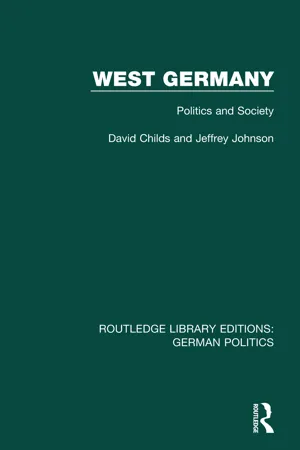
This book, originally published in 1981, provides the student and general reader alike with a fascinating account of the dynamic re-emergence of Germany after the Second World War as one of the world's leading and most powerful states. The book gives extensive coverage to all aspects of the former West Germany's political, social and economic arrangements. As well as dealing with the Basic Law, political parties, Bundestag and government, it also discusses neglected subjects, such as education, the armed forces, welfare services, the role of women, the economy and industrial relations and the mass media.
- 224 pages
- English
- ePUB (mobile friendly)
- Available on iOS & Android
eBook - ePub
About this book
Information
1 Parties and Elections
New Beginnings 1945
Given the horrifying conditions which existed in Germany, and given the bitter legacy of the Third Reich, it is remarkable that so many Germans were prepared to become politically active so soon after the surrender in May 1945. The future looked black for Germany both materially and politically. The Allies — Americans, Russians, British and French — alone determined policy in their respective zones, leaving little scope for German initiative. Moreover, all political activity had to be sanctioned by the occupying power and any German bold enough to gain that sanction ran the risk of appearing a stooge of one or other of the victorious foreign powers. Yet even before the capitulation of the armed forces of the Third Reich, German political activity had started up again in Hannover — at a meeting held on 19 April, shortly after the town's capture by the Americans, by a group of Social Democrats led by Dr Kurt Schumacher (1895-1952).
It is significant that the Social Democrats were among the first on the post-war political scene, for they bore less responsibility for the disaster which had overtaken Germany than any other German political group. Set up in 1875 at Gotha, the SPD had campaigned for democracy and socialism in the Kaiserreich (1870—1918). The Social Democrats had played a decisive part in the establishing of the democratic Weimar Republic (1919—33) and had tried hard to make it a success. In 1933, they alone had voted in the German parliament or Reichstag against the Enabling Act, which was the legal facade of the Nazi dictatorship. Many Social Democratic activists, including Schumacher, had suffered in Hitler's concentration camps, been driven abroad or even murdered. Schumacher and many of his colleagues felt, therefore, that the SPD had the moral right to take the lead in building a new Germany.
Equally certain about their own leading role were the members of the Communist Party of Germany (KPD). Founded in January 1919 by Karl Liebknecht, Rosa Luxemburg and Wilhelm Pieck from a number of disparate radical socialist groups, the KPD became the most important Communist party outside the Soviet Union. It proclaimed its aim as a Soviet Germany and took its policy direction from Moscow. At the elections of November 1932 it gained 16.8 per cent of the vote as compared with the SPD's 20.4 and the Nazis' 33.1 (these were the three largest parties). It was the first party to be banned after Hitler became Chancellor. The Communist leader Ernst Thalmann was killed by the Nazis in a concentration camp and many KPD cadres suffered the same fate. Others died in Stalin's purges in the Soviet Union where they had sought refuge. Not so Walter Ulbricht. He headed a group of emigre' Communists which arrived at the end of April 1945 from Moscow. Its tasks were to supervise any local Communist activity and, more importantly, set up local government administrations. It was in the Soviet Zone of Germany that German political activity was first permitted by the occupying power. This was on 10 June 1945. Within days the KPD and the SPD had been established. Two weeks later the Christian Democratic Union (CDU) was proclaimed. At the beginning of July the Liberal Democratic Party (LDP) followed. Thus the political tendencies which have dominated post-war Germany were born in Berlin in the summer of 1945.
The CDU was not merely the revival of a Weimar party. At its best it was an attempt by bourgeois and Christian democratic elements to learn from the mistakes of the Weimar period and come to terms with the likely reality of post-war Germany. But it was far from being just that. Neither the Catholic nor the Protestant Church had records they could be proud of in regard to the Third Reich. Yet the churches represented the one institution which went on virtually unhindered by the collapse of 1945. They retained their nationwide organisation and vast wealth. In the Western Zones they were respected by the occupying powers, in the Soviet Zone they were at least tolerated. More than the Protestants, the Catholics enjoyed excellent international contacts at high levels. Clearly, during this period when all Germans were regarded with suspicion by the victors, the imprimatur of the Catholic Church could work wonders in the Western Zones. An understanding of this fact is important to an understanding of the course the CDU took and its success. The CDU was part of an international trend; similar parties appeared in other West European countries, most successfully in Italy and Austria. Pope Pius XII had a tremendous fear of and hostility towards Communism (and socialism) which appeared on the verge of taking over Europe. He was therefore looking for new political forms, new alliances to avert this threat. The former Catholic indifference, if not downright hostility, to democracy was no longer acceptable. In addition, any new force would have to stress the social question if it were to have any appeal to the working classes.
Pius XII, himself the former Papal representative in Germany, showed his continued interest in Germany by elevating two German bishops into the College of Cardinals, and by being the first head of state to send a diplomatic representative to post-war Germany. He appointed the American bishop, Aloysius Muench, as Papal Nuncio, a powerful figure to intervene on behalf of the Germans with the Allies. This papal interest helped to establish the new party's credentials with the Americans, played a considerable role in determining its ideological framework, and helped to ensure that the Old Catholic Centre Party of Weimar was not resurrected. The Centre Party sought the allegiance of Catholics both in the Kaiser's Germany and in the Weimar period. In November 1932 it had gained 11.7 per cent of the vote.
Even if the Pope had been indifferent to a new non-socialist, Christian political movement, there were a considerable number of the surviving Weimar political elite who thought in such terms. They felt that the divisions among Christians before 1933 had made the victory of the 'anti-Christ' — Hitler — possible. If Germany were to survive, Christian principles in political life were more important than ever before. Some believed that one of the vices of the Weimar political system was the multiplicity of parties, making strong government impossible. A non-denominational, non-socialist, 'catch-all' party was therefore necessary to ensure the success of a future democratic German political system. Some saw socialism as inevitable but wanted to imbue it with Christian rather than Marxist assumptions. The Frankfurt group of Walter Dirks was prominent in this direction. On the other hand, there were those, no doubt, who simply calculated that if the propertied classes were to save anything of their wealth they needed to unite in a popular movement relying on the authority of the churches to rally support. More representative than Dirks and his group were the many former members of the German National People's Party (DNVP), the German Democratic Party (DDP) and, above all, the Centre Party. Among the latter were Dr Leo Schwering in Cologne and Doctors Andreas Hermes and Heinrich Krone in Berlin.
In Bavaria a quite separate Christian Social Union (CSU) was formed. In many respects this party drew on the traditions of the Bavarian People's Party (BVP) of the Weimar period. In North Rhine-Westphalia certain left Catholics reformed the Centre Party and gained ten seats in the first Bundestag. In the second Bundestag, due to their allegiance with the CDU, they were able to win two seats. Most of the leading members joined the CDU but the party retained a few political representatives in local government.
The fourth political trend which emerged in the summer of 1945 was that which wanted to carry on the traditions of German Liberalism. In Berlin two former ministers of Weimar Germany, Dr Eugen Schiffer and Dr Wilhelm Külz, set up the Liberal Democratic Party (LDP). The same trend appeared as the Free Democratic Party (FDP) in Bavaria, led by Dr Thomas Dehler. In Schleswig-Holstein it was called the Democratic Union and in Hamburg the Party of Free Democrats. In Hesse the same name was used as in Berlin. Of great significance for the future of West German Liberalism was the establishment of the Democratic People's Party (DVP), by Dr Theodor Heuss and Dr Reinhold Maier, in Wiirttemberg. At the last free election in Weimar Germany, in November 1932, the two Liberal parties had only achieved about 2 per cent of the vote. In 1919 their vote had been nearer 23 per cent.
The Failure of Communism
The division of Germany had a fundamental impact upon the fate of the four political tendencies which had emerged in 1945. The first two parties to feel the impact of the Cold War, and the division of the country which resulted from it, were the Social Democrats and the Communists. Perhaps the majority of ordinary Social Democrats and Communists favoured the building of a united socialist party in 1945. They did so because they believed their earlier rivalry had opened the door to Hitler. By the time the Soviet military authorities pressed to bring this about in the first part of 1946 many Social Democrats had cooled their enthusiasm. Soviet policies in their occupation zone constituted the basic reason for this. Under Otto Grotewohl, the SPD in the Soviet Zone was nevertheless amalgamated with the KPD in April 1946. In the West the SPD continued its separate existence, formally electing Schumacher as its chairman at its Hannover conference in 1946. Schumacher then led the party until his death in 1952. The Western SPD acknowledged Marxism as a method, but rejected any dogmatic reliance on Marxist texts. It advocated widespread public ownership for reasons of social justice, because of the involvement of many big industrialists with the Nazis, and because it believed speedy German economic recovery required it. It vigorously upheld German unity, rejecting any dismemberment of the pre-1938 Reich. Later it rejected West German membership of NATO and the EEC because it felt this would make agreement with the Soviet Union over German reunification more difficult. As the Cold War intensified, West Germany recovered and the SPD lost elections, the Social Democrats modified their line, drawing nearer to that of the CDU. This is not to say that the SPD changed its position merely as the response to electoral defeat. The SPD's evaluation of the performance of the centralised, state-owned, East German economy led it to the conclusion that a free market economy offered the best prospects for economic and social progress. The experience of German Social Democratic refugees with the less ideologically based working-class movements of Scandinavia and Britain, on the one hand, and the Weltanschauungsparteien of Stalin's Russia and Hitler's Germany, on the other, constituted another major factor in the change. Willy Brandt lived in Scandinavia during the Nazi period. Erich Ollenhauer, SPD Chairman (1952—63), spent this time in Britain. Herbert Wehner was able to contrast life in the USSR with that in Sweden. Fritz Erler, another influential Social Democrat, remained in the Third Reich. Electoral defeat made it easier for these and other Social Democrats to persuade their party that change was necessary. The new line found expression in the Bad Godesberg Programme of 1959.
The new programme proclaimed the virtues of the free market economy and private initiative but called for a just distribution of incomes and wealth. It came out strongly in favour of national defence but rejected West German possession of nuclear weapons. It called for co-operation between the churches and the SPD but warned against the misuse of religion for political purposes.
Though it held office in a number of the Länder, notably Bremen, Hamburg, Hesse, Lower Saxony and West Berlin, the SPD was excluded from the federal government until it joined a grand coalition with the CDU in 1966. After the election of 1969, its candidate, Willy Brandt, became Chancellor and between then and 1980 the SPD held office with the FDP.
The SPD's rival on the left, the KPD, looked like being a major force in West German politics even in 1949. By that time it was rapidly declining but in the first federal elections held in that year it managed to gain 1.3 million votes (5.7 per cent) and 15 seats in the 402-member federal parliament (Bundestag). In the second federal elections (1953) it mustered only 608,000 votes (2.2 per cent) and failed to regain entry into the Bundestag. It is not difficult to see why this happened. Like other Communist parties during this period, the KPD was totally subservient to the Soviet Union, and the Soviet Union had made itself very unpopular in Germany by its policy of annexing large areas of prewar eastern Germany, by establishing a 'People's Democracy' in its zone, and by holding large numbers of Germans captive in the USSR long after the other victors had released their prisoners. In addition, many Germans who had seen something of the Soviet Union during the war had been less than impressed by its achievements. It did not seem to have a system from which Germany could usefully learn. Yet, for the German Communists, the Soviet Union remained the most advanced system in the world. This was too much for the average German to swallow. Under Max Reimann the KPD purged those comrades who sought to wed Communism to German conditions. By the time the party was banned as unconstitutional in 1956, it was already dead politically. To some extent the KPD attempted to carry on its work with pacifist- and neutralist-inclined bodies such as the Bund der Deutschen (BdP) and the Deutsche Friedens-Union (DFU). The DFU received nearly 610,000 votes in 1961, falling to 432,000 in 1965. For the 1969 election the DFU linked up with the DKP, the Moscow-orientated Communist Party permitted to organise in 1968. This Aktion Demokratischer Fortschritt polled only about 0.2 per cent of the vote — less than the DFU alone in 1965. In 1972 and 1976 the DKP, standing alone, claimed only 0.3 per cent.
SPD—CDU/CSU Rivalry
Schumacher is often criticised by writers on German politics for being too negative, too doctrinaire, too nationalist and too stubborn. Yet the defeat of Social Democracy in the early years of the Federal Republic cannot, in this writer's view, be blamed primarily on Schumacher's attitudes and policies. No doubt his robust character and sense of mission made him a difficult man to deal with, but was this not equally true of his CDU rival Dr Konrad Adenauer (1876-1967)? Moreover, it is often forgotten that his socialist economic policies were not so very different from those of the CDU, especially in the industrialised British Zone (North Rhine-Westphalia). In any case Schumacher could not afford to appear to be to the right of the KPD in his advocacy of socialist measures. On national questions none of the three major parties — SPD, CDU/CSU, FDP — advocated recognising the de facto frontier in the east, the Oder—Neisse line or the German Democratic Republic (DDR). The SPD merely wanted to delay West Germany's Western integration until all possibilities with the USSR had been exhausted. It cannot be said that all these possibilities were exhausted (see below). Perhaps, had West Germany's two major parties been led by others more flexible than Schumacher and Adenauer, it is just possible that a successful grand coalition could have been formed as in Austria. No matter who had led the SPD, the party would have faced a difficult situation.
The SPD was cut off from some of its Weimar strongholds which were in the Soviet Zone. In pre-war Germany roughly one-third of the population was Catholic, in West Germany the figure is nearer 45 per cent. This ensured the mass basis for a party backed by the Catholic Church, and the Catholic Church was far less tolerant then than it subsequently became. Secondly, the distortion of the structure of the population by two world wars helped the Conservative forces. In 1962 11 per cent of the population of West Germany were over 65 as against only 7 per cent in 1939. In the same year, for every 1,000 men in the population, there were 1,110 women. Even in 1976 women still made up 54 per cent of West German voters. As in other European states, West German women have shown a marked preference for political Conservatism. This was especially so in the West German elections prior to 1969 and again in 1976. Dr Adenauer, already 73 when he became Chancellor in 1949, got much of his support from women and pensioners. The CDU/CSU has always gained much of its support from the rural areas and small towns, particularly the Länder of Schleswig-Holstein, Lower Saxony, Rhineland-Palatinate and Bavaria. It has also been the beneficiary of financial support from the business community, especially after it emerged as the main right of centre party from 1953 onwards. As such, it has had only a limited appeal for the working class who have constituted the main support for the SPD. In terms of the support it has gathered, the CDU/CSU has been the most successful West German party. At only o...
Table of contents
- Cover
- Half Title
- Title
- Copyright
- Original Title
- Original Copyright
- Contents
- List of Tables
- List of Abbreviations
- Preface
- 1. Parties and Elections
- 2. The Grundgesetz and the Federal System
- 3. Government and Bundestag
- 4. The Economy and Industrial Relations
- 5. Classes, Wealth and Social Security
- 6. The Education System and its Problems
- 7. The Mass Media
- 8. Law and Order
- 9. Women in the Federal Republic
- 10. The Armed Forces
- 11. Foreign Policy
- Chronology, 1918–1980
- Index of Names
- Subject Index
Trusted by 375,005 students
Access to over 1.5 million titles for a fair monthly price.
Study more efficiently using our study tools.
Frequently asked questions
Yes, you can cancel anytime from the Subscription tab in your account settings on the Perlego website. Your subscription will stay active until the end of your current billing period. Learn how to cancel your subscription
No, books cannot be downloaded as external files, such as PDFs, for use outside of Perlego. However, you can download books within the Perlego app for offline reading on mobile or tablet. Learn how to download books offline
Perlego offers two plans: Essential and Complete
- Essential is ideal for learners and professionals who enjoy exploring a wide range of subjects. Access the Essential Library with 800,000+ trusted titles and best-sellers across business, personal growth, and the humanities. Includes unlimited reading time and Standard Read Aloud voice.
- Complete: Perfect for advanced learners and researchers needing full, unrestricted access. Unlock 1.5M+ books across hundreds of subjects, including academic and specialized titles. The Complete Plan also includes advanced features like Premium Read Aloud and Research Assistant.
We are an online textbook subscription service, where you can get access to an entire online library for less than the price of a single book per month. With over 1.5 million books across 990+ topics, we’ve got you covered! Learn about our mission
Look out for the read-aloud symbol on your next book to see if you can listen to it. The read-aloud tool reads text aloud for you, highlighting the text as it is being read. You can pause it, speed it up and slow it down. Learn more about Read Aloud
Yes! You can use the Perlego app on both iOS and Android devices to read anytime, anywhere — even offline. Perfect for commutes or when you’re on the go.
Please note we cannot support devices running on iOS 13 and Android 7 or earlier. Learn more about using the app
Please note we cannot support devices running on iOS 13 and Android 7 or earlier. Learn more about using the app
Yes, you can access West Germany (RLE: German Politics) by David Childs,Jeffrey Johnson in PDF and/or ePUB format, as well as other popular books in Politics & International Relations & Comparative Politics. We have over 1.5 million books available in our catalogue for you to explore.