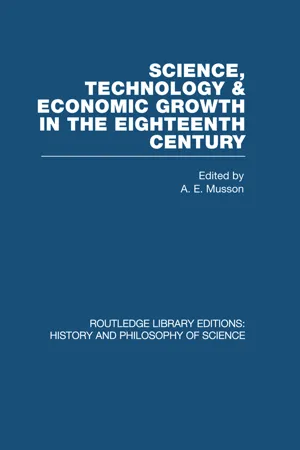
Originally published in 1972.This book illustrates the growing awareness of the importance of science and technology in the Industrial Revolution. The contributors show that the growth in the teaching and literature of natural philosophy (mechanics, hydraulics etc), mathematics and chemistry, together with such new agencies as "philosophical societies", itinerant lecturers and libraries were significant factors in the development of the Industrial Revolution.
- 212 pages
- English
- ePUB (mobile friendly)
- Available on iOS & Android
eBook - ePub
Science, technology and economic growth in the eighteenth century
About this book
Information
1 Who Unbound ‘Prometheus?
Science and ‘Technical Change, 1600–18001
This article is from Peter Mathias (ed.), Science and Society, 1600–1900, Cambridge University Press, 1972,

I
An economic historian is interested in science not for its own sake (which for a historian of science is doubtless the only academically respectable way of looking at it) but for his own utilitarian purposes. He asks the questions: how was science related to technology at this time? how far did scientific change influence the process of technological change? to what extent was the Industrial Revolution associated with scientific advance? Taking the very long view from medieval times to the present day is to see a dramatic change in these relationships. Broadly, we may postulate the earlier position as a context where empirical discoveries and the development of industrial processes in such industries as metals, textiles, brewing, dyeing took place and advanced without being directly consequential upon knowledge of fundamental scientific relationships in the materials concerned. The chemistry of what happened inside a blast furnace was not known until the mid-decades of the nineteenth century. The secrets of fermentation were first revealed by Pasteur. There might be close links between science and technology in other ways, but this was none the less a world very different from our own where industrial advance becomes more directly consequential upon the advancing frontier of scientific and technological knowledge, with a developing institutional relationship between science and industry to consolidate the connexion.
For the pivotal period of the seventeenth and eighteenth centuries, however, which saw dramatic advances in both scientific knowledge and industrial techniques, varying answers have been offered to these questions by economic historians and scholars generalizing about the relationships from the side of science. Professor A. R. Hall summed up for the earlier period 1660–1760 ‘… we have not much reason to believe that in the early stages, at any rate, learning or literacy had anything to do with it [technological change]; on the contrary, it seems likely that virtually all the techniques of civilization up to a couple of hundred years ago were the work of men as uneducated as they were anonymous’.2 Sir Eric Ashby concludes for the period 1760–1860: ‘There were a few “cultivators of science” (as they were called) engaged in research, but their work was not regarded as having much bearing on education and still less on technology. There was practically no exchange of ideas between the scientists and the designers of industrial processes.’3 Professor Landes is equally firm in this opinion to as late as 1850.4 A. P. Usher is in the same tradition.5
Equally forthright assertions crowd the other side of the stage. ‘The stream of English scientific thought,’ writes Professor Ashton, ‘was one of the main tributaries of the Industrial Revolution. … The names of engineers, iron-masters, industrial chemists, and instrument makers on the list of Fellows of the Royal Society show how close were the relations between science and practice at this time.’6 Professor Rostow, considering the whole sweep of economic change in western Europe, gives the two essential features of post-medieval Europe as ‘the discovery and re-discovery of regions beyond western Europe, and the initially slow but then accelerating development of modern scientific knowledge and attitudes’.7 When considering the essential propensities for economic growth (relationships that he does not specifically limit in time or place) the first two on his list are: ‘the propensity to develop fundamental science and to apply science to economic ends’.8 For the English case A. E. Musson and E. Robinson have recently sought to demonstrate how extensive the linkages were between innovation and science, between scientists and entrepreneurs.9 They see this co-operation assisting England to ‘retain that scientific lead over the Continent upon which she established her industrial supremacy’.10 The Lunar Society, now documented at great length, has been called ‘a pilot project or advance guard of the Industrial Revolution’ on the argument that ‘strong currents of scientific research underlie critical parts of this movement’.11
Many more such summary assertions could be deployed on either side. It seems likely that, as historians explore more systematically and in more local detail the development of different branches of the chemical industry and other industrial processes involving chemistry (following up the seminal work on the Chemical Revolution by A. and A. N. Clow, published in 195 2); as they find out more about the various local societies of gentlemen meeting in small towns up and down the country in the eighteenth century on the lines of the Lunar Society of Birmingham, the balance will tip heavily towards the positive equation. This theme is captured in the remark: ‘… science is the mother of invention; finance is its father’.12
The question, therefore, invites discussion. The arguments, however, should be prefaced with one or two comments. Without the assumption that a simple, linear, cause-and-effect relationship exists between phenomena like scientific knowledge and innovations in technique, multi-dimensional historical developments such as the Renaissance or the French Revolution or the Fall of the Roman Empire or the Industrial Revolution, cease to be analysable in terms of single-cause, single-variable phenomena. In the last analysis, quantification of contributory causes of them is impossible, given the intractable nature of the evidence and the subtlety of the interrelationships, direct and indirect, involved. Therefore, no intellectually satisfying proof becomes possible that one answer is demonstrably ‘correct’ in a scientifically provable way. Quantification does not offer any obvious solution either. One might hope that, taking a defined population of innovations, it would be possible to determine the percentage which depended upon scientific knowledge, or to allocate degrees of such dependence upon some quantified scale. But establishing the criteria of such a scale would be subjective enough, while yet greater discretion would remain in allocating most innovations to the different boxes. Moreover, innovations form a most heterogeneous collection, differing very greatly in relative importance. Bringing qualitative considerations into the argument would imply further discretionary allocation of innovations into a scale of importance so that the degree of dependence of innovations upon scientific knowledge could be construed against some norm of economic significance. Were the scientifically-orientated innovations in the ‘population’ more, or less, important than their arithmetical proportion suggests?
The question of the strategic importance of innovations raises a further issue. For example, despite the percentage of total technical change subject to the linkage with science being small, a strategic blockage on a narrow front at the frontier of technical possibilities might hold up innovation in a wider span behind it. One strategic science-linked innovation could make possible a large number of empirically-based innovations which were, to a degree, dependent upon that initial advance, and vice versa. Moreover, it is impossible to demonstrate the potential quantitative importance of this by being able to indicate what would have happened if an absolute blockage at the frontier had occurred without substitute arrangements bypassing the obstruction. Perhaps detailed analysis can be applied in the micro-study of particular innovations (carefully chosen), but it is difficult to see how a quantified assessment can be made for the wide sweep of innovations under discussion here. History is a depressingly inexact science as economists – let alone natural scientists – discover to their frustration.
Conclusions in this field are also much influenced by methodological or definitional problems. Controversies on such general themes characteristically sink under the weight of semantic disagreement and pleas for more systematic research. What do we include in (or exclude from) the concept ‘innovation’? Were the activities of these seventeenth and eighteenth-century people, properly speaking ‘scientific’? Was it real science, identified by some later, designated, objective norm – in the ‘Baconian’ or mechanistic tradition – or was it bogus, mistaken, irrational – and following a magical, alchemical, or Hermetical tradition?13 How much, for example, can one claim for Jethro Tull, eagerly pursuing ‘scientific’ technique in agriculture on the assumption that air was the greatest of all manures and that the fertility of soil consequently varied in direct correlation with the amount of ploughing and pulverizing that it received, to the exclusion of all else. Bogus science, quasi science, mistaken science, amateur science which was so very prominent in the seventeenth and eighteenth centuries, particularly in the field of chemistry (where the direct linkage between science and industry are probably most diffused) does raise interesting issues. Does one judge these practitioners by their intentions, their motivations, or by their results, however mistaken their assumptions, looked at ex post facto with hindsight? Arguments about distinctions between ‘pure’ and ‘applied’ science relate to these controversies, for the seventeenth and eighteenth centuries no less than the nineteenth and twentieth.14
This paper will first explore the positive case and then consider its qualifications.15 The key question to be answered is not what examples can be found of links between science and industry in the period but rather how important relative to other sources of impetus was scientific knowledge to industrial progress? Can it be judged ‘an engine of growth’ for innovation, or a pre-condition? In short, how extensive were the linkages, how strategic, how direct?
II
If economic history is written from the evidence of intention, of aspiration and endeavour, rather than the evidence of results (which is often less accessible), then these connexions appear very intimate indeed. In the first place, a very large number of persons – scientists, industrialists, publicists, and government servants – said loudly in the seventeenth century and have gone on saying ever since then, even more loudly, that the linkage was important and ought to be encouraged. For most of the ‘professional’ scientists of the Restoration the improvement of techniques in the material world, science in the service of a technological utopia, was a subordinate quest, a relatively low priority. But, even so, many such as Robert Boyle, were active on both sides of the watershed between searching for knowledge and applying knowledge to practice, and certainly acknowledged that one of the roles of science was to help where it could. Boyle’s Usefulness of Natural Philosophy (1664) was a systematic survey of the methods then used in industry and of the ways in which science was improving them and would continue to do so. ‘These [mechanical] arts’, he wrote, ‘ought to be looked upon as really belonging to the history of nature in its full and due extent.’16 ‘There is much real benefit to be learned [from mathematical or philosophical inquiries],’ wrote Dr J. Wilkins in 1648, ‘particularly for such gentlemen as employ their estates in those chargeable adventures of Drayning, Mines, Cole-pits, etc. … And also for such common artificers as are well skilled in the practise of the arts. …’17 Boyle was himself active particularly in investigating the techniques of mining, assaying, and agriculture. In evidence of intention, if not of result, John Richardson changed the title of his book on Philosophical Principles of the Art of Brewing, much taken up by the largest brewers in London, to Philosophical Principles of the Science of Brewing.18 R. Shannon’s more empirically titled work Practical Treatise on Brewing was primarily a plea that brewers and distillers should profit from contact with ‘men of reflection acquainted with first principles who have more methodically considered the subject’. ‘Chemistry’, he remarked, ‘is as much the basis of arts and manufactures, as mathematics is the fundamental principle of mechanics.’19 They were echoing a traditional sentiment which continued to reverberate until scientific discoveries with major implications for technology in the industry really were made by Pasteur and others in the mid-nineteenth century.
Two eminent Victorians, out of many, may be quoted to show the canon during the nineteenth century. Charles Babbage, writing On the Economy of Machinery and Manufactures (1835) concluded: ‘… it is impossible not to perceive that the arts and manufactures of the country are intimately connected with the progress of the severer sciences; and that, as we advance ...
Table of contents
- Cover
- Half Title
- Title Page
- Copyright Page
- Original Title Page
- Original Copyright Page
- Table of Contents
- Preface
- Acknowledgements
- Editor’s Introduction
- 1. Who Unbound Prometheus? Science and Technical Change, 1600–1800
- 2. The Diffusion of Technology in Great Britain during the Industrial Revolution
- 3. Some Statistics of the Industrial Revolution in Britain
- 4. The Natural History of Industry
- 5. The Industrial Orientation of Science in the Lunar Society of Birmingham
- 6. Vitriol in the Industrial Revolution
- 7. The Macintoshes and the Origins of the Chemical Industry
- 8. Bryan Higgins and his Circle
- Select Bibliography
Trusted by 375,005 students
Access to over 1.5 million titles for a fair monthly price.
Study more efficiently using our study tools.
Frequently asked questions
Yes, you can cancel anytime from the Subscription tab in your account settings on the Perlego website. Your subscription will stay active until the end of your current billing period. Learn how to cancel your subscription
No, books cannot be downloaded as external files, such as PDFs, for use outside of Perlego. However, you can download books within the Perlego app for offline reading on mobile or tablet. Learn how to download books offline
Perlego offers two plans: Essential and Complete
- Essential is ideal for learners and professionals who enjoy exploring a wide range of subjects. Access the Essential Library with 800,000+ trusted titles and best-sellers across business, personal growth, and the humanities. Includes unlimited reading time and Standard Read Aloud voice.
- Complete: Perfect for advanced learners and researchers needing full, unrestricted access. Unlock 1.5M+ books across hundreds of subjects, including academic and specialized titles. The Complete Plan also includes advanced features like Premium Read Aloud and Research Assistant.
We are an online textbook subscription service, where you can get access to an entire online library for less than the price of a single book per month. With over 1.5 million books across 990+ topics, we’ve got you covered! Learn about our mission
Look out for the read-aloud symbol on your next book to see if you can listen to it. The read-aloud tool reads text aloud for you, highlighting the text as it is being read. You can pause it, speed it up and slow it down. Learn more about Read Aloud
Yes! You can use the Perlego app on both iOS and Android devices to read anytime, anywhere — even offline. Perfect for commutes or when you’re on the go.
Please note we cannot support devices running on iOS 13 and Android 7 or earlier. Learn more about using the app
Please note we cannot support devices running on iOS 13 and Android 7 or earlier. Learn more about using the app
Yes, you can access Science, technology and economic growth in the eighteenth century by A E Musson in PDF and/or ePUB format, as well as other popular books in Philosophy & Philosophy History & Theory. We have over 1.5 million books available in our catalogue for you to explore.