eBook - ePub
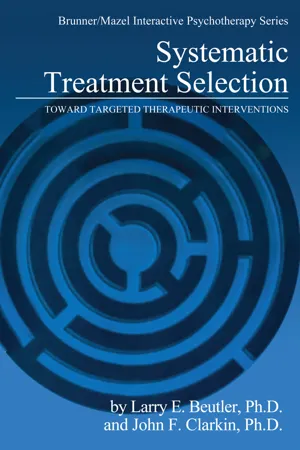
Systematic Treatment Selection
Toward Targeted Therapeutic Interventions
- 384 pages
- English
- ePUB (mobile friendly)
- Available on iOS & Android
eBook - ePub
Systematic Treatment Selection
Toward Targeted Therapeutic Interventions
About this book
This essential guide to the prescriptive selection of psychosocial interventions is founded on a research?based model that sequentially considers patient dimensions, environments, settings, therapists, and therapies. It covers the development of a prescriptive decision model, patient predisposing variables, and more.
Information
Topic
MedicineSubtopic
Psychiatry & Mental HealthPart I

Background and Introduction
1

Introduction
J.I. was a 34-year-old woman who presented with symptoms of Post Traumatic Stress Disorder (PTSD). She had nightmares, panic attacks, flashbacks, and suicidal thoughts. She came to the therapist’s office in a wheelchair, having been paraplegic since age 13, secondary to being stabbed in the back and left for dead by an unknown assailant who also raped and killed the patient’s girlfriend during a family outing. For four hours, the patient had lain motionless, unable to move and afraid to call for help.
J.I.’s family provided tentative initial support to the patient, but had taken the position that these events were a potential embarrassment and best ignored. They refused to discuss the incident and criticized the patient for her residual “helplessness.” Through years of struggle, J.I. had overcome her major fears of social contacts and gained at least marginal control of her recurrent suicidal ideation. She had achieved an education and a good job and had gotten married a few months before presenting herself to psychotherapy.
She had been in psychodynamically oriented psychotherapy for the two years immediately before the present occasion, largely motivated by free-floating anxiety and depression, and had achieved moderately good results. Now her symptoms of anxiety had been reactivated within the past month after a drunk driver had run a stop light and hit her car, destroying her only “place of safety and control.” To complicate things, J.I.’s marriage was struggling, as it had been since its inception. Her inability to give up a degree of interpersonal control and her longstanding failure to develop a feeling of intimacy toward men had provoked many arguments and power struggles, all of which now threatened the survival of the relationship.
When presented with such case material, the clinician must decide what form of initial intervention would be most productive. Most clinicians would probably agree that the exacerbated and trauma-induced anxiety symptoms deserve first attention if for no other reason than that they may impede changes that are considered to be more important. However, the method of intervening with these symptoms would probably vary widely. Some would offer reassurance and support, others desensitization, and still others anxiolytics or antidepressants. Moreover, once the anxiety symptoms have abated, as they almost surely would do with any of these treatments, should the patient be continued in treatment and if so for how long, with what goals and by what means? Would symptoms alleviate any faster or for a longer period with one treatment rather than with another? On what basis could one justify opening the door to explore old wounds in one who seeks only relief from immediate stress and who has learned to live a productive life by putting aside the memories of her early trauma?
These are some of the questions facing the mental health practitioner and these are some of the questions that we seek to answer in this volume. We do not believe that simple answers to these questions are possible. Nor do we believe that information derived from symptom presentations alone or at any one point in time provides great assistance in deriving these answers. To provide consistent and predictable interventions, the practitioner must engage in an ongoing process of assessing patient problems, existent supports and contexts, and available treatments. This process begins with understanding the patient and the patient’s environment and proceeds to understanding the nature of the available treatment resources, the characteristics of the patient-clinician relationship upon which treatment is being built, and the efficacy of the procedures that are being utilized to achieve treatment goals and subgoals.
As the foregoing suggests, the processes of assessment and treatment are inseparable. As information and knowledge unfold, new decisions are made by both clinician and patient. At each decisional step, the clinician must be open to the prospect of incorporating into those decisions a very wide array of possible treatment responses, preferably unfettered by parochial adherences to narrow theories. In order to prevent treatment from becoming an interminable, random trial-and-error selection of interventions, the clinician must have a guiding theory that governs treatment decisions. Within the framework of this theory, he or she must be willing and able to balance pragmatism with abstract theoretical concepts in order to translate the resulting plan into time-efficient interventions.
The usual term referring to the type of integration of treatment procedures to be described here is “eclecticism.” However, the term “eclectic,” at least as it has been applied to mental health treatment, is much maligned. Yet we know of no better term by which to describe the various efforts to bring the numerous viewpoints that characterize mental health treatment into some common and practical framework.
There are really several different types of eclecticism. The particular type to which this volume is addressed has been referred to as “technical eclecticism” (Lazarus, 1981; Norcross, 1986c). Technical eclecticism maintains that integration among various treatment approaches should take place at the level of specific procedures, rather than at the level of theory. That is, a technically eclectic clinician endeavors to select the best and most useful procedures for a given patient from the hundreds of procedures available, irrespective of the theories from which these procedures derive. “Theoretical Integrationism” is a second major type of eclecticism and practitioners of this philosophy are distinguishable from the practitioners of “technical eclecticism” by their desire either to combine concepts from different theories or to translate the terms used by one theory to those employed by other theories (see Norcross & Prochaska, 1988; Wolfe & Goldfried, 1988, for a discussion of these terms).
Some technical eclectic approaches have developed specific guidelines to help the clinician determine the procedures to be selected. These approaches are collectively referenced by attaching the adjective “systematic” to the term “eclectic” (Norcross, 1986a; Beutler, 1983). The approach to treatment selection to be presented here represents a form of systematic, technical eclecticism. Moreover, the methods we propose are also “prescriptive” and “differential” in that they are designed to allow the selective assignment of patients to treatments, settings and therapists on the basis of anticipated responses to those assignments. These latter terms, however, also carry unwanted meanings because of their association to medical treatments and traditional diagnoses. “Differential assignments” and “prescriptive” applications of psychotherapy are not the same as “differential diagnosis” and “prescriptive” applications of antihistamines. In psychotherapy, the treatment prescribed is as often a particular relationship between the treatment environment, the treater, and the treated as it is a specific type of medication or brand of psychotherapy.
In this initial chapter, we will explore the history and basic concepts of contemporary eclecticism. Several of the major contributors to this movement will be presented briefly. A more detailed analysis of the contributions of those who are most relevant to the current volume will be saved for presentation in Chapter 2.
A History of Eclectic Psychotherapy
This volume, we believe, is the first of the second generation of descriptive treatises on “technical eclecticism.” The first systematic effort to define a technical eclecticism for mental health treatment was made by Arnold Lazarus (1967, 1971, 1976, 1981). In breaking from the tradition of behavior theory to which he had become prominently identified, he dared to say out loud what many of us silently believed—that theoretical procedures were not intrinsically bound to their spawning theories. It was Lazarus who subsequently defined the parameters that have since guided the technical eclectic movement.
Though the term “eclectic” itself has remained controversial, the movement it describes reached a level of clear respectability with the publication of Psychotherapy: An Eclectic Approach by Garfield (1980). Following in this wake, numerous others published and presented eclectic models of treatment in the ensuing decade (see Norcross, 1986a, 1986b for a review of many of these approaches). These early efforts to develop eclectic views of psychotherapy either extracted the most effective procedures from extant theories of psychotherapy or sought ingredients which were shared among them to account for the similarity of therapeutic effects. From these analyses, the more technically oriented theorists and writers attempted to derive second-order systems for integrating the numerous specific procedures so that they could be applied in their diversity without the need to commit their loyalties to the theories which spawned the procedures.
Unlike the first generation of technical eclectic systems (to which we both have contributed), in this volume we are seeking integration among the various eclectic models of treatment selection themselves, rather than from among the primary theories of psychotherapy and psychopathology that provided the basis of discussion for previous eclectic efforts. Thus, the model presented in this volume represents an effort to integrate certain of the prior models of psychotherapy integration.
Eclecticism in Theories of Psychotherapy
Every theory is, in reality, an amalgamation of previous viewpoints. When we speak of one theory or another as “a different perspective,” we forget that it derived developmentally from others. When a “new theory” is developed and compared with an old one, the comparison dims one’s awareness of the fact that the new theory has incorporated some of the common knowledge to which the earlier theory contributed. Reichenbach (1964) refers to this creative integration as the “context of discovery” and distinguishes it from the later scientific enterprise of “confirmation.” To the degree that we accept that no new knowledge arises in a vacuum, but is an amalgamation of prior knowledge, all scientific discovery is “eclectic.”
Because of the process of theory amalgamation and borrowing, the history of eclectic psychotherapy begins before the formalization of psychotherapy. Across time, each evolving viewpoint in psychotherapy incorporated salient ingredients of prior philosophies, often extending beyond the realm of the healing arts. Even Freud was “eclectic” within this limited meaning of the word, incorporating principles of Newtonian physics and the mechanics of energy transfer into his view of neurology and psychopathology. The physics of energy conservation and transfer of Freud’s day was transported to psychopathology through a hydraulic metaphor when he presented instinctual urges as accumulating impulses that could be either discharged or diverted, but not eliminated.
As the practice of psychotherapy evolved, it did so by extending the realms of experience and knowledge which theorists attempted to incorporate within the still developing psychoanalytic theory. When Freud’s students broke with his teachings, they did so as often because of an adherence to different values, teachers and religious doctrines as they did because of advances in scientific knowledge. They placed a different value upon quasi-religious concepts of motivation (e.g., Adler), symbols (e.g., Jung) and goals (e.g., Horney) than did Freud. Neo-Freudians integrated, selected, and refined psychoanalytic principles with the western world’s emerging interest in social behavior. From these efforts arose the social psychiatry movement as well as existential and object relations theories.
The first major departure from the progressive evolution of psychoanalytic theory through the assimilation of new social viewpoints came with the advent of Client Centered Therapy (Rogers, 1951). Unlike earlier theorists, Rogers attempted to develop a new foundation for psychotherapy, rather than simply to append or modify the old one. While he was quite successful in divorcing himself from psychoanalysis, Rogers was an eclectic, nonetheless. Coming from a forgiving, American Protestant tradition, he incorporated concepts of “free will” and Christian acceptance into a view of personal change. With these quasi-religious concepts in place, Client Centered theory proposed relationships which established Rogers as an independent theorist.
The pervasive tendency among theory builders to incorporate the new into the newer (a frequently unrecognized form of “eclecticism”) is nowhere better illustrated than in the fact that Rogers’ proposals have become incorporated into the literature of most psychotherapies. Even recent applications of psychoanalytic theory have assimilated into their workings the relationship and collaboration values inherent in Client Centered Therapy (e.g., Strupp & Binder, 1984; Luborsky, 1984).
Behaviorism has been no more successful at escaping the pull of eclecticism than other theories. While Behavior Therapy arose ostensibly from atheoretical laboratory observations as a “pure” set of empirical principles that disparaged mentalistic causal elements, its application was far from being either value-free, cognition-free, or atheoretical. Eclectically assimilated theoretical notions extracted from neurology (Pavlov) and social perception (Tolman) were used to explain the effects of behavioral interventions. The relationship between values, cognitions, and behavioral principles became clear in Skinner’s (1971) Beyond Freedom and Dignity. Acknowledging the impossibility of selecting targets of change atheoretically, some authors, such as Mowrer (1953), even explicitly incorporated religious concepts such as “sin” and “repentance” into the rationale for applying behavioral interventions. Other authors tried to remain value-free by eclectically refiltering the new behaviorism until it emerged in psychoanalytic terms (e.g., Dollard & Miller, 1950; Stampfl & Levis, 1967). Efforts to integrate the apparently contradictory theoretical perspectives of behavior therapy and psychoanalytic theory have persisted in more recent efforts to find rapprochement by contemporary behavioral and psychoanalytic theorists (e.g., Arkowitz & Messer, 1984; Goldfried, 1982; Wachtel, 1977).
Out of the same type of effort to accommodate new knowledge arose the group of interventions collectively considered to be Cognitive Change Therapies. From their inception, these cognitive therapies were eclectic. In part, they were developed because of the persistent concern, expressed by relationship and insight therapists, that behaviorism failed adequately to account for the role of thinking, early experience, and unconscious processes in altering behavior.
Other developments that pushed behaviorism to become both cognitive and eclectic were more empirical than those instigated by dissatisfied psychotherapists. Behavioral theorists themselves became aware that thoughts exerted an interactive influence on the environment in which a behavior occurred (Bandura, 1977): thought processes actively changed and were changed by the environment to which a person responded. More than simply adding a cognitive dimension to established principles of behavior therapy, however, the more elaborate forms of cognitive therapy (e.g., Beck et al., 1979) incorporated a view that unconscious processes founded in early experience continued to exert a guiding influence in one’s life and were legitimate spectra on which to implement change efforts. These unconscious products of early experience were incorporated into cognitive therapy theories under the scientifically respectable label of “schema” (Beck & Weishaar, in press; Edwards, in press). These schema, it was proposed, were formed early in one’s experience and, once incorporated as organizing rules of behavior, were forgotten.
While the historical roots of cognitive therapy were rather obvious, early writings said little about the similarity of cognitive and insight therapies. More recently, it has again become respectable to discuss these similarities. Both Beutler and Guest (in press) and Beidel and Turner (1986), for ex...
Table of contents
- Cover
- Half Title
- Title Page
- Copyright Page
- Dedication
- Table of Contents
- Preface
- A Note on Case Examples
- Part I: Background and Introduction
- Part II: Patient Predisposing Variables
- Part III: The Treatment Context
- Part IV: Relationship Variables
- Part V: Tailoring Strategies and Techniques
- Part VI: Training Directions
- References
- Index
Trusted by 375,005 students
Access to over 1.5 million titles for a fair monthly price.
Study more efficiently using our study tools.
Frequently asked questions
Yes, you can cancel anytime from the Subscription tab in your account settings on the Perlego website. Your subscription will stay active until the end of your current billing period. Learn how to cancel your subscription
No, books cannot be downloaded as external files, such as PDFs, for use outside of Perlego. However, you can download books within the Perlego app for offline reading on mobile or tablet. Learn how to download books offline
Perlego offers two plans: Essential and Complete
- Essential is ideal for learners and professionals who enjoy exploring a wide range of subjects. Access the Essential Library with 800,000+ trusted titles and best-sellers across business, personal growth, and the humanities. Includes unlimited reading time and Standard Read Aloud voice.
- Complete: Perfect for advanced learners and researchers needing full, unrestricted access. Unlock 1.5M+ books across hundreds of subjects, including academic and specialized titles. The Complete Plan also includes advanced features like Premium Read Aloud and Research Assistant.
We are an online textbook subscription service, where you can get access to an entire online library for less than the price of a single book per month. With over 1.5 million books across 990+ topics, we’ve got you covered! Learn about our mission
Look out for the read-aloud symbol on your next book to see if you can listen to it. The read-aloud tool reads text aloud for you, highlighting the text as it is being read. You can pause it, speed it up and slow it down. Learn more about Read Aloud
Yes! You can use the Perlego app on both iOS and Android devices to read anytime, anywhere — even offline. Perfect for commutes or when you’re on the go.
Please note we cannot support devices running on iOS 13 and Android 7 or earlier. Learn more about using the app
Please note we cannot support devices running on iOS 13 and Android 7 or earlier. Learn more about using the app
Yes, you can access Systematic Treatment Selection by Larry E. Beutler,John F. Clarkin in PDF and/or ePUB format, as well as other popular books in Medicine & Psychiatry & Mental Health. We have over 1.5 million books available in our catalogue for you to explore.