Mainstream schools are consistently faced with numerous and often contradictory requirements, both to achieve high results and to be inclusive and incorporate children of every ability. This title, first published in 1999, describes how one renowned inclusive community school, Cleves School, responds to the challenges faced by themselves and other schools. Specifically, Priscilla Alderson shows how methods of inclusive learning can be incorporated with those designed to improve standards of achievement for every child. Practical and comprehensive, this title remains applicable to the challenges currently faced within the British education system.
eBook - ePub
Learning and Inclusion (Routledge Revivals)
The Cleves School Experience
- 95 pages
- English
- ePUB (mobile friendly)
- Available on iOS & Android
eBook - ePub
About this book
Information
Chapter 1
Introduction
Facing new challenges
New challenges to schools can be seen as attempts to stretch schools in opposite and even contradictory directions. The National Curriculum over the past decade has expanded the areas of formal knowledge which children have to learn, and the abilities they have to demonstrate during assessments. Schools are expected to achieve the best possible average results in tests and exams (DfEE 1997a). This can seem to conflict with policies to include every child, of any ability, in mainstream schools (DfEE 1997b). The school day must be highly organised if the curriculum is to be covered. Each primary school teacher must have a breadth and depth of knowledge of many topics. Here, the flow of knowledge is mainly seen as from adults to children. Yet teachers also have to encourage the children’s original and questioning thinking, their creativity and social, moral and spiritual awareness. All these flourish in less formal settings, with time to reflect and explore, drawing on children’s own ideas rather than ‘delivering’ education to them. Schools are expected to encourage a strong sense of corporate identity and loyalty yet also to welcome outsiders and newcomers. There are tensions in many school prospectuses between their stated aims that pupils must conform to strict rules and behaviour codes, but also expectations that children will become responsible and independent, able to think critically and to take initiatives (Griffith 1998).
This book describes how one primary school approaches these challenges and works to resolve the tensions in ways that can benefit every child and teacher. Methods of raising standards in one area, such as literacy, behaviour, the inclusion of disabled children, or induction and continuity when new staff and pupils arrive, can work to the benefit of all the other areas.
How this book came to be written
Cleves School is widely known about, and referred to by writers on education (Ainscow 1995). In the words of one of the teachers:
It’s very exciting to be here. You’re inundated with visitors coming to see what you’re doing. I feel proud about what we do and I want to show everybody. The staff I work with are so gifted; when they describe things or reason with the children they’re so patient. It is very good practice here. I’ve worked in a lot of schools, and here it has far wider practices, it’s better resourced, well planned.
‘You wouldn’t think it would be possible’, that’s what people say when they come here. To have all the children working alongside profoundly disabled children, and it does work. You see the spin-offs and it would be difficult for me not to work in that way now, it adds another facet to your teaching. I can’t think of a good reason to exclude children from their local school. If you are a community school you have to include every member of the family.
Brigid, the head teacher, considers that ‘The challenge from the start was to make Cleves an inclusive school. We all believed that this is an ordinary mainstream primary school with nothing special about it.’
This could sound contradictory: an ordinary school which surprises visitors. Cleves School aims to make inclusion ordinary, something which every school can do. Some of the ideas used at Cleves are also popular in other schools but others are more unusual.
The aims of the book
This is not a book about detailed teaching techniques and lesson plans. Instead we aim to:
- describe how Cleves School responds to challenges which other schools also face;
- record ideas and experiences which other schools could find useful to adapt and develop in their own ways; and
- show how the methods of inclusive education and independent and group learning can combine well with methods designed to raise standards of achievement for every child.
The writing committee
A research project was designed for an editor to work with the staff and children on writing a book about their school. The Gatsby Charitable Foundation kindly funded the project. David Fulton and Alison Foyle of David Fulton Publishers visited Cleves and were keen to publish a book about the school.
The writing committee did much of the work from May to July 1998:
Mary, a teacher;
Tanya, a parent governor and temporary clerical assistant;
1998 Year 6 members, Delicia, Harsumeet, Michael, Patrick, Sarah and Sinsi;
with Priscilla from the Institute of Education, University of London.
We would meet in the staff room, make coffee, and then talk about the school and the book. We gradually decided on the chapter headings. We wrote a letter home to every family asking for ideas linked to the chapter headings, and made a book box for people to post in contributions, placed in the school foyer. Deanna, the art specialist, took the photographs. The writing committee did some opinion surveys and also went around the school with tape recorders interviewing people. All the survey and suggestion box comments expressed satisfaction and praised the school. One mother wrote a complimentary poem. To make the book realistic and useful to other schools, we also wanted to report problems and challenges, and how these might be resolved. We asked about problems during individual interviews, and discuss them in the following chapters. One main concern during the summer term was the coming literacy hour, and how its more formal large group methods could fit with Cleves’s flexible approach, as shown in Chapter 3.
We would like to have put everyone’s names beside their comments, but very often they talked to us in groups, and people agreed a lot; they often seemed to be speaking for many others when they gave their own views. The findings from the surveys supported this. So we decided to record their views in the book without naming all the speakers. ‘We’ sometimes refers to everyone in the school, sometimes to the staff, and sometimes to the children. Although not everyone will agree with every point, those of us who have checked the drafts of the book think that it fairly reports views generally held in the school. Some of the speakers are named, the main ones are:
Brigid, the head teacher;
Joy, the early years leader;
Debbie, deputy head, SENCO, and curriculum support teacher to early years.
The second stage of writing the book came during the autumn, when drafts were checked and revised. The literacy hour had been introduced in the first week of term, from the reception year onwards. We added sections on how the literacy hour fits, so far, with the other learning activities at Cleves. We are grateful to people who read drafts and gave us critical comments, including Chris Goodey, Linda Jordan, Sarah Martyn and Judy Sebba.
The style of the book
We have aimed for a clear readable style which, we hope, will offer a quick and interesting read for busy teachers. Much of the book records the direct words of the staff and children. Sometimes they spoke about complex ideas, but always in plain English, so that we have not attempted to rewrite their thoughts in more formal terms. We hope that this book conveys something of the experience you would have if you visited the school.
Terms
For reasons which will be shown later, at Cleves the age groups are based in four wings: for early years and reception, ages 3–5 years; for Key Stage 1, Years 1 and 2, ages 6–7 years; for Key Stage 2A, Years 3 and 4, ages 8–9 years; and Key Stage 2B, Years 5 and 6, ages 10–11.
Classes are called base groups and class teachers are base teachers.
The staff work in four teams, each having a senior teacher or team leader and a curriculum support teacher who advises on enabling every child to have access to the curriculum.
The support staff – classroom or welfare assistants and nursery nurseries in every wing – are called learning assistants.
Lessons are called sessions.
The topics through this book
Inclusive education means that every child is welcomed, whatever their degree of disability or learning difficulty, and has full access to the building, the resources and activities in the school. When we opened, it was hard to establish our identity, because then schools were mainly locked into two separate models of special or mainstream schools. Now, all Newham schools include children with special needs, but then it was a challenge to establish a new kind of culture. To overcome the challenge we looked at ways of including everyone through all the daily life of the school. The first way was to set up a differentiated curriculum. Differentiated teaching means teaching all-ability groups and meeting all their different levels at the same time. The second was to use the building in ways that excluded no one – during assemblies, PE, lunch times. We decided not to have playtimes in the morning and afternoon. Instead, we have PE every day in the park, ball games or gymnastics. Chapter 2 describes how, as a community school, Cleves is planned to ensure this access through the design and use of the building and through the team teaching. Chapter 3 explains the methods of active learning and team teaching. Being friends and being equals is considered in Chapter 4, to show how the school setting and activities influence and are influenced by the relationships between everyone working in the school. Chapter 5 shows how relationships link to rules and responsibilities, and Chapter 6 describes the mixtures of work and enjoyment we aim for. Finally, we summarise some of the challenges which, like every primary school, Cleves faces in relation to learning and inclusion. Extracts from some of the policy documents by the school and by Newham Local Education Authority are given at the end of the book.
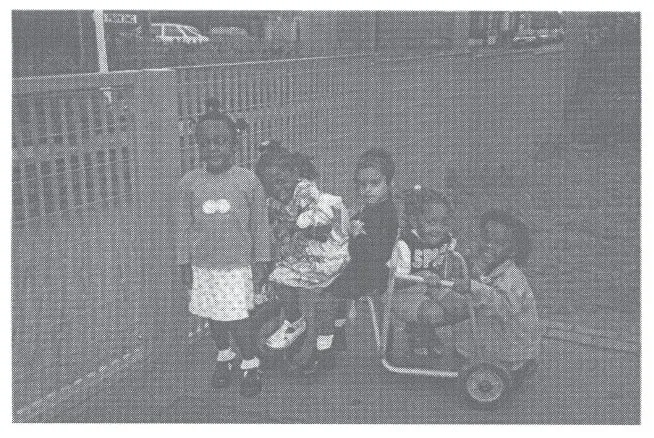
We hope you enjoy reading about our school
Chapter 2
An inclusive community school
Cleves Primary School is in Newham, East London. As well as being economically one of the most disadvantaged areas of the country, Newham is a lively cosmopolitan area. About ten years ago, Newham Council decided to make improving the education services one of its main priorities. Because of the rising numbers of children in the borough, Cleves School was opened in a new building in September 1992.
We begin by explaining the main aims of the school, and then the ways through which we achieve them.
The aims of our school
These aims have been agreed by the Staff and Governors of Cleves Primary School. They are reviewed annually. We have a shared vision of developing relationships and a curriculum that ensures that everyone feels valued, respected and reaches a high level of achievement.
1. Access to learning
- to provide an environment where each child of every race, gender, class and learning need is truly recognised, accepted and valued;
- to create an environment where there is a place for everyone and there is a feeling of belonging;
- to develop high positive self-esteem in all children and adults;
- to enable children to be aware of their interdependency on each other.
2. Curriculum
- to have an approach to the curriculum that promotes high levels of achievement and which enables children to reach their potential;
- to enable children to have access to and experience of the whole curriculum, (including the National Curriculum and Religious Education (RE);
- to have a recording and assessment system that demonstrates children’s achievement, their development and progression.
3. Process of learning
- to acknowledge that all children are decision makers and to enable them to become active participants in their own learning;
- to enable learning to start from the child’s needs;
- to ensure that all the experiences for the children are positive and rigorous;
- to provide a smooth transition from the Early Years to Year 6;
- to prepare children for the transition from Primary to Secondary school successfully and confidently.
(For more details about how our aims are carried out see Appendix 1).
4. Working cooperatively
To ensure that everyone, teachers, children, parents, governors, and other members of the community, works cooperatively and collaboratively to enable the achievement of all.
The children
There is capacity for up to 420 children in the school, and 102 who attend the early years wing, mostly part-time. Cleves is an inclusive mainstream school in an inclusive local education authority (LEA). Newham has closed almost all its special schools. One in ten of the children at Cleves has severe and profound disabilities; in other areas these children would attend schools for severe learning difficulties or residential units.
Over half (53 per cent) of ...
Table of contents
- Cover
- Half Title
- Title Page
- Copyright Page
- Original Title Page
- Original Copyright Page
- Table of Contents
- 1. Introduction
- 2. An inclusive community school
- 3. Active learning
- 4. Being friends and being equals: relationships and rules
- 5. Fun
- 6. The Cleves School experience: conclusion
- Appendices:
- Bibliography
Trusted by 375,005 students
Access to over 1.5 million titles for a fair monthly price.
Study more efficiently using our study tools.
Frequently asked questions
Yes, you can cancel anytime from the Subscription tab in your account settings on the Perlego website. Your subscription will stay active until the end of your current billing period. Learn how to cancel your subscription
No, books cannot be downloaded as external files, such as PDFs, for use outside of Perlego. However, you can download books within the Perlego app for offline reading on mobile or tablet. Learn how to download books offline
Perlego offers two plans: Essential and Complete
- Essential is ideal for learners and professionals who enjoy exploring a wide range of subjects. Access the Essential Library with 800,000+ trusted titles and best-sellers across business, personal growth, and the humanities. Includes unlimited reading time and Standard Read Aloud voice.
- Complete: Perfect for advanced learners and researchers needing full, unrestricted access. Unlock 1.5M+ books across hundreds of subjects, including academic and specialized titles. The Complete Plan also includes advanced features like Premium Read Aloud and Research Assistant.
We are an online textbook subscription service, where you can get access to an entire online library for less than the price of a single book per month. With over 1.5 million books across 990+ topics, we’ve got you covered! Learn about our mission
Look out for the read-aloud symbol on your next book to see if you can listen to it. The read-aloud tool reads text aloud for you, highlighting the text as it is being read. You can pause it, speed it up and slow it down. Learn more about Read Aloud
Yes! You can use the Perlego app on both iOS and Android devices to read anytime, anywhere — even offline. Perfect for commutes or when you’re on the go.
Please note we cannot support devices running on iOS 13 and Android 7 or earlier. Learn more about using the app
Please note we cannot support devices running on iOS 13 and Android 7 or earlier. Learn more about using the app
Yes, you can access Learning and Inclusion (Routledge Revivals) by Priscilla Alderson in PDF and/or ePUB format, as well as other popular books in Education & Education General. We have over 1.5 million books available in our catalogue for you to explore.