In compiling this bibliography, the main purpose was to assemble references to published material of a sociolinguistic nature concerning the Irish language. The intent was not to cover publications treating language per se, but rather to consider those dealing with language in its social context. Represented here are articles, chapters, books and pamphlets bearing upon social, historical, psychological and educational aspects of Irish – including the decline of the language, the restoration effort, the relationship of language to nationality and religion, and studies of important figures in the language movement.
eBook - ePub
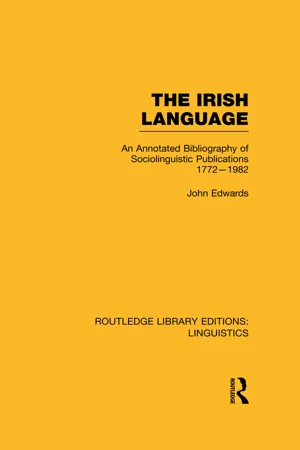
The Irish Language
An Annotated Bibliography of Sociolinguistic Publications 1772-1982
- 292 pages
- English
- ePUB (mobile friendly)
- Available on iOS & Android
eBook - ePub
About this book
Trusted by 375,005 students
Access to over 1.5 million titles for a fair monthly price.
Study more efficiently using our study tools.
Information
Topic
Lingue e linguisticaSubtopic
Linguistica 1. A.B.C. (Pseud.). “The Simplified Irish Spelling.” Irish Educational Review, 1911, 4, 273-279.
Because there is no standard Irish pronunciation, some feel that a simplified spelling would be a great help in teaching native speakers to read, and in recruiting new learners of Irish. It has been suggested that Roman characters be adopted, and that each district have its own spelling. The author is dubious, however, that a simplified Irish spelling would do much for new Irish speakers; for native speakers, the primary need is simply more reading material. District standards also present problems. Generally, the author thinks that the lack of a standard pronunciation severely hampers any proposed spelling reforms.
(See Bergin, 39; An Ruire, 728)
2. A. B. C. (Pseud.). “The Irish-speaking Districts.” Irish Educational Review, 1911, 4, 385-395.
If Ireland is not to become completely anglicized, the Gaeltacht must be supported. The policy should be for only Irish in the Gaeltacht, and for the English elsewhere in the country to be replaced as fast as possible. Bilingualism is not a suitable goal and, in fact, the author claims that a bilingual nation does not exist (Switzerland, for example, is made up of different language areas). Some criticism of the Gaelic League is justified since its object is bilingualism and it has done most of its work in anglicized Ireland. With help from home and church, and with the stemming of the tide of English literature pouring into Ireland, Irish can and should become the “full medium of the mind (p. 391).”
3. Adams, G.B. “Language and Man in Ireland.” Ulster Folk-life, 1970, 15/16, 140-171.
This paper provides some of the historical background to contemporary language issues. Adams traces language development from the pre-Celtic period, with useful notes on the P- and Q-Celtic distinction, the influences of other languages, and the growth of the use of English.
4. Adams, G.B. “The Dialects of Ulster.” In: Ó Muirithe, D. (Ed.), The English Language in Ireland. Dublin & Cork: Mercier, 1977. Pp. 56-70.
Adams presents examples here of Ulster English dialects, noting some aspects of the Gaelic influences upon them.
5. Adams, G.B., Braidwood, J., & Gregg, R.J. Ulster Dialects: An Introductory Symposium. Holywood, Co. Down: Ulster Folk Museum, 1964. xiii + 201 pp.
In this treatment of Ulster English, the authors refer to a language census of 1911. They note three categories of Irish--survival, revival and immigration (i.e., spoken by persons moving from rural areas to towns)--and remark that, unfortunately, the census did not differentiate among the three. There are useful maps and tables.
6. Adams, Michael. Censorship: The Irish Experience. University, Alabama: University of Alabama Press, 1965. 265 pp.
Adams discusses the right-wing stance of the Catholic Bulletin, with its many editorials by Corcoran. O’Faolain and The Bell were an opposing force.
(See Brown, 75; Devane, 184)
7. Adamson, Ian. The Identity of Ulster. Belfast: Baird, 1982. xiii + 125 pp.
Adamson provides brief historical notes on Irish in Ulster and notes that today, although there are more personal and place names of Gaelic derivation in Ulster than there are elsewhere in Ireland, the language is in serious decline. In part, this is due to the association of Irish with southern Irish nationalism.
8. Adler, Max K. Welsh and the Other Dying Languages in Europe. Hamburg: Helmut Buske Verlag, 1977. v + 113 pp.
There is a brief historical treatment of Irish here, but it is a poor one. Misinterpretations, confusion and oversimplifications abound.
(This book is reviewed by Nancy C. Dorian in Language in Society, 1979, 8, 69-71)
AE (Pseudonym of George Russell, q.v.)
9. Agnew, John A. “Language Shift and the Politics of Language: The Case of the Celtic Languages of the British Isles.” Language Problems and Language Planning, 1981, 5, 1-10.
As with Scots Gaelic and Welsh, Irish is largely confined to rural areas, is spoken by bilinguals, and is associated with poverty and backwardness. As well, more people can speak the language than read or write it. Agnew notes that, although the famine and emigration of the nineteenth century clearly affected Irish, there were other elements that might have helped Irish to persist--the church and the nationalist movement especially. Yet the former was ambivalent on cultural issues, and the language was not a dominant theme in the latter. Current official recognition has done little for Irish, and the Gaeltacht continues to shrink.
Agnew, John A. (See also Birch, 43; Hechter, 326).
Airasian, Peter W. (See Fontes, Kellaghan, Madaus, & Airasian, 238; Madaus, Fontes, Kellaghan, & Airasian, 456)
10. Akenson, D.H. “Conclusion.” In: The Irish Education Experiment: The National System of Education in the Nineteenth Century. London: Routledge & Kegan Paul (and Toronto: University of Toronto Press), 1970. Pp. 378–383.
In this final part of his book, Akenson presents census data concerning numbers of Irish speakers. In addition, he notes that until about 1870 there was little pressure for the use of Irish at school; after this time, interest in the language increased. This interest came, however, not from the ordinary population, nor from teachers or school managers, but rather from groups of middle-class intellectuals (e.g., the Society for the Preservation of the Irish Language, the Gaelic League).
(This book is reviewed by T.F. Kelly in Irish Journal of Education, 1970, 4, 60-64; by Leon Ó Broin in Economic and Social Review, 1970, 1, 427-429; by Bearnárd Ó Dubhthaigh in Oideas, 1970, 5, 54-55; by W. Smyth in Administration, 1969, 17, 441; see also Ó Buachalla, 557)
11. Akenson, D.H. “The Magic of Words.” In: A Mirror to Kathleen’s Face: Education in Independent Ireland 1922-1960. Montreal & London: McGil1-Queen’s University Press, 1975. Pp. 35-61.
The belief that the National School system, established in 1831, was instrumental in the decline of Irish is incorrect because: (a) English was the majority language before 1831; (b) school officials were not so much hostile to Irish as they were unaware of it; (c) most parents acquiesced in teaching through English. The educational aspects of Irish are coloured by nationalism, the desire to use Irish as a barricade against outside forces, and are not logically considered according to Akenson. He provides much of interest here regarding Irish and education; in general, he decries the treatment of children as “digits in the Irish revival statistics (p. 60).”
(This book is reviewed by H.M. Knox in British Journal of Educational Studies, 1977, 25, 188; by Norman H. MacKenzie in Canadian Journal of Irish Studies, 1976, 2(1), 57-58; by B. Titley in Studies, 1977, 66, 358-360; see also Ó Buachalla, 557)
Alatis, James E. (See Hamp, 312; Ó hUallacháin, 648, 649)
12. Alcock, Antony & O’Brien, Terence. Policies to support Radio and Television Broadcasting in the lesser used Languages of the European Community. Coleraine: New University of Ulster, 1980. 198 pp.
In this “consultative draft” Irish is described as being under severe pressure (along with Basque, Breton, Corsican, Scots Gaelic, etc.). It requires vigorous support plus a reduction or cessation of the negative forces which weaken it. There is much useful material here concerning the role of radio and television in this.
Alcock, Antony. (See also O’Brien, 550; Price, 715; Sutherland, 760)
13. Alvarez, Benjamin. “Educational Research in Ireland: A Bibliography of Empirical Work 1960-1980.” Irish Journal of Education, 1981, 15, 41-52.
This is a useful article, providing alphabetical and subject indexes.
(See Greaney, 289; Marshall, 463; Molloy & Greaney, 501)
Anderson, Alan B. (See Fennell, 229)
14. Anderson, C. A Brief Sketch of Various Attempts which have been made to diffuse a Knowledge of the Holy Scriptures through the Medium of the Irish Language. Dublin: Graisberry & Campbell, 1818. 160 pp.
The Irish language has been neglected and, consequently, the masses have not been able to properly benefit from religious instruction. Anderson’s proselytizing intent is shown in the following: “The great object … of teaching the reading of Irish, etc. is not to make those who are to be the subjects of that instruction a learned, or what may be called a reading people … but almost exclusively to bring them acquainted with … Christianity (p. 59).”
15. Anderson, C. “The Irish Language.” In: Historical Sketches of the Native Irish and their Descendants Edinburgh: Oliver & Boyd, 1830 (original, 1828). Pp. 206-231.
Anderson stresses again the need for Irish so as to communicate with the population along moral and religious lines. He refers to data collected in 1806 which show that although English has made great inroads in Leinster and Ulster, the Irish language in Munster “prevails beyond comparison”; in Connaught, it is so prevalent that “gentlemen often find it convenient to acquire the language, in order to deal with the peasantry without an interpreter (p. 213).”
16. Andrews, Liam S. The Decline of Irish as a School Subject in the Republic of Ireland 1967-1977. Dublin: Conradh na Gaeilge, 1978. 52 pp.
This paper is prepared in the face of the official silence following the publication of the report of the Committee on Irish Language Attitudes Research. Andrews gives something of the history of Irish at school, and discusses the report of the Commission on the Restoration of the Irish Language and the work of Ó hUallacháin as linguistics adviser and researcher for the government. In 1967, Ó hUallacháin was appointed director of the new Linguistics Institute of Ireland (Institiúid Teangeolalochta Éireann). Yet, Andrews notes, the government did virtually nothing to implement...
Table of contents
- Cover
- Half Title
- Title Page
- Copyright Page
- Original Title Page
- Original Copyright Page
- Dedication
- Table of Contents
- Main Entry Section
- Subject Index
- Date Index
- Journal Index
Frequently asked questions
Yes, you can cancel anytime from the Subscription tab in your account settings on the Perlego website. Your subscription will stay active until the end of your current billing period. Learn how to cancel your subscription
No, books cannot be downloaded as external files, such as PDFs, for use outside of Perlego. However, you can download books within the Perlego app for offline reading on mobile or tablet. Learn how to download books offline
Perlego offers two plans: Essential and Complete
- Essential is ideal for learners and professionals who enjoy exploring a wide range of subjects. Access the Essential Library with 800,000+ trusted titles and best-sellers across business, personal growth, and the humanities. Includes unlimited reading time and Standard Read Aloud voice.
- Complete: Perfect for advanced learners and researchers needing full, unrestricted access. Unlock 1.5M+ books across hundreds of subjects, including academic and specialized titles. The Complete Plan also includes advanced features like Premium Read Aloud and Research Assistant.
We are an online textbook subscription service, where you can get access to an entire online library for less than the price of a single book per month. With over 1.5 million books across 990+ topics, we’ve got you covered! Learn about our mission
Look out for the read-aloud symbol on your next book to see if you can listen to it. The read-aloud tool reads text aloud for you, highlighting the text as it is being read. You can pause it, speed it up and slow it down. Learn more about Read Aloud
Yes! You can use the Perlego app on both iOS and Android devices to read anytime, anywhere — even offline. Perfect for commutes or when you’re on the go.
Please note we cannot support devices running on iOS 13 and Android 7 or earlier. Learn more about using the app
Please note we cannot support devices running on iOS 13 and Android 7 or earlier. Learn more about using the app
Yes, you can access The Irish Language by John Edwards in PDF and/or ePUB format, as well as other popular books in Lingue e linguistica & Linguistica. We have over 1.5 million books available in our catalogue for you to explore.