This book explores the ways in which the American writers Gertrude Stein, Ernest Hemingway, and Zora Neale Hurston used modernist primitivism to assert a uniquely American literary identity in the face of European cultural hegemony.
The extended Introduction traces the history of primitivism from a classical rhetorical trope to its emergence in the twentieth century as aesthetic, exemplified by Picasso and his use of African masks, that combined new work in the human sciences especially anthropology and psychology, with new ideas in the visual arts to challenge traditional ideas of realism and artistic accomplishment. The first two chapters bring together visual evidence, published and unpublished writings, and linguistic theory to give the first detailed account of the theoretical and gender concerns of the Stein-Picasso collaboration, which culminated in Picasso's Les demoiselles d'Avignon and Stein's Melanctha.
In the final two chapters, the author shows how both Hemingway and Hurston participated in the racialist scientific debates of the 1920s and used primitivism to find their respective artistic voices: Hemingway in his use of American Indians in recasting his life narratives in the Nick Adams stories, and Hurston in her attempts to use her anthropological training to construct a mythic African-American past.
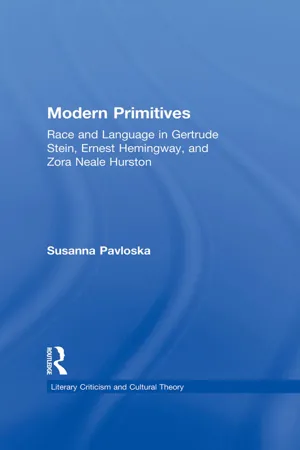
eBook - ePub
Modern Primitives
Race and Language in Gertrude Stein, Ernest Hemingway, and Zora Neale Hurston
- 154 pages
- English
- ePUB (mobile friendly)
- Available on iOS & Android
eBook - ePub
Modern Primitives
Race and Language in Gertrude Stein, Ernest Hemingway, and Zora Neale Hurston
About this book
Trusted by 375,005 students
Access to over 1.5 million titles for a fair monthly price.
Study more efficiently using our study tools.
Information
1.
Stein and Picasso: The Anti-Aesthetes
I. PORTRAIT OF A FRIENDSHIP
According to the legend inscribed in The Autobiography of Alice B. Toklas, “practically every afternoon” during the winter of 1905 Gertrude Stein would walk through the Luxembourg Gardens to the Odeon, take the horse-drawn bus to Montmartre and climb the hill to Picasso's studio to sit for the portrait that now hangs in the Metropolitan Museum of Art. Inside the little room with “Au rendezvous de poetes” above the door, amid the “enormous” canvases of the Harlequin period and the smell of cooking and dogs, she would take her pose in the large broken armchair. While Picasso struggled with his canvas, she passed the long still hours “meditating and making sentences” or engaging in her favorite practice of “talking and listening at the same time.” In the evening, she would “wander” back to Montparnasse, on Saturdays bringing the Picassos home to dine, a custom that became Leo and Gertrude Stein's weekly salon (Autobiography 46).
Scholars of art and literature alike have been at a loss as to how to account for the enigmatic friendship that grew out of this series of eighty or ninety sittings and lasted, “with all its troubled moments and complications,” a lifetime (Autobiography 15). As Neil Schmitz has noted, Stein's part in the friendship has tended to get lost in the “strong light” of “Picasso's glory” (Of Huck and Alice 169). From the early years of Picasso's fame, contemporaries of the two sought to represent Stein as an onlooker, or at most a wealthy muse. Resenting their treatment in The Autobiography of Alice B. Toklas, Matisse and Braque declared Stein to be a “tourist” with no knowledge of the art she collected (14). Another slighted friend, Ernest Hemingway, insinuated that the only reason why Picasso associated with Stein was because she was “one of the rich” and could finance his work (Moveable Feast 10). After their estrangement, Leo Stein disparaged his sister's artistic judgment and intellect in two volumes of memoirs.
Art historians have similarly tended to deny Stein an active role in Picasso's work. John Rewald dismisses her theories of art as “poorly digested notions of things Gertrude picked up from conversations with Leo, Matisse, or Picasso”(71). John Richardson allows that the relationship was based on a “deep psychic feeling,” noting the proliferation of massive Steinlike women in the canvases Picasso executed after The Portrait of Gertrude Stein, but refuses to include her to the ranks of Picasso's “poet laureates,” a group that included Max Jacob, Guillaume Appollinaire, Andre Breton and Paul Eluard. Instead, he assigns Stein the passive role of muse, characterizing the “three months or so of Picasso and Gertrude's exposure to each other's implacable regard” as a time when “the artist wrestled on canvas with Gertrude as if she were a sphinx whose image held the key to the future of his art,” while she in turn “set about hitching her covered wagon to Picasso's comet” (405).
Yet, as numerous critics have noted, during the two years following this period of almost daily contact, both achieved artistic breakthroughs: Stein produced “Melanctha,” which she considered to be “the first definite step away from the nineteenth century and into the twentieth century in literature” (Autobiography 50), while Picasso produced Les demoiselles d'Avignon, “the first truly twentieth-century painting” (Fry 12). Gertrude Stein was thirty-one; Pablo Picasso was twenty-six. Both were foreigners whose work was preoccupied with the outsiders of society: Stein in the stories of her Three Lives, and Picasso in the works of his Blue and Rose Periods. During the period of the painting of The Portrait of Gertrude Stein, both studied the paintings of Cezanne and adopted an aesthetic of crudeness, incompleteness and ugliness that culminated for Stein, in “Melanctha,” and for Picasso, in Les demoiselles d'Avignon [1907].
Significantly, both used the same mechanism to achieve this break: the original of “Melanctha,” Stein's “negro story,” was QED, an earlier novella that was conventional in every way except for its lesbian subject matter. Likewise, Les demoiselles d'Avignon started out as a “narrative” sketch of two young men in the antechamber of a brothel; in revision, the two men are gone, and the three prostitutes wear African masks.
When Stein's work began to receive serious critical attention in the 1930s, her style was usually estimated more for its effect on other, more mainstream writers than in its own right. Her influence on Sherwood Anderson and Hemingway, for example, was duly noted, but in the case of her friendship with Picasso, whether seen as hanger-on or patron, muse, or even “substitute brother” (Benstock 153), Stein was almost always assumed to occupy the subordinate position. However, the similarities in the manner in which their work changed during this crucial period suggests that the creative practice of the two is more collaborative than previously imagined.
Certainly Stein herself did all she could to promote such a view. As Schmitz observes, The Autobiography of Alice B. Toklas aimed to “thrust” Stein into the center of the modernist movement (“Of Huck and Alice,” 212):
This was the year 1907. Gertrude Stein was just seeing through the press Three Lives [sic] which she was having privately printed, and she was deep in The Making of the Americans, her thousand page book. Picasso had just finished his portrait of her which nobody at that time liked except the painter and the painted … and he had just begun his strange complicated picture of three women. Matisse had just finished his Bonheur de Vivre, his first big composition which gave him the name of Fauve or zoo. It was the moment Max Jacob called the heroic age of cubism. (Autobiography 6)
The double-voiced construction of The Autobiography is uniquely suited to the task of advertising the friendship of Stein and Picasso.1 For instance, when Alice, in the guise of the narrator, confides:
(I wish I could convey something of the simple affection and confidence with which he always pronounced her name and with which she always said, Pablo. In their long friendship with all its sometimes troubled moments and complications this has never changed.) (Autobiography 15)
The picture that Toklas paints of Stein and Picasso's relationship is one of not only the psychic but intellectual affinity:
She understands very well the basis of creation and therefore her advice and criticism is invaluable to all her friends. How often have I heard Picasso say to her when she has said something about a picture of his and then illustrated by something she was trying to do, racontez-moi cela. In other words tell me about it. These two even today have long solitary conversations. They sit in two little low chairs up in his apartment studio, knee to knee and Picasso says expliquez-moi cela. (Autobiography 72)
It is hard to reconcile the image of the woman who appears in the art historians' accounts with contemporary descriptions of Stein as an attractive woman with a head “like a Roman emperor” (Hemingway, Moveable 118) a voice like “brown velvet,” and a laugh like a “beefsteak” who “gloried” in her “pounds and pounds” of “heavy massive fat” (Luhan 327) sitting knee to knee with Picasso like an immense bisexual Caryatid. To Sherwood Anderson, who met Stein during the 1920s, “the woman is the very symbol of health and strength. She laughs. She smokes cigarettes. She tells stories with an American shrewdness getting the tang and the kick in the telling.” In contrast, Picasso was small and brooding, and partly because of his self-consciousness about his Spanish accent, had “nothing to say except the occasional firework” (L. Stein, Appreciation, 170).
Of all Picasso's biographers, only Pierre Daix fully accepts the testimony of The Autobiography of Alice Toklas. In his view, Stein's friendship had “constituted a priceless opening out” for Picasso, first of all, because Stein's “American French” freed Picasso from his own “linguistic complexes.” Besides discussing her theories of art with him, Stein introduced Picasso to Matisse, his future arch-rival, and could talk familiarly about the work of Cezanne, which at that time was known only to a small group of enthusiasts, in relation to the theories of perception she had learned in William James's Psychological Laboratory. Art historians such as Rewald have tended to emphasize the role that Leo Stein played in the dissemination of Cezanne's work, yet Gertrude Stein, because of her previous training with James, had her own considerable resources for understanding Cezanne's project. As Jayne L. Walker points out, James's studies of the process of perception and Cezanne's efforts to record his visual sensations come from the “same fundamental hypothesis”: that it is possible to circumvent the conventions upon which perception was known to be based and to see with an “innocent” eye (7).
Both Stein and Picasso were similarly ambitious in their claims for the radical nature of their work. However, aside from Daix, art historians have been unprepared to make sense of Stein's willfully naive style, what Marianne DeKoven calls her “defiance of serious thought's aura of respectability” (“Half,” 77), and have thus subjected it to a kind of ironic double standard. For example, Richardson notes Picasso's fondness for cursi, his “taste for bad taste,” and praises how he “made it work for him” (60); in the same volume, however, he warns that before “hailing [Stein's ] discrimination” as a collector of cubist works, it is necessary to “examine her motives for embracing the movement,” since “her own taste ran to kitsch” (405).
Ultimately, however, art historians' objections to considering Stein as an influence on Picasso's art hinge on her insistence on linking her writing to Picasso's painting, and on her claim that during this period of radical experimentation, she “was alone at this time in understanding him perhaps because I was expressing the same thing in literature” (Picasso 16). Richardson does admit that there are similarities:
True, the writer and painter both managed to liberate themselves from traditional themes of verbal and pictorial expression and come up with a new form of notation. True again, both of them had a similar way of displaying, at the same time concealing, their feelings, especially about the women in their lives, by resorting to a private code.
“But,” he concludes, “there the parallels end,” because the compositions of Tender Buttons are “dissociative word patterns, hermetic jingles,” while Picasso “rejected abstractionism and liked to think that his work was if anything more, certainly not less, real than the real thing,” which is why he “represented real things—newspapers, cigarette packs by themselves” (406).
This characterization of Stein's experimental writing as “hermetic” draws on a view that prevailed among the earlier generation of Stein scholars. One early critic, B.L. Reid, was so exasperated by Stein's writing that he was moved to write an “essay in decapitation.” Calling Stein “one of the greatest egos of all time,” Reid pointed to her shortcomings in relation to “the friendly communicative genius” of her “masters,” James, Whitehead and Picasso: while they pull “us gently or roughly up to the heights of their new insight,” Stein seems to be merely “talking to herself,” and thus deserved to be “defined out of existence as a writer” (168). While Reid did admit the possibility of defining Stein as a scientist, his sole method for judging the literary value of her writings seems to be whether or not he could comprehend them.
Oddly enough, Richard Bridgman, in his influential Gertrude Stein in Pieces, arrives at the same destination as Reid, but by way of the opposite track. Like Reid, he holds the view that “the total of Stein's work belongs to the phenomenology of the mind rather than to literature”; however, he attributes Stein's method, and assertions of genius, to a lack of confidence, rather than its excess, arguing, “the more aggressively Gertrude Stein insisted on her success, the more resistant were the problems she was trying to resolve” (244). He depicts the situation as one in which “finding herself perpetually frustrated in her attempts to provide a full, satisfactory description of any one or any thing, she eventually found herself driven to rely on her own subjective response, expressed in whatever words emerged at the moment of concentration” with the idea that “true confusion was superior to false order” (55). Bridgman's overall assessment of Stein's method is that it is founded in incompetence, in “unresolved bewilderment” (252), arguing that because “from her beginnings as a writer, Gertrude Stein found it difficult to construct coherent paragraphs, to sustain a tone, and idiomatic level, or an idea,” faute de mieux, she “consistently defended the virtues of the fragmentary perception, uniquely expressed” (199).
At the same time that he renders an immeasurable service in cataloguing, contextualizing, and describing the body of Stein's work, Bridgman also seems to have undertaken Reid's project: the marshaling of Stein's juvenilia and other background material toward proving that even if Stein were not “basically stupid,” as her brother insisted, she was at least as Hemingway claimed, “very lazy.”2 With few exceptions, Stein critics have praised Bridgman's study as “full of common sense,” (Hoffman, 17) and regarded it as “the single most important book on Stein.”3
In one of the first essays to address Stein's lesbianism in relation to her writing, Sandra Gilbert and Susan Gubar describe Stein as a “ravenous ego,” and her creative practice as “unmaking,” or “subtracting the signifier from the signified,” arguing that Stein replaces the traditional h...
Table of contents
- Cover
- Half Title
- Title Page
- Copyright Page
- Table of Contents
- Preface
- Introduction: Primitivism as a Theme in Rhetoric, Science, and Art
- 1. Stein and Picasso: The Anti-Aesthetes
- 2. The Fact of Blackness in “Melanctha”
- 3. Hemingway's Primal Scene
- 4. Zora Neale Hurston's Ethnological Fiction
- Bibliography
- Index
Frequently asked questions
Yes, you can cancel anytime from the Subscription tab in your account settings on the Perlego website. Your subscription will stay active until the end of your current billing period. Learn how to cancel your subscription
No, books cannot be downloaded as external files, such as PDFs, for use outside of Perlego. However, you can download books within the Perlego app for offline reading on mobile or tablet. Learn how to download books offline
Perlego offers two plans: Essential and Complete
- Essential is ideal for learners and professionals who enjoy exploring a wide range of subjects. Access the Essential Library with 800,000+ trusted titles and best-sellers across business, personal growth, and the humanities. Includes unlimited reading time and Standard Read Aloud voice.
- Complete: Perfect for advanced learners and researchers needing full, unrestricted access. Unlock 1.5M+ books across hundreds of subjects, including academic and specialized titles. The Complete Plan also includes advanced features like Premium Read Aloud and Research Assistant.
We are an online textbook subscription service, where you can get access to an entire online library for less than the price of a single book per month. With over 1.5 million books across 990+ topics, we’ve got you covered! Learn about our mission
Look out for the read-aloud symbol on your next book to see if you can listen to it. The read-aloud tool reads text aloud for you, highlighting the text as it is being read. You can pause it, speed it up and slow it down. Learn more about Read Aloud
Yes! You can use the Perlego app on both iOS and Android devices to read anytime, anywhere — even offline. Perfect for commutes or when you’re on the go.
Please note we cannot support devices running on iOS 13 and Android 7 or earlier. Learn more about using the app
Please note we cannot support devices running on iOS 13 and Android 7 or earlier. Learn more about using the app
Yes, you can access Modern Primitives by Susanna Pavloska in PDF and/or ePUB format, as well as other popular books in Literature & Literary Criticism. We have over 1.5 million books available in our catalogue for you to explore.