Here is an invaluable resource for activities professionals specializing in geriatrics. Activities in Action reflects the goals of the National Association of Activity Professionals in that it serves as a catalyst for professional and personal growth and provides a national forum on geriatric and activity issues. Some of the highlights of this significant volume include a historical perspective of the activities profession, its growth and current contributions to the life and care of nursing home residents, and an overview of a national organization representing activities professional and how this organization has contributed to the growth of the profession. An extensive aging and leisure bibliography of timely publications related to activities and aging is also included.Specific chapters emphasize a variety of topics such as the impact of federally mandated nursing home resident assessment for activity professionals; the growing concern for the quality of life and its definition for nursing home inhabitants; the role of activity professionals in providing for the spiritual needs of the elderly whom they serve; how to deal with relocation stress and territoriality in nursing home occupants; and practical guidelines on how to employ and supervise activity assistants and work effectively with other staff as well as an activity coordinator. Activities directors, coordinators, assistants, and supervisors from all levels of experience will benefit from the insightful information in this innovative book.
eBook - ePub
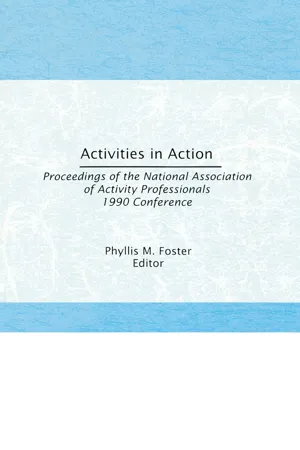
Activities in Action
Proceedings of the National Association of Activity Professionals 1990 Conference
- 116 pages
- English
- ePUB (mobile friendly)
- Available on iOS & Android
eBook - ePub
Activities in Action
Proceedings of the National Association of Activity Professionals 1990 Conference
About this book
Information
Functioning as a Department Head and Supervisor: A New Role for the Activity Coordinator
SUMMARY.Although activity programs have grown significantly more sophisticated during their relatively short history, recognition and acceptance of their importance lags behind these advances. The major reason for this may be that many activity coordinators continue to function primarily as activity leaders rather than department heads and supervisors. This article presents basic information about how to employ and supervise activity assistants and work effectively with other staff. Employing (job descriptions, interviewing, and selecting), orienting and training, motivating, and evaluating activity assistants are reviewed, and orienting and gaining the cooperation of other staff, especially nursing staff, are discussed.
Many activity coordinators continually face the problem of lack of recognition of the importance of their programs by administrators and other staff. This may be the result of the activity coordinator not functioning primarily as a department head and supervisor. If current activity programs are to truly actualize their potential to play a major part in residents continuing to experience living in a meaningful and satisfying manner, a change in the role of the activity coordinator is needed. The purposes of this article are to discuss the importance of the activities coordinator functioning as a department head and supervisor, provide an overview of employing and supervising activity assistants, and review working effectively with other staff from the perspective of a department head.
Functioning as a Department Head and Supervisor
The need for activity coordinators to begin to function more as department heads and supervisors is apparent in discussions with numerous activity professionals who frequently express a variety of problems with employing and retaining activity assistants and working effectively with other staff. Common complaints about activity assistants include depending on them to meet their responsibilities and meeting their duties at an acceptable level. Frequent absences from work and high turnover are problems as well. Gaining the acceptance and assistance of other staff, especially nursing staff, is a chronic problem and one of the most frequent complaints of activity coordinators.
High Turnover: A Reality with Activity Assistants
While the reasons for these commonly expressed problems undoubtedly vary, they appear to be based upon two basic issues. First, because of low salaries and other employment possibilities, retention of appropriate activity assistants is genuinely difficult. Since job turnover among activity coordinators is rather common, promotion from the assistant’s to the coordinator’s role is a frequent occurrence. It is to be expected and entirely reasonable that they will seek higher paying positions which provide greater responsibility and autonomy. Activity coordinators may just have to accept the fact that competent activity assistants will move on to better jobs, provide them with the best training and supervision possible, and wish them well in their new positions. From the broader perspective of the activity profession, however, thoroughly orienting and training new practitioners at the entry level as activity assistants will result in the continued upgrading of the profession.
Developing a Self-Image as a Department Head
The second reason for these problems, both with activity assistants and other staff, may well be that the roles of supervisor and department head are relatively new to many activity coordinators. Many have little experience with and may be uncomfortable with these new roles.
Perhaps the most important step in becoming more comfortable with functioning as a department head and supervisor is that activity coordinators need to move beyond a view of themselves as staff members who primarily lead activities with residents. This step may not be easy for many activity coordinators since they most likely originally assumed their positions because they wanted to work directly with residents, became very effective in that role, and gained satisfaction through doing their jobs well and leading resident activities. While directly leading activities is the core of the activity program, activity coordinators must begin to think of themselves as department heads if the program is to receive the recognition it deserves.
To truly actualized the potential of the activity program, coordinators must learn to use their considerable talents to reach the greatest number of residents possible. The way to use these talents most efficiently is through supervising and managing activity assistants, other staff, and volunteers so that they are able to effectively work directly with residents. Even though most activity coordinators have a great deal of energy and frequently work long days and weeks, there simply are not enough hours in a day or a week to function both as a department head and supervisor and as an activity leader. This is not to suggest that activity coordinators should not continue to work directly with residents. They should, but the amount of time spent directly with residents and the kinds of things done with residents needs to change.
In the relatively short history of comprehensive activity programs in long term care facilities, which only dates back to the late 1960s with the implementation of the initial Medicare regulations, activity programs have grown tremendously. According to Maypole,
As a profession into which its members have come with a wide variety of skill levels and educational backgrounds, activity [coordination] has been slowly gaining more recognition and acceptance. This acceptance is primarily reflected in the federal and state laws and regulations which require (1) organized activity… programs in nursing homes and (2) the participation of the activity (professional) in the care plan conferences and programming. However, having no common theoretical or educational base for its members, the profession is only now beginning to grapple with developing job performance standards and uniform educational expectations. (1985, p. 15)
The concept of an activity program as originally understood by administrators, nurses, and even surveyors was one in which activities staff provided entertainment-oriented activities to keep the residents busy and happy. The common view was that activities were something that were nice, but not very important to the quality of the long term care facility. An activity department was simply one more requirement which needed to be met in order to receive reimbursement through Medicare and Medicaid.
During the twenty some years since those beginnings, activity programs have become a mandated part of the resident’s care plan, and the nature and variety of the activities which are a part of the program have changed and grown dramatically. Activities are offered not merely as entertainment, but for specific treatment purposes. The activity program requirements are now a more substantive part of federal and state regulations to the place where facilities are now cited for deficiencies in their activity programs. For example, regulations in Oregon state,
An activity program shall be provided which is suited to the intellectual, social, spiritual, creative, and physical need(s), capabilities, and interests of the patients which encourages involvement and allows the patients to function at their highest level. This program shall be provided as an important part of the treatment program and coordinated with the overall plan of care.… There shall be an activity plan developed for each patient based on the total patient assessment including, but not limited to, past and current interests and activities, skills, medical limitations, cognitive and emotional functioning… The goal(s) and plan shall be entered on the overall plan of care. (Oregon Health Division, 1985)
While it is not pleasant to receive citations for deficiencies in activities, they represent dramatic acknowledgement of the greater importance of activity programs, especially from the perspective of surveyors.
The amount of growth and development in what is a very short professional history is truly phenomenal. Much of the credit goes to the hard work of current and former activity professionals. But the acceptance of activity programs by administrators and other staff has not changed as much as the developments discussed above might have warranted. As Dickey (1986) has stated, “I have had numerous activity directors tell me that they are at the bottom as far as the administrative staff is considered. I have heard this from people with schooling, with experience” (p. 79).
Two reasons for the lack of acceptance seem most likely. The first may be reflective of the nature of activity programs and the professional competence of activity coordinators. Leisure activities are, first of all, fun for the participants, and many do not feel that fun is veiy important to the quality of living of people. While activities certainly do provide pleasure and enjoyment for participants, their purposes in meeting physical, intellectual, emotional, social, and spiritual needs are much deeper than they appear. However, documenting the effects of the activity program on residents through research is also a critical need, and activity coordinators must begin to initiate and/or work with researchers to collect information which specifically addresses the efficacy of the activity program.
Additionally, planning, organizing, and implementing pleasurable experiences do not, on the surface, appear to be very hard work. How many times have activity coordinators heard other staff members say “I wish I had your job. All you do is play all day?” Those who plan and implement activities all know the amount of time, energy, and skills that are required, but perhaps because activity coordinators do their jobs so well and so professionally, the work does not appear to be that difficult or demanding.
A second, and more important, reason for lack of acceptance appears to be that activity coordinators frequently don’t view and conduct themselves as department heads and supervisors. Dickey continues, “I think that how we feel about ourselves and our departments is vital in establishing professionalism” (1986, p. 79). Too often, activity coordinators are not assertive in promoting the activity program to the administrator and other staff. Too often, when lack of support from the administrator and other staff occurs, activity coordinators do not confront them. Instead, they go along doing their jobs and hope others will somehow notice how important the activity program is to the residents.
Maypole’s (1985) study of activity professionals’ perceptions of their continuing education needs suggests that they do not view themselves as department heads and supervisors. The majority of higher priority training needs included many topics related specifically to working directly with residents (e.g., working with confused residents, bedfast activities, motivating individuals, working with groups, special mental health problems, helping techniques with death and dying, and leadership techniques). More of the perceived lower priority training needs were related to administration (e.g., volunteer recruitment, volunteer use, newspaper releases, TV publicity, appraising supervisees, delegating, budgeting, planning, evaluating job applications) even when practice and administrative needs were separated.
When the activity coordinator begins to view her or himself as a department head and supervisor and functions accordingly, greater acceptance and recognition will come. Even through assuming this new role as a department head may not initially be very comfortable, the basic reason for doing so is to provide the residents with the type of activity program which gives their lives greater meaning and helps them to feel good about themselves and what they can do for themselves and others. Enhancing the quality of living of the residents surely is justification enough for any activity coordinator beginning to view her or himself and function as a department head and supervisor.
Determining the Most Effective Supervisory Style
Once the activity coordinator has begun to view her or himself as a department head and supervisor, it is, of course, essential that she or he learns how to become an effective supervisor. Essentially, effective supervision represents effective leadership of subordinate staff.
A variety of research has been conducted in an effort to determine the characteristics of the effective leader or supervisor. Edginton and Williams (1978, p. 180) conclude, “In most cases, leadership behavior studies have found that the critical elements are task behavior and relat...
Table of contents
- Cover
- Title
- Copyright
- CONTENTS
- Preface
- The NAAP Board of Trustees 1990-1991
- The NAAP Mission and Philosophy
- Chronology of the NAAP
- The Eighth Annual Convention of the National Association of Activity Professionals: A Summary
- NAAP Keynote Address
- Federally Mandated Nursing Home Resident Assessment: Implications for Activity Professionals
- Leisure Activities and Quality of Life
- Spirituality and Aging: Activity Key to “Holiest” Health Care
- Relocation and the Resident
- Functioning as a Department Head and Supervisor: A New Role for the Activity Coordinator
- AGING AND LEISURE BIBLIOGRAPHY
Trusted by 375,005 students
Access to over 1.5 million titles for a fair monthly price.
Study more efficiently using our study tools.
Frequently asked questions
Yes, you can cancel anytime from the Subscription tab in your account settings on the Perlego website. Your subscription will stay active until the end of your current billing period. Learn how to cancel your subscription
No, books cannot be downloaded as external files, such as PDFs, for use outside of Perlego. However, you can download books within the Perlego app for offline reading on mobile or tablet. Learn how to download books offline
Perlego offers two plans: Essential and Complete
- Essential is ideal for learners and professionals who enjoy exploring a wide range of subjects. Access the Essential Library with 800,000+ trusted titles and best-sellers across business, personal growth, and the humanities. Includes unlimited reading time and Standard Read Aloud voice.
- Complete: Perfect for advanced learners and researchers needing full, unrestricted access. Unlock 1.5M+ books across hundreds of subjects, including academic and specialized titles. The Complete Plan also includes advanced features like Premium Read Aloud and Research Assistant.
We are an online textbook subscription service, where you can get access to an entire online library for less than the price of a single book per month. With over 1.5 million books across 990+ topics, we’ve got you covered! Learn about our mission
Look out for the read-aloud symbol on your next book to see if you can listen to it. The read-aloud tool reads text aloud for you, highlighting the text as it is being read. You can pause it, speed it up and slow it down. Learn more about Read Aloud
Yes! You can use the Perlego app on both iOS and Android devices to read anytime, anywhere — even offline. Perfect for commutes or when you’re on the go.
Please note we cannot support devices running on iOS 13 and Android 7 or earlier. Learn more about using the app
Please note we cannot support devices running on iOS 13 and Android 7 or earlier. Learn more about using the app
Yes, you can access Activities in Action by Phyllis M. Foster in PDF and/or ePUB format, as well as other popular books in Medicine & Health Care Delivery. We have over 1.5 million books available in our catalogue for you to explore.