This book explores how African youth are depicted in contemporary literature and popular culture, and discusses the different ways by which they attempt to construct personal and cultural identities through popular culture and social media outlets. The contributors approach the subject from an interdisciplinary perspective, looking at images in children's and adolescent literature from Africa, and the African diaspora, from Nollywood and Hollywood movies, from popular magazines, and from youth cultures encountered directly through field experiences. The findings reveal that there are many stereotypes about Africa, African youth and black cultures, and that African youth are aware of these. Since they juggle multiple identities shaped by their ethnicities, race and religion, it is often a challenge for them to define themselves. As they also share a global youth culture that transcends these cultural markers, some take advantage of media outlets to voice their concerns and participate in political struggles. Others simply use these to promote their personal interests. Contributors ponder the challenges involved in constructing unique identities, offering ideas on how African youth are doing so successfully or not in different parts of the continent and the African diaspora, and thus offer new possibilities for youth studies.
eBook - ePub
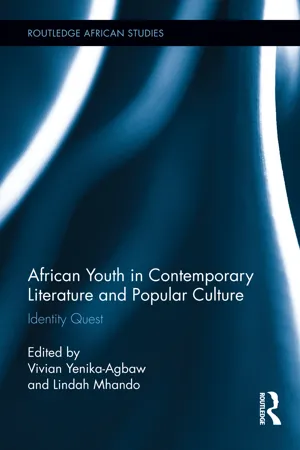
African Youth in Contemporary Literature and Popular Culture
Identity Quest
- 256 pages
- English
- ePUB (mobile friendly)
- Available on iOS & Android
eBook - ePub
African Youth in Contemporary Literature and Popular Culture
Identity Quest
About this book
Information
1 African Youth
Cultural Identity in Literature, Media and Imagined Spaces
Vivian Yenika-Agbaw and Lindah Mhando
Introduction
I must confess that, living in American society, I often suffer from what I call “identity fatigue.” Luckily for me, the cure is usually as simple as a phone call to a friend or relative who can assure me that I have another existence outside identity politics. But sometimes I must take a trip, to get far away from it all, to verify an authentic existence for myself. (Diawara 13)
We find the above quotation to be very timely and provocative. For instance, it captures the predicament of displaced people constantly involved in renegotiating their identities. It also reminds immigrants of their reality, which can be a source of confusion, frustration and/or empowerment. Fortunately, Manthia Diawara acknowledges that modernization through the rise of technology has provided us with the tools to break through our isolation and identity crisis. A simple “phone call to a friend or relative” reminds him of his identity.
Questions of identity are not new to the African or African American experience. Africana (Africa and its diaspora) agency and selfhood have been characterized by multilayered historical processes—from slavery to colonialism, to neocolonialism and now globalization. In this journey, each generation of “Africans” has struggled and found ways to cope and survive both in the continent and in the diaspora under oppressive systems.
Historical records document that during slavery, many African groups fought slave raiders. This struggle continued through the middle passage, with many captives starving themselves, jumping into the ocean and/or rising against their captors, as illustrated in the Amistad incident. This resistance to slavery continued in various forms in the new world. Whereas Africans in the Americas continued to struggle for human rights and equality, Africans in the continent fought for independence and self-determination from European colonialism.
Even after the passage of the Civil Rights Act in the 1960s and declarations of independence in many African nations, African peoples continue to seek ways of reaffirming themselves and their culture. The most effective form of resistance and self-affirmation has been through black cultural discourses, such as songs, folktales, poetry and stories. This is clearly reflected in the negritude movement through the work of such writers as Aime Cesaire, Leopold Senghor and Camara Laye, who write stories and poems celebrating the beauty and grandeur of African cultures, as well as through Langston Hughes, Claude McKay, Countee Cullen and other writers of the Harlem Renaissance, who use literature as a weapon to challenge white oppression and social injustice. Likewise, Chinua Achebe, Ngugi wa Thiong’o, Tsitsi Dangarembga, Ellen Kuzwayo and Steve Biko (to name just a few), as postcolonial writers of African literature, have implemented similar strategies in their works to interrogate African encounters with the West and how these encounters have continued to inform African cultures.
Despite centuries of struggles, African people still face major challenges and persist in their quest to affirm the self. African youth have long been part of this journey, but naming the art of naming can be complicated. “Identity,” as Stuart Hall notes, “is not as transparent or unproblematic”; [it is a] “‘production,’ which is never complete, always in process, and always constituted within, not outside, representation” (222). We situate the conversations on African youth and identity in this volume within this frame of thinking.
Back to Africa
In 2011, Vivian traveled to Africa. The first stop was her country of origin, Cameroon, in the west coast of Africa. While there, she felt more like a stranger than she had anticipated, for the society had evolved from the familiar cultural space of her youth, a place she left behind in pursuit of education and greener pastures in the West, to one that she no longer recognized as distinctly Cameroonian. The youth population she encountered informally and formally seemed savvier than she remembers our generation ever being. They were knowledgeable about global events and cultures. Most had Facebook friends from all over the world and were familiar with trendy youth culture, including fashion, slang, lingo, television shows, movies and music. It was fascinating but at the same time troubling, for whereas some used social networks and media to seek out educational and professional opportunities, others took advantage of the Internet in creative ways that were often disruptive.1
The African youth she observed informally (on the streets, in cybercafés and at professional and/or family gatherings) in Banso; Buea; Ekondo Titi; Yaounde (Cameroon); Gaborone (Botswana); Johannesburg airport (South Africa); Silver Spring, Maryland; and Washington D.C. in the summer of 2011 seemed to have agency. They appeared confident, knowledgeable and in control, and some were often vocal about their views on local and global politics. At times, understandably, they seemed uncertain. In Buea, where she interacted daily with University of Buea students formally and other youth informally in cybercafés, she observed their reactions to virtual programs on African affairs. At a popular mini cite [university hostel] close to the campus, she also noted the television shows that students watched regularly. One reality show, Big Brother Africa, stood out. She was surprised at how passionately they chastised, jeered and applauded different contestants whose behavior they disapproved or approved of. The social-media component made the experience even more entertaining, with responses appearing at the bottom of the television screen that reflected similar sentiments from viewers across the continent (or so it seemed).
Spending a week in Gaborone later, she followed the show closely without the luxury of any youth’s company like she had had earlier in Cameroon. This time, she read the postings on the television screen carefully to understand the subtle nuances that reflected pan-African, nationalistic and regional sentiments. Responses fluctuated as well, with respondents sometimes supporting a contestant from their region (Southern/West/East Africa) but later withdrawing this support based on (it looked like from their onscreen postings) a contestant’s perceived morality, which they judged daily as the events unfolded on the screen. Comments revealed each respondent’s disgust with the contestant, and the message posted insinuated that the contestant was a disgrace to the continent or was manifesting a value system that contradicted what the writer of the posting believed to be “African.” During moments like this, respondents (via their postings) lobbied for support of another contestant whose onscreen persona exhibited values they believed were appropriate, regardless of which part of the continent that particular contestant hailed from. Following this show over the course of her stay in Gaborone, Vivian was repelled and fascinated at the same time by the way these young adults manipulated viewers’ sentiments and by the viewers’ (the majority of whom she assumed were youth) active participation in shaping the image of Africa they wanted to see projected by the young contestants. Whereas some of their postings at the bottom of the television screen seemed harsh, a few were quite constructive, reflecting a deeper understanding of the struggles involved in the process of constructing a public identity with which one was comfortable. There is no question that their voices were heard somehow, for different episodes revealed behavioral changes in the contestants that fulfilled and/or defied viewers’ wishes.
This reality show, an offshoot from a Western original, was being played out in the continent as though that was where it was originally conceived. This is an indication of how cultural products, we believe, circulate in a global economy and may appear in local and national spaces—virtual and physical—in hybrid forms to become a reality for the consumer who occupies the new space momentarily. What Vivian observed was a new world order that allowed space for African youth to perform roles desired by multinational corporations. And in so doing, they were acting on the market forces as the forces acted upon them simultaneously. They indeed had agency, which Maria José Botelho and Masha Kabakow Rudman summarize as the ability to “read multiple discourses . . . as well as holding contradictory discourses” (119). They therefore seemed to be a highly visible and vocal entity in a public arena—spaces that are often contested and where identity constructions are ongoing.
Vivian’s experience in this “new” Africa is consistent with Hall’s view of cultural identity first being “a shared culture, a sort of collective ‘one true self,’ hiding inside the many other, more superficial or artificially imposed ‘selves,’ which people with a shared history and ancestry hold in common”; and secondly, as “a matter of ‘becoming’ as well as ‘being’” (225). Understanding cultural identity as always “undergo[ing] constant transformation” (225) compelled us to investigate African youth identity.
Lindah, too, was privileged to travel to Dakar, Senegal, this past year for research work. Her friend’s cousin, who was involved in a youth music group, was her companion through errands. From time to time, they met with his business associates, and through these interactions she encountered Senegalese youth firsthand. She remembers one youth telling her something that stuck in her head: “We may not know who Jay-Z is, but we know his songs and we also have our own Jay-Z here who is [as] good if not even better! I wonder if Jay-Z knows about our Jay-Z, you know, a very successful group known as the Daara J group.” (Daara is a hip-hop type of music fused with the Senegalese mbalax2 style and sabar drums.) He then told her that the meaning of “Daara” in Wolof is “school of life.” He insisted, “Everything has a meaning here!” The youth appeared to be not only well informed about global issues but also very effective and articulate in defending competing conceptions of cultural and the political identity. Lindah talked with them informally about migration, and they quickly played one of the Daara J group numbers called “Exodus,” which is about migration and dual identities:
Am I Senegalese or French? Look at my skin color, and where I am now—it feels like I am a foreigner until we can figure it out, who is a true Senegalese with the real job, good life and . . . the rest is bullshit!
Another youth, Boubacar, added:
Our culture is original, because it has been instilled in us, at a very tender age, and stays with us. Yes, I am Muslim and very proud, and like to wear Western clothes, including wearing my cap backward, but I was taught to be kind to others, practicing Teraanga (hospitality); be respectful to elders, others and myself. My body is a temple; if I don’t respect it, no one would. I was taught to say my prayers and so forth. You cannot just discard your culture, I keep it real.
The youth she encountered were keenly aware of African American popular culture, entertainers, athletes, Oprah, movie stars and musicians. She could tell that the youth were enthralled with popular culture and were listening to the same music as kids in the West and as her students. And of course, there is Barack Obama. In terms of a more profound understanding of the black experience in America, however, their knowledge seemed to be lacking, perhaps because of their unfamiliarity with the microdynamics of America. This signified that identity is a very complex and ever-shifting matter. From these conversations, we infer further, like Madan Sarup, that
identities are influenced, among other things, by what we consume, what we wear, the commodities we buy, what we see and read, how we conceive our sexuality, what we think of society and the changes we believe it is undergoing. Our identities are formed partly by what we think of ourselves and how we relate to everyday life. (1996, 105)
The contribution of youth culture in Dakar was tangible. Lindah attended an engaging and stimulating youth symposium on popular culture and the impact of HIV/AIDS. The stage was set when a young musician said, “We musicians are not only the entertainers, but we have other roles and social responsibilities. We have a role of telling our peers, even the old, the truth.” He drummed the message “AIDS kills—abstinence, fidelity, condoms.”
Discussions about the familiar theme of the African trilogy of sex, HIV/AIDS and death did not end there; there was a continuation of another session on TV moderated by UNICEF. Youth from all over the country were calling in and participating in discussions of the impact of AIDS among the youth and the issues of piety in the Senegambia region, which sparked an interesting debate about the remaking of the movie Karmen Gei (the movie is about a Senegalese goddess and her subversive power of beauty, both mystical and destructive; her sensual and seductive moves fused with griot singing make her a dangerous and ferocious goddess). In the evening, the café were full of teenagers using the Internet; even in the hotel lobby, Lindah spotted dozens of teenagers using the hotel’s Wi-Fi to get on Facebook to connect with their friends. Young professionals from Europe were socializing while speaking French and English, a phenomenon that is indicative of Hall’s many “cultural presences” (230) that work to transform the continent’s sociocultural landscape, thus further complicating African youth identity (continental, nationalistic, transnational, global, ethnic, religious, class, gendered, and so forth). These identities thus become “unstable,” with more emphasis on “positioning” (226).
Our experiences occurred in particular countries in Africa (Ca...
Table of contents
- Cover
- Title
- Copyright
- Dedication
- Contents
- List of Tables
- Acknowledgments
- 1 African Youth: Cultural Identity in Literature, Media and Imagined Spaces
- 2 Gender Bending and Identity Construction in Jelloun's The Sand Child
- 3 Childhood Creative Spaces as Survival Spaces in Sade Adeniran's Imagine This
- 4 Edwidge Danticat's Breath, Eyes, Memory: A Critique on the Tradition of "Testing"
- 5 Sankofa's Songbirds: African American Children as Culture Bearers in Jazz-Infused Children's Literature
- 6 African American Boys' Responses to Illustrations and Text Involving Black Inmates and Gangsters in Multicultural Children's Literature
- 7 The Global Outsiders and Colonized: African Child Soldiers and Inner-City African American Teen Gangsters in Adolescent Literature
- 8 Continuing the Conversation: Consider Morality in African Diaspora Nonfiction Picture Books
- 9 The Exotic, Mysterious and "Darkest Africa"
- 10 Breaking Barriers: African Knowledge Systems as Windows to Understanding African Childhood in a United States Social Studies Classroom
- 11 The Rise of Sheng: A Sociolinguistic Revolution from Below
- 12 How African Youth Control Their Identities Through Social Media
- 13 Social Media and North African Arab Spring Youth Identity
- 14 Nollywood Whispers as a Beacon of Hope for Youths
- 15 "Planète Jeunes": African Youth Cultures and Globalization
- Contributors
- Index
Trusted by 375,005 students
Access to over 1.5 million titles for a fair monthly price.
Study more efficiently using our study tools.
Frequently asked questions
Yes, you can cancel anytime from the Subscription tab in your account settings on the Perlego website. Your subscription will stay active until the end of your current billing period. Learn how to cancel your subscription
No, books cannot be downloaded as external files, such as PDFs, for use outside of Perlego. However, you can download books within the Perlego app for offline reading on mobile or tablet. Learn how to download books offline
Perlego offers two plans: Essential and Complete
- Essential is ideal for learners and professionals who enjoy exploring a wide range of subjects. Access the Essential Library with 800,000+ trusted titles and best-sellers across business, personal growth, and the humanities. Includes unlimited reading time and Standard Read Aloud voice.
- Complete: Perfect for advanced learners and researchers needing full, unrestricted access. Unlock 1.5M+ books across hundreds of subjects, including academic and specialized titles. The Complete Plan also includes advanced features like Premium Read Aloud and Research Assistant.
We are an online textbook subscription service, where you can get access to an entire online library for less than the price of a single book per month. With over 1.5 million books across 990+ topics, we’ve got you covered! Learn about our mission
Look out for the read-aloud symbol on your next book to see if you can listen to it. The read-aloud tool reads text aloud for you, highlighting the text as it is being read. You can pause it, speed it up and slow it down. Learn more about Read Aloud
Yes! You can use the Perlego app on both iOS and Android devices to read anytime, anywhere — even offline. Perfect for commutes or when you’re on the go.
Please note we cannot support devices running on iOS 13 and Android 7 or earlier. Learn more about using the app
Please note we cannot support devices running on iOS 13 and Android 7 or earlier. Learn more about using the app
Yes, you can access African Youth in Contemporary Literature and Popular Culture by Vivian Yenika-Agbaw,Lindah Mhando in PDF and/or ePUB format, as well as other popular books in Social Sciences & Black Studies. We have over 1.5 million books available in our catalogue for you to explore.