eBook - ePub
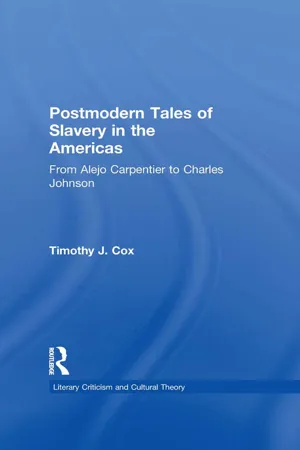
Postmodern Tales of Slavery in the Americas
From Alejo Carpentier to Charles Johnson
- 176 pages
- English
- ePUB (mobile friendly)
- Available on iOS & Android
eBook - ePub
About this book
Unlike 19th century slave narratives, many recent novel-like texts about slavery deploy ironic narrative strategies, innovative structural features, and playful cruelty. This study analyzes the postmodern aesthetics common to seven tales of slavery from the United States, Martinique, and Guadeloupe, Cuba, abd Colombia from authors including Alejo Carpentier, Miguel Barnet, Toni Morrison, and Charles Johnson.
Information
CHAPTER 1
Using American Slavery to Construct Black Aesthetics
The more things change,
the more they stay the same.
A NEW TIME IN THE NEW WORLD
Recent novels of slavery in the Americas affirm contemporary “minority” cultural presence and citizenship, because they relate a repressed past to a problematic present in ways that establish an international African American aesthetic legacy that is intimately related to (fully symbiotic with) those of the dominant European American cultures. Some of the recent slavery novels written in English, French, and Spanish are unlike earlier generations' attempts to construct Black New World or Pan-African identity aesthetics. Earlier generations claimed separate traditions that valorized African physical and cultural features while neglecting their American ones. Attempts to be separate but equal (or separate and superior) were created for scrutiny not by the dominant political (white) gaze but by a self-valorizing black gaze that renounced hybridity as assimilation. The black cultural movements since the Harlem Renaissance and the Pan-African Negritude movement of the 1930s were absolutely necessary to gather together and strengthen “minority” sensibilities in the face of European colonial racism that devalued African American peoples and their cultural forms and aesthetics. However, although these movements were necessary and achieved lasting empowerment for denigrated peoples, they relied on separatist notions that postponed the resolution of the identity conflicts at the heart of what W. E. B. Du Bois called double consciousness.
[T]he Negro is a sort of seventh son, born with a veil, and gifted with second-sight in this American world,—a world which yields him no true self-consciousness, but only lets him see himself through the revelation of the other world. It is a peculiar sensation, this double-consciousness, this sense of always looking at one's self through the eyes of others, of measuring one's soul by the tape of a world that looks on in amused contempt and pity. One ever feels his two-ness,—an American, A Negro; two souls, two thoughts, two unreconciled strivings; two warring ideals in one dark body, whose dogged strength alone keeps it from being torn asunder.The history of the American Negro is the history of this strife—this longing to attain self-conscious manhood, to merge his double self into a better and truer self. In this merging he wishes neither of the old selves to be lost. He would not Africanize America, for America has too much to teach the world and Africa. He would not bleach his Negro soul in a flood of white Americanism, for he knows that Negro blood has a message for the world. He simply wishes to make it possible for a man to be both a Negro and an American […]. (5)1
Writers since the 1960s—and not writers of African descent exclusively but rather what I would call writers of African American sensibility, even outside the Americas—have given rise to a new appreciation of cultural difference based on inter-cultural relation and sharing rather than on separatism (difference as something shared rather than as something unique and separate). The primary domain of difference shared by colonial cultures and transplanted peoples in the Americas is the slavery of Africans and their descendents, and the aftermath of racism and ethnic cultural conflict. Thus slavery and its aftermath have become the subject of a growing number of literary attempts to recover the past and to recover from it, as well as to recover meaning and idenriry in the present. Novels that use slavery time as a territory for inter-cultural understanding have emerged throughout the various American regions. In the 1990s the trend has caught on, leading to abundant novel production. Repetition of this form is redefining the state of knowledge about the Americas' pasts and its peoples—not only those of African descent and sensibility, but everyone of American descent and sensibility. With this new literature and vantage point have come innovative uses of memory, where imagination supplants historical empiricism and mythological idealization as the operant of cultural pathos. The body of recent writings, and the novels in particular, end forever the suspicion of Black aesthetics as predicated upon derivative or pathological responses to whiteness or upon ambivalent identification with blackness or American-ness.
These assertions are supported by collaterally connected simulacra of theory about the formation, mediation and dissemination of a group's being sensible to its group-ness. In the wake of structuralism, barely preceding and for the most part accompanying the new writings on slavery, a new taste in language-oriented theory has developed for the difference embedded between what have long been encoded as separate terms. The interstices between words and what they mean are the domain of the new sharing. The word slavery, for example, long understood as the unlimit-ed power of one person (group) over another, is more recently better understood as limiting the lives of both slave and master. A dominant group locks up not only the other but also itself, restricting the freedom, humanity, and happiness of both slave and master. This is not in any way to say the sufferings of both are equal, but the personal and social costs of such institutions are extremely high for both “sides. “ The most famous early example of this interrelation is Herman Melville's Benito Cereno (1855).
The theories discussed below are relevant to the new novels of slavery beyond the obvious link in “minority” uses of language and of postcolonial issues. The role of improvisational imagination (similar to jazz aesthetics), in reconstructing intercultural collective memory, departs not only from the black literary tradition of representation by autobiography, mimesis, and militance; more than that, the preference for inventio, evidenced throughout the long span of African New World writing, is unapologetically embraced as it explodes constraints on representational modes. Black literary history is the story of increasing freedom of self-expression over and above the limitations, erasures, or silencing imposed by the dominant publishing establishment or self-imposed by an internalized white gaze. The new slavery novels redefine the time and territory of the Americas as wholly shared and nothing less. What in contemporary New World consciousness makes these stories feel true although they are not, strictly historically speaking, true? That stories of people living under slavery—what built and bilked the New World—can be true and not true at the same time warrants critical investigation. And the theorists of post-structuralism, cultural studies, and literary language supply the concepts and methods for such an enterprise. What constitutes the truth of a story may be an inverse function of its author's freedom to imagine and invent “novel” ways to signify—at least, when it is not the author's necessity to come to terms with her or his own philosophical positionality.
The new novels create a time-space in the past for working through questions of the present. In the same gesture they engage the past for creative uses in the implied reader's present. Projection of self across political, linguistic, and generational boundaries activates a discipline of remembrance and ownership of the past. This practice of discursive continuity promotes self-recognition as an equal member of American society, such that who is “in power” becomes subordinate to one's own free agency in one's multiple domains of action. A new model of literary history can be used, one that reckons with the new slavery novelists' philosophical sources as residing in the way they see things—not only fragments but also what separates them; not borders but the in-betweens; the collage, not the disarray. It is a perspective where the authors turn to the slavery experience itself and recover the human values highlighted (not erased) by slavery and its aftermaths of institutionalized racism in the various dominant cultures. In the wasteland of progress we see more distinctly the aftermaths, and multicultural ones at that, of the people who have historically, again and again, picked up their pieces and overcome adversity.
The cultural philosophers discussed in the next section do not let the history of philosophy enslave them; they are not concerned about genealogical lines of descent where some tradition of history or knowledge must be maintained. Rather, they free themselves; they assimilate the past by negating its power to remain a dominant presence in the face of human agency. In a similar way, the new slavery novelists studied here free themselves from the dictates of traditional concepts of history, identity, and knowledge. The imaginative remembrance of the slaves themselves is heartfelt, deeply ethical, and purposeful, if it is also at times fantastic, playful, or closely tied to psychoanalytic theory. These novelists provide an antidote for the disillusionment often resulting from the discouraging record of black history taken merely as a feature within its (presumed) white context, that is, in the context of European American dominance that is clearly the matter of empirical record. The novels reposition the discourse among continuities of black experience and self-questioning.
Because slavery was a shared, multicultural experience, the project of remembering and addressing ambivalence in identities of all Americans along the color spectrum must be no less inclusive if it is to surmount racist predicates. Most opinions would have it that present-day, ongoing identity conflicts are only or primarily the problem of groups classified as minorities and victims; however, such an orientation precludes resolution (or even recognition) of double consciousnesses altogether.2 Until the dominant groups understand and work through whatever notions of exclusivity they reserve for themselves, and come to terms with how slavery and its aftermaths have functioned for centuries in ways that narrow their humanity as well as that of people of color, the reality of salubrious cultural encounter between people of African descent and people of European descent in their various American contexts will not be achieved.
In all likelihood, the theory and literature of mutually affirmative cultural encounters will precede the reality—in Utopian and thesis fictions. At this point a literature of such a positive reality, a literature not of exhaustion or of replenishment but of restitution, is inconceivable. But an intermediary step toward that never-never realm of the happy ending is a literature of remembrance.3 The literature of remembrance brings the forgotten or silenced members of society back to the stage. The forgotten are remembered, and are re-member-ized, or repatriated as citizens of the society, the whole body politic, from which they had become separated.
Toward the multivocal approach, my study includes novels about slavery authored by persons of European descent, if sometimes in collaboration with Afro-Antilleans. I would argue that El reino de este mundo by the Cuban Nobel Prize laureate Alejo Carpentier inaugurates in 1949 a re-orientation toward the perspective and memory of the most common and forgotten of slaves. In Carpentier's novel it is the slave of slaves, product of the Haitian revolution, who signifies on the whole project of constructing black identity in the New World while failing to come to terms with the past. It is this novel that marks the turn toward a particularly constructive aesthetics of African American postmodernism that makes urgent the recuperation of African sensibility in the New World past. We must note here that, paradoxical to his incursion into black territories of time and space, Carpentier does not “trespass” by presuming to write Haitian identity. He keeps his distance by deploying a cruel irony to reveal the absence of history's lessons endemic to Haiti's black national history. To credit Carpentier with being the first to argue for the recovery of the past is not to say that his work influenced the slavery fiction production of the 1960s and beyond. Rather, his is the chief example of the “appositional” approach to comparative Inter-American literary studies as defined by Gustavo Pérez Firmat, which “involves placing works side by side without postulating causal connections ”. (4).4 In my theory of multicultural Inter-American literature, Carpentier is in a way the best evidence I can offer of a “rhizomatic”5 conduit of primary texts, criticism, and literary and cultural theory.
Not obviously related to Carpentier are two other fictional re-creations of the African American past brought to print by white men of African sensibility: the Cuban “novel” Biografia de un cimarrón by Miguel Barnet, which is based on interviews with slavery survivor Esteban Montejo, and the French/francophone Antillean La mulâtresse Solitude by the French Jew André Schwarz-Bart in collaboration with his Guadeloupean wife, Simone Schwarz-Bart. Dislocated as they are from some notions of a pure or exclusive Afro-Antillean tradition, these three novels by Barnet, Carpentier, and the Schwarz-Barts in a way amortize the wrong-headed tradition of separatism defining (defying?) cultural and literary historical studies and understanding.
This multicultural body of primary texts complements the equally multicultural grouping of cultural and literary theorists whose ideas enable an organized discussion of the new slavery novel genre. Taken together, this panoply of voices and ideas suggest how peoples can work together to advance self-knowledge and knowledge of others, the best ends of humanistic studies.
CAN YOU DIG? IDENTITY THROUGH ARCHEOLOGY, RHIZOMES, AND RELATION
Preferring not to locate ideas of history and territoriality among the stars, the early champions of post-structural linguistic theory use wholly earthy and “collective” metaphors to visualize and render the ways marginalized groups—those pulled up and discarded at the edges of established discourse communities, like weeds or stones, in a variety of fields—are claiming their place in the present. In Michel Foucault's ground-breaking re-thinking of the philosophy of history, The Archaeology of Knowledge,6 a series of notions coalesce about the nature of history. This questioning of modern Western assumptions about the nature of knowledge arose in the 1960s out of structuralism and its illusory cohesion. The result for literature was a space for postmodern awareness and, eventually, aesthetics. The main thrust in this orientation is toward the de-centering of certain powerful subjects that would rest upon theretofore a priori philosophical precepts demarcating the usable from the unusable in human experience. Foucault acknowledges the common ground of his work in the 1960s with that of Gilles Deleuze,7 a thinker likewise engaged in the problematics of centering, the falsifying constructs of officialdom, and the verification of differences. Deleuze's ideas germinated with those of Félix Guattari in the same era of intellectual revolution; their use of the metaphor of the rhizome for expressions of difference as explained in their book A Thousand Plateaus,8 complements Foucault's metaphor of archeology for exploring what transpires beneath surface realities re-covered by evolving politics.9 The correspondences between Deleuze and Guattari's essays on rhizomes and their notions of deterritorialization as exigence for “minority” writing, from the essay “What Is a Minor Literature?”,10 complete the theoretical grounding upon which I will discuss selected New World slavery novels that have surfaced in many countries. Deleuze and Guattari define a “minor literature” thus: “A minor literature doesn't come from a minor language; it is rather that which a minority constructs within a major language” (16). They identify three characteristics of a “minor literature”: (1) caused by the deterritorialization of a “minority” group and their symbolic systems, a minor literature effects a similar deterritorialization upon the major language, whereby the symbolic systems are challenged or broken down. (2) Everything in a minor literature is political, with even the personal enunciation expressing the collective minority's displacement through language, time, and space. There is no “outside” the opposition of the other. (3) The individual enunciation necessarily speaks for the collective and “produces active solidarity in spite of skepticism” (17). The more divided the collective may seem to become, the greater its spread and presence—like certain plants classified as rhizomes.
The emergence of difference happens when a diverse, certainly dispersed, ...
Table of contents
- Cover
- Half Title
- Title Page
- Copyright Page
- Table of Contents
- Acknowledgements
- Introduction. New Slavery Novels: Nation-ness and Imagination in the New World Context
- Chapter One. Using American Slavery to Construct Black Aesthetics
- Chapter Two. Dissembling History: Postmodern Irony as Narrative Strategy
- Chapter Three. Re(-)fusing the New World in Accounts of the Middle Passage
- Chapter Four. Oscillatory Structures, Running Away, and (Dis)Locating the Self
- Conclusion. Problematics of the Questioning of Identity
- Works Cited
- Index
Trusted by 375,005 students
Access to over 1.5 million titles for a fair monthly price.
Study more efficiently using our study tools.
Frequently asked questions
Yes, you can cancel anytime from the Subscription tab in your account settings on the Perlego website. Your subscription will stay active until the end of your current billing period. Learn how to cancel your subscription
No, books cannot be downloaded as external files, such as PDFs, for use outside of Perlego. However, you can download books within the Perlego app for offline reading on mobile or tablet. Learn how to download books offline
Perlego offers two plans: Essential and Complete
- Essential is ideal for learners and professionals who enjoy exploring a wide range of subjects. Access the Essential Library with 800,000+ trusted titles and best-sellers across business, personal growth, and the humanities. Includes unlimited reading time and Standard Read Aloud voice.
- Complete: Perfect for advanced learners and researchers needing full, unrestricted access. Unlock 1.5M+ books across hundreds of subjects, including academic and specialized titles. The Complete Plan also includes advanced features like Premium Read Aloud and Research Assistant.
We are an online textbook subscription service, where you can get access to an entire online library for less than the price of a single book per month. With over 1.5 million books across 990+ topics, we’ve got you covered! Learn about our mission
Look out for the read-aloud symbol on your next book to see if you can listen to it. The read-aloud tool reads text aloud for you, highlighting the text as it is being read. You can pause it, speed it up and slow it down. Learn more about Read Aloud
Yes! You can use the Perlego app on both iOS and Android devices to read anytime, anywhere — even offline. Perfect for commutes or when you’re on the go.
Please note we cannot support devices running on iOS 13 and Android 7 or earlier. Learn more about using the app
Please note we cannot support devices running on iOS 13 and Android 7 or earlier. Learn more about using the app
Yes, you can access Postmodern Tales of Slavery in the Americas by Timothy J. Cox in PDF and/or ePUB format, as well as other popular books in Literatura & Crítica literaria. We have over 1.5 million books available in our catalogue for you to explore.