In the general area of style study or stylistics there is no shortage of ideas, definitions or published works. It is hoped, in the present volume, to contribute to the prosperity of the discipline mainly by clarifying and exemplifying how pragmatic considerations may be relevant to any study of style, in the conviction that pragmastylistics is more interesting and useful than stylistics on its own. The starting point must be a brief survey of the definitions and style and stylistics. The very form of the latter term suggests a scientific and orderly, rather than an intuitive or impressionistic, investigation of style. There are two separate levels of study: one, a general, methodical and scientific discipline; the other, an application of its methods or postulates to the analysis of the 'style' of a specific utterance, text, speaker, writer, movement or period. It is clear that, in order to approach either, we must first attempt to understand style.
- 216 pages
- English
- ePUB (mobile friendly)
- Available on iOS & Android
eBook - ePub
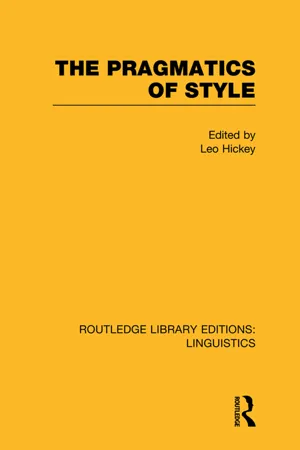
The Pragmatics of Style
About this book
Trusted by 375,005 students
Access to over 1.5 million titles for a fair monthly price.
Study more efficiently using our study tools.
Information
Section II
Style in Speech and Situation
Essentially concerned with the study of all types of communication through language, pragmatists pay more attention in practice to spoken than to written forms. Indeed, conversational analysis has developed as a sub-discipline in its own right, with much cross-referencing between general pragmatic principles and models of interpersonal language-use in particular. As in all pragmatic studies, the objective is usually to provide an explanation of the devices or strategies used by interlocutors to organize, structure and develop their discoursal relationship so as to achieve the ends they have in mind. Whatever else they may be, styles in conversation are the result of choices made on the subject of such devices and they frequently manifest features not found in written texts. In a special way, therefore, speakers’ choices are directly determined by what they are trying to do, and their style, in turn, is their way of doing it.
The chapters which comprise this section select four aspects of spoken language for detailed scrutiny. These are certain devices which show that particular referents are of special importance to a speaker, ways in which speakers express their attitudes to the truth or falsehood of what they say, means by which speech style is negotiated or interactively achieved by interlocutors and strategies used to negotiate power relationships in the course of an oral exchange.
Whereas the last chapter in Section I dealt with topicalization based on a written corpus (including dialogue in fiction), the phenomenon examined by Flora Klein-Andreu is found exclusively in spoken Spanish and indeed it might be regarded as a specifically oral version of topicalization. Her study is very much concerned with oral communication in practice and the feature discussed, the X-form, is essentially an informal style marker. The author suggests, however, that it is a way of expressing that the referent is important to the speaker for any number of reasons and not merely because the discourse is ‘about’ it, as would be central to most definitions of topic.
Carmen Silva-Corvalán discusses certain features which express speakers’ attitudes to the possibility that the content of their propositions may or may not be true. Such features determine what she calls ‘hypothetical discourse’, and this may vary along a scale of assertiveness. The choice of language, resulting in style, is conditioned by pragmatic considerations, including the degree of the speakers’ assertiveness, the effect they intend to produce and the formality of the situation. To the extent to which speakers select from the options open to them prompted by such factors, ‘style necessarily becomes a question of pragmatics’, the author concludes.
Also studying conversational speech styles, Margret Selting shows how the shifting and switching of such styles is not determined by extralinguistic or contextual factors, but by ‘dynamic interactively-achieved ways of speaking by which participants signal and achieve the constitution of global and local dynamic conversational contexts interactively’. Using a German corpus, she shows how style in speech is the result of a developing partnership between the interlocutors as they go along, rather than something fixed a priori by their situation or anything else.
A very similar point is discussed by Jenny A. Thomas, who focuses in particular on devices used in conversation to affirm, negotiate or control power relations; she is interested in ‘interpersonal pragmatics’ with the objective of moving ‘towards a more predictive and explanatory model of discourse organization’. Her examples are taken from ‘unequal encounters’, in the sense of conversations between superiors and subordinates, and her findings are similar to Margret Selting’s, namely that style is not settled before the interaction commences but is established as the exchange proceeds.
Chapter four
Speech priorities
Introduction
I should like to take this occasion to continue examining structures that occur in conversational Spanish, but not, it seems, in the written language or in the more formal spoken registers, under the assumption that the characteristics of these oral forms are due to the speech situation itself. My discussion is based on speech recorded in Spain, and specifically on consideration of a particular kind of construction that I have studied in detail: the constructions I call ‘X-forms’ (Klein-Andreu, 1989)
1. The Spanish ‘X-forms’
Consider the following examples:
(1) Y yo me entró una tos que me ahogaba.
(2) Tú te gusto ‘Upstairs Downstairs’?
(3) El águila real, la pieza favorita es la liebre.
What these utterances have in common is that each begins by mentioning a referent that is closely related semantically to the reference of a neighbouring utterance, but without the expected morphosyntactic indication of the nature of the relationship. Thus, in (1) and (2) we find the free (or subject) pronouns yo ‘I’ and tú ‘you (subj.)’, where the actual role of the referents would call for the prepositional forms a mí and a tí, respectively, as in (lb) and (2b) below. Similarly, in (3) we find el águila real ‘the royal eagle’ preceding la pieza favorita ‘the favourite prey’, with no specification of the relationship between the two, where we would expect to find la pieza favorita in initial position, as ‘head’, modified by the prepositional del águila real ‘of the royal eagle’, as in (3b).
(1b) | Y a mí me entró una tos que me ahogaba. |
(2b) | A tí te gusto ‘Upstairs Downstairs’? |
(3b) | La pieza favorita del aguila real es la liebre. |
Thus, examples (1), (2), and (3) are ‘ungrammatical’ in that they counter the expectations set up by grammatical prescription. Yet, though such constructions seem relatively common in ordinary speech, at all educational levels, prescriptive grammars do not actually mention them at all, even to condemn them. From this I conclude that they must not be common in writing or in the more formal or ‘planned’ registers of speech. For this reason, too, they have no traditional designation, so that I refer to them as ‘X-forms’.
2. The problem and present approach
The questions to be asked, then, are why do such forms occur, and why do they occur precisely where they do – in ordinary conversation rather than in writing or in more formal oral registers. A common reaction is, of course, that such forms are simply errors, due to the time-pressure under which speech is produced. It seems to me, however, that this begs the question of just what is meant by an ‘error’ in the first place. Put differently, it is hard to imagine how we can ever hope to understand the characteristics of spoken language (or of any phenomenon, for that matter) if we start out by discarding examples of it from the outset, as ‘erroneous’. I therefore take the position that one must instead start by investigating whether the phenomena in question exhibit any systematic characteristics at all, that might help to explain their occurrence and especially their occurrence in particular contexts rather than in others.
Of course, the kinds of systematic characteristics one looks for will depend on one’s view of language. Thus, if one regards language as essentially an instrument of communication – the point of view that seems reasonable to me, though obviously not the only one possible – systematicity will be sought in the relation between overt form(s) and the kinds of communications with which they are associated, both at the local (syntactic/semantic) and at the larger (discourse-pragmatic) levels.
Accordingly, the next section summarizes some of the characteristics of the X-form’s reference and discourse-function that I have found to be systematic, as discussed in earlier work (Klein-Andreu, 1989). We then go on to examine the relation between these findings and one of the concepts most often employed in work on discourse: the concept of topicalization. Based on examples of X-forms in their actual context, we consider whether and to what extent this concept is an analytically useful characterization of these forms. Finally, we attempt to determine just what functional characteristics seem to be shared by all X-forms, and how they relate to the kind of situation in which X-forms occur – namely, ordinary conversation.
3. X-forms’ reference
Examination of X-forms’ reference shows that their occurrence is not random, but rather seems to depend on the X-form’s referent and its relation to the discourse in which it occurs. First, various statistical measures indicate that referents of X-forms typically are ‘topic-worthy’. Thus, in comparison with an equal number of grammatical subjects of randomly chosen utterances without X-forms, produced by the same speakers, we find that the X-forms are more likely than the subjects to have definite and animate referents, and even to refer to the interlocutors themselves or members of their immediate family. Further, the most usual operational measure of a referent’s actual topicality...
Table of contents
- Cover Page
- Half Title page
- Title Page
- Copyright Page
- Original Title Page
- Original Copyright Page
- Contents
- Introduction
- Section I Style in Communication and Comprehension
- Section II Style in Speech and Situation
- Section III Style in Literature and Learning
Frequently asked questions
Yes, you can cancel anytime from the Subscription tab in your account settings on the Perlego website. Your subscription will stay active until the end of your current billing period. Learn how to cancel your subscription
No, books cannot be downloaded as external files, such as PDFs, for use outside of Perlego. However, you can download books within the Perlego app for offline reading on mobile or tablet. Learn how to download books offline
Perlego offers two plans: Essential and Complete
- Essential is ideal for learners and professionals who enjoy exploring a wide range of subjects. Access the Essential Library with 800,000+ trusted titles and best-sellers across business, personal growth, and the humanities. Includes unlimited reading time and Standard Read Aloud voice.
- Complete: Perfect for advanced learners and researchers needing full, unrestricted access. Unlock 1.5M+ books across hundreds of subjects, including academic and specialized titles. The Complete Plan also includes advanced features like Premium Read Aloud and Research Assistant.
We are an online textbook subscription service, where you can get access to an entire online library for less than the price of a single book per month. With over 1.5 million books across 990+ topics, we’ve got you covered! Learn about our mission
Look out for the read-aloud symbol on your next book to see if you can listen to it. The read-aloud tool reads text aloud for you, highlighting the text as it is being read. You can pause it, speed it up and slow it down. Learn more about Read Aloud
Yes! You can use the Perlego app on both iOS and Android devices to read anytime, anywhere — even offline. Perfect for commutes or when you’re on the go.
Please note we cannot support devices running on iOS 13 and Android 7 or earlier. Learn more about using the app
Please note we cannot support devices running on iOS 13 and Android 7 or earlier. Learn more about using the app
Yes, you can access The Pragmatics of Style by Leo Hickey in PDF and/or ePUB format, as well as other popular books in Languages & Linguistics & Linguistics. We have over 1.5 million books available in our catalogue for you to explore.