This book studies the syntax of switch-reference and its implications for the theory of grammar. Switch-reference, found in many genetically and geographically diverse languages, is a phenomenon whereby referential identity between subjects of hierarchically adjacent clauses is encoded by the presence of a morpheme, usually suffixed to the verb of the subordinate clause. This book argues that switch-reference should be analysed as a syntactic rather than a purely pragmatic or functional feature of language.
Trusted by 375,005 students
Access to over 1 million titles for a fair monthly price.
In Chapter II we argued that cases of core switch-reference fall under the Binding Theory once certain assumptions are made. To briefly recapitulate, the assumptions which played a crucial role were:
(1) a. SS and DS are generated in COMP and form a discontinuous constituent with AGR, and are coindexed with [NP, S] of the sister S.
b. SS is an A’-anaphor
c. DS is an A’-pronominal
(1) will remain active throughout this chapter, but the data discussed in the first section will call for a revision of current methods of indicating and interpreting referential relations among NP’s. This revision, besides accounting for the new SR patterns, will enable us to straightforwardly provide a characterization of certain constructions that pose problems for current Government and Finding Theory (cf. Lasnik 1980). The empirical coverage of this latter proposal is then extended to include the semantic interpretation of reciprocal anaphors.
Additional Switch-Reference Data with Inclusive Reference
While the SR patterns discussed in Chapter III were basically identical across the languages considered, there is some language-particular variation where a relation of inclusive reference obtains between the subject of a switch-reference clause and the subject of the clause immediately superordinate to it. Thus, in Washo, we find patterns like those in (2), where the interpretation of the singular subject NP is such that it is properly included in the denotaton of the plural NP. Jacobsen notes “a change between singular and plural subjects, when the singular referent is included in those referred to by the plural, is ordinarily not signalled as a switch” (1967:244).1
men two are-there-(SS) / one man is-standing-DS / one is-crouching
In (2a), the woman who was digging is a member of the group tht landed, and even though the interpretation of the two subject NP’s is not strictly identical, no change of subjects is indicated by DS. Similarly in (2b), ‘two men’ and ‘one man’ are not coreferential, but SS is used to mediate between the first two clauses. The stander and the stooper of the second two clauses are not identical, and even though they are members of the same group, one is not included in the other, so DS marking appears. The generalization here in Washo appears to be that DS is present only when the subjects of two hierarchically adjacent clauses are disjoint in reference (refer to sets that have no members in common).
In Seri, however, inclusive reference between subjects does require the presence of DS. Moser (1978) gives the following examples.
(3) a. ko m-p-askin ta-X / Xaa ?aa ?a-sii-Skam-a?a
3rd 2sj-dFUT-paddle DS-cond / soon there lsj-pl-FUT-arrive-pl-TM
‘If you paddle with it, soon we’ll arrive there’
b. Feliipe k? i-?aX ano ?-p-iix ta / ta?aWkW kix ko nt?-a-ss-aat-a?a
Feliipe def 3-side in 1sj-dFUT-sit DS / Tiburon forward-1sj-pl-FUT-move-pl-TM
‘When I am in Felipe’s boat, we’ll go to Tiburon’
And Weber (1980) cites data from Huallaga Quechua which patterns like that of Seri.
(4) a. Chaya-pti-nchi / goyku-shaq
arrive-DS-1+2 / give-1FUT
‘When we (incl) arrive, I will give it to him’
b. Qam-ta apari-pti-:-pis / manam chaya-shun-chu
you-acc carry-DS-1pl-even / not arrive-1+2FUT-NEG
‘Even if I carry you, we (incl) will not arrive’
These Seri and Quechua facts contrast sharply with the Washo data in (2). Where disjoint reference conditions DS in Washo, simple non-coreference conditions DS in Seri and Quechua. The respective contrapositives hold as well: strict coreference and inclusive reference induce SS in Washo, but only strict coreference induces SS in Seri and Quechua.
Data like that from Seri and Quechua pose no problem to the analysis outlined in Chapter II; we may assume that coindexed NP’s are interpreted as coreferential and contraindexed NP’s as noncoreferential. The Washo case, however, is a challege to the analysis. As proposed above in Chapter II, SS is an A’-anaphor, and as such it must be bound in its governing category. This requires that the Washo examples in (2) have the representation in (5).
(5) [[NP[+pl]i VP AGRi SSi] NP[-pl]i VP AGRi]]
But clearly, the two subjects cannot be coindexed, assuming that coindexation is interpreted as coreference --- in neither case can the top subject in the examples in (2) be coreferential with the bottom subject. The denotation of one can certainly be properly included in the denotation of the other in the above examples, but strict coreference between ‘they’ and ‘she’, or ‘two men’ and ‘one man’ is simply out of the question.
The situation appears to be more complex in Mojave, where it looks as though DS and SS are in free variation in in cases of inclusive reference. Munro (1980) gives the following examples:
(6) a. ‘ava-th ‘-ivaa-k / mat ‘-kuunav-m
house-dem 1-arrive-SS / recip 1-talk-tns
b. ‘ava-th ‘ivaa-m / mat ‘-kuunav-m
house-dem 1-arrive-DS / recip 1-talk-tns
‘I came to the house, and then we talked (together)’
These data seem to call for either of two approaches: (i) parameterization of the interpretation of coindexed NP’s, or (ii) the proposal of a different method of indexing such that relations of inclusive reference can be encoded at S–structure or Logical Form.
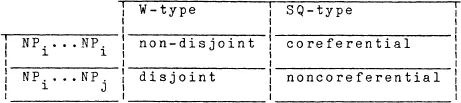
The first approach would involve a proposal something like the following. Reconsider the indexed structure above in (5). Although there is a prima facie violation of the natural interpretation of coindexation here (coreference), we might propose that coindexing in a Washo-type language can be interpreted as inclusive reference as well as strict coreference, and thus the A’-anaphor SS can be bound. In Seri or Quechua, however, the facts indicate that coindexation is interpreted as strict coreference. This being the case, the two subject NP’s must not bear the same index in the structures corresponding to (5) in Seri and Quechua, and therefore DS is required. The breakdown of index interpretation in these two classes of language-types may be represented as in (7).
(7)
What this alternative essentially amounts to is that there is a parameterization of index interpretation available in Universal Grammar such that coindexed NP’s may be interpreted as either coreferential or inclusive, and contraindexed NP’s may be interpreted as either disjoint or noncoreferential. Presumably these two choices would be linked. That is, there should be no grammar of a language where coindexed NP’s are interpreted as coreferential and contra-indexed NP’s are interpreted as disjoint. If there were, then there would be an irresolvable conflict between the interpretation of indexed NP’s and the lexical meaning of morphemes corresponding to I and we (see the next section for further discussion).
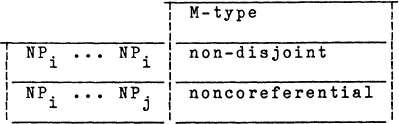
The other pair of choices, however, would go some way toward accounting for the Mojave facts. This UG option would take coindexed NP’s as non-disjoint and contraindexed NP’s as noncoreferential, and Mojave, recall, appears to allow either DS or SS to appear in a case of inclusive reference. Since the referential relation between ‘I’ and ‘we’ is both non-disjoint and noncoreferential, either coindexing or contraindexing accords with the interpretation of the subjects of (6), so either SS or DS would be free to appear. Thus another column can be added to the chart in (7).
(8)
As attractive as this alternative may be, there is some empirical evidence which weighs against it. The data presented thus far in this section display three patterns where inclusive reference between subjects is involved: SS marking (Washo), DS marking (Seri and Quechua) and either SS or DS marking (Moja...
Table of contents
Cover
Half Title
Title Page
Copyright Page
Table of Contents
ACKNOWLEDGEMENTS
ABSTRACT
I. INTRODUCTORY REMARKS
II. THE SYNTACTIC NATURE OF SWITCH-REFERENCE
III. INCLUSIVE REFERENCE AND SWITCH-REFERENCE
IV. ANTICIPATORY SUBJECTS
V. RELATED AND RESIDUAL TOPICS
BIBLIOGRAPHY
Frequently asked questions
Yes, you can cancel anytime from the Subscription tab in your account settings on the Perlego website. Your subscription will stay active until the end of your current billing period. Learn how to cancel your subscription
No, books cannot be downloaded as external files, such as PDFs, for use outside of Perlego. However, you can download books within the Perlego app for offline reading on mobile or tablet. Learn how to download books offline
Perlego offers two plans: Essential and Complete
Essential is ideal for learners and professionals who enjoy exploring a wide range of subjects. Access the Essential Library with 800,000+ trusted titles and best-sellers across business, personal growth, and the humanities. Includes unlimited reading time and Standard Read Aloud voice.
Complete: Perfect for advanced learners and researchers needing full, unrestricted access. Unlock 1.4M+ books across hundreds of subjects, including academic and specialized titles. The Complete Plan also includes advanced features like Premium Read Aloud and Research Assistant.
Both plans are available with monthly, semester, or annual billing cycles.
We are an online textbook subscription service, where you can get access to an entire online library for less than the price of a single book per month. With over 1 million books across 990+ topics, we’ve got you covered! Learn about our mission
Look out for the read-aloud symbol on your next book to see if you can listen to it. The read-aloud tool reads text aloud for you, highlighting the text as it is being read. You can pause it, speed it up and slow it down. Learn more about Read Aloud
Yes! You can use the Perlego app on both iOS and Android devices to read anytime, anywhere — even offline. Perfect for commutes or when you’re on the go. Please note we cannot support devices running on iOS 13 and Android 7 or earlier. Learn more about using the app
Yes, you can access The Formal Grammar of Switch-Reference by Daniel L Finer in PDF and/or ePUB format, as well as other popular books in Languages & Linguistics & Linguistics. We have over one million books available in our catalogue for you to explore.