- 328 pages
- English
- ePUB (mobile friendly)
- Available on iOS & Android
eBook - ePub
About this book
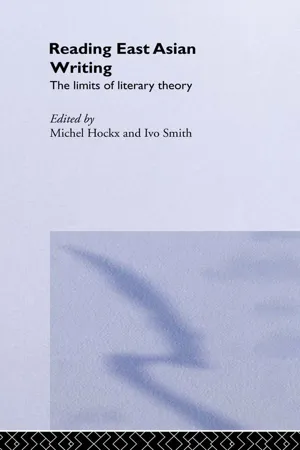
This book presents contributions by thirteen scholars of Chinese and Japanese literature whose work is characterised by a strong interest in literary theory. They focus in particular on the various new theories that have emerged during the past two decades, uprooting traditional forms of understanding literary texts, their function, their readership and their interpretation. Often confined to discussion of a specific country or area, these theories have been criticised for their Western bias.
This collection breaks through these barriers, providing an opportunity for scholars of two closely related yet often independently studied cultures to present and compare their views on specific theories of literature, to discuss the advantages and shortcomings of those theories, and to consider specific difficulties related to the East-West dimension.
Information
CHAPTER 1
FATEFUL ATTACHMENTS: ON COLLECTING, FIDELITY, AND LAO SHE
REY CHOW
Collectors are among the most suggestive characters in literary histories East and West.1 What is intriguing about them is often not only what they collect but also the paradoxical movement, inscribed in their collecting behaviour, from the frivolous to the serious, from the casual pleasures of accumulating nonessential objects to the most perverse kinds of addiction. In this movement lies a type of personality disorder that can be aesthetically fascinating. But aesthetic observations alone have far from exhausted the interpretative possibilities of the collector’s obsession; other libidinal ramifications, albeit less frequently observed and explored, lurk behind what seems at first to be a matter of pure eccentric individualism. This is especially the case if a collector is faced not only with his/her collected objects but simultaneously with the forces of socialization, such as the moral imperative of self-sacrifice vis-à-vis a collective. At the juncture between the love for the inanimate as such and the demands of group identity, what might the act of collecting signify? What might an intimacy with inanimate objects do to one’s sense of communal belonging, of being part of, say, a national community?
These questions are unveiled by the remarkable, little-known short story ‘Lian’ (‘Attachment’) by the modern Chinese author Lao She (1943:37–43; 1944:110–21; 1999:211–25), the pen name of Shu Qingchun or Shu Sheyu (1899–1966). In the discussion to follow, I shall suggest that inscribed in this narrative of an ordinary man’s idiosyncratic obsession with collectibles is nothing less than an alternative way of thinking about what we nowadays call identity politics. Accordingly, the far-reaching implications concerning social identity and identification are illuminated not so much through the well-worn light of human subjectivity as through the obscure allure of material objects, an allure which in turn tells us something about the passion with which such objects have characteristically been condemned in modern theory.
Often characterized as a humorous realist novelist, Lao She is, among modern Chinese writers, second perhaps only to Lu Xun in international renown, with works translated into some twenty languages other than Chinese.2 Lao She had a prolific writing career, which spanned over four decades from the 1920s (when he was a lecturer in Chinese at what was then known as the School of Oriental Studies, University of London) to the 1960s, and which included numerous novels, short story collections, essays, plays, and poems.3 In the West, he is best known for his novel Luotuo xiangzi (Rickshaw, 1936–7), which features a lower-class labourer, a rickshaw puller. It is notable that Lao She was the author who produced the first significant proletarian novel in China even as the Chinese Communist Party was gathering momentum and beginning to make propagandist declarations about writing for the people.4 In ‘Attachment’ we find a very different kind of story, one that returns us, by an alternative route, to the entire problematic of collective purpose and struggle in a modern political state.
First published in 1943 during China’s War of Resistance against Japan, this story tells of the events that take place in the life of an unremarkable art collector, Zhuang Yiya. Lao She begins by observing that there are two kinds of collectors. The first are those who collect as a distraction. Typically, these collectors ‘have some learning which enables them to make an honest living’ and who, ‘whenever they have spare money … will spend it on things which delight their hearts and enhance their sense of refinement.’ The second kind of collector is very different: ‘They collect, but they also peddle. They appear to be refined, but at core they are no different from merchants.’ These other collectors’ collecting ‘is equivalent to hoarding’ (Lao She 1999:211–12).
Among theorists of modernity, Walter Benjamin’s account of the book collector serves as a relevant intertext here because of its unabashed acknowledgement of the importance, in collecting, of ownership. For Benjamin’s book collector, to acquire an old book is to give it rebirth, and collecting is thus part of an endeavour to renew the world by tearing things out of their original contexts and inserting them in the novel one of the collection. Ownership, Benjamin writes, ‘is the most intimate relationship that one can have to objects. Not that they come alive in him [the collector]; it is he who lives in them’ (Benjamin 1969:67).5 Approaching his topic at the historically transitional period from high bourgeois European society to the mass culture world of global modernity, Benjamin sees in collecting an intellectual practice that allows one to remain in touch with the past. What are being assembled through collecting are not just the things themselves but also memories: ‘Every passion borders on the chaotic, but the collector’s passion borders on the chaos of memories’ (60). Together, the twin obsessions with ownership and with memory suggest that collecting carries with it a desire for possessing history, even if such a possession can only come in fragmented, incomplete forms. At the same time, because of the often accidental nature of the encounter with objects – one can never be sure what might come one’s way, when and where – the nostalgia for owning the past that is embedded in collecting is, arguably, inseparable from a Utopian sense of anticipation, of looking forward to a future that is not yet entirely known.
Benjamin’s stance on collecting is thought-provoking because it offers a significant shift from the stern critique of commodity fetishism that has, since Marx’s Capital, been a predominant way of viewing material things in late capitalist culture. In his famous analysis, Marx points out that commodities are artificial objects that hide the human labour that has gone into their making. To underscore his point that such commodities are false representations of the real relations of production, Marx mobilizes a series of terms – such as ‘mist-enveloped’, ‘secret’, ‘disguised’, ‘hidden’, ‘absurd’ – that foreground the fabulous, beguiling nature of their appeal. ‘The whole mystery of commodities, all the magic and necromancy that surrounds the products of labour as long as they take the form of commodities’, he writes, ‘vanishes ... so soon as we come to other forms of production’ (Marx 1906:1:7). Despite the ambiguities that may be detected in Marx’s memorable portrayal, this portrayal is also what has given rise to a prevalent modernist intellectual tendency to regard things as superficial and morally suspect phenomena. Writing in the 1920s, Georg Lukacs, for instance, would extend the implications of Marx’s argument for his own theory of the reification of human consciousness in capitalist society. For Lukacs, the thing-dominated relation between man and the world is what gives rise to ideology, an inverted, distorted understanding of history that could only be corrected through the proletarian revolution (Lukács 1971). Roland Barthes, on his part, would attempt, in the 1950s, to rewrite the classic critique of ‘false consciousness’ by way of the tools of semiology, so that reification – which Barthes at that time identified with petty-bourgeois French mass culture, from the advertisements of soap powders and detergents, to ornamental cooking, to toys and plastic – could be dissected through a ‘scientific’ analysis of staggering sign systems working in collaboration with one another (Barthes 1973). The novelty and fashionableness of his analysis (at the time he wrote) notwithstanding, Barthes was by and large still participating in the Marxist tradition of a deep distrust of the objects that saturate the commercial cultural environment of the industrialized modern world.
In view of this persistent sense of misgiving about things even within bourgeois Western society, it is not surprising that things were also among the evils that had to be purged in a self-consciously revolutionary political state such as Communist China. Among the popular representations of the traumatic happenings of the Cultural Revolution of the 1960s, for instance, is the burning of books and artefacts, the shameful reminders of bygone eras of ideological corruption. Such burning was characteristic of the ‘class struggle’ that was officially launched against both China’s feudalist tradition and Western imperialism. As such, the destruction of ‘bad’ things became Communist China’s way of honouring, in a literal manner, the critical revolutionary tradition of thing phobia that arguably began with Marx. Ironically, in the retrospective assessments of the Cultural Revolution, scholars and writers have tended overwhelmingly to interpret such destruction of things as part of a larger violence against humanity – when strictly speaking, such destruction was entirely genealogically consistent with the Marxist critique of dehumanization as made manifest in the processes of reification and commodification. In the midst of this theoretical confusion dominated by humanism (What is human and what is inhuman – preserving things or destroying them?), an interesting question is elided: If these remnants of the past are indeed so despicable, why not simply confiscate and dispose of them in secret? Why the visual, almost celebratory, public display of the act of destruction?
One possible answer, of course, is ‘so as to teach everyone a lesson’. This displacement on to an altruistic, collective purpose is perhaps the most readily available – and ‘respectable’ – antidote to any fascination with things in themselves, a fascination which is usually considered a symptom of selfishness. One reason Benjamin’s work is so powerful, it follows, is that he manages to turn this entrenched discursive stereotyping of love-of-things-as-selfishness around, by arguing that collecting, however private and selfish it may seem, can also be understood as a kind of historical materialist practice.6 He thus makes it possible to lavish attention on the ‘mist-enveloped’ objects of bourgeois modernity while also holding on to Marx’s emphasis on a critique of history. Indeed, by combining that emphasis with a sympathetic reading of the inorganic, Benjamin astutely paves the way for a drastically different type of theoretical attitude toward the universe of objects. At the same time, his modes of inquiry, because they stem concretely from a historical materialism that specializes in the cultural sediments of late capitalist bourgeois Europe, do not necessarily provide answers for every kind of question that arises with the act of collecting and its existential implications – especially when such questions pertain to a non-Western culture in the throes of collective endeavours such as modernization and nationalist revolution. To return to the example of China, what kind of historical lesson is being taught in the Cultural Revolution practice of setting piles of things on fire, and for what purpose? In the demonstrative spectacle of burning that is supposed to teach everyone a lesson, there seems to be something that exceeds the explicit rationale of the attributed pedagogical function and, for that matter, any attempt to redefine it within a strictly historical materialist framework. It is in this light – that is, the possible theoretical insufficiency of even the most sympathetic historical materialist reader of things, such as Benjamin – that the work of a writer such as Lao She may, I believe, serve as a provocative alternative approach to the love of things in modern times.
In Lao She’s protagonist Zhuang Yiya we see a good example of the Benjaminian passion for owning bits and pieces of history. History here appears in the form of ‘culture’ – the ‘cherished collectibles’ that, supposedly, enhance people’s sense of their own refinement. Remarkably, Lao She depicts changing attitudes toward history by way of the changing attitudes toward collecting, and thereby incidentally introduces the issue of class understood in cultural rather than economic terms.7 The first kind of collector, his story tells us, includes those who may be described as members of the new middle class in early twentieth-century urban China: ‘In terms of profession, these people are perhaps government employees, or perhaps middle school teachers. Sometimes we also find lawyers or doctors’ (Lao She 1999:211). But in terms of the enjoyment of leisure, these people are members of an older society in which ‘culture’ still means something pleasurable, something to be enjoyed or possessed for itself. Their behaviour toward objects, the scraps and ruins of bygone years, contains an indulgent, lingering quality that is fast becoming out of step with their times. By contrast, the second kind of collector is merely opportunistic; though these collectors may appear to be refined, they are not collecting for the sake of the pleasure given by the objects but rather in order to make money. Accumulating the bits and pieces of the past is for them simply a means to an end, the end of generating capital. To this extent, they belong to a newer order of society, a newer class whose ties with the past are strictly through the external relation of trade and exchange. Apart from its commodified forms, which offer themselves to be raided, these people have little or no use for history, which they suppose can be readily discarded in their march toward the future.
Its brevity notwithstanding, ‘Attachment’ is carefully organized into three distinct narrative segments, each bearing a progressively different significance. The first of these segments concentrates on establishing Zhuang as a character with his special attachment. A member of the Jinan gentry, Zhuang is a college graduate, and has worked as an administrator and as a middle school teacher. He began collecting by buying numerous inexpensive items, on which he bestows a rapt, ritualistic attention. Under his gaze, these items become personified with human features, yet at the same time he has to subject them to an impersonal, methodical process of sorting and classifying before they can be safely put away:
He will take home a couple of such eighty-cent treasures, full of insect holes, smudgy, smeared, and crinkled up like an old woman’s face. Only at night, after locking the door to his room, will he savor and enjoy his modest purchases, handling them over and over again. After numbering them, he will carefully press his seal on them, then put them in a large cedar chest. This bit of exertion will send him to bed, happily weary and satisfied. Even his world of dreams will be quaintly ancient. (213)
As time goes by, Zhuang acquires the reputation – given in jest and with sarcasm by fellow collectors and shop owners – of being a ‘connoisseur of Shandong’s minor artists’ (215). Although he would like to earn more in order to buy better pieces of calligraphy and painting, Zhuang never considers using his collection to make money: ‘selling his calligraphy and paintings to make some money is something he will not do. For better or for worse, this is his collection, and it will follow him to his grave. He will never sell it. He is not a merchant’ (216, translators’ emphasis).
The second segment of the narrative begins as Zhuang turns forty. It is 1937, the year in which China was invaded by the Japanese. By this time, Zhuang has fully internalized the idea that he is an expert; he understands the rituals that accompany the activity of collecting and wants to leave a name: ‘He has made no contribution to the world, but becomi...
Table of contents
- Cover
- Half Title
- Title Page
- Copyright Page
- Table of Contents
- Acknowledgements
- Notes on Contributors
- Introduction
- 1 Fateful Attachments: On Collecting, Fidelity, and Lao She
- 2 Canon Formation in Japan: Genre, Gender, Popular Culture, and Nationalism
- 3 Là, tout n'est qu'ordre et beauté: The Surprises of Applied Structuralism
- 4 Kristevan (Mis)understandings: Writing in the Feminine
- 5 The Heian Literary System: A Tentative Model
- 6 Did the Master Instruct his Followers to Attack Heretics? A Note on Readings of Lunyu 2.1
- 7 The Power of Words: Forging Fujiwara no Teika's Poetic Theory. A Philological Approach to Japanese Poetics
- 8 What the Messenger of Souls Has to Say: New Historicism and the Poetics of Chinese Culture
- 9 Places of Mediation: Poets and Salons in Medieval Japan
- 10 Theory as Practice: Modern Chinese Literature and Bourdieu
- 11 Making Space: Kunikida Doppo and the 'Native Place' Ideal in Meiji Literature
- 12 Re/reading 'Modern Japanese Literature' as a Critical Project: The Case of Dazai Osamu's Autobiographical Novel Tsugaru
- 13 Digital Wen: On the Digitization of Letter- and Character-based Systems of Inscription
- Index
Trusted by 375,005 students
Access to over 1.5 million titles for a fair monthly price.
Study more efficiently using our study tools.
Frequently asked questions
Yes, you can cancel anytime from the Subscription tab in your account settings on the Perlego website. Your subscription will stay active until the end of your current billing period. Learn how to cancel your subscription
No, books cannot be downloaded as external files, such as PDFs, for use outside of Perlego. However, you can download books within the Perlego app for offline reading on mobile or tablet. Learn how to download books offline
Perlego offers two plans: Essential and Complete
- Essential is ideal for learners and professionals who enjoy exploring a wide range of subjects. Access the Essential Library with 800,000+ trusted titles and best-sellers across business, personal growth, and the humanities. Includes unlimited reading time and Standard Read Aloud voice.
- Complete: Perfect for advanced learners and researchers needing full, unrestricted access. Unlock 1.5M+ books across hundreds of subjects, including academic and specialized titles. The Complete Plan also includes advanced features like Premium Read Aloud and Research Assistant.
We are an online textbook subscription service, where you can get access to an entire online library for less than the price of a single book per month. With over 1.5 million books across 990+ topics, we’ve got you covered! Learn about our mission
Look out for the read-aloud symbol on your next book to see if you can listen to it. The read-aloud tool reads text aloud for you, highlighting the text as it is being read. You can pause it, speed it up and slow it down. Learn more about Read Aloud
Yes! You can use the Perlego app on both iOS and Android devices to read anytime, anywhere — even offline. Perfect for commutes or when you’re on the go.
Please note we cannot support devices running on iOS 13 and Android 7 or earlier. Learn more about using the app
Please note we cannot support devices running on iOS 13 and Android 7 or earlier. Learn more about using the app
Yes, you can access Reading East Asian Writing by Michel Hockx,Ivo Smits in PDF and/or ePUB format, as well as other popular books in Literature & Asian Literary Criticism. We have over 1.5 million books available in our catalogue for you to explore.