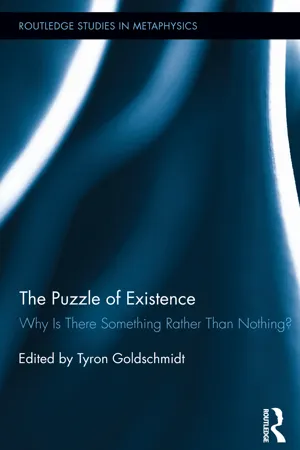
This groundbreaking volume investigates the most fundamental question of all: Why is there something rather than nothing? The question is explored from diverse and radical perspectives: religious, naturalistic, platonistic and skeptical. Does science answer the question? Or does theology? Does everything need an explanation? Or can there be brute, inexplicable facts? Could there have been nothing whatsoever? Or is there any being that could not have failed to exist? Is the question meaningful after all? The volume advances cutting-edge debates in metaphysics, philosophy of cosmology and philosophy of religion, and will intrigue and challenge readers interested in any of these subjects.
- 296 pages
- English
- ePUB (mobile friendly)
- Available on iOS & Android
eBook - ePub
About this book
Information
1 Introduction
Understanding the Question
Tyron Goldschmidt
Why is there something rather than nothing? The question encapsulates the puzzle of existence. This chapter introduces the puzzle and the rest of the volume. After some terminological preliminaries in Section 1, Section 2 explains the puzzle by identifying and distinguishing more particular questions. Section 3 surveys the main answers that have been put forward and outlines the chapters in the rest of the volume, identifying their bearing on the different questions and on each other. There are a couple of original and pertinent points too.
1 Preliminaries
A few philosophical notions are helpful in formulating the questions and are at work in the chapters that follow. Particularly prevalent are the pairs of notions of concreteness and abstractness, and contingency and necessity, and then, the trickiest of all, the notion of possible worlds.
Concreteness and Abstractness
The distinction between concrete and abstract beings has been drawn in various ways but usually by using spatiotemporal and causal criteria. On the spatiotemporal criterion, concrete beings are spatiotemporal: concrete beings are in space or time, whereas abstract beings are spaceless and timeless. On the causal criterion, concrete beings are causal in nature: concrete beings have causal powers, whereas abstract beings are powerless. There are then the tasks of providing more precise criteria for spatiotemporality and causal powers in turn. In any case, concrete beings are typically thicker and heavier, abstract beings thinner and wispier, and the categories mutually exclusive and exhaustive.
The spatiotemporal and causal criteria have similar extensions: planets and plants count as concrete on either, while numbers and propositions, as conceived by platonists, count as abstract on either. But they might not overlap entirely. On the one hand, there are candidates for spatiotemporal beings that are not causal: for example, spatiotemporal points. On the other hand, there are candidates for causal beings that are not spatiotemporal: for example, God. But these are controversial exceptions, both as to whether they exist and as to whether they are exceptions: some ascribe powers to spatiotemporal points, and spatiotemporality (or at least temporality) to God.
I take the criteria to be stipulative definitions; concrete and abstract are terms of art. When philosophers disagree about them they disagree only about how to use the terms, and not about the nature of things. Thus, we do not have to decide which is correct; we have only to decide how to use our terms.1
Contingency and Necessity
Contingent beings are things that both could exist and also could fail to exist, whereas necessary beings are things that could not fail to exist. Necessary beings have a stronger grip on reality than do contingent beings. Planets and plants are contingent beings. If the boundary conditions of the universe or natural laws were ever so slightly different, no planets would have formed, and even with the boundary conditions and natural laws there are, if the planet were ever so slightly nearer to or further from the sun, plants would not have evolved.
God, as traditionally conceived, would be a necessary being. God would not just happen to exist; if God exists at all, then God is the sort of being that could not have failed to exist. Other candidates for necessary beings are numbers and propositions (once again, as conceived by platonists), though these are controversial candidates, both as to their necessity and as to their very existence, which is at least as controversial as the existence of God.
The examples show that the categories of concrete and abstract, on the one hand, and contingent and necessary, on the other, could cut across each other. While most readily available examples of concrete beings are also contingent (thus plants and planets), there could be exceptions: for example, God would be concrete but necessary. Then there are abstract beings that are necessary (thus numbers and propositions), but there are also contingent abstract beings: for example, sets are abstract beings, but sets whose members are contingent—such as {Aristotle, the Eiffel Tower}—would themselves be contingent.
Possible Worlds
A possible world is a comprehensive way things could have been. The world could have contained many more planets than it does, and it could have contained fewer planets. There is thus a possible world containing more planets than does our world, and there is a possible world containing fewer planets. In contrast, there could never have been a square circle. There is thus no possible world containing a square circle. The actual world, the way things actually are, is a possible world because the way things are is a way things could have been.
Possible worlds have been said to contain beings, or (what is the same) beings have been said to exist in worlds. Possible worlds can also be said to obtain or not to obtain, or (what is the same) to be actualized or to be unactualized. The actual world is the possible world that obtains, whereas all other worlds are merely possible worlds. If a world contains a being or a being exists in a world, then if the world obtains, the being exists. Thus the actual world contains plants and planets, but only some merely possible world contains a unicorn.
The notion of possible worlds can help to explicate, or at least to make vivid, the notions of contingency and necessity just outlined. A contingent being, like a planet, is a being that exists in some possible worlds but not in all, while a necessary being, like God, is a being that exists in all possible worlds. One reason for believing in possible worlds is that they are useful in making sense of such and various other philosophical notions. The notion of possible worlds will be helpful in framing and distinguishing our questions, and some of the contributions also employ it.2
However, what exactly the notion amounts to—what the real nature of the worlds is, if it is anything at all—is the subject of extensive dispute, as are the notions of a world’s obtaining or containing other beings. Some take worlds to be spatiotemporally discrete universes no less real than our own (and thus to be concrete), whereas others take them to be spaceless and timeless sets of propositions about how things could be (and thus to be abstract). Some take them to be merely a sort of useful fiction or heuristic (and thus to be nothing much at all), whereas others take them to be not-so-useful fictions (contrast Lewis 1986; Plantinga 1974; Rosen 1990; and Heil, this volume). As we will see, the debate bears crucially on the puzzle of existence.
2 The Questions
The puzzle of existence can now be framed in terms of the notions introduced. More particularly, various fundamental questions about the world and the universe can be distinguished; one or more of these questions has been intended by the question “Why is there something rather than nothing?” The most frequently intended are the following.
Why Are There Any Beings at All?
This question asks why a world containing any beings obtains. This is the broadest question of all. The question would remain had any other world, no matter how radically different from our own, obtained; it would remain in a world containing only abstract beings, though of course there would be no one in such a world to ask it. The question amounts to a question about why any world obtains. After all, worlds are ways things could be, and without any ways or things—beings broadly construed—there can be no world. (The question should thus not be construed as a question about why a possible world containing some being obtains rather than a world containing no beings at all. The notion of such a perfectly empty world is incoherent.3)
Why Are There Any Concrete Beings?
This question differs depending on the criterion of concreteness employed. On the spatiotemporal criterion, the question asks why a possible world containing beings in space or time obtains rather than a world containing no beings in space or time. On the causal criterion, it asks why a world containing beings with causal powers obtains. We could frame yet other criteria of concreteness, and thus other questions: for example, we could combine both criteria to ask why a world containing any spatiotemporal or causal beings obtains. The questions would remain in worlds containing spatiotemporal or causal beings—and even in a world containing only a particle, though there would then be no intelligent beings to ask it.
Why Are There Any Contingent Beings?
This question asks why a possible world containing any contingent being obtains. Assuming there are contingent beings, the question can be asked in our world and in worlds containing other contingent beings. When beings is construed so broadly as to cover contingent things of any kind (substances, events, sets, facts, etc.), perhaps every world will contain some contingent being—perhaps even a world containing no contingent substances or events would have to contain the very negative but contingent fact of there being no such beings. But beings can be construed more narrowly to mean substances (like planets or plants) or events (like battles or big bangs). The question would then ask why a world containing any such thing as a planet or a big bang obtains rather than a world containing no such beings, even should that world contain the contingent fact of there being no such beings. Yet another question combines the questions about concrete and contingent beings to ask why there are any beings that are both concrete and contingent.
Why Are There the Concrete/Contingent Beings There Are?
Besides the questions about why there are any concrete beings and any contingent beings, there are questions about why there are precisely the concrete and contingent beings there are. There is the question about why the particular collection or sum of concrete beings there are exists. This question would remain only in worlds containing all the concrete beings of our world. It is at least close to the question of why the universe exists, since the universe could mean the sum of all spatiotemporal things related to us or, alternatively, the sum of all things causally related to us. But there might be concrete beings beyond our universe—there might be multiple other universes of concrete beings, a multiverse. The question about why any universe exists could coincide with the question about why any concrete being exists.
The question about why the particular contingent beings there are exist would differ depending on the meaning of beings—again, whether this covers any kind of contingent being or only substances and events. On the broadest interpretation of beings, possible worlds are distinguished by the contingent beings they contain. The question would then ask why our particular world obtains rather than some other possible world. This question is less general than the previous ones in the sense that it can’t be asked in any other world. Of course, the inhabitants of some other world can ask why their world obtains; if theirs were actualized, then that would be a fair enough question, at least as fair as the question about why the actual world obtains.4 But their question is not why this—our—world obtains. In contrast, the previous questions can be asked in other worlds. The first question would remain in any world whatsoever, the second in any world containing concrete beings, and the third in any world containing contingent beings.
Why Do Concrete/Contingent Beings Exist Now?
Less frequently asked, but worth distinguishing from the previous questions, are questions about why there exist concrete beings now, and why there now are the contingent beings there are. These questions differ from the previous ones. We could imagine worlds identical to our own up until, but not including, the present moment, when the beings then pop out of existence. Such worlds would still contain concrete beings, and if they obtained the question about why there are such beings would remain. But the questions about why the beings exist now can’t be properly asked since they don’t—at least on criteria of concreteness that do not count the present moment as concrete, for otherwise there could be no now without concrete beings. Similarly, the worlds could contain all the contingent substances there are, albeit with gappy or truncated lives, and if they obtained the question about why these beings exist would remain, though not the question about why they exist now.
There are yet other questions about why things continue to exist, perdure, or endure, over other times: Where do things find their continuing source of ontological fuel? What grounds their existential inertia? Doubtless the inhabitants of worlds where things don’t run so smoothly would face their own pressing questions.
Why Is There Not a Void?
Another question that is less frequently asked but worth distinguishing is about why a world containing only a void does not obtain, where a void would be something like an empty space-time, a totally dark and vast abyss. When addressing the questions about why there are concrete or contingent beings, there’s a tendency to try to represent the alternative as a void. So long as the void is itself concrete or contingent this is a misrepresentation. For example, if the question is about why any world containing concrete beings obtains, and a void counts as concrete (since spatiotemporal), then the alternative is not accurately represented by a void; when asking, “Why is there something rather than nothing?” the “nothing” is not a name for a void, an especially thin being but concrete nonetheless.
Once again, there are yet other cosmological questions about the void or at least void-like states of affairs. These are motivated by contemporary scientific proposals that the universe arose from a quantum vacuum. How did the universe arise from a quantum vacuum? Why was the quantum vacuum on the scene in the first place? The first question is close to one about why the universe exists if the universe is taken to cover only states of affairs subsequent to the quantum vacuum; the second question is closer if the universe covers everything spatiotemporal or causal and the quantum vacuum counts as spatiotemporal or causal.
These are enough questions for now; we turn to canvassing a few answers. The projects of understanding a question and of answering it are related in both directions: while there is no prospect of answering a question without some understanding of what is being asked, understanding what would count as an answer also helps in understanding the question.
3 The Answers
All the above questions are why-questions, and the answers to such are explanations. There are other kinds of responses to the questions—responses denying that...
Table of contents
- Cover
- Title
- Copyright
- Dedication
- Contents
- 1 Introduction: Understanding the Question
- 2 Could There Be a Complete Explanation of Everything?
- 3 Ultimate Naturalistic Causal Explanations
- 4 Reasoning Without the Principle of Sufficient Reason
- 5 The Principle of Sufficient Reason and the Grand Inexplicable
- 6 Contingency, Dependence, and the Ontology of the Many
- 7 Conceiving Absolute Greatness
- 8 A Proof of God's Reality
- 9 Methodological Separatism, Modal Pluralism, and Metaphysical Nihilism
- 10 Contingency
- 11 Metaphysical Nihilism Revisited
- 12 The Subtraction Arguments for Metaphysical Nihilism: Compared and Defended
- 13 The Probabilistic Explanation of Why There Is Something Rather Than Nothing
- 14 Are Some Things Naturally Necessary?
- 15 Questioning the Question
- 16 Ontological Pluralism, the Gradation of Being, and the Question "Why Is There Something Rather Than Nothing?"
- Contributors
- Index
Trusted by 375,005 students
Access to over 1.5 million titles for a fair monthly price.
Study more efficiently using our study tools.
Frequently asked questions
Yes, you can cancel anytime from the Subscription tab in your account settings on the Perlego website. Your subscription will stay active until the end of your current billing period. Learn how to cancel your subscription
No, books cannot be downloaded as external files, such as PDFs, for use outside of Perlego. However, you can download books within the Perlego app for offline reading on mobile or tablet. Learn how to download books offline
Perlego offers two plans: Essential and Complete
- Essential is ideal for learners and professionals who enjoy exploring a wide range of subjects. Access the Essential Library with 800,000+ trusted titles and best-sellers across business, personal growth, and the humanities. Includes unlimited reading time and Standard Read Aloud voice.
- Complete: Perfect for advanced learners and researchers needing full, unrestricted access. Unlock 1.5M+ books across hundreds of subjects, including academic and specialized titles. The Complete Plan also includes advanced features like Premium Read Aloud and Research Assistant.
We are an online textbook subscription service, where you can get access to an entire online library for less than the price of a single book per month. With over 1.5 million books across 990+ topics, we’ve got you covered! Learn about our mission
Look out for the read-aloud symbol on your next book to see if you can listen to it. The read-aloud tool reads text aloud for you, highlighting the text as it is being read. You can pause it, speed it up and slow it down. Learn more about Read Aloud
Yes! You can use the Perlego app on both iOS and Android devices to read anytime, anywhere — even offline. Perfect for commutes or when you’re on the go.
Please note we cannot support devices running on iOS 13 and Android 7 or earlier. Learn more about using the app
Please note we cannot support devices running on iOS 13 and Android 7 or earlier. Learn more about using the app
Yes, you can access The Puzzle of Existence by Tyron Goldschmidt in PDF and/or ePUB format, as well as other popular books in Philosophy & Philosophical Metaphysics. We have over 1.5 million books available in our catalogue for you to explore.