- 336 pages
- English
- ePUB (mobile friendly)
- Available on iOS & Android
eBook - ePub
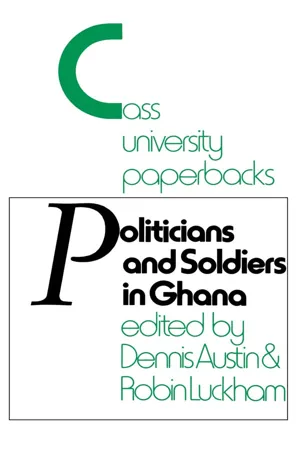
Politicians and Soldiers in Ghana 1966-1972
About this book
First published in 1975. Legatee of a vast empire, the Commonwealth still carries the imprint of its past, and in doing so it may be said to have a collective identity which, in a very varying degree, each of its members exhibits. This can sustain a collective inquiry into the political history and institutions of countries which were once governed within the British Empire. The present series of books is intended to express that interest and those traditions. They are presented not as a guide to the Commonwealth as a corporate entity, but as studies either in the politics and recent history of its member states or of themes which are of common interest to several of the countries concerned. This volume It examines the attempt to restore, and the failure to maintain, a parliamentary Westminster form of government in Ghana, a study in 'Commonwealth Legacies' which brings together scholars from Ghana, Britain and North America.
CHAPTER I
MILITARY AND POLICE RULE
Robert Dowse*
In 1966 the Ghana army consisted of some 600 officers and 14,000 other ranks. It was then the largest in West Africa and the cost of maintaining it the fifth highest in the continent. It had been expanded rapidly since 1960 when it had 7,000 men and (at officer level) it was entirely Africanised. Similarly, the police force, which at independence had numbered about 6,000 men, had grown to 14,000 some ten years later.1 The army was officered primarily by men from the coastal areas; the other ranks, despite efforts to broaden the pattern of recruitment, were still predominantly from the north. Such was the composition of the armed forces which brought down the party regime on 24 February 1966. It was shortly before dawn that day when Col. Kotoka, Commander of the Second Infantry Brigade Group, declared in a radio broadcast:
Fellow Citizens of Ghana, I have come to inform you that the Military, in cooperation with the Ghana police, have taken over the government of Ghana today. The myth surrounding Nkrumah has been broken. Parliament is dissolved and Kwame Nkrumah is dismissed from office. All ministers are also dismissed. The Convention People’s Party is disbanded with effect from now.
Compared with the forces of other African countries, neither the army nor the police had been badly paid or poorly equipped, and although there were complaints (after the coup) that the army had been starved of resources, it is difficult to believe that this was the main motive for intervention. The conspirators seemed primarily to have been moved by a combination of fear and resentment. They feared that the President’s Own Guard Regiment, built up by Nkrumah with Russian help, might displace regular units of the army in presidential favour; they resented Nkrumah’s sporadic interference with the army’s internal affairs, including not only promotions and retirements but the party’s meddling (as the army officers saw it) in the very difficult Congo operation. And both emotions were strengthened by the belief that Nkrumah was dragging the country towards economic collapse under a single party dictatorship. The coup almost failed through poor coordination, nor was it wholly bloodless—those killed included Maj. Gen. Charles Barwah, Chief of the General Staff, in addition to those of the President’s Own Guard Regiment who remained loyal to Nkrumah—but it was quickly brought to a conclusion, and a distinct pattern of military-police rule began almost immediately to take shape.
At 1 p.m. on 24 February, a spokesman on Accra radio justified the coup by the misdeeds of Nkrumah who had ‘been running the country as his own personal property’, the result being ‘gross economic mismanagement’ from which ‘all of us have suffered in one way or another’. Inflation and unemployment were rampant—’the country is on the verge of national bankruptcy’—and there was need for ‘a radical rethinking of economic and financial policies’. Nkrumah was accused of ruling capriciously and dangerously, but the case against him was not spelled out in detail. The underlying professional grievances could be seen in the announcement that Maj. Gen. Ankrah, who had been forcibly retired by Nkrumah, had now been reinstated and promoted to Lt. General. (It was one of several promotions seif-bestowed.) The President’s Own Guard Regiment was absorbed into the main body of the army after its Commander, Col. David Zanlerigu, had been placed in protective custody. And the broadcast, which announced that a National Liberation Council had been brought together to govern the country, ended with an appeal to the civil service: ‘All principal secretaries, heads of department and other members of the public service are asked to stay at their posts.’ Since, in the earlier announcement, the soldiers had dissolved the C.P.P. and the 1960 constitution, and were shortly to declare all political activity illegal, the rudiments of an administrative state emerged immediately. In a further broadcast later that evening, the N.L.C. announced that some five hundred political prisoners, held under the Preventive Detention Act passed by the former regime, were to be released, and that all the party posts throughout the country were to be controlled by the administrative secretaries to the now dismissed C.P.P. Commissioners.
The N.L.C. had acted quickly to erect the new administrative structure. And it acted equally quickly to destroy the old C.P.P. The leading cadres of the party were immediately arrested and placed in ‘protective detention’ by the police which, since it had branches throughout the country, was in a very strong position to know who might be a danger to the new regime. It was this aspect of the ‘coalition coup’ that made it so successful: the army had the force to overthrow at the centre; the police had the intimate local knowledge to enable it to prevent potential opposition before it could take shape. But although many of their grievances were of a quite specifically professional nature, that is not to say that the military and police were acting contrary to the wishes or even to the interests of the majority of Ghanaians. It is, indeed, difficult to think of any interest in Ghana that immediately stood to lose from the coup, apart from those employed by the government on state projects of one kind or another, and the various officials and agents of the now disbanded C.P.P. which by 1966 was quite incapable of offering resistance to the combined police and army.
Initially the N.L.C. consisted of seven men: Lieutenant-General Ankrah, three other soldiers—E. K. Kotoka, A. K. Ocran and A. A. Afrifa—and three policemen: J. W. K. Harlley the Inspector General, B. A. Yakubu his deputy, and J. E. O. Nunoo. Neither the air force nor the navy was involved. Thus the army had a majority until early March when another policeman, A. K. Deku, was added, bringing about an even balance within the army-police coalition. Ethnically, the admission of Deku upset the previous balance since it gave the Ewe-speaking community three—Kotoka, Harlley and Deku—of the eight places; moreover, Harlley and Kotoka were the chief architects of the coup, and both Ankrah and Nunoo were from the Ga community in Accra. Thus, the N.L.C. was numerically dominated by the minority communities, a fact which did not escape local notice. To offset this imbalance, however, there were other considerations. Afrifa, the third principal instigator of the coup, was an Ashanti, Ocran, a Fanti, and Yakubu, a northerner. Equally important was the fact that on the very important eight-member Economic Committee, only R. S. Amegashie was an Ewe; its leading member, E. N. Omaboe, was a Ga but the rest were Akan. Hence, at first sight, the ethnic element seemed less significant than the anti-political and pro-administrative bias of the N.L.C. The initial success of the N.L.C. also owed much to the commonsense of the original leaders who were very quick to include their senior colleagues—including Ankrah who had played no part in the coup—in their joint council of command. In addition, there was that widespread sense of grievance against Nkrumah among the military—a professional sense of danger—which cut across lines of possible tribal difference. And acting as a united group, the military and police had a strong base from which to seek allies.
From the first day of its rule the N.L.C. did everything it could to win over the civil service. There was not only the replacement of politicians by civil servants in the District and Regions. The N.L.C. also turned to the administration for help at a national level through an Economic Committee of senior civil servants, plus two directors from the Ghana Commercial Bank and the Bank of Ghana. It was on the advice of this Committee that General Ankrah (in a broadcast on 28 February) announced that Ghana would be seeking I.M.F. advice.3 Not until July was a Political Committee appointed (consisting eventually of twenty-three members) and it was then regarded as much less important than the Economic Committee whose chairman had almost daily meetings with the N.L.C.4 The N.L.C. also brought order into what had bordered on administrative chaos, reducing the number of Ministries to seventeen, dismantling the alternative civil service which had grown up around the President’s Office, and reducing the number of districts considerably.5 On 14 March, the soldiers actually delegated the policy functions of the ex-Ministers ‘to Principal secretaries or other heads of Ministries for which the Ministers were responsible’.6 Similarly, the N.L.C. displayed a high regard for professional competence in the foreign service, relying for advice on the career diplomats who were said to have ‘enjoyed far greater influence in decision-making under the N.L.C. than in the preceeding period’.7 In addition, it closed a large number of expensive and distant embassies, and concluded limited economic and defence agreements with Togo and the Ivory Coast. It took altogether a much more modest administrative assessment of Ghana’s role in Africa and the world.8
The N.L.C.’s economic policy was similarly cautious in the sense of being calculative and rational rather than political and demonstrative. It might, for example, have refused to recognise at least that section of the foreign debt which had been incurred by ex-Ministers, and in many cases incurred simply for the 10 per cent commission which foreign contractors had paid. Such a move would certainly have been popular; it would have been largely justified; but it might also have proved administratively embarrassing, and almost certainly it would have been frowned on by the I.M.F. from whom help was expected. Instead, the N.L.C. accepted the I.M.F. arguments for deflation, the rescheduling of loans, the encouragement of private enterprise, the shuffling off of administrative responsibilities, such as the state farms, and the attempted sale of state enterprises.9
Further evidence of the administrative bias of the N.L.C. came with its curious decree of October 1966 which made the spreading of rumours illegal, and the appointment of an enormous number of commissions and enquiries into all aspects of Ghanaian life. And its endorsement of the commission’s reports, often without change, was itself indicative of the common frame of reference between the soldiers and the administrative-cum-technical élite. So, too, was the ban on politics for the election of representatives to the Constituent Assembly—a ban which prevented the formation of parties until the very eve of the 1969 election. Politics, for the N.L.C. and its administrative allies, were evidently an extravagance which sensible people could well do without. No wonder that potential politicians complained; and, although they did not press their disagreement too far, it is clear that Busia and those who began to gather round him did not approve of the time-table of reform, and wanted an earlier lifting of the ban.
The alliance with the civil service sprang from a number of related factors. After all, the alternatives available to the N.L.C. were very restricted. Under Nkrumah, Ghana had become, capita, one of the most debt-ridden countries in the world. A policy of deflation and economic caution was held to be vital, and civil servants were natural instruments for such a task. The training and background of the Ghanaian military and civil service were also broadly similar. Both were relatively rigid hierarchies, both had a strong predilection for caution and order, both had traditions pre-dating the political arrival of the ‘verandah boys’ of the C.P.P.,10 and both were under severe attack during the latter years of the Nkrumah regime. The civil service had a further reason for its continued co-operation with the N.L.C. since it was under strong and sustained criticism from a section of the population—notably the ‘new intelligentsia’—during the period of the N.L.C.’s rule. Two assertions, drawn from many, illustrate the point. In July 1966, B. D. G. Folson of the University of Ghana wrote that ‘it is clear that those who have benefited most [from the coup] are the civil servants’ and that in relation to N.L.C. policy ‘they have, with the expert hands of bureaucrats, doubtless been slanting their recommendations in the usual way’.11 In April 1967 Professor Adu Boahen (also of the University of Ghana) asked why, alone among Ghanaians, civil servants had not been investigated by the various N.L.C. Commissions when ‘most people complain that it is the same Civil Servants who helped Nkrumah on his golden road to dictatorial and tyrannical rule [and] who are still at the helm of affairs’.12
The civil servants’ immunity was not difficult to explain. Lacking the resources of a political party, the N.L.C. was necessarily more reliant on the public service than any party-based successor was likely to be. The N.L.C. had every wish, too, to expose the misdeeds of the former regime without jeopardising its own rule. The role of the civil service was greatly expanded therefore under the N.L.C., in sharp contrast with its earlier position under Nkrumah. Senior administrators were brought into policy making; they dealt directly with foreign and local business interests, and were ‘relied upon as a major communication link between the new military leadership and the general public’.13 And although the N.L.C. may have had no option but to rely upon, and therefore to protect, the civil service, it did so with evident enthusiasm. During his speech on the first hundred days of the N.L.C., General Ankrah commented that at independence in 1957 the civil service had been excellent and free from politics, a state of affairs eminently desirable, but that Nkrumah had abolished the Civil Service Commission and demoralised the service. The N.L.C. had replaced the Commission, ‘thus ensuring fair play and s...
Table of contents
- Cover
- Half Title
- Title Page
- Copyright Page
- Maps
- Table of Contents
- List of Contributors
- Foreword
- Preface
- Introduction
- 1. Military and Police Rule
- 2. Economic Policies
- 3. The Constitutional Commission
- 4. The Constituent Assembly
- 5. The Electoral Commission
- 6. The 1969 Election
- 7. Politics in Asunafo
- 8. Politics in Abuakwa
- 9. Politics in Swedru
- 10. Politics in Sekyere
- Epilogue: Malcontents in Uniform
- Selected Bibliography
- Index
Frequently asked questions
Yes, you can cancel anytime from the Subscription tab in your account settings on the Perlego website. Your subscription will stay active until the end of your current billing period. Learn how to cancel your subscription
No, books cannot be downloaded as external files, such as PDFs, for use outside of Perlego. However, you can download books within the Perlego app for offline reading on mobile or tablet. Learn how to download books offline
Perlego offers two plans: Essential and Complete
- Essential is ideal for learners and professionals who enjoy exploring a wide range of subjects. Access the Essential Library with 800,000+ trusted titles and best-sellers across business, personal growth, and the humanities. Includes unlimited reading time and Standard Read Aloud voice.
- Complete: Perfect for advanced learners and researchers needing full, unrestricted access. Unlock 1.5M+ books across hundreds of subjects, including academic and specialized titles. The Complete Plan also includes advanced features like Premium Read Aloud and Research Assistant.
We are an online textbook subscription service, where you can get access to an entire online library for less than the price of a single book per month. With over 1.5 million books across 990+ topics, we’ve got you covered! Learn about our mission
Look out for the read-aloud symbol on your next book to see if you can listen to it. The read-aloud tool reads text aloud for you, highlighting the text as it is being read. You can pause it, speed it up and slow it down. Learn more about Read Aloud
Yes! You can use the Perlego app on both iOS and Android devices to read anytime, anywhere — even offline. Perfect for commutes or when you’re on the go.
Please note we cannot support devices running on iOS 13 and Android 7 or earlier. Learn more about using the app
Please note we cannot support devices running on iOS 13 and Android 7 or earlier. Learn more about using the app
Yes, you can access Politicians and Soldiers in Ghana 1966-1972 by Dennis Austin,Robin Luckham in PDF and/or ePUB format, as well as other popular books in History & World History. We have over 1.5 million books available in our catalogue for you to explore.