Data Analytics for Pandemics
eBook - ePub

Data Analytics for Pandemics

A COVID-19 Case Study

  1. 88 pages
  2. English
  3. ePUB (mobile friendly)
  4. Available on iOS & Android
eBook - ePub

Data Analytics for Pandemics

A COVID-19 Case Study

About this book

Epidemic trend analysis, timeline progression, prediction, and recommendation are critical for initiating effective public health control strategies, and AI and data analytics play an important role in epidemiology, diagnostic, and clinical fronts. The focus of this book is data analytics for COVID-19, which includes an overview of COVID-19 in terms of epidemic/pandemic, data processing and knowledge extraction. Data sources, storage and platforms are discussed along with discussions on data models, their performance, different big data techniques, tools and technologies. This book also addresses the challenges in applying analytics to pandemic scenarios, case studies and control strategies. Aimed at Data Analysts, Epidemiologists and associated researchers, this book:


  • discusses challenges of AI model for big data analytics in pandemic scenarios;


  • explains how different big data analytics techniques can be implemented;


  • provides a set of recommendations to minimize infection rate of COVID-19;


  • summarizes various techniques of data processing and knowledge extraction;


  • enables users to understand big data analytics techniques required for prediction purposes.

Frequently asked questions

Yes, you can cancel anytime from the Subscription tab in your account settings on the Perlego website. Your subscription will stay active until the end of your current billing period. Learn how to cancel your subscription.
At the moment all of our mobile-responsive ePub books are available to download via the app. Most of our PDFs are also available to download and we're working on making the final remaining ones downloadable now. Learn more here.
Perlego offers two plans: Essential and Complete
  • Essential is ideal for learners and professionals who enjoy exploring a wide range of subjects. Access the Essential Library with 800,000+ trusted titles and best-sellers across business, personal growth, and the humanities. Includes unlimited reading time and Standard Read Aloud voice.
  • Complete: Perfect for advanced learners and researchers needing full, unrestricted access. Unlock 1.4M+ books across hundreds of subjects, including academic and specialized titles. The Complete Plan also includes advanced features like Premium Read Aloud and Research Assistant.
Both plans are available with monthly, semester, or annual billing cycles.
We are an online textbook subscription service, where you can get access to an entire online library for less than the price of a single book per month. With over 1 million books across 1000+ topics, we’ve got you covered! Learn more here.
Look out for the read-aloud symbol on your next book to see if you can listen to it. The read-aloud tool reads text aloud for you, highlighting the text as it is being read. You can pause it, speed it up and slow it down. Learn more here.
Yes! You can use the Perlego app on both iOS or Android devices to read anytime, anywhere — even offline. Perfect for commutes or when you’re on the go.
Please note we cannot support devices running on iOS 13 and Android 7 or earlier. Learn more about using the app.
Yes, you can access Data Analytics for Pandemics by Gitanjali Rahul Shinde,Asmita Balasaheb Kalamkar,Parikshit N. Mahalle,Nilanjan Dey in PDF and/or ePUB format, as well as other popular books in Computer Science & Computer Science General. We have over one million books available in our catalogue for you to explore.

Information

1
COVID-19 Outbreak

1.1 Introduction

The key to understanding a pandemic starts with an understanding of the disease itself and the progression of the natural course of the disease. The word “disease” is defined as the state that negatively affects the body of a living person, plant, or animal. A disease affects the body because of a pathogenic infection. The natural course of the disease starts before the onset of the infection, after which it progresses through the pre-symptomatic stage. The last stage is the clinical phase. In the clinical phase, a patient receives the prognosis of the disease. After successful treatment of the disease, the patient enters into the remission stage. Remission refers to a decrease in the symptoms or a complete disappearance of the disease. The patient needs to strictly follow instructions given by the doctor during the remission stage. This will ensure that the disease does not recur. If treatment is not successful, the patient can die or be chronically disabled. The following are some important terms that are used to represent the disease state:
  1. (i) Case-fatality rate: It is defined as the ratio of the number of patients who die due to the disease to the number of people affected by it.
  2. (ii) Observed survival rate: It is the prediction of the probability of survival.
  3. (iii) Relative survival rate: It is defined as the percentage of the observed survival to the survival rate expectation.
Diseases are mainly categorized into two types:
  1. (i) Congenital diseases
  2. (ii) Acquired diseases
Congenital diseases exist in the body right from birth. These diseases are generally activated through genetic disorders, environmental factors, or a combination of both. These diseases are generally hereditary, i.e. passed on through generations, for example, hearing conditions and Down syndrome. In contrast to the former, acquired diseases spread through living organisms. These are not hereditary.
The acquired disease category is further classified into two types:
  1. (i) Infectious diseases
  2. (ii) Non-infectious diseases
Infectious diseases are induced by pathogens or viruses. They are also called communicable diseases. As the name suggests, these diseases are infectious. It means that if one person has contracted the infectious disease then the disease can be passed on to another person through air, food, water, touch (physical contact), etc. SARS and SARS COVID-19 are examples of infectious diseases.
Similarly, as the name suggests, non-infectious diseases do not occur due to any kind of infection. It means that a person with a non-infectious disease will not be able to spread the disease to a healthy person. Diseases such as cancer and auto-immune disorders are examples of non-infectious diseases.
Infectious disease can affect a healthy person in two ways.
  1. (i) Direct transmission
  2. (ii) Indirect transmission
When the pathogens travel from a patient to a healthy person without any middle carrier, then the transmission is referred to as direct transmission. Direct transmission can happen in the following ways:
  • Coming in contact with the infected person.
  • Via droplet infection (coughing, sneezing, and spitting).
  • Coming in contact with the soil.
Animal bites are also one of the causes of direct transmission.
Whenever there is a reservoir of infection that can transmit the disease from a patient to a healthy person with a middle agent, then that transmission is known as indirect transmission. Indirect transmission can happen in the following ways.
  • If pathogens are transmitted through food, water, etc., it is known as vehicle-borne disease.
  • If pathogens are transmitted through the air, then it is known as airborne disease.
  • If pathogens are transmitted through contaminated items like clothing, utensils, books, etc., it is known as fomite-borne disease.
After the diagnosis of the disease comes the most important part: the treatment. Treatment generally consists of targeting the biochemical reactions occurring due to pathogens. There are two ways to stop that reaction so that the infection will not spread:
  1. (i) Prevention
  2. (ii) Cure
Through prevention, symptoms of the infection can be reduced using painkillers so that patients can be at ease. Preventive measures also include immunization and vaccination. Through cure, particular drugs are used to kill the pathogen [1].
1.2 Epidemic and Pandemic Overview

1.2.1 Stages of Disease

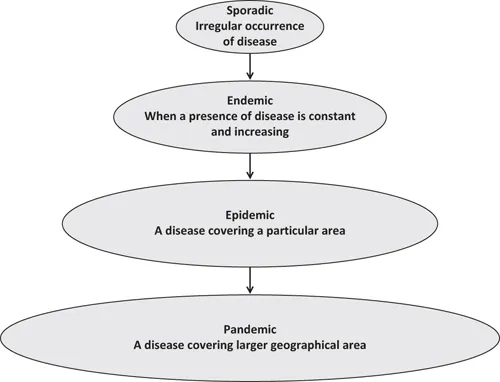
Before studying the latest pandemic, it is very important to study basic terminologies associated with the pattern of disease spread. A diagrammatical overview of stages of the disease is depicted in Figure 1.1.
Figure 1.1 Stages of the disease.
  1. (i) Sporadic
    When the occurrence of the disease is not regular and is infrequent, it is termed as sporadic.
  2. (ii) Endemic
    When the presence of the disease is constant in a particular geographical area, it is known as endemic. Endemic turns into a hyperendemic situation when a high level of disease occurrence is observed.
  3. (iii) Epidemic
    When there is a sudden rise in the number of patients with the same disease and within a particular area, it is termed as an epidemic.
  4. (iv) Pandemic
    When epidemics affect larger geographical areas (including multiple countries and continents), it is known as a pandemic.
A disease takes the form of an epidemic when the following two conditions are met. First is when several people are affected by an illness/disease that has a similar nature of the disease and the same root cause, and the second is when the number of infected people rapidly increase over a period. When the epidemic crosses local boundaries and covers a wide geological area at the same time, it becomes a pandemic. A disease is listed under the category of pandemic because of its infectious nature. A pandemic does not give any information about the severity and impact of the disease. It merely states the fact that people across a wide geographical area are being infected with the disease.
One more term that is majorly used while studying infectious diseases is “outbreak.” Outbreak happens when a sudden rise in the number of patients is observed. Outbreaks can last a few days, weeks, or months. A pandemic is also sometimes referred to as an outbreak.

1.2.2 Pandemic Phases

When the World Health Organization (WHO) declares a pandemic alert for a disease, it follows six different phases.
  • Phase 1: A pathogen/virus that exists in animals has not caused any kind of infection to humans.
  • Phase 2: A pathogen/virus has infected humans.
  • Phase 3: Small groups of people or random persons are infected with the virus.
  • Phase 4: Human to human transmission is observed due to the outbreak at the community level.
  • Phase 5: The disease has spread in multiple WHO regions.
  • Phase 6: There is an outbreak of the disease in one or more regions different from the ones enlisted in Phase 5 [2].

1.2.2.1 Pandemic Risk Factors

A combination of spread risk and spark risk plays a primary role in pandemic risks. The spark risk occurs due to the transmission of the pathogen from animals to humans. These animals can be domestic animals or wild animals. The spread of the disease due to domestic animals is generally confined to densely populated areas. The key drivers of spark risks are live animal markets, wildlife reservoirs, etc. [3, 4]. The spark risk is usually followed by the spread risk. As the name suggests, it concerns the transmission of the virus along with the genetic adaptation of the virus. The spread risk is influe...

Table of contents

  1. Cover
  2. Half-Title
  3. Series
  4. Title
  5. Copyright
  6. Contents
  7. Preface
  8. Acknowledgment
  9. Authors
  10. 1 COVID-19 Outbreak
  11. 2 Data Processing and Knowledge Extraction
  12. 3 Big Data Analytics for COVID-19
  13. 4 Mitigation Strategies and Recommendations
  14. Index