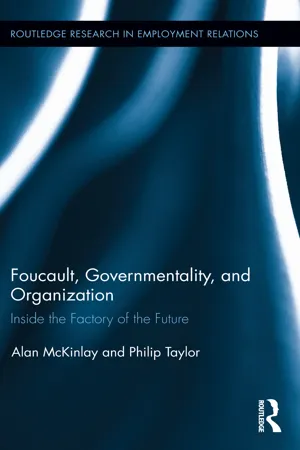
This book traces how abstract managerial ideas about maximizing production flexibility and employee freedom were translated into concrete, day-to-day practices at the Motorola plant in East Kilbride, UK. Using eyewitness accounts, the book describes how employees dealt with the increased freedom Motorola promoted amongst its employees, how employees adapted to managerial changes, specifically the elimination of large-scale management, and where the 'managerless' system came under strain. This book will be of essential reading for researchers, graduate students, and undergraduates interested in the areas of management studies, human resource management, and organizational studies, among others.
eBook - ePub
Foucault, Governmentality, and Organization
Inside the Factory of the Future
- 174 pages
- English
- ePUB (mobile friendly)
- Available on iOS & Android
eBook - ePub
Foucault, Governmentality, and Organization
Inside the Factory of the Future
1 The Will to Empower
Governing the Workplace
Introduction
If one question runs through Michel Foucault’s work, it is how do we govern ourselves and govern others? Foucault addresses this question through historical research into the development of forms of knowledge and practices of power that treat people as both the subject and object of scrutiny. This discursive innovation, coupled with a whole series of institutional practices, results in the construction of a ‘subject’ to be known, that is, a process of knowing that necessarily objectifies the subject. This insistence on the cultural and historical specificity of the changing nature of the subject registers, for Foucault, the untenability of any humanistic argument predicated upon some notion of a universal, transhistorical subject. No longer can particular attitudes or acts be ascribed convincingly to some universal human nature. The complex, often paradoxical, interplay between discipline and freedom forms the terrains within which we live our modern lives. This is the subject of the chapter’s opening section. Discipline has an obvious double meaning that is seldom taken seriously by commentators. First, and by far the most common reading, is that discipline refers to practices and places of constraint and correction. A second meaning of discipline, of course, is a body of knowledge tied to practices, but this sense is much less favoured by acolytes and critics alike. In Foucault’s double sense, expertise is disciplinary to the extent that an individual or group’s behaviour can be predicted or retrospectively interpreted in terms of how closely it matches a specific category or identity. Writing of the role of expert testimony in criminal proceedings, Foucault makes observations that might serve as a useful general guide. Expert testimony aims ‘to show how the individual already resembles his crime before he has committed it.’ Thus the expert provides ‘proof of a form of conduct, a character, and an attitude that are moral defects while being neither, pathologically, illnesses nor, legally, offenses.’1 All sorts of prior behaviours are invested with a cumulative meaning and become symptoms of abnormality. Nor is this an end of the matter. Foucault is equally insistent that subjects are not constructed exclusively by authoritative disciplines but also construct themselves through and against these dominant discourses. Individuals construct their own identities by their interpretation and embodiment of some version of the dominant discourse. Identity is a process of both institutional or social construction and individual action. The point of such expertise, as Jeffrey Nealon points out, is not to devise a singular, central binary that distinguishes between the normal and the abnormal. Power gains most when it is applied most widely and in great detail: ‘Foucaultian . . . norms do not primarily work to exclude the abnormal; rather, they work ceaselessly to account for it as such—to render it as normal or abnormal—and in addition to link it with the murky, amorphous category of life or lifestyle.’2 Identifying the deviant is a prelude to the proliferation of analytical categories and reformative practices that produces—multiplies—the number of identities available to subjects, rather than reducing them to a simple normal/abnormal distinction. Of course, this proliferation is a precondition to the efficient and continuous measurement and calculation that so effectively make and legitimise expert knowledge. Here Foucault is suggesting that what is needed to understand the rise of neoliberalism is not so much a political economy as a political statistic.
Discipline should be efficient, or at least justified in terms of efficiency and in forms that provoke as little resistance as possible.3 This is best achieved through targeting impersonal actions or behaviours rather than specific types of individuals, particularly when the unstated objective is to reform precisely those individuals. The most effective forms of disciplines, then, are those that are not explicitly prohibitive or punitive but that foreground their productive, positive objectives. Here the effectiveness of a disciplinary practice is that it minimises, if not avoids, resistance with all its attendant uncertainties. We will elaborate on this in the second section, which outlines the development of Foucault’s concept of governmentality. Disciplinary power seeks to be imperceptible and unremarkable. The exercise of power and control becomes a dull routine, all the more effective when those subjected to it are scarcely aware of its operation. Further, disciplinary power works most effectively though administrative routines from which the administered perceive some benefit from compliance. How we might approach an example of the processes of translation of corporate ideals into the routines of the so-called factory of the future is considered in the final section.
Governing the Workplace
Governmentality has proved to be perhaps Foucault’s most productive concept. Governmentalist studies have spread across the social sciences and the humanities. Yet ‘governmentality’ was not a neologism coined by Foucault. Rather, it was a term invented by Roland Barthes in 1957 to capture the technocratic drift of French politics that reduced issues of government to questions of efficiency, at least rhetorically. The most profound political act, following Barthes, is to neutralise questions of power as technocratic administrative issues, nothing more. This takes issues of, for instance, power or poverty out of public debate and defines them as primarily administrative, not political, matters. This depoliticisation radically circumscribed public awareness and debate. For Barthes, this slippage of social transformation to public administration was so obvious that governmentality—a term he thought useful, if clumsy, even ‘barbarous’—required little further elaboration. Foucault was introduced to the term during the late 1950s and early 1960s when he and Barthes were part of the circle of the newly formed Tel Quel, a journal that blurred the boundaries between literature, philosophy, and psychoanalysis, and of the more established political and theoretical journal Critique.4 In an important sense, Foucault did not just borrow—somewhat apologetically—the term ‘governmentality’ from Barthes but problematised the ways in which government depoliticised what were inherently political issues, from welfare, to economic performance, to security. What should be studied was not the presentation of ideologies but the practices of government. Here, of course, Foucault goes beyond Barthes’s original term. One of Foucault’s closest friends and colleagues, Paul Veyne, observes that this approach involved an abiding concern with what people actually did.5 Foucault did not search for underlying causes or the hidden agency of society or history. Indeed, Foucault can be usefully interpreted as a very knowing empiricist determined to understand how taken-for-granted facts and practices came about and were, in their turn, dislodged by other, no less compelling, eternal verities. The mechanisms that depoliticised welfare—or rather defined it as a moral failing of individuals to be contained by the state—were critical, not just the efficiency of such state interventions.6 Methodologically, Foucault directs us to study those technologies that produce populations to be managed and specific forms of individuality, rather than the state or institutions per se. Crucially, however, this does not mean that the state is of no consequence. The state, particularly in neoliberalism, argues Foucault, plays an increasingly strategic role not as the source of governmental powers, but as the regulator of their manifold conditions of existence. The defining motif of contemporary political strategy is calculation, not transformation.
Foucault outlined what he meant by governmentality in a series of lectures at the Collège de France in 1978 and 1979. These lectures chronologically and intellectually bridged his research on disciplinary techniques and his final research on the emergence of modern subjectivities in the History of Sexuality. We should be cautious in talking about bridges between different parts of Foucault’s work because it suggests—much too emphatically—two quite different territories, the earlier ‘disciplinary’ Foucault and a later concern for ethics and subjectivities that can be misread as a rejection of his own previous work on prisons, hospitals, and asylums.7 There is, however, little doubt that these lectures were vital in the development of Foucault’s thinking. There was, however, no wavering in his lifelong concentration on understanding the unfolding of power as a political, legal, and social concept as well as its specific formations. Equally, in no sense do the lectures involve a rejection of his work on discipline, surveillance, and the individual. 8 Rather, just as disciplinary power did not replace sovereign power so much as supplement it, so governmentality—with its focus on populations— signals the addition of another distinctive mode of power. Similarly, Foucault remained certain that power should not be identified with the state, a certainty expressed in his famous dictum that cutting off the king’s head—or thinking beyond the state—was theoretically essential. No less important, this theoretical manoeuvre was necessary to the development of progressive social movements that did not assume that capturing the state was sufficient for progressive, far less revolutionary politics.
In the Collège de France lectures, Foucault observes that his refusal to make governmentality synonymous with the state reflects the much broader meaning of government that was current until the eighteenth century. His inference is clear enough: this broader, archaic meaning of government needs to be revived in order to understand contemporary forms of rule and order. Foucault’s 1978–79 lectures were not just based on the resurrection of archaic notions of the so-called arts of government but were also, of course, rooted in contemporary shifts in liberalism, precisely the rise of neoliberalism. From the eighteenth century, Foucault suggests, governmentality has involved some combination of political and pastoral powers. By political power, Foucault was referring to the familiar freedoms of Western democracies: universal suffrage, common rights, a legal system independent of the executive. Pastoral power, on the other hand, is less familiar as a political concept: a form of power that compels individuals to become individuals through producing truth about themselves. The archetypal form of pastoral power is a confession that allows—or rather, forces—individuals to develop their individuality through the contemplation of their public behaviour and private thoughts. All of this is couched in a pastoral system in which the individual receives consolation, guidance, and protection from the pastor. In its secularised form, pastoral power becomes the ways in which the modern state produces the conditions necessary for the free, liberal individual by assuming responsibility for the security and well-being of the population.9 Here Foucault uses the term ‘conduct of conduct’ to capture the interplay between those performative technologies that prescribe behaviours and those that encourage self-control.
I think that if one wants to analyse the genealogy of the subject in Western civilization, he has to take into account not only techniques of domination but also techniques of the self. Let’s say: he has to take into account the interaction between those two types of techniques— techniques of domination and techniques of the self. Neither is reducible to the other; and neither can be understood solely in its own terms. He has to take into account the points where the technologies of domination of individuals over one another have recourse to processes by which the individual acts upon himself. And conversely, he has to take into account the points where the techniques of the self are integrated into structures of coercion and domination. The contact point, where the individuals are driven by others is tied to the way they conduct themselves, is what we call government. Governing people, in the broad sense of the word, is not a way to force people to do what the governor wants; it is always a versatile equilibrium, with complementarity and conflicts between techniques which assure coercion and processes through which the self is constructed or modified by himself.10
When Foucault speaks of technologies, he means this in the broadest sense—all those social, organisational, mechanical, and digital ways that shape individuals’ behaviours and attitudes and within and against which individuals make themselves. Technologies are not simply a reflection of preexisting social relations, nor an expression of power. Technologies of power are, rather, the variety of mechanisms that constitute social relations, that create specific forms of individual and populations to be variously freed, empowered, rehabilitated, and so on. Technologies, for Foucault, are specific to institutions and particular projects that seek to understand some aspect of the social—a population—and to remake individuals in some way. It is this inescapable combination of a political rationality and a technology that defines a governmentalist project.
Foucault had a peculiarly ambivalent relationship to political theory. On the one hand, he was dismissive of general theories of power or the state while, on the other hand, prepared to develop his argument through an engagement with, amongst many others, Bentham, Machiavelli and Marx. Specifically, Foucault was responding to the theoretical and political choices of the mid-seventies. Theoretically, he rejected any notion that the operation of the state was reducible to the logic of capital or that the development of the modern state involved a long process of functional accretion.11 Politically, his was also an implicit rejection of any Leninist political strategy that hinged on the capture of the state. Despite his many speeches, interviews, and commentaries on contemporary politics, Foucault rarely allowed himself to be drawn into debate with political opponents or theoretical critics, always preferring to develop his own research agenda rather than respond to others. In his Collège de France lectures through the mid-1970s, Foucault preferred to offer an oblique commentary on emerging neoliberal thought and policy via meditations on marginal philosophers and long forgotten statesmen. Of course, Foucault was acutely aware that this reluctance to engage directly with contemporary theorists tended to fragment and obscure his argument.
This readiness to use the lectures as a conceptual proving ground gives them a provisional feel that has stimulated an explosion of interest in the unfinished business of governmentality. However, we can surely read Barthes’s original meaning of governmentality as evaluating the state—as well as politics—in terms of its efficiency and efficacy as a constant theme in Foucault’s theoretical development and in his own political activism.
Consider Foucault’s reading of Machiavelli. Machiavelli is important for Foucault not so much for his advice on political strategy as for what that advice signified in terms of who had access to political knowledge. In other words, Machiavelli represents the separation of ‘the arts of government’ from the person of the prince. Machiavelli’s advice may have been intended for the Prince’s ears only, but, once printed, it became public knowledge, a way for others to judge the validity, integrity, and wisdom of royal strategy. Statecraft becomes not private counsel but, at least in principle, replicable in other domains. Foucault spoke often of the analytical need to cut off the king’s head, to accept that the modern state is not the source or even a privileged place of power. Analogously, this is suggested by the relationship between the prince and his adviser. Over time, the arts of government became a form of expert knowledge. Just as the arts of government become separate from the body of the prince, so the ways in which state efficiency is judged emerge as part of the rise of liberalism and then the common sense of all kinds of institutions. Classical liberalism, for Foucault, has a double focus: on the one hand, maximising the liberty of the individual and, on the other, constantly assessing the...
Table of contents
- Cover
- Half Title
- Title
- Copyright
- Contents
- Acknowledgements
- 1 The Will to Empower: Governing the Workplace
- 2 Working for the Yankee Dollar
- 3 Greenfield Site, Greenfield Labour?
- 4 'Not Just Another Number': Empowerment, Discipline, and Teamworking Freedom
- 5 Confession, Discipline, and Freedom
- 6 'Just Like Any Other Factory'
- Bibliography and Other Resources
- Index
Trusted by 375,005 students
Access to over 1.5 million titles for a fair monthly price.
Study more efficiently using our study tools.
Frequently asked questions
Yes, you can cancel anytime from the Subscription tab in your account settings on the Perlego website. Your subscription will stay active until the end of your current billing period. Learn how to cancel your subscription
No, books cannot be downloaded as external files, such as PDFs, for use outside of Perlego. However, you can download books within the Perlego app for offline reading on mobile or tablet. Learn how to download books offline
Perlego offers two plans: Essential and Complete
- Essential is ideal for learners and professionals who enjoy exploring a wide range of subjects. Access the Essential Library with 800,000+ trusted titles and best-sellers across business, personal growth, and the humanities. Includes unlimited reading time and Standard Read Aloud voice.
- Complete: Perfect for advanced learners and researchers needing full, unrestricted access. Unlock 1.5M+ books across hundreds of subjects, including academic and specialized titles. The Complete Plan also includes advanced features like Premium Read Aloud and Research Assistant.
We are an online textbook subscription service, where you can get access to an entire online library for less than the price of a single book per month. With over 1.5 million books across 990+ topics, we’ve got you covered! Learn about our mission
Look out for the read-aloud symbol on your next book to see if you can listen to it. The read-aloud tool reads text aloud for you, highlighting the text as it is being read. You can pause it, speed it up and slow it down. Learn more about Read Aloud
Yes! You can use the Perlego app on both iOS and Android devices to read anytime, anywhere — even offline. Perfect for commutes or when you’re on the go.
Please note we cannot support devices running on iOS 13 and Android 7 or earlier. Learn more about using the app
Please note we cannot support devices running on iOS 13 and Android 7 or earlier. Learn more about using the app
Yes, you can access Foucault, Governmentality, and Organization by Alan McKinlay,Philip Taylor in PDF and/or ePUB format, as well as other popular books in Economics & Business General. We have over 1.5 million books available in our catalogue for you to explore.