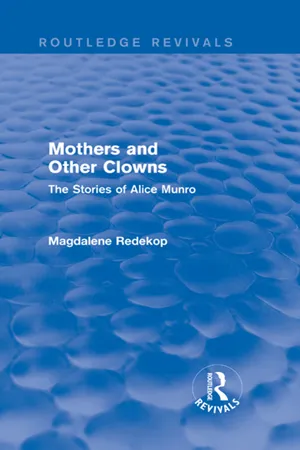
First published in 1992, this is the first study of the work of Alice Munro to focus on her obsession with mothering, and to relate it to the hallucinatory quality of her magic realism. A bizarre collection of clowning mothers parade across the pages of Munro's fiction, playing practical jokes, performing stunts, and dressing in disguises that recycle vintage literary images. Magdalene Redekop studies this with the aim of gaining increased understanding of Munro's evolving comic vision.
eBook - ePub
Mothers and Other Clowns (Routledge Revivals)
The Stories of Alice Munro
- 252 pages
- English
- ePUB (mobile friendly)
- Available on iOS & Android
eBook - ePub
About this book
Information
The argument
Chapter 1
Paying attention: here come the mothering clowns
The pleasure of reading Alice Munro is, in the first place, a pleasure of recognition. Even readers, for example, who have never been to a place called Miles City, Montana, will experience recognition in “Miles City, Montana”:
No place became real till you got out of the car. Dazed with the heat, with the sun on the blistered houses, the pavement, the burned grass, I walked slowly. I paid attention to a squashed leaf, ground a Popsicle stick under the heel of my sandal, squinted at a trash can strapped to a tree. This is the way you look at the poorest details of the world resurfaced, after you’ve been driving for a long time – you feel their singleness and precise location and the forlorn coincidence of your being there to see them.
(PL, 99)
Never mind that the word “forlorn” will soon be a bell to toll you back to your sole self and to artifice. Pay attention. For the time being this place becomes “real.” The pleasure of these listed details in a “precise location” is like the pleasure described by Barthes as “an excess of precision, a kind of maniacal exactitude of language, a descriptive madness” (1975,26) Aha, we say to ourselves, and yes, she’s got it just right: that is just how “you” feel when you are travelling. When we pay attention, however, to the fact that the details are refuse and that they refuse meaning, then we are returned to a recognition not of the place but of “the way you look” at a place. The pleasure of reading Alice Munro is, in the final analysis, that we catch ourselves in the act of looking.
Munro’s fiction offers many examples of what Nancy Miller, in another context, has called a “sudden staging of the hermeneutic act” (Miller, 1986a, 278). I have selected this particular example of a staged reading act because the story so clearly illustrates how “the way you look” is different when the watcher is a mother. When I first set out to write a book on Munro, the issue that commanded my attention – along with her much-admired “magic realism” – was her obsession with mothering. Munro has talked about her “intense relationship” with her mother (who died slowly of Parkinson’s Disease) and she has acknowledged during conversation with Geoff Hancock that “the whole mother-daughter relationship interests me a great deal. It probably obsesses me” (Hancock, 1987, 215). I was fascinated by the stories (“The Peace of Utrecht” and “The Ottawa Valley”) in which Munro struggles with the impossibility of picturing her own mother. I was even more interested in the multiplication of surrogate mother figures in her stories. Her stories are peopled with stepmothers, foster mothers, adoptive mothers, child mothers, nurses, old maids mothering their parents, lovers mothering each other, husbands mothering wives, wives mothering husbands, sisters mothering each other, and numerous women and men behaving in ways that could be described as maternal. The gestures of tucking someone in, of rocking and being rocked, and of feeding and being fed, are, for example, recurring ones.
As I read and reread the stories, I began to discern the outlines of a composite figure – a mothering clown that I decided to call a mock mother. The mock mother is constructed as a result of the impossibility of picturing the “real” mother. Often she performs as a kind of trickster who challenges our old ways of looking at the relation between the work of art and the human body. Unlike the spread-eagled male body made famous by Leonardo da Vinci, this body is not static. The belly expands and contracts, sometimes an arm or a leg or a breast is amputated, the iris moves in and out, the blind spot floats over various parts of the body, and the body may be stood on its head or perform acrobatic stunts. What happens if you substitute this figure for the spread-eagled male with the centrally placed penis who is so often seen as an analogy for the work of art? The first thing that surfaces is an awareness of the danger of objectification. If we don’t feel this danger when we look at the body of a male it is surely because male consciousness is seen as the peak of our civilization. The first step to take to avoid the trap of turning the maternal body into an object, is to see that the mother is in the act of looking at herself, even when she is also looking after her children.
The scene from “Miles City, Montana” is a particularly graphic example of how a woman’s act of looking at herself may come into conflict with her act of looking after others – or mothering. The “watcher” and the “keeper” are at odds in her. The story also reflects Munro’s concern with the implications of this for the construction of autobiography. The narrator is a woman who is mothering her self – she refers to a “wooing of distant parts” of herself (PL, 88) – as well as mothering her often distant children. Her juggling act will be familiar to those readers who are “real” mothers: “I could be talking to Andrew, talking to the children and looking at whatever they wanted me to look at… and pouring lemonade into plastic cups” (PL, 88). For her the details are more than idle pleasure: “a pig on a sign, a pony in a field, a Volkswagen on a revolving stand” are all “bits and pieces… flying together” inside her to form an “essential composition” (PL, 88). Nothing less than the survival of her self is at stake. This process of composition (related, by implication, to the composition of the story) is dramatically at odds with her responsibilities as a mother. She has a dread of turning into one of those mothers who move in a “woolly-smelling, milky-smelling fog, solemn with trivial burdens” (PL, 90). She sees the anxious “attention these mothers paid” as the “cause of colic, bed-wetting, asthma” (PL, 90). By simultaneously paying attention to her children and to the Popsicle stick, however, she is performing a precarious stunt. It leads, as so often happens in a Munro story, to a carefully staged failure.
“Where are the children?” (PL, 99) is the question that triggers the collapse of the composition. When the family act is reconstituted, it is with ironic distance. “What I can’t get over,” says the husband after they rescue their daughter from drowning, “is how you got the signal. It’s got to be some extra sense that mothers have.” She, meanwhile, marvels at the sudden mysterious strength that enabled him to scale the fence. Maternal intuition and paternal strength are seen as a kind of circus stunt. The narrator confesses: “Partly I wanted to believe that, to bask in my extra sense. Partly I wanted to warn him – to warn everybody – never to count on it” (PL, 105). Munro’s fiction is warning us all never to count on it.
The drama of the near-drowning in “Miles City, Montana” comes from a conflict between two ways of paying attention. Like Rose, many of the women in Munro’s stories are tempted to “jolt” their families by yelling the words of Lady Macbeth “into the kitchen”: “Come to my woman’s breasts,/ And take my milk for gall, you murdering ministers!” (WDY, 49). Milk is an image of maternal self-lessness whereas gall is associated with the bitterness of self-interest. When Gerard Manley Hopkins announces “I am gall,” it is a way of saying “my taste was me” (Hopkins, 1953,62). Gall is a recurring image in Munro’s fiction, Flo’s gallstones being one conspicuous example. In “The Turkey Season,” Herb, a homosexual, warns the gutters not to break the gall “‘or it will taste the entire turkey’” (MJ, 62). Although the turkey in question has testicles, Herb issues the order “‘Knees up, Mother Brown.’” The gender confusion shows how hard it is for a man to be associated with the milk of human kindness and for a woman to have the gall to say “me.”
Hélène Cixous has argued that women write in “white ink”: “Voice. Inexhaustible milk. Is rediscovered. The lost mother. Eternity: voice mixed with milk” (Cixous, quoted by Stanton, 1986, 167). Cixous’s work is part of what Bella Brodzki refers to as a “thriving brand of feminist criticism (call it womb criticism).” It “seeks to replace or subvert phallic criticism” (Brodzki, 1988, 247) but ends up installing, once again, the very essentialized maternity that it aims to shatter (see also Stanton, 1986, 163; Auerbach, 1985, 171). There is an intoxicating power in Cixous’s imagery, partly because it is a necessary repudiation of earlier stages of feminist thought which saw the experience of mothering as by definition hostile to feminism itself. Feminists and sexists often conspire to blame the mother, the one seeing her as a “tool of patriarchy” (Palmer, 1989, 96), the other blaming her for not living up to the ideal of maternity constructed by that patriarchy. By the same token, feminists and sexists are often indistinguishable when it comes to apotheosizing the mother. Graves, Briffault, Jung and company clearly believe they are doing women a favour when they indulge in this process. I agree with Millicent Fawcett’s view that feminists should know better than to ‘“talk about Woman with a capital W. That we leave to our enemies’” (quoted by Parker, 1984, 4).
Munro’s stories are best served by approaches to motherhood that separate (as does Adrienne Rich) the experience and the institution. The yearning for an archaic maternal past is acknowledged by Munro, but it is seen from an ironic, anti-nostalgic distance. Voice mixed with milk will not show up on paper unless there is at least a little gall. Unless the voice uses a little black ink, moreover, the woman will not achieve either identity or fame. In “The Progress of Love” Fame’s mother describes how “One drop of hatred in your soul will spread and discolor everything like a drop of black ink in white milk” (PL, 6). Milk is an inherently absurd image to many of the people in Munro’s stories. While Fame milks the cows, her visiting aunt wonders aloud if it hurts the cow and adds: “‘Think if it was you’” (PL, 16). Fame is “shaken by this indecency,” but Munro’s own fame is built on just such daring connections. When Jocelyn and Rose are in the maternity ward, they laugh hysterically about ‘“False tits, false bums, false baby cows!”’ (WDY, 102) until the “vacuum-cleaning woman” issues a threat: “She said if they didn’t stop the way they carried on they would sour their milk.… She asked if they were fit to be mothers” (WDY, 102). Jocelyn wonders if maybe her milk “‘is sour’” since it is an “‘awfully disgusting’” shade of blue, which leads Rose to speculate that “‘maybe it’s ink!”’ (WDY, 102). These conversations undermine the idea that women write with milk and remind us that the same society that etherealizes motherhood places a very low economic value on the act of nurturing. The duplicity is captured by Nicole Brossard: “The milk sours. The Mona Lisa smiles” (1983, 21).
Since milk and cows recur as images in Munro’s stories, it is perhaps not surprising that a crucial staging of the reading act takes the cow as a dead metaphor. Looking at the dead cow in “Heirs of the Living Body,” Del sees the cow’s hide as a map to be read. But this map acts as a guide to no place; it is something non-referential posed by Del as referentiality and leading her to an unanswerable question: “Why should the white spots be shaped just the way they were, and never again, not on any cow or creature, shaped in exactly the same way?” (LGW, 44-45). The result of Del’s straining is to lead us away from sacred cows and back to the surface of words themselves: “day-ud cow” does not become a symbol of something greater than itself. Del could say, like Gertrude Stein: “and what did I do I caressed completely caressed and addressed a noun” (Stein, 1967,138). The “day-ud cow”, like Barthes’s double sign (5/Z), points transparently to the corpse of the cow but at the same time it points at its own opacity and at Del’s use of the sign, at the pleasure she takes in that exercise of power: ‘“Day-ud cow,’ I said, expanding the word lusciously. ‘Day-ud cow, day-ud cow’” (LGW, 44; see Godard, 1984, 43).
Munro’s “magic realism” is a kind of meta-realism. What I notice here is that Del’s caressing of the word is an evasion: she is afraid to caress the “real” cow. Munro has described how she sees even “totally commonplace things” as having a “kind of rim around them” (Hancock, 1987, 212), but her stories (like the paintings of Mary. Pratt or Alex Colville) are examples of a typically Canadian product: the realistic work that is not realistic. Her popularity among so-called “common readers” seems to be based on their recognition of what is “real” or “natural” and this makes literary critics twitchy. The word “natural” has been treacherous territory at least since people started misreading Wordsworth’s “Preface” and realism has become an increasingly vexed issue in recent years. Post-Saussurean work on language questions the concept of realism and representation by emphasizing the arbitrariness of the sign.
The signs in Munro’s stories do not pretend to be natural, and this is true for the sign Mother just as it is for the dead cow or the Popsicle stick or the “pig on a sign” (PL, 88). The subtlety of her method, however, suggests that you cannot understand the full power of the old traps if you see yourself as standing on some moral high ground, free of old habits. Munro herself is positioned along with her reader, inside the old patterns, breaking them up from within. The word “real” is not an easily dismissed illusion in Munro’s story. The word echoes and re-echoes in Munro’s fiction as it does in the poetry of Wallace Stevens. It acts as a kind of reproach, like a conscience keeping the artist honest (Grant, 1970, 14). In “The Spanish Lady,” for example, the narrator hears a “real cry” which she describes as “coming from outside myself” (SIB, 189), the cry of a man dying. “By that cry” the whole fiction we have just read is “pushed back. What we say and feel no longer rings true, it is slightly beside the point” (SIB, 190).
Munro’s gift for “realism,” then, leaves us confronting a blind spot made visible. Her stories are like rare presents that are as hard to unpack as the presents brought by now absent family visitors in “Connection.” In the house, in the room, in the dresser, is a linen-drawer which contains a chocolate-box which contains, in turn, the “empty chocolate cups of dark, fluted paper.” The narrator sometimes goes to “read again the descriptions on the map provided on the inside of the box-top: hazelnut, creamy nougat, Turkish delight, golden toffee, peppermint cream” (MJ, 3). Is there any intrinsic reason why the list could not be altered to read: walnut cream, strawberry delight…? The list, like the salvaged box, waits for some “ceremonial use” that never presents itself and Munro writes against the grain of our desire for symbolic meaning. Tempted by the precise detailing of the fluted rim the greedy reader may try to fill in the missing content. If we do so we destroy the magic and achieve, instead, something resembling the “thought of Cora” in “Privilege”: “the sense of a glowing dark spot, a melting center, a smell and taste of burnt chocolate, that [Rose] could never get at” (WDY, 34).
If this failure is felt most intensely when the reader in question is a mother, that is because the mother, in the symbolic order, is transgressing just by being a reader. She is the Symbol. She is the vessel and has no business expressing a hunger for the contents of the cup. Derrida describes the mother as the “faceless figure of a figurant, an extra.… Everything comes back to her, beginning with her life; everything addresses and destines itself to her. She survives on condition of remaining at bottom” (Derrida, 1985, 38). We are sadly familiar with this erasure now. The idea of the mother’s absence has come to form a central part of our notion of narrative, and of language itself. Many have argued that the uncanny presence of the absent mother ensures that what is left out of the container as unrepresentable is, in the end, what is most powerfully represented (see for example Jardine, 1985,38). The haunting sense of an absence, however, is not the main manifestation of maternity in Munro’s stories. I am tempted to say that these are real mothers in her stories but as I say it I become conscious of Lacanian capitals looming over me. In my use of the word real (as of the phrase symbolic order) I am influenced by Lacan. In the end, however, I untied Munro’s women from his capitals, preferring to leave them free to do their levelling stunts. Dancing in front of the erasure, the conspicuous mock-maternal figures do not affirm something inexpressible or sacred. Munro achieves, instead, what Bakhtin has termed a destruction of “epic distance.” The entertainments of her mock mothers enable us to walk “disrespectfully” around our idealized images of maternity. With her “comical operation of dismemberment,” Munro enables us to see the “back and rear portion” of an object as well as the “innards” (Bakhtin, 1981, 23-24).
The term mock mother is my invention but it is Munro who repeatedly establishes a mocking distance from the very word Mother. In “The Progress of Love,” for example, Fame confesses to “a childish notion – I knew it was childish – that Mother suited my mother better than it did other mothers” (PL, 9). The mother’s story can be told only if the daughter stops calling her Mother and calls her Marietta. The word echoes both Mary, Mother of God, and marionette. To diminish and mock the figure of the mother in this way is to make it possible to deal with the power projected into her. The narrating daughter in “Images,” by contrast, cannot get past the block called Mother that is set up by her own “irascible and comforting human mother.” That Mother is compared to the “name of Jesus” and is the ghost that haunts many of Munro’s stories. She is an “everlastingly wounded phantom” who brings the daughter “wretchedness and shame” (DHS, 33). We confront this ghost again in “The Progress of Love,” where Fame imagines beating her head against her mother’s “stomach and breasts… demanding to be forgiven,” only to have her mother direct her to God. “But it wasn’t God,” Fame concludes, “it was my mother I had to get straight with.” The “sickening shame” is like a cloud or a poison that “you couldn’t see through, or get to the end of” (PL, 13).
How to get straight with the mother? How to celebrate her? How to get rid of her? How to get to the end of this shame? The mock mothers are Munro’s response to this dilemma. They call “into question the assumption of an unmediated presence embodied in/by the mother and an unproblematical relation to the maternal origin” (Brodzki, 1988, 247). Munro often stages the death of the “real” mother with self-conscious melodrama in order to make room for the mock mothers. A mother is pictured dying on the kitchen table among the “teacups and ketchup and jam” (LGW, 77). A mother dies imagining an egg stuck in her chest (WDY, 2). A mother bleeds to death while giving birth to her daughter (PL, 150). When the mother is dead, killed off spectacularly, or simply rendered helpless, her role is taken over by surrogates. Caddy, in the Sound and the Fury, substitutes for Mrs Compson and her care of Benjy is echoed in Patricia’s care for the retarded Benny in “The Time of Death.”
The behaviour of the mock mothers may be comforting, frightening, or entertaining but it is always related to an investigation of the power of the symbolic order in relation to reproduction. The reproduction of writing may itself become a form of resistance to Rousseau’s statement that “there is no substitute for a mother’s love” (quoted by Derrida, 1974, 145). The problems come in distinguishing the regenerative pow...
Table of contents
- Cover Page
- Half Title Page
- Title Page
- Copyright Page
- Original Title Page
- Original Copyright Page
- Dedication
- Contents
- Abbreviations
- Preface
- Acknowledgements
- Part I The argument
- Part II Readings
- Postscript: writing on a living author
- Bibliography
- Index
Trusted by 375,005 students
Access to over 1.5 million titles for a fair monthly price.
Study more efficiently using our study tools.
Frequently asked questions
Yes, you can cancel anytime from the Subscription tab in your account settings on the Perlego website. Your subscription will stay active until the end of your current billing period. Learn how to cancel your subscription
No, books cannot be downloaded as external files, such as PDFs, for use outside of Perlego. However, you can download books within the Perlego app for offline reading on mobile or tablet. Learn how to download books offline
Perlego offers two plans: Essential and Complete
- Essential is ideal for learners and professionals who enjoy exploring a wide range of subjects. Access the Essential Library with 800,000+ trusted titles and best-sellers across business, personal growth, and the humanities. Includes unlimited reading time and Standard Read Aloud voice.
- Complete: Perfect for advanced learners and researchers needing full, unrestricted access. Unlock 1.5M+ books across hundreds of subjects, including academic and specialized titles. The Complete Plan also includes advanced features like Premium Read Aloud and Research Assistant.
We are an online textbook subscription service, where you can get access to an entire online library for less than the price of a single book per month. With over 1.5 million books across 990+ topics, we’ve got you covered! Learn about our mission
Look out for the read-aloud symbol on your next book to see if you can listen to it. The read-aloud tool reads text aloud for you, highlighting the text as it is being read. You can pause it, speed it up and slow it down. Learn more about Read Aloud
Yes! You can use the Perlego app on both iOS and Android devices to read anytime, anywhere — even offline. Perfect for commutes or when you’re on the go.
Please note we cannot support devices running on iOS 13 and Android 7 or earlier. Learn more about using the app
Please note we cannot support devices running on iOS 13 and Android 7 or earlier. Learn more about using the app
Yes, you can access Mothers and Other Clowns (Routledge Revivals) by Magdalene Redekop in PDF and/or ePUB format, as well as other popular books in Literatur & Literaturkritik. We have over 1.5 million books available in our catalogue for you to explore.