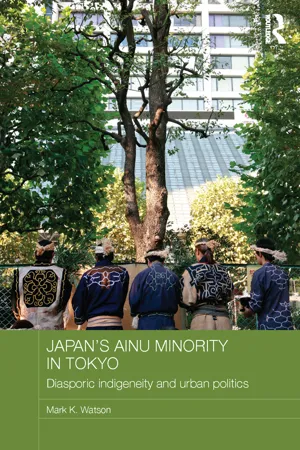
This book is about the Ainu, the indigenous people of Japan, living in and around Tokyo; it is, therefore, about what has been pushed to the margins of history. Customarily, anthropologists and public officials have represented Ainu issues and political affairs as limited to rural pockets of Hokkaido. Today, however, a significant proportion of the Ainu people live in and around major cities on the main island of Honshu, particularly Tokyo. Based on extensive original ethnographic research, this book explores this largely unknown diasporic aspect of Ainu life and society. Drawing from debates on place-based rights and urban indigeneity in the twenty-first century, the book engages with the experiences and collective struggles of Tokyo Ainu in seeking to promote a better understanding of their cultural and political identity and sense of community in the city. Looking in-depth for the first time at the urban context of ritual performance, cultural transmission and the construction of places or 'hubs' of Ainu social activity, this book argues that recent government initiatives aimed at fostering a national Ainu policy will ultimately founder unless its architects are able to fully recognize the historical and social complexities of the urban Ainu experience.
- 190 pages
- English
- ePUB (mobile friendly)
- Available on iOS & Android
eBook - ePub
About this book
Information
1 Introduction: Ainu in Tokyo
This book is about the Ainu, the Indigenous people of Japan, living in and around Tokyo; it is, therefore, about what has been pushed to the margins of history. It is about rethinking the production and reproduction of images of Ainu and Indigenous peoples in general both within and outside of academia and what it means to bring Indigenous life lived in cities to the center of analysis. It asks questions of Japan and, more pressingly at times, of belonging, community, place-based rights and Indigeneity in the twenty-first century. It contests the regionalization of Ainu affairs to the northern Japanese archipelago and the conflation of Ainu Mosir—the Ainu homeland— with the island of Hokkaido, to echo the message of Ainu at public events in the capital that: “Yes, Ainu live in Tokyo.” Ainu have lived in, journeyed to and traveled through the capital region for well over a century and (based on archaeological and ethnological evidence) probably much longer. With the advent of a new era in Indigenous rights, the hidden, dia-sporic history of Ainu life and collectivity in the city demands greater public and academic attention.
Courtesy of a scholarship, I awoke on a cold and wintry February day in 2002 in a dorm room at the Japan Foundation center in Osaka across the water from Kansai airport. My three months there offered the opportunity to lay foundations for fieldwork proper that I anticipated would start later that summer. All too aware of the difficulties I faced in returning to Japan, I never shirked the fact that my very being there at all was based on a moment of pure serendipity.
Between 1997 and 1999 I had worked as an Assistant Language Teacher on the government’s Japan Exchange and Teaching Programme at an industrial high school in the southern region of Ishikawa prefecture, on the west coast of the main island of Honshu. Unusual, perhaps, but it had been there that I first learned of the Ainu people. During Japanese language classes at a local volunteer centre, my instructor would often take me out of the classroom to visit local museums one of which detailed the history of the Noto Hanto, the peninsula to the north of the prefecture that juts out like a finger into the Japan Sea. Alongside a wide range of archaeological data, the exhibit detailed the area’s history and early modern maritime trade links with northern Japan and Ainu communities. Evidence of this remained in the continued preparation of several stew and salmon dishes similar to traditional Ainu fare and etymological conjecture that suggested even the name “Noto” derived from the Ainu word nopo meaning “set apart.”
Intrigued by this history, it was shortly before finishing my contract in Japan that I made a simple Internet search on Ainu. I obviously had time on my hands that day because it was on page 20-something of the results that I noticed a link to a statement authored by a group called the Ainu International Network. The document had been prepared for presentation at the sixteenth session of the United Nations’ Working Group on Indigenous Populations (1998) in Geneva. In it, the seven youthful Ainu authors described a hidden side to Ainu life, namely the challenges facing migrants who moved down from the northern homeland of Hokkaido to live and work in and around Tokyo (Kanto) or those Ainu who were born and had grown up in the city. Under the sub-heading “Wailing Souls in the City” the authors outlined the history of Ainu self-organization in the capital that stretched back to the 1960s and made reference to the results of a 1989 survey that reported an Ainu population of 2,700 in the Kanto region, a demographic that if calculated on a national scale would account for approximately 10 per cent of the “official” Ainu population.1 In conclusion, the Ainu authors explained:
During the period of Japan’s high economic growth in the 1960s, many Ainu immigrated (sic.) to the city to work as laborers. However, they faced strong discrimination. Thus many of the urban Ainu face problems such as alcoholism, homelessness and violence. Trying to escape this, countless Ainu who live in the city are forced to hide their Ainu identity deep in their hearts.
(Ainu International Network 1998)
Inspired by this statement, I searched for more information both on-line and in the academic literature but, as I explain below, I found very little. My interest deepened because of this and it became the focal point of my doctoral research, the scope of which departed significantly from all other studies that regarded Ainu to be a regional, northern issue, inseparable from the history and landscape of Hokkaido.
INDIGENEITY IN JAPAN
In order to highlight the rather delicate web of social and political relations in which any research on Ainu society is inevitably situated, I want to narrate the story of how my fieldwork began that February day in Osaka. However, based on the general lack of public knowledge about Ainu affairs both within and outside Japan, I think it first prudent to discuss who the Ainu people are and establish exactly why it is that Ainu life in Tokyo exists at the margins of standard Ainu research.
The Ainu are an ethnic group indigenous to an area which today spans the nations of Japan and Russia. Historically, Ainu were hunter-gatherers and occupied an area that extended from Tōhoku (northern Honshū) in the south to the lower regions of Sakhalin, Kamchatka and the Kurile Islands in the north (Uemura 2002: 10; Watanabe 1963: 1). In 2008, after more than several decades of social and political activism and lobbying, the Japanese parliament unexpectedly passed a resolution recognizing Ainu as “first inhabitants of the northern part of the Japanese archipelago and surrounds and Hokkaido in particular” (Stevens 2008: 50). This resolution followed on from Japan’s signature of the United Nations Declaration on the Rights of Indigenous Peoples in September of 2007 which carries the caveat that the right to self-determination or collective rights will not be recognized within Japan.2 In July 2009 a government-appointed panel of experts published a report on the implications of the 2008 decision in which, true to historical form, the language of colonization, Ainu land rights and constitutional reform was carefully sidestepped. At the time of writing, another committee is in session to determine the consequences of Indigenous recognition for future government Ainu policy. As this subject is currently under constant revision and deserving of its own discussion, I will leave my reflections on these latest developments to the Epilogue where I discuss in more detail the implications this decision has had for Ainu in Tokyo.
Indigenous pluralism
Although Ainu are regarded to be the Indigenous people of Japan, they are not the only people in Japan for whom Indigeneity is an issue. Some Okina-wans or Ryukyuans, for example, also contend their case for Indigenous rights that is further strengthened by their ability to fit the definition of “Indigenous minority” as given in a landmark ruling passed down by the Sapporo District Court in March 1997 (Stewart 2003: 408; for a wider discussion of this ruling see Levin 2001; Stevens 2001; Tsunemoto 2001; Uemura 1997; also see Siddle 2003: 137–46). Other Indigenous populations are also resident in Japan. Some Uilta remain in Hokkaido and under the guidance of Kitagawa Gentaro (1922–84) the Uilta Association (Uilta Kyŭkai) was established in 1975 and a documentation center founded in Abashiri, Hokkaido (see Suzuki and Oiwa 1996: 93–99; also see Morris-Suzuki 2001: 667–68). In Tokyo, a number of activists and members from Indigenous groups in Asia and Latin America are also resident and often work in co-operation with Ainu and other minority groups. Finally, in any discussion of Indigen-ousness and Japan, one must not overlook a rise in “strategic self-indigenization” (Knight 2000) with ancient ethnic groupings in several regions across the country—e.g. Kumaso in southern Kyūshū (Hudson 1999b: 245–48). However, as John Knight (2000) discusses with regard to one municipality’s claim of direct ancestry with the prehistoric Jomon people, far from supporting the political movement for Indigenous self-determination, this new kind of identification is primarily a position of the Japanese right which recognizes dangers posed to national unity by a multi-ethnic society. Any such claim to a national form of Indigenousness is, therefore, part of “a rhetorical defense against the rise of indigenist politics in Japan” (Knight 2000: 168).3
Still, it is only Ainu who the Japanese government (now) officially recognize as Indigenous. Over the centuries, it is they who have captured the imagination of Japanese and foreign explorers, governments, scientists and publics, and who came to be known as “the enigmatic problem of anthropology” (Sternberg 1929). Indeed, interest in Ainu history and issues continues seemingly unabated inspiring numerous if very generalized writings in many languages from modern-day travelogues (Aritz 2009; de la Rupelle 2005; Leroi-Gourhan and Leroi-Gourhan 1989; Turk 2005), novels (Chung 1989), to poetry (Quasha 1999) and children’s stories (Kayano 2003a, 2006; Namioka 2005) as well as self-published speculation over their origins (Johnson 1999).
AINU IDENTITY, ORIGINS AND CONJECTURAL HISTORY
In the Ainu language, the word “Ainu” is translated into English as “human” (or “ningen” in Japanese), a convenient and, one must point out, normalized interpretation that authors commonly compare to the naming schema of other Indigenous peoples. Yet it is also a word with a difficult social history and one that for most Ainu in the post-war era had become, as Sala describes, “an unendurable burden in a highly prejudiced society” (1975: 56). Reflecting this was the fact that the word utari, meaning “fellow” or “brethren” in the Ainu language became the term more commonly used by Ainu to refer to one another and in 1961 was adopted as the name of the major Ainu association of Hokkaido—the Hokkaidō Utari Kyōkai—replacing the term “Ainu” which had been used since the association’s establishment in 1946. It should be noted however that in light of developments at the domestic and international level regarding Indigenous rights and symbolic of ethnic pride, on 1 April 2009 the association officially reverted back to its original name, the Hokkaido Ainu Association.4
Indeed, it is under the auspices of the Hokkaido Ainu Association that “Ainu” is defined in their seven-yearly surveys of socio-economic conditions in Hokkaido (excluding Ainu who reside outside of the prefecture).5 The definition employed states that to be considered Ainu, one can be either: i) an individual of Ainu ancestry; ii) an individual married to a person of Ainu ancestry; or, iii) a non-Ainu child adopted into an Ainu family. Most importantly, if an individual meets one of the above criteria and does not self-identify as Ainu then that person is not considered Ainu. This constitutes a major shift away from common-sense understanding prevalent up until the late 1970s of “Ainu” as tantamount to an ascribed identity.
In spite of shifts in historical and social context that have greatly affected public understanding of “Ainu,” the word has definitive linguistic roots. For example, although “human” is certainly one meaning it is important to recognize how the term opens up in differing contexts. The native Ainu linguist, Chiri Mashiho (1909–61), for instance, in his highly regarded dictionary of the Ainu language first published in 1953 was careful to distinguish the situational usage of the term and offers six different if complementary meanings. At the level of a group, Chiri points out, “Ainu” is rather fluid in that it can be used either as an ethnonym—as in the “Ainu people”—or as a signifier for all human beings. Other articulations of “Ainu” he highlights are oppositional; thus we can find it meaning men opposed to women, father opposed to child or even husband opposed to wife (Miyajima 1998: 17; also see Chiri 1973).6 Finally, Chiri notes what is perhaps the most definitive classification, that of Ainu meaning human but in its proper opposition to kamuy or the spirits. Traditionally, Ainu recognize kamuy as present within all objects, phenomena and non-human beings and although they come from and, through ceremonial reverence, are returned to Kamuy Mosir (Land of Spirits), in this world called Ainu Mosir (Land of Humans) they occupy the same earthly, existential space as Ainu.7 As Honda Katsuichi (2000) stresses in his historical reconstruction of the life of an Ainu woman from the early-modern period, the lived experience of autonomous, precolonial Ainu life most likely entailed a constant if unselfconscious negotiation with kamuy. Therefore who Ainu are is also a question about kamuy without whom Ainu would not exist, and although today the role of kamuy in everyday life is often downplayed, as I will come to show, their presence still dictates many aspects of cultural life and understanding.
It also stands to reason that kamuy feature so prominently in Ainu stories of their own origins.8 One such story or yukar, recorded by the Japanese explorer Matsuura Takeshiro (1818–88) during his journeys through Ezo (as Hokkaido was formerly known) between 1845 and 1858, recounts the first formation of mosir as Mount Shirebishi (also known as Ezo Fuji) when two kamuy, Pekerchup (the sun god from the “she mountain”) and Kunnechup (the moon god from the “he mountain”), ascend into heaven to illuminate the sky. Many kamuy follow and once Ainu Mosir is formed animals are introduced. Ainu are created last and it is left to Ainurakkur the “humanlike god” born of the marriage between Elm (female god) and Thunder (male god) to descend to Ainu Mosir and to teach Ainu how to live, survive and protect themselves from demons (Honda 2000: 34–48; also see Strong 2011).
The physical preoccupation with Ainu ethnogenesis
Within the introductory literature, customary attempts to address the age-old question of “who Ainu are” tend to elide linguistic complexities or the proclivities of social and cultural history and quickly defer questions of Ainu origins to the physical anthropological evidence. Although, as Hudson (1999b: vii) notes, it is very difficult to talk of human origins in anything but “a very broad spatial and temporal sense” and as I will come to address further below the “evidence” of Ainu origin theories needs careful historicization, I provide a brief overview.
From the sixteenth century on, attempts at racial classification of Ainu by foreign explorers and missionaries based on morphological analysis claimed that they were a Caucasoid race originating from central Asia (Refsing 2000). Fascination with the Caucasoid link extended well into the twentieth century. Nazi scholars in the 1930s sanctioned by the leadership of the German Third Reich, for example, were famous advocates of this theory in their bid to find commonalities between the two Fascist powers (Morris-Suzuki 1994). Of course, the Caucasian theory played a role in the racial classification of many Indigenous peoples across the world (McGregor 1996). For Ainu, however, their Caucasian ancestry based primarily on observation of skin color was complicated by archaeological, genetic and toponymic evidence linking their heritage to earlier Jomon peoples (Hanihara 1991; Horai et al. 1989, 1991; Yamaguchi 1982), a theory that geneticist Atsushi Tajima amongst others asserts needs better qualification if the genetic characteristics of Ainu are to be determined as congruent with the neolithic Jomon (Taj...
Table of contents
- Cover
- Half Title
- Japan Anthropology Workshop Series
- Title Page
- Copyright Page
- Dedication
- Table of Contents
- Foreword
- Acknowledgments
- Note on style
- 1. Introduction: Ainu in Tokyo
- 2. Diasporic Indigeneity: place, experience and translocalism
- 3. How far south is north? Questioning the regionalization of Ainu life
- 4. Cosmopolitan Tokyo Ainu history
- 5. Rera Cise: a home in the city
- 6. Ritual as moral practice: the icarpa and Ainu ceremonies in Tokyo
- 7. Making Ainu citizens: the politics of the CPA and everyday life
- 8. Conclusion: Tokyo Ainu and Urban Indigenous Studies
- 9. Epilogue: the end of a paradigm? 2008 and beyond
- Bibliography
- Index
Trusted by 375,005 students
Access to over 1.5 million titles for a fair monthly price.
Study more efficiently using our study tools.
Frequently asked questions
Yes, you can cancel anytime from the Subscription tab in your account settings on the Perlego website. Your subscription will stay active until the end of your current billing period. Learn how to cancel your subscription
No, books cannot be downloaded as external files, such as PDFs, for use outside of Perlego. However, you can download books within the Perlego app for offline reading on mobile or tablet. Learn how to download books offline
Perlego offers two plans: Essential and Complete
- Essential is ideal for learners and professionals who enjoy exploring a wide range of subjects. Access the Essential Library with 800,000+ trusted titles and best-sellers across business, personal growth, and the humanities. Includes unlimited reading time and Standard Read Aloud voice.
- Complete: Perfect for advanced learners and researchers needing full, unrestricted access. Unlock 1.5M+ books across hundreds of subjects, including academic and specialized titles. The Complete Plan also includes advanced features like Premium Read Aloud and Research Assistant.
We are an online textbook subscription service, where you can get access to an entire online library for less than the price of a single book per month. With over 1.5 million books across 990+ topics, we’ve got you covered! Learn about our mission
Look out for the read-aloud symbol on your next book to see if you can listen to it. The read-aloud tool reads text aloud for you, highlighting the text as it is being read. You can pause it, speed it up and slow it down. Learn more about Read Aloud
Yes! You can use the Perlego app on both iOS and Android devices to read anytime, anywhere — even offline. Perfect for commutes or when you’re on the go.
Please note we cannot support devices running on iOS 13 and Android 7 or earlier. Learn more about using the app
Please note we cannot support devices running on iOS 13 and Android 7 or earlier. Learn more about using the app
Yes, you can access Japan's Ainu Minority in Tokyo by Mark K. Watson in PDF and/or ePUB format, as well as other popular books in Social Sciences & Ethnic Studies. We have over 1.5 million books available in our catalogue for you to explore.