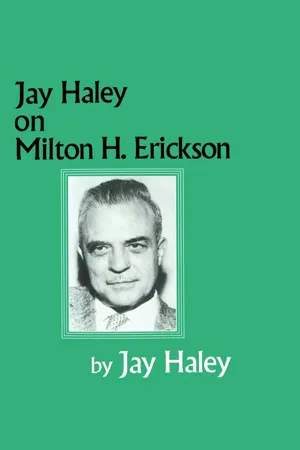
The first chapter provides a succinct biography of this extraodinary man, describing how Erickson overcame numerous adversities in early life, and how these events shaped his development as a highly innovative thinker. Commentaries on Milton Erickson, M.D. examines the practical and theoretical aspects of Erickson's methods, including his therapeutic posture, expectation of change, emphasis on the positive, acknowledgement of more than one solution to a problem, blocking of symptomatic behavior, change in relation to the therapist, use of anectodes, and willingness to "let go" of patients. A Review of Ordeal Therapy focuses on a controversial therapeutic technique successfully used by Erickson. Haley cautions the reader, however, of the care with which this powerful technique should be exercised. A fascinating dialogue between Jay Haley and John Weakland,
- 200 pages
- English
- ePUB (mobile friendly)
- Available on iOS & Android
eBook - ePub
Jay Haley On Milton H. Erickson
About this book
Information
1
Milton H. Erickson: A Brief Biography (1967)
Milton H. Erickson, M.D., is generally acknowledged to be the world’s leading practitioner of medical hypnosis. His writings on hypnosis are the authoritative word on techniques of inducing trance, experimental work exploring the possibilities and limits of the hypnotic experience, and investigations of the nature of the relationship between hypnotist and subject.
Perhaps less well known is the fact that Dr. Erickson has a unique approach to psychotherapy which represents a major innovation in therapeutic technique. For many years he has been developing effective and practical methods of treatment which may or may not involve the formal induction of trance. Those who think of him largely as a hypnotherapist might be surprised that he lists himself in the telephone directory as psychiatrist and family counselor.
Dr. Erickson is both a psychiatrist and a psychologist, having received his medical degree and his master’s degree in psychology simultaneously. Consequently he is a Fellow of both the American Psychiatric Association and the American Psychological Association. In addition, he is a Fellow of the American Psychopathological Association, and he is an honorary member of numerous societies of medical hypnosis in Europe, Latin America, and Asia. He was the founding president of the American Society for Clinical Hypnosis as well as the founder and editor of that society’s professional journal. His professional life since 1950 has included both a busy private practice in Phoenix, Arizona, and constant traveling to offer seminars in hypnosis and lectures both in the United States and many foreign countries.
Born in Aurum, Nevada, a town which has since disappeared, Dr. Erickson is one of the few people who traveled east in a covered wagon when his family settled on a farm in Wisconsin. His interest in hypnosis came about when he was an undergraduate student in psychology at the University of Wisconsin and observed a demonstration of hypnosis by Clark L. Hull. Impressed by what he had seen, Erickson invited Hull’s subject up to his room and hypnotized him himself. From that time on he taught himself to be a hypnotist by using as subjects anyone who would hold still for him, including his fellow students, friends, and his family when he returned to his father’s farm for summer vacation. In the Fall of the next year he took part in a seminar in hypnosis from Hull, which was largely devoted to examining Erickson’s experiences hypnotizing people during the summer and his experimental work in the laboratory. By his third year of college, Erickson had hypnotized several hundred people, he had carried on quite a number of experiments, and he had demonstrated hypnosis for the faculty of the medical school and the psychology department as well as the staff of Mendota State Hospital.
After receiving his medical degree at the Colorado General Hospital and completing his internship and a special period of training at the Colorado Psychopathic Hospital, Erickson accepted the position of junior psychiatrist at Rhode Island State Hospital. A few months later, in April, 1930, he joined the staff of the Research Service at the Worcester State Hospital and rapidly rose from junior to senior to Chief Psychiatrist on the Research Service. Four years later, he went to Eloise, Michigan, as Director of Psychiatric Research and Training at Wayne County General Hospital and Infirmary. In addition, he became an Associate Professor of Psychiatry at the Wayne State University College of Medicine as well as a full professor in the Graduate School there. Briefly, he was concurrently a Visiting Professor of Clinical Psychology at Michigan State University in East Lansing. He did his most extensive experimentation with hypnosis at Eloise and found ideas from hypnosis particularly useful in the training of psychiatric residents.
When training psychiatrists, as well as medical students, Dr. Erickson put great emphasis upon learning how to observe a patient, and he believes that training as a hypnotist increases that ability. His own extraordinary powers of observation are legendary. Remarking that physical limitations made him more observant, he says, “I had a polio attack when 17 years old and I lay in bed without a sense of body awareness. I couldn’t even tell the position of my arms or legs in bed. So I spent hours trying to locate my hand or my foot or my toes by a sense of feeling, and I became acutely aware of what movements were. Later, when I went into medicine, I learned the nature of muscles. I used that knowledge to develop an adequate use of the muscles polio had left me and to limp with the least possible strain; this took me ten years. I also became extremely aware of physical movements and this has been exceedingly useful. People use those little telltale movements, those adequate movements that are so revealing if one can notice them. So much of our communication is in our bodily movements, not in our speech. I’ve found that I can recognize a good piano player not by the noises he makes, but by the ways his fingers touch the keys. The sure touch, the delicate touch, the forceful touch that is so accurate. Proper playing involves such exquisite physical movement.”
Dr. Erickson cannot recognize a good piano player by the noise he makes because he is tone deaf. This, too, he defines as an asset in his work. “So much is communicated by the way a person speaks,” he says. “My tone deafness has forced me to pay attention to inflections in the voice. This means I’m less distracted by the content of what people say. Many patterns of behavior are reflected in the way a person says something rather than in what he says.”
Dr. Erickson is also color blind, and this too became an asset when he experimented with producing color blindness with hypnosis. Experimenter bias was avoided. To this writer, one of the more extraordinary scenes in research is reported in “The Hypnotic Induction of Hallucinatory Color Vision Followed by Pseudo Negative After-Images.” Experimental subjects in trance were shown white sheets of paper and they hallucinated colors upon them. Then they were immediately shown white sheets of paper and hallucinated the after-image, this being the complementary color. Holding up the white sheets was Dr. Erickson, who could not visualize the colors whether awake or in trance. (The one color he can enjoy is purple. Although it might not always be an appropriate color, he manages to surround himself with it whenever he can. He wears purple ties and sport shirts, his pajamas are purple, and the bathroom in his house has purple walls.)
Dr. Erickson likes to describe therapy as a way of helping patients extend their limits, and he has spent his own life doing that. In 1919 when he was stricken with polio, he was informed that he would never again be able to walk. After spending many hours concentrating on achieving a flicker of movement in the muscles of his legs, he was up on crutches within a year. He even managed to obtain and hold a sitting-down job in a cannery to help finance his way into the University of Wisconsin. After his first year at the university, he was advised by his physician to spend his summer vacation getting a great deal of exercise in the sunshine without using his legs. Deciding that a canoe trip would provide the appropriate exercise, Erickson set out in June in a 17-foot canoe, wearing a bathing suit, a pair of overalls, and a knotted handkerehief on his head for a hat. He did not have the strength in his legs to pull his canoe out of the water and he could swim only a few feet. His supplies for his summer’s voyage consisted of a small sack of beans, another of rice, and a few cooking utensils. His wealth for the purchase of more supplies consisted of $2.32. With these provisions, he spent from June until September traveling through the lakes of Madison, down the Yahara River, down the Rock River, into the Mississippi and on down to a few miles above St. Louis, then back up the Illinois River, through the Hennepin Canal to the Rock River, and so to Madison. He foraged for his food along the way by eating what fish he could catch, finding edible plants on the river banks when he camped at night, and harvesting crops from the Mississippi. These crops consisted of the bushels of peelings the cooks on the river steamers threw overboard. Among them, there were always a few whole potatoes or apples thrown out by mistake. By the end of the summer, he had traveled a distance of 1,200 miles with almost no supplies or money, without sufficient strength in his legs to carry his canoe over the dams which blocked his way, and so physically weak when he began that he could hardly paddle a few miles downstream without getting overtired.
The journey was even more complicated for Erickson than it would have been for anyone else. He was the kind of young man who refused to ask assistance of anyone. That is, he refused to ask directly, but he enjoyed arranging the situation so that people would “spontaneously” do things for him. In telling about his canoe trip, he said, “I would paddle within hailing distance of a fishing boat. Since I tanned very deeply and wore that knotted handkerchief on my head, the fishermen would get curious and hail me to ask a few questions. I would tell them I was a pre-med student at the University of Wisconsin canoeing for my health. They would ask how the fishing was, I would reply that the day was yet young. Invariably they gave me fish at the end of the conversation, though I never asked for any. Usually they tried to give me catfish, but I always refused them. Catfish were much too expensive and they were making their living fishing. When I refused the catfish they would give me double or three times the amount of Mississippi perch.”
Although he could not carry his canoe over a dam, Dr. Erickson would never ask for assistance. He says, “I would shinny up one of the poles that are always around dams. Soon people would gather and look up curiously at me sitting up there reading a German book I brought with me in preparation for my medical studies. Finally someone would ask me what on earth I was doing up on that pole. I would look up from my book and say that I was waiting to get my canoe carried over the dam. This always meant volunteer service.”
With an occasional day’s work along the river, and volunteer service, Erickson completed his summer of canoeing, extending his limits by putting himself in good physical shape. When he returned, his chest measurement had increased six inches, he could swim a mile, and he could paddle upstream against a four-mile current from dawn to dusk. He could also carry his own canoe over a dam.
Years later, in 1952, Dr. Erickson suffered a rare medical occurrence when he was stricken with another strain of polio. This attack markedly affected his right arm and side. Within a year he had made one of the more difficult hikes in the mountains of Arizona with the use of two canes.
Dr. Erickson left Eloise and settled in Phoenix, largely for his health. His private practice is conducted in a unique setting. The office in which he sees patients is in his home, a small three-bedroom brick house in a pleasant neighborhood. His waiting room is the living room, and his patients have been exposed over the years to his family life and his eight children. He sees patients in an office which is just large enough to contain his desk, a few chairs, and bookcases. On the wall is a picture of his parents who lived until into their nineties, and scattered about are family mementos from over the years, including a stuffed badger. This office is almost absurdly unpretentious for a psychiatrist of Dr. Erickson’s stature, but his attitude toward it is that it is convenient. A young disciple who was setting up a practice in Phoenix was seeking a proper office, and he once protested to Dr. Erickson that his office was not all that it might be. Dr. Erickson replied that it had been even less fancy when he first began practice, since the room had in it only a card table and two chairs. “However,” he said, “I was there.”
Besides his private practice, Dr. Erickson carries on many of his professional activities from his home, including editing The American Journal of Clinical Hypnosis with the assistance of his wife. Elizabeth Erickson has worked with her husband in many activities over the years and co-authored a number of papers with him. They met when she was a psychology student and laboratory assistant at Wayne State University, and were married in 1936. Dr. Erickson, who had been previously married, brought three children to the marriage. Since then, they have had five more children, with a consequently lively family life. Mrs. Erickson once estimated that they would have at least one teenager in the family for 30 consecutive years. The last two are now in their teens, and the earlier children are married and bringing home grandchildren.
Dr. Erickson uses examples from his life with his children when discussing hypnosis and therapy. Readers who might wonder what it is like to have a father who is a master hypnotist could enjoy the article “Pediatric Hypnotherapy.” Dr. Erickson describes handling an incident with his son Robert to illustrate how to deal with children in pain. Robert fell down the back stairs, split his lip, and knocked his upper tooth back into the maxilla. He was bleeding and screaming with pain and fright. His parents rushed to him and saw that it was an emergency. Dr. Erickson writes,
No effort was made to pick him up. Instead, as he paused for breath for fresh screaming, he was told quickly, simply, sympathetically, and emphatically, “That hurts awful, Robert. That hurts terrible.”
Right then, without any doubt, my son knew that I knew what I was talking about. He could agree with me and he knew I was agreeing with him completely. Therefore he could listen respectfully to me, because I had demonstrated that I understood the situation fully.
Rather than reassure the boy, Dr. Erickson proceeded in typical fashion:
Then I told Robert, “And it will keep right on hurting.” In this simple statement, I named his own fear, confirmed his own judgment of the situation, demonstrated my good intelligent grasp of the entire matter and my entire agreement with him, since right then he could foresee a lifetime of anguish and pain for himself.
The next step for him and for me was to declare, as he took another breath, “And you really wish it would stop hurting.” Again, we were in full agreement and he was gratified and even encouraged in his wish. And it was his wish, deriving entirely from within him and constituting his own urgent need.
With the situation so defined, I could then offer a suggestion with some certainty of his acceptance. This suggestion was, “Maybe it will stop hurting in a little while, in just a minute or two.”
This was a suggestion in full accord with his own needs and wishes and, because it was qualified by “maybe it will,” it was not in contradiction to his own understandings of the situation. Thus he could accept the idea and initiate his response to it.
Dr. Erickson then shifted to another important matter. As he puts it:
Robert knew that he hurt, that he was a damaged person; he could see his blood upon the pavement, taste it in his mouth and see it on his hands. And yet, like all other human beings, he too could desire narcissistic distinction in his misfortune, along with the desire for even more narcissistic comfort. Nobody wants a picayune headache; since a headache must be endured, let it be so colossal that only the sufferer could endure it. Human pride is so curiously good and comforting! Therefore, Robert’s attention was doubly directed to two vital issues of comprehensible importance to him by the simple statements, “That’s an awful lot of blood on the pavement. Is it good, red, strong blood? Look carefully, Mother, and see. I think it is, but I want you to be sure.”
Examination proved it to be good strong blood, but it was necessary to verify this by examination of it against the white background of the bathroom sink. In this way the boy, who had ceased crying in pain and fright, was cleaned up. When he went to the doctor for stitches the question was whether he would get as many as his sister had once been given. The suturing was done without anesthetic on a boy who was an interested participant in the procedure.
Although Dr. Erickson has a local practice, many of the patients who come to see him have traveled considerable distances. Patients will fly from as far as New York or from Mexico City to be relieved of their troubles almost as if visiting a surgeon, and others commute irregularly from the West Coast. In recent years both his practice and his teaching have been curtailed because of illness. When he attends an occasional meeting now it is in a wheelchair, and his work load at home is reduced.
Many of the admirers of Dr. Erickson have felt that his approach to therapy and hypnosis have not been adequately presented to the psychiatric community. Although he is well known and a figure of some controversy, his basic writings have not been easily available. He has published over 100 papers on a variety of subjects over the years, but the reader of an occasional article or the student at a lecture cannot properly appreciate the magnitude of this man’s work or the innovations he has introduced.
2
Commentary on Milton H. Erickson, M.D. (1967)
In every profession, there is an occasional man who can be called an “original” because he works within a profession while deviating markedly from the ways of most of his colleagues. Sometimes such a man persuades the profession to follow him, and at other times he remains an outsider and does not make a ripple in the stream. Sigmund Freud took a unique direction and offered both a set of powerful ideas and an organization to foster and perpetuate a following. Harry Stack Sullivan did not organize, but the force of his new ideas and his personal influence as a teacher impressed his views upon the profession. As an innovator in psychiatry, Milton H. Erickson can be classed with Freud and Sullivan. Whether he will have as great an influence on the field is yet to be determined.
Like Freud, Erickson’s major ideas came out of the field of hypnosis. Unlike Freud, he has stayed within the hypnotic tradition and reached quite different conclusions about the nature of psychopathology and therapeutic change. Like Sullivan, Erickson has placed greater emphasis upon the relationship than upon the individual. Unlike both Freud and Sullivan, Erickson’s primary interest has been the exploration of diverse techniques for producing therapeutic change. What is most original about him, and what makes his approach not a simple school or method, is his flexibility; he is willing to orient his therapeutic approach to the particular problem before him. In a period of psychiatric history where a man was judged by whether or not he followed the proper theory and method, Erickson originated experimental therapy.
In the first half of this century, during the period of Erickson’s development, there was a trend toward defense against innovation in the psychiatric profession. As psychoanalysis gained prestige in the consulting room and the university, there was a shift from the original exploratory approach of Freud to a ritualized treatment method and the repetition of stereotyped ideas. In this process, a peculiar change in emphasis took place in psychiatry. Complex human dilemmas were forced into a narrow theoretical scheme, and therapy began to be judged by whether the proper procedures were followed and not by whether results were obtained. It was in this climate...
Table of contents
- Cover
- Half Title
- Title Page
- Copyright Page
- Table of Contents
- Acknowledgments
- Introduction
- 1. Milton H. Erickson: A Brief Biography (1967)
- 2. Commentary on Milton H. Erickson, M.D (1967)
- 3. Erickson’s Contribution to Therapy (1982)
- 4. A Review of Ordeal Therapy (1984)
- 5. Remembering Erickson: A Dialogue Between Jay Haley and John Weakland (1985)
- 6. Why Not Long-Term Therapy? (1990)
- 7. Zen and the Art of Therapy (1992)
- 8. Erickson Hypnotic Demonstration: 1964 (1993)
- 9. Typically Erickson (1993)
Trusted by 375,005 students
Access to over 1.5 million titles for a fair monthly price.
Study more efficiently using our study tools.
Frequently asked questions
Yes, you can cancel anytime from the Subscription tab in your account settings on the Perlego website. Your subscription will stay active until the end of your current billing period. Learn how to cancel your subscription
No, books cannot be downloaded as external files, such as PDFs, for use outside of Perlego. However, you can download books within the Perlego app for offline reading on mobile or tablet. Learn how to download books offline
Perlego offers two plans: Essential and Complete
- Essential is ideal for learners and professionals who enjoy exploring a wide range of subjects. Access the Essential Library with 800,000+ trusted titles and best-sellers across business, personal growth, and the humanities. Includes unlimited reading time and Standard Read Aloud voice.
- Complete: Perfect for advanced learners and researchers needing full, unrestricted access. Unlock 1.5M+ books across hundreds of subjects, including academic and specialized titles. The Complete Plan also includes advanced features like Premium Read Aloud and Research Assistant.
We are an online textbook subscription service, where you can get access to an entire online library for less than the price of a single book per month. With over 1.5 million books across 990+ topics, we’ve got you covered! Learn about our mission
Look out for the read-aloud symbol on your next book to see if you can listen to it. The read-aloud tool reads text aloud for you, highlighting the text as it is being read. You can pause it, speed it up and slow it down. Learn more about Read Aloud
Yes! You can use the Perlego app on both iOS and Android devices to read anytime, anywhere — even offline. Perfect for commutes or when you’re on the go.
Please note we cannot support devices running on iOS 13 and Android 7 or earlier. Learn more about using the app
Please note we cannot support devices running on iOS 13 and Android 7 or earlier. Learn more about using the app
Yes, you can access Jay Haley On Milton H. Erickson by Jay Haley in PDF and/or ePUB format, as well as other popular books in Psychology & Mental Health in Psychology. We have over 1.5 million books available in our catalogue for you to explore.