The Politics of Haunting and Memory in International Relations
eBook - ePub

The Politics of Haunting and Memory in International Relations

  1. 178 pages
  2. English
  3. ePUB (mobile friendly)
  4. Available on iOS & Android
eBook - ePub

The Politics of Haunting and Memory in International Relations

About this book

International Relations has traditionally focused on conflict and war, but the effects of violence including dead bodies and memorialization practices have largely been considered beyond the purview of the field. Drawing on Jacques Derrida's notion of hauntology to consider the politics of life and death, Auchter traces the story of how life and death and a clear division between the two is summoned in the project of statecraft. She argues that by letting ourselves be haunted, or looking for ghosts, it is possible to trace how statecraft relies on the construction of such a dichotomy.

Three empirical cases offer fertile ground for complicating the picture often painted of memorialization: Rwandan genocide memorials, the underexplored case of undocumented immigrants who die crossing the US-Mexico border, and the body/ruins nexus in 9/11 memorialization.

Focusing on the role of dead bodies and the construction of particular spaces as the appropriate sites for memory to be situated, it offers an alternative take on the new materialisms movement in international relations by asking after the questions that arise from an ethnographic approach to the subject: viewing things from the perspective of dead bodies, who occupy the shadowy world of post-conflict international politics. This work will be of great interest to students and scholars of critical international relations, security studies, statecraft and memory studies.

Frequently asked questions

Yes, you can cancel anytime from the Subscription tab in your account settings on the Perlego website. Your subscription will stay active until the end of your current billing period. Learn how to cancel your subscription.
At the moment all of our mobile-responsive ePub books are available to download via the app. Most of our PDFs are also available to download and we're working on making the final remaining ones downloadable now. Learn more here.
Perlego offers two plans: Essential and Complete
  • Essential is ideal for learners and professionals who enjoy exploring a wide range of subjects. Access the Essential Library with 800,000+ trusted titles and best-sellers across business, personal growth, and the humanities. Includes unlimited reading time and Standard Read Aloud voice.
  • Complete: Perfect for advanced learners and researchers needing full, unrestricted access. Unlock 1.4M+ books across hundreds of subjects, including academic and specialized titles. The Complete Plan also includes advanced features like Premium Read Aloud and Research Assistant.
Both plans are available with monthly, semester, or annual billing cycles.
We are an online textbook subscription service, where you can get access to an entire online library for less than the price of a single book per month. With over 1 million books across 1000+ topics, we’ve got you covered! Learn more here.
Look out for the read-aloud symbol on your next book to see if you can listen to it. The read-aloud tool reads text aloud for you, highlighting the text as it is being read. You can pause it, speed it up and slow it down. Learn more here.
Yes! You can use the Perlego app on both iOS or Android devices to read anytime, anywhere — even offline. Perfect for commutes or when you’re on the go.
Please note we cannot support devices running on iOS 13 and Android 7 or earlier. Learn more about using the app.
Yes, you can access The Politics of Haunting and Memory in International Relations by Jessica Auchter in PDF and/or ePUB format, as well as other popular books in Politics & International Relations & International Relations. We have over one million books available in our catalogue for you to explore.
Interventions
Edited by:
Jenny Edkins, Aberystwyth University and Nick Vaughan-Williams, University of Warwick
‘As Michel Foucault has famously stated, “knowledge is not made for understanding; it is made for cutting.” In this spirit the Edkins–Vaughan-Williams Interventions series solicits cutting edge, critical works that challenge mainstream understandings in international relations. It is the best place to contribute post-disciplinary works that think rather than merely recognize and affirm the world recycled in IR’s traditional geopolitical imaginary.’
Michael J. Shapiro, University of Hawai’i at Mãnoa, United States
The series aims to advance understanding of the key areas in which scholars working within broad critical post-structural and post-colonial traditions have chosen to make their interventions, and to present innovative analyses of important topics.
Titles in the series engage with critical thinkers in philosophy, sociology, politics and other disciplines and provide situated historical, empirical and textual studies in international politics.
Critical Theorists and International Relations
Edited by Jenny Edkins and Nick Vaughan-Williams
Ethics as Foreign Policy
Britain, the EU and the other
Dan Bulley
Universality, Ethics and International Relations
A grammatical reading
Véronique Pin-Fat
The Time of the City
Politics, philosophy, and genre
Michael J. Shapiro
Governing Sustainable Development
Partnership, protest and power at the world summit
Carl Death
Insuring Security
Biopolitics, security and risk
Luis Lobo-Guerrero
Foucault and International Relations
New critical engagements
Edited by Nicholas J. Kiersey and Doug Stokes
International Relations and Non-Western Thought
Imperialism, colonialism and investigations of global modernity
Edited by Robbie Shilliam
Autobiographical International Relations
I, IR
Edited by Naeem Inayatullah
War and Rape
Law, memory and justice
Nicola Henry
Madness in International Relations
Psychology, security and the global governance of mental health
Alison Howell
Spatiality, Sovereignty and Carl Schmitt
Geographies of the nomos
Edited by Stephen Legg
Politics of Urbanism
Seeing like a city
Warren Magnusson
Beyond Biopolitics
Theory, violence and horror in world politics
François Debrix and Alexander D. Barder
The Politics of Speed
Capitalism, the state and war in an accelerating world
Simon Glezos
Politics and the Art of Commemoration
Memorials to struggle in Latin America and Spain
Katherine Hite
Indian Foreign Policy
The politics of postcolonial identity
Priya Chacko
Politics of the Event
Time, movement, becoming
Tom Lundborg
Theorising Post-Conflict Reconciliation
Agonism, restitution and repair
Edited by Alexander Keller Hirsch
Europe’s Encounter with Islam
The secular and the postsecular
Luca Mavelli
Re-Thinking International Relations Theory via Deconstruction
Badredine Arfi
The New Violent Cartography
Geo-analysis after the aesthetic turn
Edited by Sam Okoth Opondo and Michael J. Shapiro
Insuring War
Sovereignty, security and risk
Luis Lobo-Guerrero
International Relations, Meaning and Mimesis
Necati Polat
The Postcolonial Subject
Claiming politics/governing others in late modernity
Vivienne Jabri
Foucault and the Politics of Hearing
Lauri SiisiÀinen
Volunteer Tourism in the Global South
Giving back in neoliberal times
Wanda Vrasti
Cosmopolitan Government in Europe
Citizens and entrepreneurs in postnational politics
Owen Parker
Studies in the Trans-Disciplinary Method
After the aesthetic turn
Michael J. Shapiro
Alternative Accountabilities in Global Politics
The scars of violence
Brent J. Steele
Celebrity Humanitarianism
The ideo...
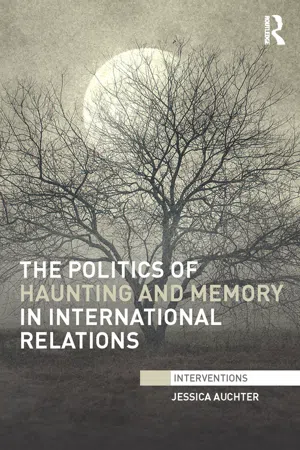
Table of contents

  1. Cover Page
  2. Half Title Page
  3. Frontmatter 1
  4. Title Page
  5. Copyright Page
  6. Table of Contents
  7. List of figures
  8. Acknowledgements
  9. 1 Ghostly politics: an introduction
  10. 2 ‘We’re All of Us Haunted and Haunting’
  11. 3 Bones in a brown bag: haunting and the place of the body in Rwandan genocide memorialisation
  12. 4 Border monuments: memory, counter-memory, and (b)ordering practices along the US–exico border
  13. 5 Vanishing monuments: absence and 9/11 memorialisation
  14. 6 After ghostly politics: some conclusions
  15. Index