eBook - ePub
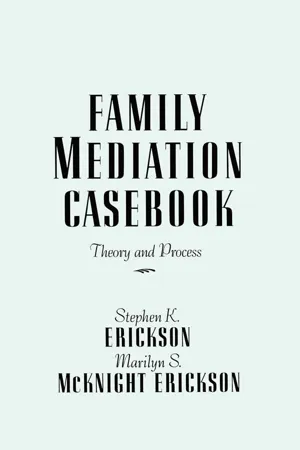
Family Mediation Casebook
Theory And Process
- 231 pages
- English
- ePUB (mobile friendly)
- Available on iOS & Android
eBook - ePub
About this book
First published in 1989. This book contains a straightforward, unembellished articulation of the how to of family and divorce mediation, enabling the reader to bring it to successful conclusion; emphasis on process and technique is amply illustrated by case presentations and analyses. The authors provide a well-thought-out discussion of the differences between mediation and counseling, and throughout the book, in their exposition of the mediation process, make clear how this differs from the adversarial process.
1
A Conceptual Framework of Divorce Mediation
Although much has been published in the last 10 years about divorce mediation, few have tried to explain in detail the actual mechanics of the process. This book attempts to provide the reader with both a theoretical framework and a look at how the theory is applied to actual cases mediated successfully.
Conceptual frameworks have always been helpful in describing a theory or explaining a complex idea. Were we to know all there is to know about teaching people to cooperate, this world would be a very different place to live. Although we still have a great deal to learn, the fol-lowing ideas emerge from our experience during the past 11 years, as well as from the existing research and literature on conflict resolution.
Mediation, particularly family mediation, is easy to describe in a few words. It is a communication process by which a husband and wife resolve the practical and the emotional issues of divorce or separation in a mutual, cooperative manner as opposed to an adversarial, competitive manner. Using a neutral mediator to guide the couple’s communication, mediation allows couples to make the best possible decisions in the settlement of their divorce, even though they may be in great turmoil and conflict. Given the two parties’ different values, different abilities and limited resources to face the future, mediation provides a participatory process for them to achieve a successful termination of a partnership that has created children, shared income and accumulated assets. The goal is for each of them to receive the best settlement possible that will satisfy to the greatest extent possible their respective needs and interests, now and in the future.
Although the couple may be highly conflicted, the goal of mediation is to prevent the conflict from becoming destructive. Conflict is always painful: “Conflict is among the most common causes of long-term, severe suffering because nowhere do we lose more control than when we are in true conflict” (Glasser, 1984, p. 149). When a husband and wife divorce, the pain of the conflict can become infinitely damaging to the entire family.
Unfortunately, as a society we have given little assistance to families in divorce and in most cases we have unknowingly generated more harm and pain through our adversarial system of justice. In fact, our society has constructed a legal remedy for resolving the divorce conflict that is completely antithetical to basic mental health principles. “The successful divorce should also leave each partner with a balanced view of the other and of the marriage, and with a sense of psychological closure” (Kressel, 1985, p. 77). The adversarial system accomplishes neither goal. At the point couples embark on the process of separation and divorce, society advises them to get a zealous attorney to protect themselves. In order to be successful in an adversarial divorce, couples learn to view their spouse as an adversary, resulting in a billion-dollar industry that often generates even more conflict and pain for the couple and their children. Because the nature of the adversarial system requires zealous representation, an attorney who might wish to take a balanced view of the other side may be accused of providing weak and ineffective representation. Unfortunately, the net result of a lawyer’s representation is often exacerbation of the conflict rather than psychological closure.
Divorce mediation is an attempt to establish a more humane, cooperative approach to divorce settlement. This is consistent with the objectives of mental health practitioners who assert that couples must move beyond pain, anger and mistrust in order to achieve a satisfactory resolution of the divorce experience. As will be seen by the case examples, mediated divorces promise to be less painful and more protective of the “needs” of couples in the midst of divorce.
Many conceptual frameworks can be summarized in a single phrase, such as systems theory, symbolic interac-tionism, problem-solving therapy, or other descriptive words that capture the theory. The term “process theory” is chosen to describe our conceptual framework of mediation based upon the belief that a set of fair procedural steps, coupled with application of many techniques pioneered by mental health professionals, results in a process that inevitably moves the couple towards cooperative choices and tolerable solutions.
The process of family mediation provides an orderly manner for couples to begin to achieve wholeness after the emotional and financial chaos of terminating the marriage relationship because it does not require each spouse to view the other as an adversary. In addition, a cornerstone of the theory is that people achieve quicker, wiser and more lasting results when they are encouraged to make their own decisions about the termination of the marital partnership than if others make choices for them.
Unfortunately, most couples are unable to sit down around the kitchen table and make good decisions about children, money and property without professional help. This is because emotions are so intense during the divorce that their decision-making process gets contaminated by the emotional overlay. Indeed, researchers have shown that the mental health effects of divorce and separation are overwhelming (Barker, 1984, p. 21). Traditionally, couples have turned to therapists for help with the emotions and to lawyers for help with the decisions to be made affecting the material things of the marriage (including children).
With the emergence of family mediation, couples may now use one professional mediator to assist with the resolution of the material things of the marriage; in that process the emotions are often improved. Indeed, the process theory of divorce mediation argues that it is always therapeutic to create order and certainty out of chaos and confusion. For many couples, the cooperative decision making involved in divorce mediation is enough therapy in itself to get them through the business of finishing the stages of the emotional divorce. For others, a referral to a qualified therapist may be necessary to keep the mediation negotiations from becoming negatively affected by intense emotions. In such cases, the processes of mediation and therapy occur simultaneously and greatly complement each other.
The building blocks of this conceptual framework are observed in the way a mediator influences four aspects of the negotiations. These are: (1) communication; (2) attitudes; (3) negotiating methods; and (4) outcome goals. To understand the conceptual framework of family mediation, it is important to analyze each part of the process and compare it with the adversarial framework of a litigated or lawyer-negotiated divorce. The following, then, is a description of the four areas a mediator tries to influence so as to create a cooperative settlement outcome.
1. COMMUNICATION
Open and Honest Rather Than Guarded, Secretive or Deceptive Communication
A professional family mediator will have clearly in mind the skills needed to influence healthy communication. Bolton (1979) outlines many of the basic tenets of what the mediator must do in this phase of the process. He states that open, honest communication, with an absence of blaming and fault-finding, is essential to maintaining a healthy relationship. Researcher Morton Deutsch (1973) looked not at marriage relationships but rather at the bargaining and negotiation processes and reached a similar conclusion about communication. He argued that cooperative negotiations also required an environment where the communication patterns were open and honest and contained little or no blaming or fault-finding (pp. 351–400).
Successful divorce mediation requires intervention skills that diminish or eliminate the need to be guarded, secretive or deceptive in communications between the parties. This is often difficult, because they may have previously retained an attorney who has urged each of them to be wary of disclosing anything material to the other and the attorney may even have strongly advised the couple to avoid speaking to each other. This is certainly good advice if the decisions are going to be resolved in the competitive atmosphere of the courthouse (or the courthouse steps). However, we have learned from the mental health profession that good marriages are based upon open and honest communication. We know from Deutsch and from our own experience with couples who achieve success in divorce mediation that open and honest communication is one of the first prerequisites to successful resolution of the concrete issues of divorce.
Mediators create the environment for open and honest communication by establishing formal (see Appendix A) and informal rules which include:
1. Confidentiality that prohibits the use of mediation discussions in the adversarial process, and also commits each to not discuss what is happening in mediation with others outside the room except by prior agreement. Confidentiality also respects their privacy in mediation and does not allow the mediator to discuss their mediation with others unless written permission is obtained from both parties.
2. Full disclosure assures each of them that they will mediate with full and complete information about all assets, liabilities and other information pertinent to the settlement of their divorce.
3. Speak for yourself using “I” statements that do not include statements about or in place of the other party to the mediation.
4. Speak in positive language that does not allow for disparaging remarks aimed at the other party, either explicitly or implicitly.
These rules lay the groundwork for open, honest discussion of all of the issues without harm, secrets or deception. They are intended to ensure an atmosphere of emotional safety, as well as to promote direct communication.
Some family law attorneys maintain that only the power of the court can compel honesty. This is false; in fact, obtaining necessary facts about assets and finances in an adversarial manner actually creates the environment for dishonesty and unwillingness to disclose by imposing a competitive process that encourages vigorous attempts to “win” the conflict. Frequently, the unwillingness to disclose in a litigating forum results from fear and frustration with the process. Skilled family mediators have been able to mediate even the most complex divorce cases involving several million dollars in property assets using the process theory approach to mediation. There is no need to assume that only custody matters should be submitted to mediation. However, a mediator must be aware of the need to be detailed and demanding when helping the couple identify and value their assets.
Persuasive Rather Than Coercive Communication
Deutsch (1973) observes that destructive conflict is characterized by a tendency to expand and escalate (p. 351). Also, he notes: “Paralleling the expansion of the scope of conflict, there is an increasing reliance upon a strategy of power and upon the tactics of threat, coer-cion, and deception. Correspondingly, there is a shift away from a strategy of persuasion and from the tactics of conciliation, minimization of differences and enhancement of mutual understanding and goodwill” (p. 352).
In the process theory of mediation, the mediator’s technique of immediately intervening to prohibit coercive communication statements and patterns has the effect of reversing the escalation of the conflict. Efforts at teaching the couple to communicate in a persuasive manner further create an environment where cooperation can occur.
Listening skills are another basic tool to encourage persuasive communication. Any statement made by a party that contains a threat or an “if …, then …” sequence will be noted by the mediator as not being helpful to the process. The mediator may then ask for a restatement or may even rephrase what is being said in order to understand the underlying need expressed by the person. Indeed, many facial expressions observed in the mediation room evidencing anger or hostility are often preceded by the other party communicating in a threatening or coercive manner. Parties are taught by the mediator that it is easier for them to get their needs met through persuasive communication rather than by coercion.
Little or No Blaming or Fault-Finding as Opposed to Finding Fault in Order to Prove One’s Case
Mediators try to reduce or eliminate blaming and faultfinding. Litigators use fault-finding as a way to win their cases. It is still the law in Louisiana that if an attorney can show that the wife engaged in adulterous behavior or other conduct that would entitle a husband to obtain a legal separation, during marriage or the period of separation, she is not entitled to receive spousal support (Louisiana Civil Code, Article 160). Moreover, in every state, in order to win custody or a higher level of ownership of the children, one must show that the other parent engaged (or will engage) in faulty parenting as compared to one’s own parenting abilities.
Process theory mediators assume that both parents are significant to the children as parents and that the goal is not to spend thousands to prove who was the worst parent in the past, but to define the shape of the parenting relationship of each parent in the future. Parents in mediation will learn how to make agreements and carry them out over a period of time so that each parent can be the good, loving parent he or she wishes to be. Such learning cannot occur in an atmosphere of blame and faultfinding.
Mediators minimize blaming and fault finding communication patterns by using several methods. First, the couple is asked to agree that such communication does not enhance the process, but rather detracts from a successful mediation process. Second, the mediator redefines the issues in such a way as to require mutual positive work to answer the question, rather than asking the question in such a way as to require a good-bad examination. Third, mediators use skills and techniques to focus the couple on the future rather than on the past.
In the process theory of divorce mediation, the mediator must also be able to influence the attitudes of the parties in order to achieve a successful, cooperative outcome. Thus, the intervention used by the mediator in such a way as to change attitudes becomes the second major aspect of the conceptual framework.
2. ATTITUDES
Create Trust, Rather Than Encourage Mistrust and Suspicion
Experts on cooperative conflict resolution methods stress the importance of creating trust and attitudes of mutuality. The problem for couples in the midst of divorce is to help them find the concrete agreements both can make in order to begin experiencing a measure of trust in the other.
We have frequently been asked by media representatives, “How can you possibly expect a husband and wife to sit down to the mediation table and work out their divorce—aren’t they ready to kill each other?” Mediators understand that when a couple decides to divorce, they are perhaps at the most highly conflicted point in their entire lives. Yet it does not make sense to say to them, “You each need to get a strong, aggressive attorney and spend the next 18 months trying to prove that the other is the root cause of all your problems.” It is much wiser from both a commonsense as well as a mental health viewpoint to encourage a change of attitude so productive interaction as separate parents in the future will occur. As idealistic as this may sound, all couples indicate a preference for divorcing with dignity.
Divorce mediators and most mental health professionals agree that in order for the couple to carry on separate parenting after the divorce, they must have some measure of trust or they will never be able to effectively exchange the children and communicate about all the joint issues that arise when parenting the children from separate homes. Divorce mediators also know that good negotiations require an element of trust in order to be successfully concluded and implemented.
Therefore, mediators create an attitude of trust by first assuming that all people are capable of giving and receiving trust and then by asking the couple to begin the process of rebuilding trust. This is done by selecting small, manageable areas of decision making, asking them to agree, and then helping t...
Table of contents
- Cover
- Half Title
- Title Page
- Copyright Page
- Table of Contents
- Preface by Florence W. Kaslow, Ph.D.
- Introduction
- 1. A Conceptual Framework of Divorce Mediation
- 2. Major Mediator Interventions
- 3. Dan and Linda: A Typical Divorce Mediation Case
- 4. Ron and Sue: A Spousal Abuse Relationship in Divorce Mediation
- 5. Parenting Disputes: Who Will Have the Children?
- 6. Maternal Grandparents and Dad: Who Will Raise Christine?
- 7. Perceptions of Power in Mediation: Case Examples of Power Imbalance
- 8. Strategies to Avoid Impasse
- Appendix A: Rules and Guidelines of Family Mediation Services
- Appendix B: Agreement to Begin Mediation
- Appendix C: Family Mediation Services Questionnaire
- Reference
- Index
Trusted by 375,005 students
Access to over 1.5 million titles for a fair monthly price.
Study more efficiently using our study tools.
Frequently asked questions
Yes, you can cancel anytime from the Subscription tab in your account settings on the Perlego website. Your subscription will stay active until the end of your current billing period. Learn how to cancel your subscription
No, books cannot be downloaded as external files, such as PDFs, for use outside of Perlego. However, you can download books within the Perlego app for offline reading on mobile or tablet. Learn how to download books offline
Perlego offers two plans: Essential and Complete
- Essential is ideal for learners and professionals who enjoy exploring a wide range of subjects. Access the Essential Library with 800,000+ trusted titles and best-sellers across business, personal growth, and the humanities. Includes unlimited reading time and Standard Read Aloud voice.
- Complete: Perfect for advanced learners and researchers needing full, unrestricted access. Unlock 1.5M+ books across hundreds of subjects, including academic and specialized titles. The Complete Plan also includes advanced features like Premium Read Aloud and Research Assistant.
We are an online textbook subscription service, where you can get access to an entire online library for less than the price of a single book per month. With over 1.5 million books across 990+ topics, we’ve got you covered! Learn about our mission
Look out for the read-aloud symbol on your next book to see if you can listen to it. The read-aloud tool reads text aloud for you, highlighting the text as it is being read. You can pause it, speed it up and slow it down. Learn more about Read Aloud
Yes! You can use the Perlego app on both iOS and Android devices to read anytime, anywhere — even offline. Perfect for commutes or when you’re on the go.
Please note we cannot support devices running on iOS 13 and Android 7 or earlier. Learn more about using the app
Please note we cannot support devices running on iOS 13 and Android 7 or earlier. Learn more about using the app
Yes, you can access Family Mediation Casebook by Stephen K. Erickson,Marilyn S. McKnight Erickson in PDF and/or ePUB format, as well as other popular books in Law & Alternative Dispute Resolution. We have over 1.5 million books available in our catalogue for you to explore.