- 126 pages
- English
- ePUB (mobile friendly)
- Available on iOS & Android
eBook - ePub
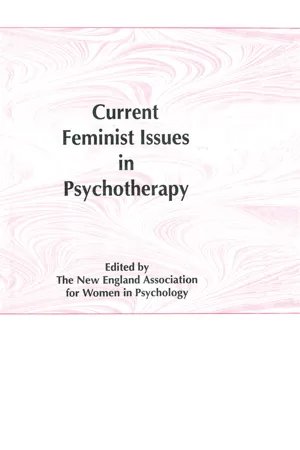
Current Feminist Issues in Psychotherapy
About this book
This insightful book addresses a variety of clinical issues--depression, displaced homemakers, sibling incest, and body image--from a feminist perspective.
Information
A Study of Issues in Sexuality Counseling for Women with Spinal Cord Injuries
Janna Zwerner is a rehabilitation counselor and consultant specializing in the field of sexuality and disabled women. She is currently Director of Services at Boston Self Help Center.
Introduction
Disabled consumers have made the demand for social and physical integration into the mainstream of contemporary life. This rise of consumer awareness has opened up a Pandora’s box for professionals working in the disabled community. Not only are there psychological and vocational issues to face, there are social and sexual issues as well. Until recently, the sexual needs of individuals with physical disabilities has been largely ignored by the rehabilitation community and not recognized as an area of legitimate concern for social service professionals. In particular, little information is available concerning the sexual functioning of spinal cord injured women.
The sexual problems of disabled women in general stem from two sources: those resulting from cultural myths and attitudinal barriers, and those resulting from actual physical limitations. We are all subjected to societal mandates encouraging romantic and spontaneous sexual relations, and sexual intercourse and orgasm are often seen as crucial for sexual fulfillment. Such rules are harmful to us all, but particularly so to disabled people. These assumptions about sex may lead to a sense of failure for disabled women, interfering with the realization that sexuality is not limited to a specific act. “When these beliefs are recognized as myths by the individuals, the problems arise from physical limitations seem much less formidable.”1
Traditional public sentiment has stigmatized the disabled as being asexual, or at best, undesirable dating and sexual partners. For many years, the use of sublimation was advocated as an effective and final technique for dealing with sexual impulses.2 Many individuals, including physicians and rehabilitation practitioners, still hold the belief that after being confined to a wheelchair one’s sexual life was over.3
Review of the Literature
It has only been since 1972 that rehabilitation literature has considered sexuality as integral to the total psychological adjustment to disability.4 While references are available in specialized medical journals concerning specific disabilities and their sexual concomitants, this information has not been brought to the attention of social service practitioners, and has received little attention in rehabilitation journals.5
Information concerning the sexual functioning of spinal cord injured (SCI) males is in abundance relative to the literature pertaining to SCI females. This discrepancy is partially due to the fact that 4 out of every 5 SCI individuals are males.6 However, the attitude exists that sexual problems are not as traumatic for the SCI woman because she usually “plays the passive role in sexual relations. ’ ’7 This is also assumed to be the case because almost all SCI women continue to remain fertile. Thus, the sexual functioning of SCI females have not had the same level of serious inquiry as compared to studies of SCI males.
Physiological Considerations
As early as 1917, Riddoch8 reported on the sexual response of paraplegic men with complete and incomplete spinal lesions. Since then, numerous studies have produced detailed information, classified according to the level and completeness of the lesion, coupled with a “statistical prognosis” of the probability of reflexogenic sexual response in males.9,10 However, very little similar descriptive data is available on the physiological and psychogenic aspects of sexual response in women with lesions at various levels.11 Griffith and Trieschmann12 postulated the presence of a “genital reflex” in SCI women paralleling the reflex found in SCI men. The functions involved in this reflexogenic response would include vascular engorgement of the clitoris, labia minora and vagina, and increased secretions of the Bartholin glands. Nevertheless, clinical observations are scarce, and comprehensive research with SCI women is still severely lacking.
The large majority of reports that do exist concentrate on the reproductive aspect of female sexuality, that is, menstruation, fertility, and pregnancy.13,14 There appears to be great intrigue with SCI women’s reproductive ability, most likely because their male conterparts often quickly become infertile. Many SCI women also go through a painless labor process, providing a unique phenomenon to study for the medical community. Yet, there is an increased risk of autonomic dysreflexia,* post-partum uterine prolapse, and susceptibility to infection. In some cases this preoccupation with the childbearing capacity of SCI women has led to the erroneous belief that “woman patients have no loss of physical sexual function.”16 Crigler17 suggested that this assumption may be due to the fact that erectile and ejaculatory functions are often impaired in men, whereas “sexual dysfunction is not as graphically apparent in an injured woman.” Even if this suggestion were true, one cannot forget that for a large segment of our society, women’s sexuality exists for the sole purpose of perpetuating our species, bereft of satisfaction, except for pleasing one’s spouse and creating offspring. Furthermore, it is difficult to imagine that a SCI woman would consider her own “sexual dysfunction [as not] graphically apparent.”
A few studies noted disturbances in the orgasmic phase of female sexual response.9,18 When spinal lesions were complete, women were often “anorgasmic,” but were sexually aroused by intense tactile stimulation above the sensory level, especially around the breasts.12 In many instances there is an overly sensitive zone above the level of injury, also heightened in an erogenous sense. It is evident in numerous subjective reports of both paraplegic and quadriplegic women that erotogenic areas may be found in places where they previously had produced little or no sexual excitement.19,20
A wide variety of experiences were interpreted as orgasm and usually involved muscle contraction and spasticity followed by a generalized decrease in muscle tension.12,20 Peripheral responses to sexual stimulation, such as increased respiration and blood pressure, swelling of the breasts, and a sex flush, often remained intact.21 Money22,23 reported the experience of “phantom orgasm” in the dreams and waking imagery of paraplegic men and women who did not have voluntary movement or somatic sensation in the genito-pelvic area. The use of the word “phantom” is questionable at best, and at worst, downright oppressive to the disabled individual. Nongenitally based orgasms are possible and it seems senseless to demean the complex experience of climax as being “phantom.” These findings underscore the subjective interpretation of orgasm, giving clinical foundation to the wide variety of sexual response in humans. This holds particularly true for the female orgasmic experience which displays greater diversification in the intensity and duration of response than the male’s relatively standard pattern of ejaculatory reaction.24
Previous research defined libido as interest in sexual intercourse and focused on the act of coitus as the predominant mode of sexual interaction.18,25 But the common notion of ‘ ‘the sex act’ ’ (male superior position) as the foundation of sexual intimacy is no longer a valid concept for many individuals, and particularly for severely disabled women. An increased risk toward urinary and vaginal infections, spasms, lack of lubrication and sensation, and personal preferences may make intercourse undesirable to many SCI women. None of these reasons necessarily dampen sexual drives nor rid one of the reality of sexual being. Thus, it is not surprising that many studies reported a marked decrease in sexual activities (intercourse) amongst many physically disabled populations.25 This appears crucial in light of recent research with SCI couples showing that those with a greater acceptance of sexual variety tended to be more satisfied with their sexual activities. It was speculated that other couples had a higher tolerance for less sexual activity due to a lack of adequate information about their sexuality.26
Often, it is simply the facts that are needed to dispel myths and thorough information dissemination becomes of the utmost importance. After interviewing 19 SCI women, Becker27 found those with die most accurate and extensive information regarding their sexuality have fewer emotional conflicts emerging from sexual conflicts. These findings support the need for information and sexuality counseling designed to increase sexual repertoire and acceptance of sexual variety. Sexuality counseling should also include a basic explanation of spinal cord physiology in order to promote an understanding of post-injuiy sexual response.
Psychosocial Considerations
In some circumstances the emotional sequelae of a new physical disability may interfere with sexual functioning. Traumatic SCI affects a person in a myriad of ways, not only neurologically, but psychologically and socially as well. Wright has suggested that because “sex identification is often a central personal characteristic that serves to define the person to herself and others, it can be expected that any circumstance that alters or endangers this identification will have a marked effect on the self concept.”28 Self concept is known to influence sexual attitudes and activities, just as sexual adjustment will play a role in defining and enhancing self concept.29
Teal and Athelstan30 reviewed numerous articles investigating changes in self concept through their expression in changed body image. The total experience of one’s body image is resistant to abrupt modification and some authors noted a tendency to maintain a pre-injury body image, with more difficulty in body image adjustment for quadriplegics than paraplegics. However, very few of the studies reviewed included female subjects in their samples. Rather, post-injuiy feelings of feminine attractiveness has more frequently been studied in SCI women. Perhaps not surprisingly, many aspects of femininity and attractiveness are the same for SCI women as they are for non-disabled women.31,32 Yet, many women stressed that although they were currendy involved in sexual relationships and had a positive self image, the first few years after injury were extremely difficult. Most of the women mentioned a lack of understanding and sensitivity by health professionals of their sexual needs and viewed this as a hindrance in adjustment to their disability.
It is not uncommon for individuals to experience depression, lowered self esteem, changed self image, or performance fears as a result of stress at the time of injury. A trained counselor can provide emotional support and assistance in working through these feelings. Thornton33 revealed that in her work with SCI women, brief therapy, initiated for emotional problems related to sexual expression, was often very successful. Important areas in sexuality counseling were outlined, including learning one’s current sexual response and sexual experimentation. Although it had been believed that a great deal of practice over a long period of time was essential to a fulfilling sex life among the cord injured, little correlation was found between sexual adjustment and time since injury.34
Perhaps the belief that SCI males go through a more difficult sexual identity readjustment process has contributed to the lack of research regarding women in this area. Several of the reports endorsing this notion were published in the late 60s and early 70s. While these beliefs may have held true for some women at that time, they are most definitely rapidly changing in the present. In an era where exploration of non-traditional social and vocational roles are being encouraged for wome...
Table of contents
- Cover
- Title
- Copyright
- CONTENTS
- EDITORIAL
- INTRODUCTION
- Women’s Socialization and the Prevalence of Depression: The Feminine Mistake
- Addressing Stress Factors in Single-Parent Women-Headed Households
- The Psychological Impact of Family Law on Displaced Homemakers
- The Black Sisterhood: A Second Look
- Women’s Career Decision-Making Process: A Feminist Perspective
- Transforming Body Image: Your Body, Friend or Foe?
- Battered Women, Cultural Myths and Clinical Interventions: A Feminist Analysis
- Sibling Incest: The Myth of Benign Sibling Incest
- A Study of Issues in Sexuality Counseling for Women with Spinal Cord Injuries
- Counseling Women with Developmental Disabilities
- An Account of the Psychotherapeutic Process from the Perspective of a Client with a Disability
Trusted by 375,005 students
Access to over 1.5 million titles for a fair monthly price.
Study more efficiently using our study tools.
Frequently asked questions
Yes, you can cancel anytime from the Subscription tab in your account settings on the Perlego website. Your subscription will stay active until the end of your current billing period. Learn how to cancel your subscription
No, books cannot be downloaded as external files, such as PDFs, for use outside of Perlego. However, you can download books within the Perlego app for offline reading on mobile or tablet. Learn how to download books offline
Perlego offers two plans: Essential and Complete
- Essential is ideal for learners and professionals who enjoy exploring a wide range of subjects. Access the Essential Library with 800,000+ trusted titles and best-sellers across business, personal growth, and the humanities. Includes unlimited reading time and Standard Read Aloud voice.
- Complete: Perfect for advanced learners and researchers needing full, unrestricted access. Unlock 1.5M+ books across hundreds of subjects, including academic and specialized titles. The Complete Plan also includes advanced features like Premium Read Aloud and Research Assistant.
We are an online textbook subscription service, where you can get access to an entire online library for less than the price of a single book per month. With over 1.5 million books across 990+ topics, we’ve got you covered! Learn about our mission
Look out for the read-aloud symbol on your next book to see if you can listen to it. The read-aloud tool reads text aloud for you, highlighting the text as it is being read. You can pause it, speed it up and slow it down. Learn more about Read Aloud
Yes! You can use the Perlego app on both iOS and Android devices to read anytime, anywhere — even offline. Perfect for commutes or when you’re on the go.
Please note we cannot support devices running on iOS 13 and Android 7 or earlier. Learn more about using the app
Please note we cannot support devices running on iOS 13 and Android 7 or earlier. Learn more about using the app
Yes, you can access Current Feminist Issues in Psychotherapy by Betts Collett in PDF and/or ePUB format, as well as other popular books in Psychology & Mental Health in Psychology. We have over 1.5 million books available in our catalogue for you to explore.