eBook - ePub
Evenki
About this book
Evenki is one of nine Tungusic languages spoken in Siberia and Northern China. This book gives the first ever complete description of all this language's linguistic domain. Evenki is remarkable both for the vast area where it is spoken - from Western Siberia through the Amur region to the shores of the Arctic Ocean to Northern China - and for its immense number of dialects and sub-dialects.
Information
Chapter 1
Syntax
1.1. GENERAL QUESTIONS
1.1.1. Sentence-types
1.1.1.1. Direct and reported speech
1.1.1.1.1. Syntagmatic means
These are the predominant ways of expressing indirect speech, and involve verbs of reporting followed by object clauses with participial verb forms. The latter are in fact ordinary noun clauses (see 1.1.2.2.3 for the expression of indirect statements), formed by one of three participles:
simultaneous participle in -d’Ari (see 2.1.3.5) is used when the reported action is simultaneous with that of the main verb, as in (1);
perfect participle in -nA (see 2.1.3.5) is used when the reported action is anterior to that of the main verb, as in (2) and (3);
posterior participle in -d’AngA (see 2.1.3.5) is used when the reported action is posterior to that of the main verb, as in (4).
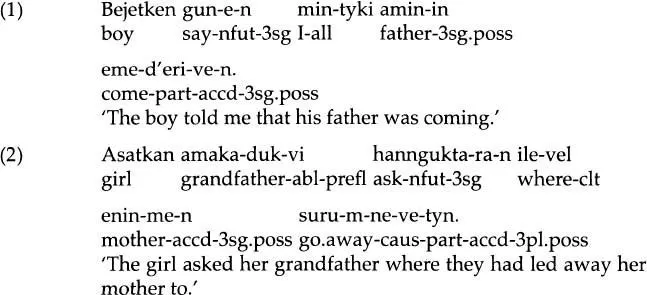
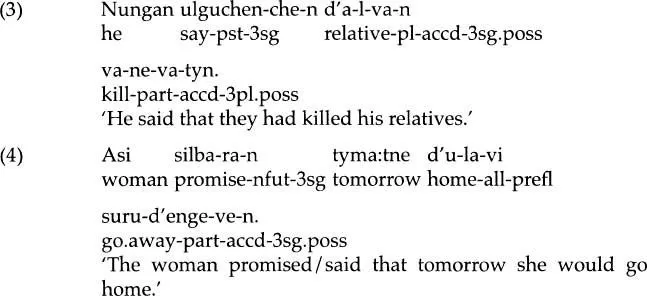
Participles of these three taxis types (of simultaneity, of anteriority, and of posteriority) in complement clauses of this type always take the suffix -vA of the definite accusative case plus the possession affixes marking person and number of the agent of action expressed by the participle. Markers of personal possession (but not of reflexive possession!) are used with participles in the constructions of this type with both coreferential and non-coreferential agents.
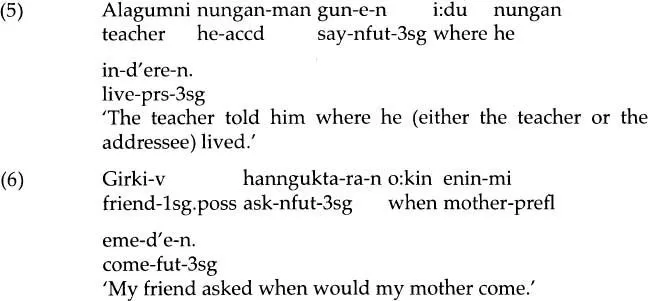
All verbs of reporting (perhaps due to the influence of Russian) may also take indicative mood forms, especially when a conjunction is used (which comes from a question-word with the meanings ‘when’, ‘where’ and the like (see also 1.1.2.2.3 and 1.1.2.2.4 for indirect statements and indirect questions respectively):
1.1.1.1.2. Enclitic
Texts recorded in the 1920s and 1930s contain constructions with indirect speech involving the converbal form in -nA of the verb gun- ‘say’ – gunne/gune (lit. ‘saying’/‘having said’), used immediately after the direct speech phrase (compare the Turkic element d’eb lit. ‘having said’ used in subordinate clauses of the analogous type), compare:
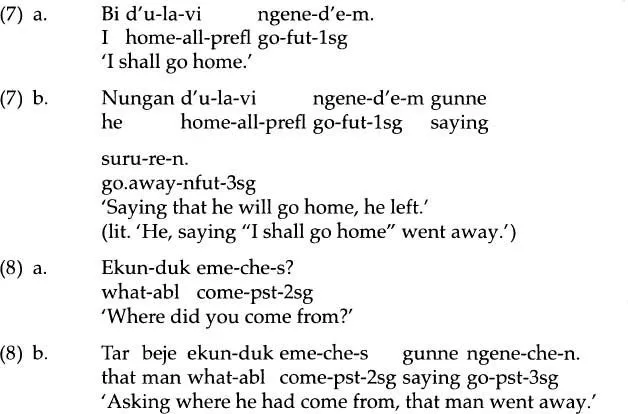
1.1.1.1.3. Direct speech
Direct speech is introduced by a verb of saying or asking, etc. either following or preceding the quoted phrase:
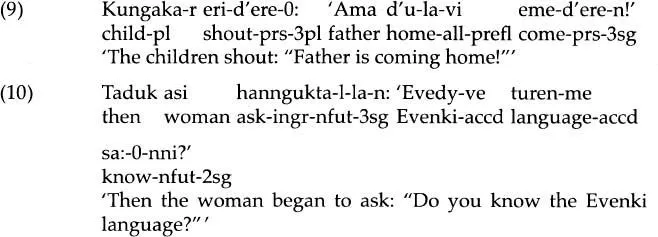
1.1.1.2. Interrogative sentences
There are two main types of interrogative sentences. The first includes a part of yes-no questions with finite verb forms taking the same morphological markers as the declarative (positive) verb forms, but differentiated from the latter only by intonational pattern. The second includes a part of yes-no questions and all question-word questions, one of the nominal or verbal (or other) components of which takes the interrogative particle -gu/-ku/-ngu/-vu ‘if/whether’. The interrogative form cannot be produced by altering word order.
1.1.1.2.1. Yes-no questions
1.1.1.2.1.1. Neutral Neutral yes-no questions, as a rule, combine ordinary positive sentence with a high-pitch intonation pattern, the tone peak being much higher than that of the positive utterance. (Italics in Evenki examples indicate tone peaks or emphasis.)
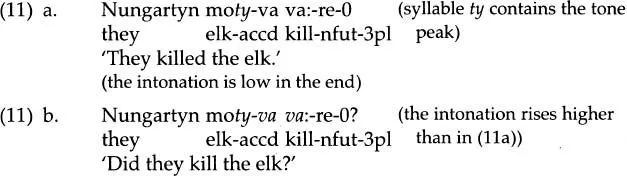
The focus, as a rule, attracts the intonational nucleus on to itself, the intonational contour being higher and more prolonged than that of the corresponding positive sentence, as in:
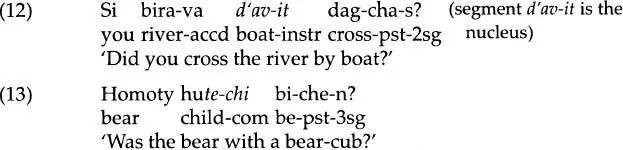
If one of the elements is emphasized the word order, which is in general very flexible, may change:
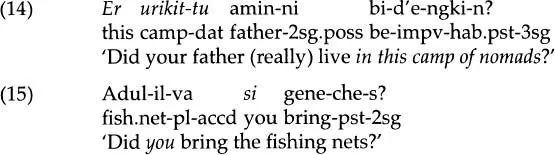
With the declarative (falling) intonation, the four last constructions ((12)–(15)) without any morphological changes would correspondingly mean ‘You crossed the river by boat’, ‘The bear was with a bear cub’, ‘Your father lived in this camp of nomads’ (as if revealing a secret), ‘You brought the fishing nets’.
Verbless yes-no questions have the same features:
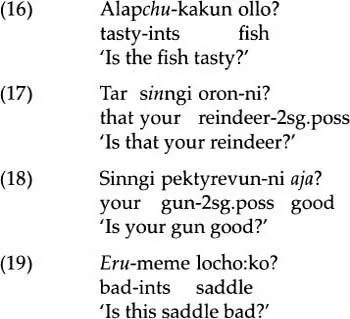
Yes-no question intonation in such sentences in fact resembles an exaggerated declarative intonation with the rise of the intonation and final fall. Interrogative intonation with sharp final rise may only be found in cases when the speaker expresses surprise:

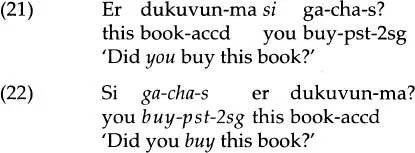
As in the last example, the word order of yes-no questions is usually the same as in the corresponding declarative sentences (SOV), but in the case of stress the direct object may take the first position (OSV), or the predicate may take the second position (SVO), as in (21) and (22):
Very often the subject is omitted when it expresses the addressee, compare:
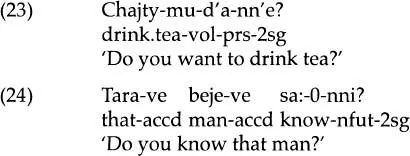
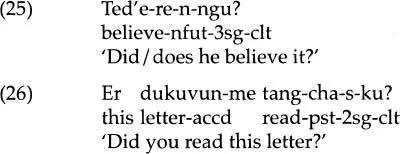
An interrogative enclitic -gu/-ku/-ngu/-vu is often added to the verb form or more rarely to the nominal part of the question, but it never attracts the intonational nucleus on to itself:
1.1.1.2.1.2. Leading
1.1.1.2.1.2.1. Expecting the answer ‘yes’: There is no structural distinction between neutral yes-no questions with no expectation as to a positive as opposed to a negative answer and leading yes-no questions which do have such an expectation. The only possible difference is perhaps in the corresponding intonational patterns, and also the use of certain enclitics (including those borrowed from Russian, for example, vid/mit coming from Russian ved’ ‘but really’/‘but in fact’), for example:
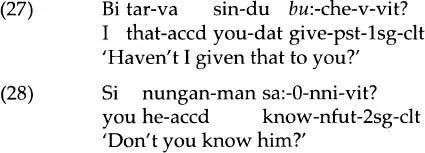
An overtly leading ‘request for confirmation’ may be expressed by an interrogative sentence with adverbs tug’e ‘really/so’, ke ‘well’, esile ‘and now’ and/or enclitic -gu/-ku/-ngu/-vu. Such utterances have the declarative intonational contour with the usual low rise-fall. The speaker wants the addressee to agree with him:

The next example shows the possibility of imperative/optative verb forms to be used i...
Table of contents
- Cover
- Half Title
- Title Page
- Copyright Page
- Dedication
- Table of Contents
- Acknowledgements
- Alphabetical symbols
- Abbreviations
- Introduction
- Representation of Evenki examples
- 1. SYNTAX
- 2. MORPHOLOGY
- 3. PHONOLOGY
- 4. IDEOPHONES AND INTERJECTIONS
- 5. LEXICON
- References
- Index
Trusted by 375,005 students
Access to over 1.5 million titles for a fair monthly price.
Study more efficiently using our study tools.
Frequently asked questions
Yes, you can cancel anytime from the Subscription tab in your account settings on the Perlego website. Your subscription will stay active until the end of your current billing period. Learn how to cancel your subscription
No, books cannot be downloaded as external files, such as PDFs, for use outside of Perlego. However, you can download books within the Perlego app for offline reading on mobile or tablet. Learn how to download books offline
Perlego offers two plans: Essential and Complete
- Essential is ideal for learners and professionals who enjoy exploring a wide range of subjects. Access the Essential Library with 800,000+ trusted titles and best-sellers across business, personal growth, and the humanities. Includes unlimited reading time and Standard Read Aloud voice.
- Complete: Perfect for advanced learners and researchers needing full, unrestricted access. Unlock 1.5M+ books across hundreds of subjects, including academic and specialized titles. The Complete Plan also includes advanced features like Premium Read Aloud and Research Assistant.
We are an online textbook subscription service, where you can get access to an entire online library for less than the price of a single book per month. With over 1.5 million books across 990+ topics, we’ve got you covered! Learn about our mission
Look out for the read-aloud symbol on your next book to see if you can listen to it. The read-aloud tool reads text aloud for you, highlighting the text as it is being read. You can pause it, speed it up and slow it down. Learn more about Read Aloud
Yes! You can use the Perlego app on both iOS and Android devices to read anytime, anywhere — even offline. Perfect for commutes or when you’re on the go.
Please note we cannot support devices running on iOS 13 and Android 7 or earlier. Learn more about using the app
Please note we cannot support devices running on iOS 13 and Android 7 or earlier. Learn more about using the app
Yes, you can access Evenki by Igor Nedjalkov in PDF and/or ePUB format, as well as other popular books in Languages & Linguistics & Linguistics. We have over 1.5 million books available in our catalogue for you to explore.