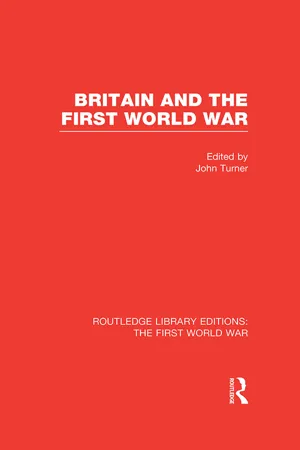
This book gives students an informed insight into the British experience in the First World War. The contributors, all established First World War historians, have drawn on their own research and secondary sources to give a succinct account of politics, diplomacy, strategy and social developments during a period of dramatic change. Each chapter gives a concise account of its subject and the chapters are well supported by maps and tables. This is an important textbook for school students and undergraduates which bridges the gap between specialized research on the First World War and the needs of the student reader.
- 174 pages
- English
- ePUB (mobile friendly)
- Available on iOS & Android
eBook - ePub
Britain and the First World War (RLE The First World War)
1
Allies, Rivals and Enemies: British Strategy and War Aims During the First World War
Any historian trying to understand what the British were seeking to achieve during the First World War must be tempted at times to abandon the task in horror as he contemplates the apparently fruitless slaughter of the war. But that is the counsel of despair. The British war effort did make sense. Between 1914 and 1918 successive British governments did evolve a rational, if not always coherent, war aims programme and they did attempt to pursue it by evolving a carefully considered, if not always realistic, strategy.
The politicians and senior diplomats, soldiers and sailors who made up the British policy-making elite instinctively agreed with the German soldier and philosopher of war, Carl von Clausewitz, that war was ‘a continuation of political activity by other means’.1 They sought to secure a stable peace settlement which would safeguard the future security of Britain and her empire. In August 1914, Britain ostensibly entered the war because by invading Belgium the Germans threatened Britain’s own security. Anglo-German relations had deteriorated in the years before the war because of Germany’s efforts to destroy the ententes Britain had signed with France in 1904 and Russia in 1907, and because of her determination to build a fleet to rival the Royal Navy. These developments had convinced some policy-makers that Germany was determined to gain hegemony over Europe. But between 1912 and 1914 Anglo-German relations appeared to have improved from the low point they had reached during the Agadir crisis of 1911. Thus the sudden outbreak of war in August 1914 came as a shock. The British interpreted it as the result of a shift in the centre of power in Berlin. During the two preceding years, they believed, a ‘peace party’ bent on good relations with Britain had controlled German policy but during the July crisis they had been ousted by a ‘war party’ of Prussian militarists. The British therefore sought a peace settlement which would protect them from future German aggression by ending the dominance of the Prussian militarists within Germany.
At first glance this seemed a most moderate objective. But concealed beneath the apparent readiness to distinguish between militarists and the rest of the German people there lay the fact that the policy-makers could not agree upon how to achieve their aim. Politicians and the soldier-statesman Lord Kitchener, who was the Secretary of State for War between 1914 and 1916, believed that the influence of the militarists would only be eliminated after a revolution in Germany had placed power in the hands of a new and more liberal elite. But most senior soldiers shared the views of Sir Douglas Haig, the commander of the British army in France between 1916 and 1918, who told the king on 2 January 1918 that ‘Few of us feel that the “democratising of Germany” is worth the loss of a single Englishman!’2 They believed that German militarism would only be rendered impotent if Britain and her allies could inflict such a crushing military defeat on the German army that the influence of the military would be discredited for ever.
In 1914 the British realized that co-operation with France and Russia was vital if they were to prevent the Germans from winning. Their immediate objective was to lend enough support to France and Russia to prevent them from succumbing to Germany and her ally Austria-Hungary. But the British were almost as suspicious of the longer-term objectives of their friends as they were of their enemies. Most members of the policy-making elite were bom between the mid-1850s and the mid-1860s and reached maturity in the late 1870s and early 1880s at a time when France and Russia were emerging as Britain’s bitter colonial rivals in Africa and Asia. They had been taught to see Russian and French imperial ambitions as a danger to the security of the British Empire long before the German threat emerged. The German threat and the ententes of 1904 and 1907 may have muted Britain’s imperial rivalries with France and Russia but they did not eliminate them. These residual suspicions were extremely influential in shaping the development of British strategy and war aims. Britain sought a final peace settlement which would weaken Germany but would also ensure that neither France nor more especially Russia gained so much at her expense that it in turn became a threat to the European balance of power or the security of the Empire. It would avail the British little if, in eliminating one threat, they merely built up another.
The debate within the policy-making elite during the war has been depicted as having been conducted between two sharply differing schools of thought. ‘Westerners’, epitomized by Haig and Sir William Robertson, the Chief of the Imperial General Staff between 1915 and 1918, were supposedly eager to commit hundreds of thousands of British troops to costly and futile battles of attrition in France and Flanders. By contrast ‘Easterners’ like David Lloyd George, who became Prime Minister in December 1916, and Winston Churchill, the First Lord of the Admiralty and one of the architects of the ill-fated Dardanelles campaign of 1915, were said to believe that they had found a cheaper and quicker way of defeating Germany by attacking her weaker allies, the Turks, Austrians and Bulgarians, and thus ‘bringing Germany down by the process of knocking the props under her’ as Lloyd George wrote on 1 January 1915.3 But this was a caricature of reality created by the memoirs and biographies of the participants which were published in 1920s and 1930s. Books like Lloyd George’s War Memoirs, Churchill’s The World Crisis 1911–1918 or Robertson’s Soldiers and Statesmen, 1914–1918 did not attempt to present a dispassionate history of events. They were pieces of polemical literature in which each author tried to prove that he had been right and his enemies wrong.
The real division between British policy-makers was not between ‘Easterners’ and ‘Westerners’. It was between those like Reginald McKenna, successively Home Secretary and Chancellor of the Exchequer in the Asquith governments of 1914–16, who argued that Britain could best assist her allies by limiting the size of her own army and giving them money and equipment, and those like Robertson and Lloyd George who by the summer of 1915 championed the cause of a large conscript army as the only way of demonstrating to France and Russia that Britain had not abandoned them.
The factor which dominated British strategy between 1914 and 1918 was that she fought the war as a member of a coalition, the Entente alliance. During the war she was allied to two great powers, France and Russia, and to a series of lesser ones, including Belgium, Serbia, Japan, Italy, Romania and Greece. In April 1917 the United States of America entered the war on the side of the Entente as an Associated Power. The Entente alliance existed on four levels: military, political, naval and economic. The lesser powers, with the occasional exception of Italy, carried little weight in determining the Entente’s strategy. In 1914 Britain was the strongest economic power within the Entente, but France and Russia both possessed large and powerful armies. Britain had the largest navy and it was only in the naval sphere that she dominated the Entente from the start to the finish of the war. She began the war with the smallest army of the ‘big three’ and did not achieve even a rough military parity with France or Russia until 1916. Initially British strategy was designed to maximize her strengths and minimize her weaknesses. The British assumed that the major burden of fighting the continental land war would fall upon France and Russia. Britain made a token contribution to the land fighting by sending the British Expeditionary Force (BEF) to northern France, but her main contribution was in the shape of the Royal Navy, which quickly blockaded the Central Powers, and the economic and financial assistance which she extended to her allies. This was the strategy of ‘business as usual’. Britain became the economic powerhouse of the Entente and tried to get rich by lending her allies the money they needed to buy the weapons they required to defeat the German and Austrian armies. Meanwhile Kitchener began to raise a huge new volunteer army. He predicted that by the beginning of 1917 the French, Russian, German and Austrian armies would have exhausted their manpower reserves and fought each other to a standstill. But his New Armies would be unbloodied. Britain would be the only belligerent with large manpower reserves and she would be able to intervene, inflict a final defeat on the Central Powers and then impose her own peace terms on allies and enemies alike.
‘Business as usual’ promised Britain maximum victory at minimum cost. But it depended on the ability and the willingness of France and Russia to fight for two years without large-scale British military assistance. By December 1914 it was clear that this was unrealistic. Although the French and Russians thwarted the Germans’ plan to achieve a quick victory in a two-front war their armies suffered horribly in doing so and by the end of 1914 the enemy was in occupation of large tracts of Allied territory. In November 1914 the Germans recognized that their only hope of winning would be to detach one of the partners from the Entente and they began to extend peace feelers to both France and Russia in the hope that they might persuade them to break with Britain. The British were alarmed when they learned of this. Before the war they knew that there had been politicians in both countries who would have preferred an understanding with Germany rather than to continue the ententes with Britain. In 1914–15 even those politicians friendly to Britain were aggrieved that her help was so slow in coming. A bitter joke began to circulate in Petrograd that ‘the British would fight to the last Russian’.4 In 1915–16 British strategy therefore shifted towards being seen to be doing whatever they could to give their allies material and moral assistance.
In November 1914 a further complication arose when Turkey joined the Central Powers. A small Anglo-Indian force quickly landed at Basra in Mesopotamia, ostensibly to protect the nearby oil-fields but in reality to reassert British prestige and prevent agents of the Central Powers from encouraging Muslim fundamentalists in Mesopotamia, Persia and Afghanistan from launching a holy war against British India. The Indian Mutiny of 1857 and the Mahdist rising in the Sudan in 1880s had taught the British in India and Egypt the danger which Muslim fundamentalism posed to their colonial regimes. Turkey’s entry into the war also raised the question of the ultimate disposition of Constantinople. The Russians had sought to acquire the city throughout the nineteenth century to give themselves a warm-water port open to the sea. In February 1915 an Anglo-French fleet began to sail cautiously up the Dardanelles towards Constantinople. The operation was intended to knock Turkey out of the war and persuade Italy and the neutral Balkan states, Greece, Bulgaria and Romania, to join the Entente. In March it seemed to be on the point of success. Dissident Turks were conducting secret peace talks with British agents, and both the Italians and Greeks appeared eager to join the Entente. But subsequent events only highlighted the incompatibility of British and Russian policy. The Russians, fearful that Greek rather than Russian troops might liberate Constantinople and claim it for themselves, insisted that before they would agree to more states joining the Entente their allies should first promise them that Constantinople would be theirs at the end of the war. They hinted that if their wishes were not met they might seek better terms from Germany. The Greeks quickly backed away, but the British had no option but to agree to Russia’s demands even though they made a negotiated peace with Turkey impossible. The Italians similarly drove a hard bargain at Austria’s expense before they consented to join the Entente. Far from hastening the end of the war, these agreements only stiffened the Central Powers’ resolve to continue fighting to prevent the dismemberment of their own empires.
The purely naval assault at the Dardanelles had achieved nothing by March, and therefore in April an army under Sir Ian Hamilton landed on the Gallipoli peninsula. The failure of this landing and of a second landing at Suvla Bay in August to silence the Turks’ defences encouraged Bulgaria to join the Central Powers. In October they invaded Serbia. An Anglo-French force landed at the Greek port of Salonika but failed to secure an escape route for the Serbian army. By December the Germans had opened a direct railway line to Constantinople. After weeks of indecision the British government finally agreed to evacuate the Gallipoli peninsula before German troops arrived in force and drove the Allied army into the sea. The Anglo-French force remained at Salonika until the end of the war, a source of deep distrust to many British observers. They rightly suspected that French enthusiasm for the enterprise had much to do with their desire to establish an informal Balkan empire after the war. The Gallipoli débâcle at the hands of the Muslim Turks had repercussions far beyond the peninsula. It encouraged the British in a foolhardy attempt to save face in Muslim eyes by sending a small force up the River Tigris to capture Baghdad. But in November the British force was besieged at Kut and in April 1916 it was forced into a humiliating surrender. Similarly in Egypt the British administration tried to prevent a holy war by winning over to the Entente cause Sharif Hussein of Mecca, the guardian of the Muslim holy cities of Mecca and Medina, by vague promises of independence from the Turks. Later in 1915 the British and French began discussions to decide their own desiderata in the Turkish empire. These culminated in the Sykes-Picot agreement of February 1916 which divided Turkey in Asia into spheres of interest.
August 1915 marked a major turning point in British strategy. The Germans drove the Russians from Poland, and occupied Warsaw on 5 August. The Suvla Bay landing at Gallipoli failed to drive the Turks from the peninsula, and Britain’s bankers in New York warned that they were dangerously short of funds to meet the huge bills Britain and her allies had run up in the United States of America to buy war supplies. Rumours that France or Russia might seek a separate peace unless the British did more to help them intensified. In March and May, Sir John French, the commander of the BEF, had already mounted two assaults against the German line at Neuve Chapelle and Festubert. They demonstrated that he did not yet have the men, guns or shells necessary to achieve a breakthrough. But the Allies’ plight could not be ignored. On 20 August, Kitchener told his Cabinet colleagues that ‘unfortunately we had to make war as we must, and not as we should like to’.5 In late September the BEF launched the battle of Loos, not because the high command had any great hopes of securing a major military victory but because the government was afraid that if they continued their policy of withholding Britain’s main effort until 1917 one or more of their major allies would desert them.
In December 1915 the military representatives of the Entente decided that the setbacks of 1915 were due to the fact that they had lacked a common plan. In 1916 they were determined to avoid this by acting in concert to mount a co-ordinated offensive in the summer of 1916 on the Western, Eastern and Italian fronts. They hoped that this would negate the Central Powers’ advantage of interior lines of communication and force them to sue for peace by the end of the year. The British role in this plan was to attack north of the River Somme in co-operation with a French attack to the south of the river. The government agonized until April over whether or not to accept this recommendation. The army could only sustain such an offensive if conscription was introduced to make good the losses the BEF was likely to suffer. Some ministers, led by McKenna, were afraid that if still more men were taken from the factories and fields and placed in uniform Britain’s balance of payments would collapse and she would be bankrupt before the Central Powers were beaten. But by April the majority had reluctantly agreed with Kitchener and Robertson that the war might end in an indecisive peace, or worse still a German victory, if they did not throw caution to the wind and gamble on winning the war before Britain had passed the peak of her strength.
For a few weeks in August and September 1916 it seemed as though the gamble had succeeded. The Italian offensive never really started. The French contribution on the Somme was much reduced because a large proportion of the French army was employed in defending Verdun against a German offensive which began in February. The British offensive started on 1 July and continued until November, gaining little ground at great cost but containing a large part of the German army in the west. The Russian offensive, however, was a brilliant success. Within weeks between a third and a half of the Austrian army had been killed or captured. Encouraged by this success and by the promise of an offensive by the Allied army at Salonika, the Romanians joined the Entente at the end of August. When the Kaiser heard this news he declared that the war was lost. By contrast some British policy-makers decided that it was time to consider detailed territorial war aims preparatory to the peace conference. The map of Europe was to be rearranged on lines broadly consistent with the principles of national self-determination. But this was tempered by a determination to re-establish a balance of power that did not leave Russia or Germany able to dominate Central and Eastern Europe and the Balkans and by the knowledge that the Entente had already promised Italy large parts of Austrian territory which were not inhabited by ethnic Italians. Germany was to lose her fleet and, if the Admiralty and the Colonial Office had their way, most of her colonies. The Admiralty feared them as bases from which Germany might again threaten Britain’s imperial communications, and the Dominions and the Japanese, who had captured many of them, showed a marked reluctance throughout the war to surrender their gains.
But by December, when Lloyd George replaced Asquith as Prime Minister, hopes of an early peace had been dashed. The Germans had halted the Russian and Somme offensives and mounted a successful counter-attack in Romania which enabled them to occupy Bucharest before Christmas. Forty per cent of all the money the British spent on the war was spent in America and most of their purchases were made on credit. Only American credit and goodwill could sustain Britain and her allies into 1917 and beyond, but it was by no means certain that the Americans would give generously of either commodity. On 30 November 1916 the United States Federal Reserve Board advised American bankers to stop lending to the belligerents. On 12 December the triumphant Germans professed their readiness to discuss peace terms, and a week later the American President, Woodrow Wilson, demanded that the belligerents should announce their war aims. He hoped that this would be the first step towards a negotiated peace between equals based on democracy and justice. It would be sustained not by a return to the balance ...
Table of contents
- Cover
- Half Title
- Title Page
- Copyright Page
- Original Title Page
- Original Copyright Page
- Table of Contents
- List of Maps
- List of Tables
- Preface
- Introduction
- 1. Allies, Rivals and Enemies: British Strategy and War Aims during the First World War
- 2. The War and the British Empire
- 3. The Royal Navy and the War at Sea
- 4. The New Warfare and Economic Mobilization
- 5. The British Population at War
- 6. The British Army, 1914–18: The Illusion of Change
- 7. British Politics and the Great War
- Epilogue
- Military and Naval Chronology of the First World War
- Suggested Reading
- Notes on the Contributors
- Index
Trusted by 375,005 students
Access to over 1.5 million titles for a fair monthly price.
Study more efficiently using our study tools.
Frequently asked questions
Yes, you can cancel anytime from the Subscription tab in your account settings on the Perlego website. Your subscription will stay active until the end of your current billing period. Learn how to cancel your subscription
No, books cannot be downloaded as external files, such as PDFs, for use outside of Perlego. However, you can download books within the Perlego app for offline reading on mobile or tablet. Learn how to download books offline
Perlego offers two plans: Essential and Complete
- Essential is ideal for learners and professionals who enjoy exploring a wide range of subjects. Access the Essential Library with 800,000+ trusted titles and best-sellers across business, personal growth, and the humanities. Includes unlimited reading time and Standard Read Aloud voice.
- Complete: Perfect for advanced learners and researchers needing full, unrestricted access. Unlock 1.5M+ books across hundreds of subjects, including academic and specialized titles. The Complete Plan also includes advanced features like Premium Read Aloud and Research Assistant.
We are an online textbook subscription service, where you can get access to an entire online library for less than the price of a single book per month. With over 1.5 million books across 990+ topics, we’ve got you covered! Learn about our mission
Look out for the read-aloud symbol on your next book to see if you can listen to it. The read-aloud tool reads text aloud for you, highlighting the text as it is being read. You can pause it, speed it up and slow it down. Learn more about Read Aloud
Yes! You can use the Perlego app on both iOS and Android devices to read anytime, anywhere — even offline. Perfect for commutes or when you’re on the go.
Please note we cannot support devices running on iOS 13 and Android 7 or earlier. Learn more about using the app
Please note we cannot support devices running on iOS 13 and Android 7 or earlier. Learn more about using the app
Yes, you can access Britain and the First World War (RLE The First World War) by John Turner in PDF and/or ePUB format, as well as other popular books in History & 20th Century History. We have over 1.5 million books available in our catalogue for you to explore.