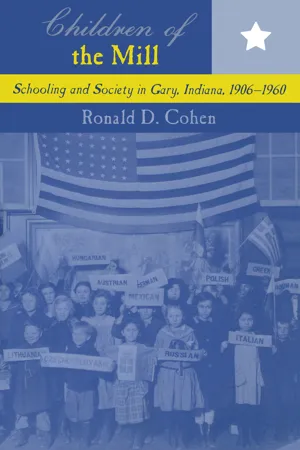
Gary, Indiana was founded in 1906, and was part of the US Steel Corporation's plan to build the world's largest steel mill. The city's school system became world-famous as a progressive educational experiment until the 1930s when a changing political and economic climate led to an erosion of the system, which faced a serious overcrowding crisis in the 1950s. Blending social and intellectual history, Ronald Cohen examines the economic, political, and cultural context of the unique educational experience developed in this urban industrial center. Cohen demonstrates that while various interest groups - local as well as national - helped mold educational policies and practices, the Gary schools operated within the framework of corporate capitalism. Despite their early experimental nature, the Gary schools exemplified the rise of mass education in a multi-racial, multi-ethnic, class structure and urban setting.
- 304 pages
- English
- ePUB (mobile friendly)
- Available on iOS & Android
eBook - ePub
About this book
Trusted by 375,005 students
Access to over 1.5 million titles for a fair monthly price.
Study more efficiently using our study tools.
Information
Notes
Preface
1. Lawrence A. Cremin, The Transformation of the School: Progressivism in American Education, 1876-1957 (New York, 1961, paperback ed. 1964), viii, 155; Ellwood P. Cubberley, Public Education in the United States: A Study and Interpretation of American Educational History (revised and enlarged ed., Boston, 1934), 530. Cremin has recently somewhat modified his view of progressive education, but not by much; see American Education, vol. 3: The Metropolitan Experience, 1876-1980 (New York, 1988).
2. Callahan, Education and the Cult of Efficiency: A Study of the Social Forces That Have Shaped the Administration of the Public Schools (Chicago, 1962), vii, 131; Kliebard, The Struggle for the American Curriculum, 1893-1958 (Boston and London, 1986), 98.
3. For an earlier statement of my historiographical views see Ronald D. Cohen and Raymond A. Mohl, The Paradox of Progressive Education: The Gary Plan and Urban Schooling (Port Washington, N.Y., 1979), chap. 8.
1. Establishing the System
1. Gary Daily Tribune, June 1, 1909,
2. William A. Wirt manuscript speech, 1926, 3-4, William A. Wirt and Mildred H. Wirt Papers, Calumet Regional Archives, Indiana University Northwest, Gary, Indiana (hereafter cited as Wirt Pps.).
3. Ibid., 8-9. On Weaver see Merle Curti, "A Great Teacher's Teacher," Social Education, 13 (October 1949):263—266, 274, who was particularly liked by Wirt's classmate the historian Charles A. Beard. For William Morris and his influence in the U.S. see Eileen Boris, Art and Labor: Ruskin, Morris, and the Craftsman Ideal in America (Philadelphia, 1986),
4. Wirt manuscript speech, 1926, 17, Wirt Pps.
5. William A. Wirt, "Industrial Work in Public Schools," The Platoon School, 6 (December 1932): 12 (originally published in The Twenty-third Biennial Report of the State Superintendent of Public Instruction (Indiana) for the School Years Ending July 31, 1905 and July 31, 1906 [Indianapolis, 1906])—only the original has the illustrations, which are most interesting; Wirt, "A School Year of Twelve Months," Education, 27 (1906-07):619-622.
6. Wirt, "Industrial Work in Public Schools," 14-15; Lawrence Cremin, The Transformation of the School: Progressivism in American Education, 1876-1957 (New York, 1964), 135-142.
7. Gary Post-Tribune, May 13, 1922; "Minutes of Meetings of the School Board of the Town of Gary, Lake County, Indiana," I, 9, 17, manuscript in Service Center, School City of Gary, Gary, Indiana; Northern Indianian, September 21, 1906; W. R. Curtis to C. O. Holmes, September 25, 1906, William A. Wirt Manuscripts, Lilly Library, Indiana University, Bloomington, Indiana (hereafter cited as Wirt Mss.). On the city's founding see James B. Lane, "City of the Century": A History of Gary, Indiana (Bloomington, Ind., 1978), 27-48, and Raymond A. Mohl and Neil Betten, Steel City: Urban and Ethnic Patterns in Gary, Indiana, 1906-1950 (New York, 1986), 10-25.
8. Holmes to Wirt, November 5, 1906, Wirt to Holmes, November 7, 1906, Wirt Mss.; Bluffton Evening News, November 8, 1906.
9. David Tyack and Elisabeth Hansot, Managers of Virtue: Public School Leadership in America, 1820-1980 (New York, 1982), 116-120 and chap. 11.
10. Wirt to Board of Education, December 15, 1906, Holmes to Wirt, December 20, 1906, Holmes to Wirt, January 21, 1907, Wirt Mss.
11. Guy Study, "The Work of William B. Ittner FAIA," Architectural Record, 57 (February 1925):99, and 97-124; Marie Anderson Ittner, "William B. Ittner: His Service to American School Architecture," American School Board Journal, 102 (January 1941):30—31, 101. On the Saint Louis schools, which influenced Wirt in many ways, see Selwyn K. Troen, The Public and the Schools: Shaping the St. Louis System, 1838-1920 (Columbia, Mo., 1975).
12. Holmes to Wirt, March 29, 1907, Wirt Mss.
13. On the European trip see Wirt to Holmes, May 13, 1907, Wirt Pps. Northern Indianian, September 13, 1907; Gary Post-Tribune, November 24, 1953; Melvin Snyder, "Music in the Early Years of the Gary Schools," 5, unpub. ms. in files of the Post-Tribune, Gary, Ifid. On German schooling see James C. Albisetti, Secondary School Reform in Imperial Germany (Princeton, N.J., 1983).
14. Gary Post-Tribune, June 3, 1956, B7; Gertrude Ogg Fife, "Gary's First High School," unpub. ms., copy in author's possession; Snyder, "Music in the Early Years of the Gary Schools," 3.
15. Northern Indianian, January 24, 1908, April 17, 1908, May 29, 1908, July 3, 1908, July 10, 1908. For the Chicago schools see David Hogan, Class and Reform: School and Society in Chicago, 1880-1930 (Philadelphia, 1985), particularly chap. 4 on vocational schooling.
16. Gary Daily Tribune, September 10, 1908, December 14, 1908, December 15, 1908, December 18, 1908; Northern Indianian, December 18, 1908; Ronald D. Cohen and Raymond A. Mohl, The Paradox of Progressive Education: The Gary Plan and Urban Schooling (Port Washington, N.Y., 1979), chap. 5. For other examples see Michael W. Homel, Down from Equality: Black Chicagoans and the Public Schools, 1920-41 (Urbana, Ill., 1984); Judy Jolley Mohraz, The Separate Problem: Case Studies of Black Education in the North, 1900-1930 (Westport, Conn., 1979); Vincent P. Franklin, The Education of Black Philadelphia: The Social and Educational History of a Minority Community, 1900-1950 (Philadelphia, 1979).
17. President [Holmes] to Mr. Muzzall, December 14, 1906, Wirt Mss.; Clifton J. Phillips, Indiana in Transition: The Emergence of an Industrial Commonwealth, 1880-1920 (Indianapolis, 1968), 389; and see David Tyack and Michael Berkowitz, "The Man Nobody Liked: Toward a Social History of the Truant Officer, 1840-1940," American Quarterly, 29 (Spring 1977):34.
18. [Wirt] to Muzzall, January 2, 1909, Wirt Mss.; Gary Daily Tribune, September 30, 1908, October 15, 1908, November 18, 1908, November 19, 1908.
19. Gary Daily Tribune, February 8, 1909, February 22, 1909, February 24, 1909.
20. Ibid., March 11, 1909, October 13, 1909, October 21, 1909; Ray to Wirt, January 19, 1910, Wirt Mss.
21. Gary Daily Tribune, July 1, 1910; Ray to Wirt, June 27, 1910, Wirt Mss. On the connection between poverty and truancy in Chicago see Hogan, Class and Reform, 110-113.
22. For different interpretations of the purposes of kindergartens see Michael S. Shapiro, Child's Garden: The Kindergarten Movement from Froebel to Dewey (University Park, Pa., 1983); Marvin Lazerson, Origins of the Urban School: Public Education in Massachusetts, 1870-1915 (Cambridge, Mass., 1971), 72-73; Hogan, Class and Reform, 79-82.
23. Gary Daily Tribune, September 10, 1908, October 8, 1909, January 13, 1910, January 14, 1910; Wirt to Principals, January 6, 1914, Wirt Mss.
24. Gary Daily Tribune, December 9, 1908; Gary Evening Post, Novembers, 1909. For the national context see Clarence A. Perry, Wider Use of the School Plant (New York, 1910), chap. 2; William J. Reese, Power and the Pro...
Table of contents
- Cover
- Half Title
- Title
- Copyright
- Dedication
- Contents
- FOREWORD
- PREFACE
- I. Establishing the System, 1906-1910
- II. In the Schools, 1910-1915
- III. Times of Troubles, 1915-1920
- IV. Flush Times, 1920-1930
- V. Survival, 1930-1940
- VI. The War Years, 1940-1945
- VII. Postwar Problems, 1945-1950
- VIII. Continuity and Change, 1950-1960
- Afterword
- A NOTE ON SOURCES
- NOTES
- INDEX
Frequently asked questions
Yes, you can cancel anytime from the Subscription tab in your account settings on the Perlego website. Your subscription will stay active until the end of your current billing period. Learn how to cancel your subscription
No, books cannot be downloaded as external files, such as PDFs, for use outside of Perlego. However, you can download books within the Perlego app for offline reading on mobile or tablet. Learn how to download books offline
Perlego offers two plans: Essential and Complete
- Essential is ideal for learners and professionals who enjoy exploring a wide range of subjects. Access the Essential Library with 800,000+ trusted titles and best-sellers across business, personal growth, and the humanities. Includes unlimited reading time and Standard Read Aloud voice.
- Complete: Perfect for advanced learners and researchers needing full, unrestricted access. Unlock 1.5M+ books across hundreds of subjects, including academic and specialized titles. The Complete Plan also includes advanced features like Premium Read Aloud and Research Assistant.
We are an online textbook subscription service, where you can get access to an entire online library for less than the price of a single book per month. With over 1.5 million books across 990+ topics, we’ve got you covered! Learn about our mission
Look out for the read-aloud symbol on your next book to see if you can listen to it. The read-aloud tool reads text aloud for you, highlighting the text as it is being read. You can pause it, speed it up and slow it down. Learn more about Read Aloud
Yes! You can use the Perlego app on both iOS and Android devices to read anytime, anywhere — even offline. Perfect for commutes or when you’re on the go.
Please note we cannot support devices running on iOS 13 and Android 7 or earlier. Learn more about using the app
Please note we cannot support devices running on iOS 13 and Android 7 or earlier. Learn more about using the app
Yes, you can access Children of the Mill by Ronald D. Cohen in PDF and/or ePUB format, as well as other popular books in Education & Education General. We have over 1.5 million books available in our catalogue for you to explore.