- 232 pages
- English
- ePUB (mobile friendly)
- Available on iOS & Android
eBook - ePub
About this book
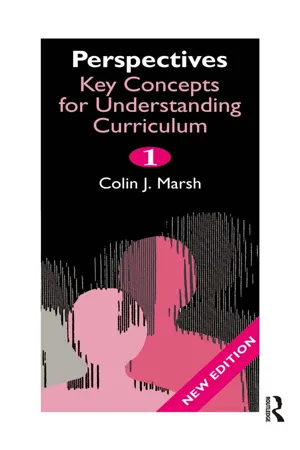
Each chapter of this book is devoted to a separate concept, which is analysed in terms of its major features. Follow-up questions at the end of each chapter are designed to challenge the reader to reflect on the specific issues raised. Vol I is largely introductory dealing with students' and teachers' perspectives of curriculum.
Information
Part I
Introduction
1 What Is Curriculum?
Introduction
Numerous scholars have commented upon what they perceive to be curriculum. For example, Goodson (1994), describes curriculum ‘as a multifaceted concept, constructed, negotiated and renegotiated at a variety of levels and in a variety of arenas’ (p. 111).
Longstreet and Shane (1993), consider that ‘curriculum is an historical accident — it has not been deliberately developed to accomplish a clear set of purposes. Rather, it has evolved as a response to the increasing complexity of educational decision making’ (p. 7).
It is certainly the case that curriculum has been a matter of intense debate during the twentieth century. There have been all kinds of priorities put forward including citizenship demands, personal development priorities and vocational training pressures. There have also been various pressures ranging from practical, school-focused approaches to curriculum and curriculum development; theoretical perspectives of different kinds and technical, scientific management approaches.
Some Definitions of Curriculum
Over the decades many definitions of curriculum have been provided but because key players in education represent a diversity of values and experience, it is extremely difficult to get wide public or professional consensus. Consider the following selection of definitions of curriculum:
• Curriculum is that which is taught in school.
• Curriculum is a set of subjects.
• Curriculum is content.
• Curriculum is a set of materials.
• Curriculum is a set of performance objectives.
• Curriculum is that which is taught both inside and outside of school and directed by the school.
• Curriculum is that which an individual learner experiences as a result of schooling.
• Curriculum is everything that is planned by school personnel.
To define curriculum as ‘what is taught in schools’ is of course, very vague. Persons often talk about the ‘school curriculum’ in this general way and they tend to mean by this the range of subjects taught and the amount of instruction time given to each in terms of hours or minutes.
Curriculum defined as ‘content’ is an interesting emphasis and brings into question another term, namely the ‘syllabus’. A ‘syllabus’ is usually a summary statement about the content to be taught in a course or unit, often linked to an external examination. This emphasis on what content to be taught is a critical element of a ‘syllabus’ but a ‘curriculum’ includes more than this. For example how you teach content can drastically affect what is taught. Also, the extent to which students are sufficiently prepared and motivated to study particular content will affect very greatly what is learnt.
Curriculum is quite often defined as a product — a document which includes details about goals, objectives, content, teaching techniques, evaluation and assessment, resources. Sometimes these are official documents issued by the government or one of its agencies and which prescribe how and what is to be taught. Of course it is important to realize that a curriculum document represents the ideal rather than the actual curriculum. A teacher may not accept all aspects of a written curriculum and/or be unable to implement a curriculum exactly as prescribed due to lack of training and understanding. There can be gaps between the intended, ideal curriculum and the actual curriculum. It may be that the level and interests of the students, or local community preferences, may prevent a teacher from implementing a curriculum as prescribed.
Defining a curriculum as a ‘set of performance objectives’ or student learning is a very practical orientation to curriculum. This approach focuses upon specific skills or knowledge that it is considered should be attained by students. Proponents of this approach argue that if a teacher knows the targets which students should achieve, it is so much easier to organize other elements to achieve this end, such as the appropriate content and teaching methods.
Few would deny that another strength of this approach is the emphasis upon students. After all, they are the ultimate consumers and it is important to focus upon what it is anticipated that they will achieve and to organize all teaching activities to that end. Yet it must also be remembered that this approach can lead to an overemphasis upon behavioural outcomes and objectives which can be easily measured. Some skills and values are far more difficult to state in terms of performance objectives. Also, a curriculum document which is simply a listing of performance objectives would have to be very large and tends to be unwieldy.
To define curriculum as ‘that which is taught both inside and outside school, directed by the school’ indicates that all kinds of activities that occur in the classroom, playground and community, comprise the curriculum. This emphasis has merit in that it demonstrates that school learning is not just confined to the classroom. However, it should be noted that the emphasis is upon ‘direction’ by the school which seems to indicate that the only important learning experiences are those which are directed by school personnel. Few would accept this statement and so it is necessary to look at other definitions.
To define curriculum in terms of ‘what an individual learner experiences as a result of schooling’ is an attempt to widen the focus. The emphasis here is upon the student as a self-motivated learner. Each student should be encouraged to select those learning experiences that will enable him/her to develop into a fully-functioning person. However, it should be noted that each student acquires knowledge, skills and values not only from the official or formal curriculum but also from the unofficial or hidden curriculum (see also Chapter 4). As noted by Pollard and Tann (1987) the hidden curriculum is implicit within regular school procedures, in curriculum materials, and in communication approaches and mannerisms used by staff. It is important to remember that students do learn a lot from the hidden curriculum even though this is not intended by teachers.
The definition which refers to curriculum as ‘everything that is planned by school personnel’ is yet another orientation which emphasizes the planning aspect of curriculum. Few would deny that classroom learning experiences for students need to be planned although some unplanned activities will always occur (and these can have positive or negative effects). This definition also brings to ...
Table of contents
- Cover
- Half Title
- The Falmer Press Teachers' Library
- Title Page
- Copyright Page
- Table of Contents
- List of Tables
- List of Figures
- Preface
- Dedication
- Part I Introduction
- Part II Student Perspectives
- Part III Teacher Perspectives
- Part IV Collaborative Involvement in Curriculum
- Concluding Issues
- Index
Trusted by 375,005 students
Access to over 1.5 million titles for a fair monthly price.
Study more efficiently using our study tools.
Frequently asked questions
Yes, you can cancel anytime from the Subscription tab in your account settings on the Perlego website. Your subscription will stay active until the end of your current billing period. Learn how to cancel your subscription
No, books cannot be downloaded as external files, such as PDFs, for use outside of Perlego. However, you can download books within the Perlego app for offline reading on mobile or tablet. Learn how to download books offline
Perlego offers two plans: Essential and Complete
- Essential is ideal for learners and professionals who enjoy exploring a wide range of subjects. Access the Essential Library with 800,000+ trusted titles and best-sellers across business, personal growth, and the humanities. Includes unlimited reading time and Standard Read Aloud voice.
- Complete: Perfect for advanced learners and researchers needing full, unrestricted access. Unlock 1.5M+ books across hundreds of subjects, including academic and specialized titles. The Complete Plan also includes advanced features like Premium Read Aloud and Research Assistant.
We are an online textbook subscription service, where you can get access to an entire online library for less than the price of a single book per month. With over 1.5 million books across 990+ topics, we’ve got you covered! Learn about our mission
Look out for the read-aloud symbol on your next book to see if you can listen to it. The read-aloud tool reads text aloud for you, highlighting the text as it is being read. You can pause it, speed it up and slow it down. Learn more about Read Aloud
Yes! You can use the Perlego app on both iOS and Android devices to read anytime, anywhere — even offline. Perfect for commutes or when you’re on the go.
Please note we cannot support devices running on iOS 13 and Android 7 or earlier. Learn more about using the app
Please note we cannot support devices running on iOS 13 and Android 7 or earlier. Learn more about using the app
Yes, you can access Perspectives by Colin Marsh in PDF and/or ePUB format, as well as other popular books in Education & Education General. We have over 1.5 million books available in our catalogue for you to explore.