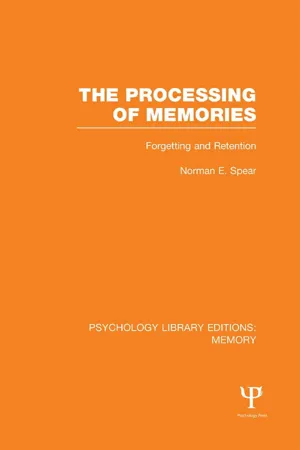
Originally published in 1978, this volume contains the evidence that is most crucial for our understanding the processes of forgetting and retention. Organized in terms of problem areas and issues that are particularly pertinent to understanding these processes, the book deals with both animal and human studies. The author begins by defining the topic and reviewing its historical development. A theoretical orientation follows, and then the author begins to address the major factors that determine what is, and what is not, remembered. Although we cannot yet specify the principles from which we can predict when an episode, once learned, will be remembered well or forgotten entirely, the author demonstrates that such principles are not that far away. He considers the issues that must be resolved before such principles are established, and in the course of doing so covers the major research on why we remember events and why they are forgotten.
- 554 pages
- English
- ePUB (mobile friendly)
- Available on iOS & Android
eBook - ePub
About this book
Information
Publisher
Psychology PressYear
2014Print ISBN
9781138998063
9781848723832
Edition
1eBook ISBN
9781317743835
1
Introduction and Historical Perspective
“Blackouts” may result when too much alcohol is ingested. Blackouts are a symptom associated with alcoholism, although they occur in nonalcoholics as well. This symptom is a special kind of forgetting that is abnormally severe and attributed to a source not usually encountered in nature, which may qualify it as a case of “amnesia.”
The term blackout is misleading because its occurrence does not necessarily involve loss of consciousness. A person suffering a blackout does not appear abnormal to most observers, and in fact some victims have been said to appear less intoxicated during a blackout than otherwise (Goodwin, 1971).
Neither the functional nor the organic basis of blackouts is understood, and their study is impeded by their irregularity. Blackouts occur sometimes in alcoholics, but neither exclusively nor inevitably. They often follow if large amounts of alcohol are consumed at a rapid rate, but not always, even among persons for whom blackouts are common. In addition, there appear to be two very distinct types of blackouts: the more severe en bloc type and a mild type. The latter case of blackout is so similar to normal bouts of forgetting that often the same memory deficit may occur when no alcohol has been consumed, in which case the diagnosis “blackout” or “amnesia” may be superfluous.
The topics to be discussed in this book are not the sorrier consequences of ingesting alcohol or any other drug, as the title indicates. However, the blackout phenomenon is a convenient vehicle for introducing some issues of memory processing because the associated memory deficit is perhaps the most common severe instance of abnormal forgetting. Many of us either have experienced, or thought we experienced, a blackout. This case of amnesia may be used to illustrate some general features of memory processing. As with most cases of forgetting, persons experiencing the less severe case of blackout may not realize that they have lost their memory of specific events unless they are made aware that these events did in fact occur. As with more common forgetting, memories of these events may return if the subject is “reminded” by the appropriate hints or cues, that is, by real or vicarious exposure to associated events. One similarity between blackouts and instances of common forgetting is especially intriguing: In spite of apparently adequate sensation and perception of prior events and reasonable intent to learn them, there is utter failure to account for them later. Whenever perception of certain events is inadequate, the study of their retention usually is uninteresting. To study retention and forgetting, we have to compare differences in performance, and we can only draw the conclusions we seek if the performance differences are not due to uncontrolled differences in sensation, perception and motivation. Indeed, we must also exclude contamination by differences in learning, a measure that seems especially difficult to control. More on this later.
The more severe en bloc type of blackout has limited counterparts in normal memory. This is characterized by an inability to recall events that occurred throughout entire periods of time, from a few hours to a few days. Recall for these events often cannot be recovered, in spite of intense prompting. A few instances of common forgetting are this extreme—for example, you might try to recall events in your own history prior to reaching the age of two or three—but it is rare for events not too remote in time.
Our stored representations (“memories”) of personal experiences are relatively permanent. In this book, we will find it useful to assume that ordinarily memories are absolutely permanent once stored. We will be concerned here with the circumstances under which a memory comes to influence our behavior and the circumstances under which it does not. Blackouts are one of many specific behavioral phenomena that provide an experimental preparation for use in studying this question, but we now consider more general issues concerning the processing of memories.
BASIC CONCEPTS
Memory and Its Processing
If an organism is to make use of the internal representation—the memory—of events encountered, two steps are required. Though only preliminary to our concerns here, these steps in themselves have enormous significance for behavior. First, the events must be perceived, coded at the receptor level in terms of neurochemical activity, and further modified in the central nervous system in light of prior experience with similar events. This process of perception is quite beyond the scope of this book, and we will have little more to say about it. It is notable, nevertheless, that it is by no means simple to determine whether certain phenomena often considered to be aspects of “short-term memory” are in fact separable from perception, and vice versa.
The second preliminary process is the encoding that occurs beyond perception, in which representations of events are “stamped into” an organism for future reference and consequent modification of behavior. The set of representations of events—collectively, the memory—must be “stored” or “consolidated” neurochemically. Storage of the memory may be accomplished simultaneously with perception, but not usually. Because memory storage more commonly proceeds beyond initial perception, we are led to consider the principles of learning and conditioning in order to understand the environmental determinants of memory storage.
By learning and conditioning we mean the portion of memory processing that functions when an organism is exposed, usually repetitively, to certain episodes (an “episode” being a set of events). If the separable events of an episode are related (e.g., if those events are contiguous, predictive, etc.), then this group of environmental events may be represented in the organism by a group of corresponding “memory attributes,” which collectively constitute the “memory” for that episode.
When we say “I remember a bell and I remember the end of a lecture period,” we imply only separately stored memory attributes representing the concepts “bell” and “lecture period.” But when we say “I remember that a bell indicates the end of a lecture period,” we describe the memorial consequences of conditioning—a joint representation of “bell and lecture period” together with attributes that represent the general stimulus context in which this relationship has been acquired. Further, if we say “I remember that the bell indicates the end of the lecture on experimental psychology,” the contextual attribute of the memory is still more specific.
Of course, the consequences of conditioning and learning need not be verbalizable. The point is, however, that learning and conditioning are processes by which a relationship between events becomes stored as a memory together with specific attributes representing the context of those events. A good share of our attention will be given to the hypothetical consolidation process that may be viewed as responsible for initial storage of a memory. For our purposes, consolidation is interesting to the extent that it may be separated from perception. If the consolidation process actually proceeds so rapidly as to fall within the duration of the perceptual processes, then it may be more effective to consider it together with other phenomena of perception, which we shall not discuss in this book. Later we shall discuss further the concept of consolidation, especially in considering abnormal memory processing. Certainly, we must consider the events that follow initial consolidation—the elaboration of the basic memory through integration with previously established memories of similar content, an interaction that hardly can be denied in view of the dynamic quality of memory processing. But for the most part the focus of this book will be on the behavioral manifestation of established, “well-consolidated” memories. Thus, for our purposes perception will be assumed and the characteristics and determinants of original learning are of only secondary interest.
What is a “Memory”?
It was first realistic, then useful, and now customary to take a multidimensional view of a memory. A memory is a conglomerate of attributes, characteristics, or dimensions that uniquely define an event. Although “memory” often is used also with reference to the entire process of learning and remembering, it is used here only as the individual’s representation of events. It is a hypothetical construct for what is remembered. The memory of a human child’s scratchy encounter with an impatient cat may be represented not only as a startling, claw-induced pain from a previously soft, furry object but also as the yowl of the cat, the scream of the mother, the child’s own internal sympathetic response to these exciting or noxious stimuli, the sequence of “cat teasing” that preceded the scratch and whether the episode occurred in the living room or on the patio, and more. A rat confronted with the task of leaving one compartment and entering another within five seconds to avoid footshock may represent this episode collectively in terms of separate memory attributes (apart from the immediate experimental contingencies governing the footshock): the odor of the room, the sensation of the experimenter’s hand, the rat’s internal hormonal state based on time of day or point in estrous cycle or state of adrenal depletion, the rat’s physical or emotional state (illness, fatigue, hunger, or fear), the severity of the footshock, the structure of the grid floor, and perhaps the sequence of just-preceding events in its home cage leading up to its predicament.
Similarly, as Underwood (1969) has described, the memory of a verbal unit by an adult human may include attributes that define the unit’s orthographic characteristics, its acoustical characteristics, its relative frequency in a given context or absolute frequency in the language, and the general context in which the verbal unit was presented.
Serving as a subject in a verbal learning experiment, a student instructed to memorize a list of words may include as part of her memory not only the words-as-presented but perhaps also some features of the room, the color of the paper on which the words were written, the odor of the experimenter’s perfume, and whether the student is nervous about appearing stupid or is irritated at having been coerced into serving in the experiment. The complexity of the memory—the number of separate events represented for an episode—will vary depending on a variety of circumstances, such as how familiar the subject is with the environment of learning, whether the task or material to be learned has been practiced before, and so on.
Each representation of a psychologically separable event is called a memory attribute. When we speak of “memory” processing, we are referring hypothetically to the entire set of memory attributes formed during original learning. In actual fact, these attributes may function rather independently. If you are asked to recall the latest portion read of the novel you are now reading, you may immediately respond with the gist of the recent events in the story, and perhaps the general portion of the book in which it belongs. However, you are unlikely to remember the precise page numbers, the first word on the page you are now reading, or the precise time at which you picked up the novel, even though you may have registered this information originally. The point is that different attributes of a memory may be forgotten at different rates. If so (we shall consider this question later), it would appear that attributes of a memory should be treated as mutually independent. A further point is that subjects may select for retrieval only one aspect of a memory, depending on what they believe is required. It is not necessary at this point to make precise assumptions about these theoretical aspects of a memory. It is useful, however, to think of a memory as a multidimensional representation.
This multidimensional characteristic of memory is quite obvious in any educational enterprise. A former student once carefully reported to me that he remembered the names my infant daughter had assigned two of her dolls. As an anecdotal illustration of infantile amnesia, I had described in a lecture how my daughter, now grown to age five, did not recognize the names “Darfy” and “Lub-Lub” as the names she earlier had assigned these dolls (which she had played with constantly at age two, but since were stored away). Moreover, she had thought her father a bit weird for suggesting such absurd names. The point is that while the former student readily produced the words “Darfy” and “Lub-Lub” and remembered my daughter’s disappointment with her father’s silly behavior, he sheepishly admitted that he forgot why I had told that story. Although trivial details of the episode were remembered, the major point was forgotten.
Finally, the concept of “coding” is intrinsic to understanding the nature of a memory. What is stored is not the external “stimuli” but the organism’s responses to those stimuli. The nominal stimulus is therefore not usually the functional stimulus. The difference between them depends on the external context of the nominal stimulus and the internal state of the organism, as well as response biases due to past learning or biological dispositions. These factors determine this elementary form of coding, which occurs in animals and humans alike to yield the multidimensional representation termed a memory.
Memory Storage and Memory Retrieval
Memory “storage” and memory “retrieval” are hypothetical constructs. Storage is the process of representing events initially and thus establishing the memory for potential future reference. Retrieval is the process that takes the stored representations (memories) of events and manifests them in terms of behavior, with the understanding that “behavior” in this case might include further covert processing of the memory that may be inferred from subsequent overt behavior (an empirical example of the latter is “implicit reactivation,” described in Chapter 7; see also Spear, 1973, 1976).
Perhaps the most ubiquitous reference to memory processing is not how representations of episodes are stored initially but how and when a memory influences behavior after it has been stored. How can we retrieve the information that has been stored as a memory? Under what circumstances will a memory be retained or forgotten?
In common usage, memory is most often applied as if it were the retrieval process. If John Doe says “I have a poor memory for names,” he does not mean that he cannot learn the name of a woman he is meeting for the first time. Nor does John mean that he cannot refer to the woman’s name during the next few minutes or hours of conversation with her. Instead, the reference is to what happens after John has stopped active processing, “thinking” of that particular episode; then, when John later sees the now-familiar face, he cannot produce her name. Notice that John probably can retrieve some representation of that woman. For instance, in addition to recognizing her face from among strangers, other physical characteristics may be remembered, and, probably, John will remember to a large extent what her name is not.
The problem of memory retrieval may be addressed by considering any instances in which an animal or human engages in an episode (a set of events) and learns it. Let us say there is evidence that behavior has been modified as a consequence of the episode. Can we now be certain that the individual’s retrieval process will cause the “new” behavior to recur when appropriate conditions call for it? For example, if you should learn to recite this paragraph verbatim, could we be certain that you would recite it perfectly next year? Of course not.
The reasons for our uncertainty are at the same time obvious and obscure. It is obvious that acquired information is not inevitably available for use (i.e., “remembered”). Your parents could tell you how at the age of two or three you had learned quite well the names of your dolls, the location of hidden cookies, and several road signs on the way to Grandma’s. Yet it is unlikely that you can recall this information today.
The obscure aspect is reflected in how widely the likelihood of recalling acquired information may differ, yet how effectively this recall may be controlled. Equally obscure is a clear understanding of the basic processes underlying such recall and why their effectiveness varies. Differences in the accuracy of remembering among individuals equal in many other skills can be astounding. Mr. S. was reported by Luria (1968) to recall perfectly a matrix of 20 randomly chosen numbers that had been presented to him on a single occasion 16 years earlier. In contrast, certain victims of brain damage, whose basic IQ nevertheless may be equal to that of Mr. S., may be quite unable to remember the name of their doctor within a few seconds after he has left the room (see, e.g., Barbizet, 1970). Equally wide variability may be found in terms of experimental tests of memory processing in animals. For example, certain drugs that act as neural stimulants, when given shortly after learning a problem, may negate later remembering; other drugs with similar effects on the central nervous system may be given to another animal to enhance remembering of the same problem.
The obscurity of the reasons for forgetting may be illustrated further by simple treatments that seem to alleviate forgetting. Adults instructed to stand in front of a group of other adults and shout loudly “No, I won’t!” may spontaneously recall forgotten events of childhood or adopt childish postures (Tompkins, 1970). Tompkins also reports that the idiosyncratic nature of the adult signature may be lost and childish handwriting assumed when adults are instructed to write their names slowly, at the rate of about three seconds per letter. It often is reported that through hypnotic suggestion adults may be made to recall verifiable events of childhood that apparently otherwise were not remembered (e.g., Reiff & Scheerer, 1959). Humans or animals given treatments that induce amnesia for specific learning can be made to recover from that amnesia by the simple passage of time or by the presentation of some portion of the circumstances that governed the original learning (e.g., Bickford, Mulder, Dodge, Svien, & Rome, 1958; Lewis, 1969; Spear, 1973, 1976).
The point I wish to emphasize is that following its acquisition a memory continues to be subject to psychological processes that determine ultimately whether this information will influence behavior at any given moment. These memory processes that occur following learning will occupy much of our attention in the following chapters. But before we can discuss this topic meaningfully, we must identify more specifically how we may measure the product of the retrieval process—specifically, what is meant by retention and forgetting. The bulk of the current chapter then will explore the history of the study of memory processing.
Retention and Forgetting
Two terms associated with the study of memory processing—retention and forgetting—will be used in a strictly operational sense. To assess the extent to which a memor...
Table of contents
- Cover
- Half Title
- Title Page
- Copyright Page
- Original Title Page
- Original Copyright Page
- Dedication
- Table of Contents
- Preface
- 1. Introduction and Historical Perspective
- 2. Contextual Determinants of Retention
- 3. Retention after Short Intervals
- 4. Analysis of Sources of Forgetting Affecting Long-Term Retention
- 5. Further Sources of Forgetting and Related Issues
- 6. The Abnormal Processing of Memories
- 7. Experimental Analysis of Amnesia and Hypermnesia
- 8. Three Major Issues
- 9. Brief Comments on Selected Issues
- References
- Author Index
- Subject Index
Trusted by 375,005 students
Access to over 1.5 million titles for a fair monthly price.
Study more efficiently using our study tools.
Frequently asked questions
Yes, you can cancel anytime from the Subscription tab in your account settings on the Perlego website. Your subscription will stay active until the end of your current billing period. Learn how to cancel your subscription
No, books cannot be downloaded as external files, such as PDFs, for use outside of Perlego. However, you can download books within the Perlego app for offline reading on mobile or tablet. Learn how to download books offline
Perlego offers two plans: Essential and Complete
- Essential is ideal for learners and professionals who enjoy exploring a wide range of subjects. Access the Essential Library with 800,000+ trusted titles and best-sellers across business, personal growth, and the humanities. Includes unlimited reading time and Standard Read Aloud voice.
- Complete: Perfect for advanced learners and researchers needing full, unrestricted access. Unlock 1.5M+ books across hundreds of subjects, including academic and specialized titles. The Complete Plan also includes advanced features like Premium Read Aloud and Research Assistant.
We are an online textbook subscription service, where you can get access to an entire online library for less than the price of a single book per month. With over 1.5 million books across 990+ topics, we’ve got you covered! Learn about our mission
Look out for the read-aloud symbol on your next book to see if you can listen to it. The read-aloud tool reads text aloud for you, highlighting the text as it is being read. You can pause it, speed it up and slow it down. Learn more about Read Aloud
Yes! You can use the Perlego app on both iOS and Android devices to read anytime, anywhere — even offline. Perfect for commutes or when you’re on the go.
Please note we cannot support devices running on iOS 13 and Android 7 or earlier. Learn more about using the app
Please note we cannot support devices running on iOS 13 and Android 7 or earlier. Learn more about using the app
Yes, you can access The Processing of Memories (PLE: Memory) by Norman E. Spear in PDF and/or ePUB format, as well as other popular books in Psychology & Cognitive Psychology & Cognition. We have over 1.5 million books available in our catalogue for you to explore.