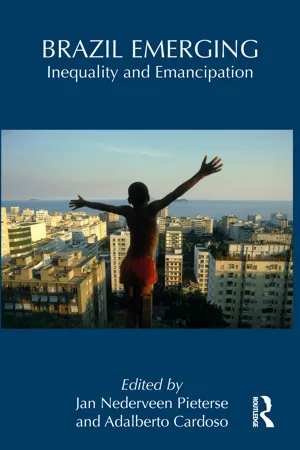
This volume is a critical inquiry into the social project and socioeconomic realities of emerging Brazil, a country that faces profound changes. A team of acknowledged specialists on Brazil's complex configuration addresses state policies, social dynamics and economic constraints and opportunities for emancipation. Chapters adopt long-run perspectives on the development of the Brazilian welfare state, limits and opportunities for emancipation in the labor market, the scope and depth of social policies such as "Bolsa Família" and Rio's Peacemaking Police Units (UPP), social movements - in particular, the Movement of the Landless (MST) - cultural policies at the federal level, the role of media in the country's democratization project, and how two important commodities (sugar and oil) shape the identities of blacks and whites in Bahia. This book is essential reading for all those interested in understanding what kind of Brazil has acquired a prominent global position and what hurdles it faces to consolidate its position as a global player.
- 216 pages
- English
- ePUB (mobile friendly)
- Available on iOS & Android
eBook - ePub
1 Building Democracy in an Emerging Society
Challenges of the Welfare State in Brazil
Sonia Fleury
This chapter analyzes some topics related to the challenges of building democracy and social inclusion in Brazil, one of the most unequal societies in the world. The focus will be on the efforts of building up a welfare state (WS) in extremely adverse conditions.
Recently, Latin American countries had to face the challenges of improving social inclusion and economic redistribution, as well as consolidating democratic institutions. Facing the pressure for social inclusion was all the more difficult in Latin American countries because these were societies characterized by some of the worst income disparities in the world, high degrees of labor market informality, and the presence of powerful actors with vested interests in maintaining the old social protection system, which was stratified and exclusive. These stratified and centralized protection models, restricted to workers employed in the formal labor market, were reformed in the last quarter of the twentieth century, because they were seen as far from egalitarian and as actually reproducing social injustice. These reforms engendered new designs of social policies in a double movement of universalizing social coverage as well as targeting poverty and urban violence.
In addition to the challenge of increasing social inclusion and fighting poverty, the construction of new democratic and inclusive institutions had its takeoff in a context of macroeconomic adjustment aimed at combating hyperinflation, in which there was pressure from international agencies to downsize the state and reduce its power. Moreover, this new global pattern of productive, economic, and social development was characterized by Kim (2009: 18) as postindustrialization, postclassism, and postfamilism, indicating that in the last quarter of the twentieth century the basic conditions supporting the welfare state were eliminated, because economic growth was no longer based on manufactured production, social mobilization was disconnected from class struggle and organized labor, and the modern family has deviated from a male breadwinner model thus reflecting a new gender and age structure.
In the last two decades, Brazil has been trying to build a welfare system based on the principle of extending social rights to all citizens through universal social policies, a principle that is enshrined in the social security concept of the Federal Constitution of 1988. The importance of studying the Brazilian experience lies not only in observing the path dependency impact of the former institutional social protection model but also in addressing the absence in Brazil of the most important requirements pointed out by the literature as necessary for the successful development of an egalitarian welfare system. This chapter reviews the WS literature and compares it to the Brazilian experience in order to highlight this discrepancy and analyze its effects on the emerging system. It contends that the statecraft of the institutional framework of social policies that occurred during the 1990s had to cope with dreadfully restrictive economic constraints. The analysis of the way the economic, cultural, and institutional constraints have affected the construction of the Brazilian welfare state (BWS) demonstrates how the absence of important requirements for WS development has led to a mixed and sometimes hidden institutional framework that enables the prevalence of private interests in public policy.
The reduction of poverty is an important outcome of recent social policies as well as of continuous increases in the minimum wage. Nonetheless, government has not prioritized the universal systems of health and education, which increases the stress and contradictions between the demands of the citizens and the state’s capacity to provide both access and high-quality services. The precariousness of social inclusion, both in the market and in the community of citizens, generates demands for a comprehensive public sphere and new institutional arrangements of a deliberative democracy capable of generating conditions not only to guarantee social rights but also to lead to emancipation.
The European bias in the WS literature leads to an implicit conclusion that this experience cannot be replicated in other contexts, in which some of the presumed preconditions are absent. Even the maintenance of the WS in these original countries seems to be threatened by the profound changes in the economic and social pillars of the social democratic construct. This concern is based on the decline of labor-based societies and the replacement of social cohesion bonds by negative competitive individualism (Castel 1995). The reduction of the middle class and the growth of inequalities magnified the income gap between the extremes of the social scale. The difficulty of enforcing an equitable tax system in a predominantly financial economy and the pressure to prevent financial bankruptcy led to cuts in public expenditure, productive investments, and redistributive policies.
Beyond that, the importance of economic interests in social sectors is expanding, with powerful profit-seeking actors like pharmaceutical industries, insurance companies, and private service-providers now playing a dominant role in public polices by influencing their design and management as well as by shaping the consumption of social services. The analysis of the opportunities for building up social protection in a region such as Latin America is overdue, considering the enduring and pervasive high levels of inequality extant there, in spite of the influence of the European social ideals in these countries’ intellectual elite. The recent wave of democracy in Latin America put social protection and poverty reduction in the public agenda, notwithstanding the legacy of authoritarian regimes, the preponderance of the elite’s vested interests in the public arena, and the dispute for scarce public resources in a context of economic crisis.
The global economic crisis is now narrowing the distance between developed welfare societies and laggard ones. Therefore, it is necessary to revisit European WS theories in order to establish a dialogue with experiences in adverse contexts.
The Limits of Welfare State Theory to Explain the Experience of Emerging Societies
Most studies on the WS derive their conclusions from comparing European experiences. This literature has pointed out some conditions associated with the emergence and consolidation of the WS. The starting point is considered to be the industrialization process (Rimlinger 1971), along with the emergence of social insecurity in a context of urbanization. The roots of the WS development are based, on one hand, on the fracture of the traditional communitarian bonds of solidarity and their displacement by class organization and new identities. On the other hand, they are embedded in the development of civil service and state administrative structures. In this sense, the WS was responsible for forging new bonds in complex societies and also for creating a new institutional pattern of redistributive conflict resolution, launching the basis for social cohesion and integration.
The WS and the competitive political party system are seen by Offe (1984) as the main institutions capable of promoting the coexistence of capitalism and democracy in its virtuous cycle. Contradictorily, at the end of this cycle of economic growth in a regulated market, both features were regarded as inflexible obstacles for renewing the capitalist economy. The convergence perspective is expressed by Wilensky’s (1975: 27) conclusion that, in spite of ideological and political regimes, the WS is the most persistent structural tendency in the development of modern societies. In this manner, he associated the WS with economic development and the social modernization process.
Differently from this nomothetic (Takegawa 2009) perspective, other authors have highlighted the importance of path dependency in the process, stressing that demands for the emergence of social protection have received different responses according to the previous institutional, political. and economic environment. Flora and Alber (1981) identify the emergence of the universal model of social protection as dependent on the strength of a homogeneous working class in fighting for social rights, as well as on the capacity of each society to institutionalize this conflict through democratic procedures.
Starting with Titmuss’s (1958) classical typology of social services, we can find a confluence of criteria encompassing both the relations between market and public sector and the degree of redistribution through social policies. His typology is based on the extension of social rights and on the double movement of expanding state structures and policies on one hand, and redistributing resources according to necessities on the other hand. According to Wincott (2011: 358), both Titmuss and Marshall were late converts to the use of the term ‘welfare state’, a name actually used by the critics of social policies in England. Marshall (1967) emphasizes the core role of citizenship status in the coexistence of an egalitarian political principle within a class-based economy. In his classic article on social classes and citizenship, he identified three kinds of rights as components of citizenship—civil, political, and social—each having its own path and institutional structure.
The WS is considered a new arrangement for consensus building and to convey conflicts to the redistributive arena, where they can have a negotiated solution. Different patterns of social protection were identified according to where the main aim of inclusion was centered: on the poor and other vulnerable groups, on labor fractions of the workforce, or on the citizens. The inclusion of social rights as part of the status of citizenship represented the most paradoxical solution for the distributive conflict in a class economy, because it had generated a public sphere not primarily subordinated to the process of accumulation, an anti-value mechanism according to Oliveira (1988). Esping-Andersen (1990) shed new light on social rights, which were reconceptualized in terms of their degree of ‘de-commodification’, meaning the capacity to take social reproduction away from merchandise circulation, producing a new, socially stratified blueprint. He also underlines the importance of institutionalization when he analyzes the consequences of the WS crisis at the end of the last century in three different regimes—the liberal welfare regime, the corporatist-state regime, and the social democratic regime. His analysis concludes that the political and institutional mechanisms of interest representation and consensus building, especially in the social democratic arrangement, have a strong impact on the preservation of employment and social rights (Esping-Andersen 1995: 77).
To summarize, according to the WS literature the development of the WS has been associated with an array of elements related to the progress of the capitalist economy, as well as with the transformation of societies as a consequence of urbanization and industrialization processes that imposed a new division of labor and led to more complex social relationships. The WS is also part of the state-building process, and this expansion is a component of the democratization of power and wealth in a mass society, with the emergence of new collective actors and political organizations. Nonetheless, it contributed to the creation of a more cohesive society, based on social principles of solidarity, in which social inclusion was widespread. However, during the crisis of the capitalist economy that started in the 1970s, the institutional mechanisms of social protection were accused of impeding the renovation of the productive relations in order to increase competition and productivity. Lately, the loss of affiliation links was pointed out as being responsible for the crisis of sociability, the rise of insecurity, the sprout of negative individualism, and the replacement of policies of inclusion by policies of labor-market insertion—also called active inclusion or workfare regime (Castel 1995).
Recent studies on the WS in developing societies have pointed out the incapacity of established theories to explain the efforts to build up social protection in different contexts in developing societies. To rethink social policy in developing countries, Wood and Gough (2008: 313) suggested that Esping-Andersen’s original typology of welfare state regimes must be seen according to the degree of in/security and in/formality of rights and correlatives duties in each society. To this effect they added two mixed variants to the previous scheme: the liberal-informal WS regimes in Latin America and the productivist WS in Asia, stressing the informality of benefits and programs in the first case and the role of employers in the second.
Regardless of recent efforts to conceptualize and understand what is happening beyond Europe, the interpretation of the Asian late-coming WS is criticized for being unable to include some important variables such as the influence of international circumstances on these countries (Takegawa 2009: 81). Takegawa hypothesizes that whereas domestic factors determine the time of the takeoff, international circumstances govern the development of the WS. The takeoff of the WS in Japan in the mid-1970s was embedded in the liberalism, because it occurred during the crisis of the traditional WS. These constraints led to a relatively low level of public social expenditure, what Takegawa (2009: 89) called universalism rationing, that is, the simultaneous adoption of pro-welfare and anti-burden policies. The result was the mixed Japanese system, involving families and enterprises in social protection. However, this productivist model was not a consequence of Confucianism. Instead, this mix is the product of expanding welfare protection with low public social expenditure and strong state intervention in the economy.
Kim (2009) also denies the application of the concept of hybrid welfare to explain the South Korean reform, because this kind of label is based on value judgments about welfare states’ leaders or laggards, instead of trying to understand the peculiar dynamics of each reform. In South Korea a peculiar process of controlling and restructuring of the WS occurred simultaneously with its formation. This process of going backward and forward in the universal WS project can be understood only if one combines the need for social inclusion after the fall of the military regimes along with the specific governmental ideologies in a context of economic constraints.
Although the process of Latin American WS building is older than many others in Europe, it has similarities with the Asian cases, because the international economic context had the same effect of constraining the expansion of social expenditures, creating an obstacle to the promotion of social inclusion in the new democratic regimes. On the other hand, the former institutional framework for corporative, stratified, and segmented protection gave rise to a community policy with strong veto power over the reforms of these systems as well as the existence of a market for the provision of social services. The incapacity of weakened nation-states to build consensus regarding the reform guidelines and to regulate the market were some of the regional challenges. Barrientos (2008) characterized the changing WS in Latin American during the 1990s as a conversion of the conservative-informal welfare regime into a liberal-informal regime. He labeled the previous Latin American regime as conservative-informal to identify the stratified nature of social protection, and concluded that currently there is a change in this pattern towards a liberal-informal welfare regime as a consequence of market deregulation. The new regime is also characterized as informal because the replacement of collective insurance for individual savings and free-market provision of services did not extend formal rights to social protection for those employed in the informal labor market. Nevertheless, the category liberal-informal is unable to differentiate among the reforms that occurred in the last quarter of the twentieth century; therefore it is not a useful tool for explaining variations in the WS in this region.
Although the reforms occurred in a period of prevalence of liberal ideology and economic adjustment, there were differentiated institutional solutions for the national explosion of social demands for inclusion. The strong global trend towards state contraction and liberalization of labor protection obscures the originality of the regional reforms as well as the plurality of WS reforms in the region.
In order to account for this plurality and originality, it is useful to review the literature on WS building in the region and also on the models of reforms after the 1980s. The leading comparative study on social policy development in Latin America was made by Mesa-Lago (1978). Comparing the development of the retirement and pension systems, he adopts the timing of social policies’ takeoff as the main explanatory factor that permits grouping the countries in the region. Accordingly, he categorizes them as pioneers, intermediate countries, or delayed countries. The timing is taken as a path dependence assumption for differences in benefit institutionalization and population coverage. His most important contribution was to outline stratification as the common mark of the Latin American model of social protection, being present in all the three types. As a consequence, even the oldest and more inclusive systems still keep different conditions of access and benefits, according to the bargaining power of each group covered.
Filgueira and Filgueira (2002) compared several countries, combining the amount of public social expenditure with the results expressed in social data, and reaffirmed Mesa-Lagos’s conclusion on the Latin American pattern of social benefits stratification. In addition, they stressed the combination of this stratified inclusion of formal workers with different degrees of social exclusion. This result cannot be explained solely by the economic development of the country or through the maturation of the systems. Instead, it seems to be mostly dependent on political options. They found, until the 1970s, three different groups of welfare benefits distribution: a group of stratified universalism (Argentina, Chile, and Uruguay with high public expenditure and almost universal stratified coverage), a group of dual system (Brazil and Mexico, with high p...
Table of contents
- Cover
- Title
- Copyright
- Contents
- List of Figures
- List of Graphs
- List of Tables
- Acknowledgments
- Introduction
- 1 Building Democracy in an Emerging Society: Challenges of the Welfare State in Brazil
- 2 Inequality, Poverty, and the Brazilian Social Protection System
- 3 Growth and Social Policies: Towards Inclusive Development
- 4 Brazil's Labor Market: Limitations and Opportunities for Emancipation
- 5 Social Movements and Emancipation in Brazil
- 6 MST's Agenda of Emancipation: Interfaces of National Politics and Global Contestation
- 7 Brazilian Culture as Category of Public Intervention
- 8 Community Policing of Rio's Favelas: State-Led Development or Market-Oriented Intervention?
- 9 Media Democratization in Brazil Revisited
- 10 A Bahian Counterpoint of Sugar and Oil: Global Commodities, Global Identities?
- 11 Why (Post)Colonialism and (De)Coloniality Are Not Enough: A Postimperialist Perspective
- Contributors
- Index
Trusted by 375,005 students
Access to over 1.5 million titles for a fair monthly price.
Study more efficiently using our study tools.
Frequently asked questions
Yes, you can cancel anytime from the Subscription tab in your account settings on the Perlego website. Your subscription will stay active until the end of your current billing period. Learn how to cancel your subscription
No, books cannot be downloaded as external files, such as PDFs, for use outside of Perlego. However, you can download books within the Perlego app for offline reading on mobile or tablet. Learn how to download books offline
Perlego offers two plans: Essential and Complete
- Essential is ideal for learners and professionals who enjoy exploring a wide range of subjects. Access the Essential Library with 800,000+ trusted titles and best-sellers across business, personal growth, and the humanities. Includes unlimited reading time and Standard Read Aloud voice.
- Complete: Perfect for advanced learners and researchers needing full, unrestricted access. Unlock 1.5M+ books across hundreds of subjects, including academic and specialized titles. The Complete Plan also includes advanced features like Premium Read Aloud and Research Assistant.
We are an online textbook subscription service, where you can get access to an entire online library for less than the price of a single book per month. With over 1.5 million books across 990+ topics, we’ve got you covered! Learn about our mission
Look out for the read-aloud symbol on your next book to see if you can listen to it. The read-aloud tool reads text aloud for you, highlighting the text as it is being read. You can pause it, speed it up and slow it down. Learn more about Read Aloud
Yes! You can use the Perlego app on both iOS and Android devices to read anytime, anywhere — even offline. Perfect for commutes or when you’re on the go.
Please note we cannot support devices running on iOS 13 and Android 7 or earlier. Learn more about using the app
Please note we cannot support devices running on iOS 13 and Android 7 or earlier. Learn more about using the app
Yes, you can access Brazil Emerging by Jan Nederveen Pieterse,Adalberto Cardoso in PDF and/or ePUB format, as well as other popular books in Social Sciences & Geography. We have over 1.5 million books available in our catalogue for you to explore.