Shifting understandings and ongoing conversations about race, celebrity, and protest in the twenty-first century call for a closer examination of the evolution of dissent by black celebrities and their reception in the public sphere. This book focuses on the way the mainstream and black press have covered cases of controversial political dissent by African American celebrities from Paul Robeson to Kanye West. Jackson considers the following questions: 1) What unique agency is available to celebrities with racialized identities to present critiques of American culture? 2) How have journalists in both the mainstream and black press limited or facilitated this agency through framing? What does this say about the varying role of journalism in American racial politics? 3) How have framing trends regarding these figures shifted from the mid-twentieth century to the twenty-first century? Through a series of case studies that also includes Eartha Kitt, Sister Souljah, and Mahmoud Abdul-Rauf, Jackson illustrates the shifting public narratives and historical moments that both limit and enable African American celebrities in the wake of making public politicized statements that critique the accepted racial, economic, and military systems in the United States.
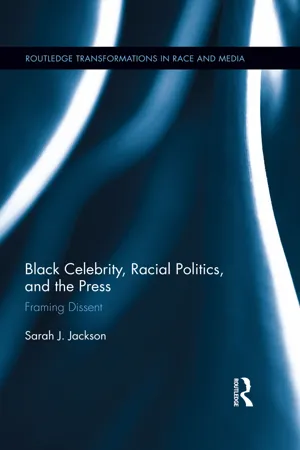
- 206 pages
- English
- ePUB (mobile friendly)
- Available on iOS & Android
eBook - ePub
About this book
Information
1
Paul Robeson at Peekskill, NY, 1949
Nothing’s happened to me. I’m just looking for freedom.1
Paul Robeson, the son of an escaped slave, was the first African American to obtain crossover celebrity status and arguably the first modern celebrity of any race in the United States.2 The Rutgers University football star, law school graduate, and stage and screen actor, was celebrated among Americans for his deep and distinctive baritone and his adeptness with Shakespeare and Negro spirituals alike. Early in his career, Robeson, while supportive of popular civil rights initiatives like anti-lynching laws, was largely silent on more controversial issues, believing his inclusion in white public arenas represented some progress. Initial media discourse about Robeson easily constructed him in line with the stereotypical casting of his early acting career—a primitively strong but comfortably familiar, naturally musical “darkie.” Although these roles resulted in some critique from black activists, his mainstream successes and popularity with white audiences led many in the black community to view Robeson as a torch bearer whose success represented a potential communal path toward racial inclusion.3
According to Jeffrey C. Stewart, “in the 1920s, and for a good part of the 1930s, Robeson became the site where African American and European American aspirations for the ability to cross over came together.”4 Of course, “crossing over” meant very different things to black and white audiences—for whites the opportunity to consume and appropriate the Other, for blacks the potential to be seen as part of mainstream society. Robeson’s celebrity also occurred at a unique historical moment in which entertainment was shifting from a participatory culture to a consumptive one.5 While on one hand the resulting commodification of Robeson’s blackness rendered his presence in white spaces non-threatening, it also became increasingly marked by a new understanding of fame that recognized that roles played by screen stars did not necessarily reflect their real-life personas. In this changing context, Robeson’s rise to international fame evolved from a 1920s and early 1930s seamless and safe construction of the star, to a later “inter-textual” representation of Robeson that recognized a conflict between his early roles and his real-life choices and politics. This representational evolution is also testament to Robeson’s understanding of the racialized limits placed upon him in the entertainment industry, and his choices to disrupt these limits as his popularity grew.
By the late 1930s, Robeson used his uniquely elevated status to publicly challenge caricatures of blacks in American film, including critiquing many of his past roles, and to turn down roles that he felt catered to the racism of the American South. He spoke publicly about these decisions and became increasingly candid about his frustrations with the lack of racial progress in America. As Robeson consciously represented himself in ways that were not consistent with “safe” black stereotypes, and as his personal life (including affairs with white women and close friendships with radical thinkers) became public, mainstream opinion of the baritone began to shift.6
As Robeson articulated his politics internationally in the 1940s—including staunch anti-racist, anti-colonial, and pro-labor perspectives and sympathies with the Soviet Union—he became regarded by many as—at best— tragically misinformed, and—at worst—a threat tarnishing the global reputation of the U.S. Robeson was called to testify in front of the House Un-American Activities Committee (HUAC) as early as 1946 and was the target of politically motivated concert cancellations throughout 1947.7 Despite this, Robeson’s celebrity status meant that he could not be ignored. Even as public understandings of the star became more and more negative, his newsworthiness guaranteed Robeson’s alternative articulations of nation, race, and democracy would be re- (and often mis-) articulated to the public by journalists.
In April 1949, the Associated Press reported that Robeson, while attending the Congress of World Partisans for Peace in Paris, had stated, “It is unthinkable that American Negroes would go to war on behalf of those who oppressed us for generations against a country [the Soviet Union] which in one generation has raised our people to the full dignity of mankind.”8 There has been some disagreement as to if this was, in fact, what Robeson said, with some historians suggesting it was a misquote, and many original reports of the speech in international papers quoting him as saying he spoke “on behalf of all American workers,” who “shall not make war on the Soviet Union.”9
Many black leaders and white labor organizations who had previously supported Robeson’s political activism disavowed these comments. The Cold War was escalating, anti-Communist sentiment was running high, and McCarthyism was stifling freedom of expression through persecution of Communists, Socialists, and virtually anyone known to support a left agenda.10 At the same time, race relations in the late 1940s were in a period of flux. Early moves toward desegregating national institutions like the armed forces and baseball took place alongside the increasing influence of segregationist Dixiecrats. African American veterans who had volunteered to fight in World Wars I and II felt a growing discontent at the violation of American democratic principles at their expense at home. And, as Joseph Dorinson and William Pencak note, prior to the rise of McCarthyism tens of thousands of Americans, black and white, had joined or come to support the Communist Party because it espoused an explicit commitment to racial equality and labor rights.11
The intersection of these phenomena meant that as McCarthyism took hold, anti-Communist narratives were often used to silence movements for racial equality and critiques of the U.S. government that went along with them. Civil rights organizations stood on the tenuous ground of attempting to pursue progress and critique national institutions while being forced to shy away from union, grassroots, and more politically radical figures for fear of political persecution.12 Members of the black press were also well aware of the dangers of the political moment as they had recently experienced governmental censorship and threats of shut down for perceived sedition by the federal government during World Wars I and II.13 Thus, while Robeson and many other Americans, black and white, journalist, politician, and civilian, held alternative understandings of Communism than that constructed in dominant discourse, the level of public fear generated by the idea that Communism was inherently seditious and threatening made the term a weapon of ideological conformity.14
Notably, despite their own vulnerability, many of the most racially and economically diverse left-leaning political organizations (usually headed by black and Jewish leftists and Communists) continued to support Robeson through concert bookings and speaking engagements during these years.15 On August 27, 1949, Robeson, now labeled a “Communist sympathizer” by mainstream journalists and under the constant surveillance (and harassment) of the CIA, was scheduled to give a concert in Peekskill, New York. As testament to his continuing popularity with both blacks and whites on the left and the active interracial political coalitions that existed at the time, the proceeds of Robeson’s concert were to benefit the Harlem chapter of the Civil Rights Congress (CRC).16
While Robeson had performed in the area three times in previous years with no difficulty, 1949 was clearly different. Riled up by the editorializing of the local Peekskill Evening Star, which labeled the concert “subversive” and the sponsoring organization a “Red Front,” a group of Peekskill residents and local veterans associations organized a protest outside the entrance to the grounds where the Robeson concert was to be held.17 While the veterans publicized the protest as one that would be a peaceful attempt to communicate disapproval of Robeson’s politics, there were more nefarious anti-black, anti-Jewish, and anti-labor undertones to the subsequent actions of the protesters. Before Robeson could arrive to perform, the waiting concertgoers were assaulted with loud, often racist jeering—including shouts of “nigger” and “kikes”—and a cross was set ablaze on a nearby hill. Without police intervention, Robeson supporters and fans were assaulted for two hours by the protestors, who set fire to their belongings and hurled rocks as they tried to exit the scene.18
Eventually, the slow-to-act police insisted that the rioters disperse. Several days later Robeson gave a speech that was, according to his biographer Martin Duberman “as fierce and telling as he ever delivered,” to a Harlem crowd of over three thousand, saying in part:
It’s been a long struggle I’ve waged, sometimes not very well understood…. I will be loyal to the America of true traditions; to the America of abolitionists, of Harriet Tubman, of Thaddeus Stevens, of those who fought for my people’s freedom, not for those who tried to enslave them…. This means that from now on we take the offensive. We take it! We’ll have our meetings and our concerts all over these United States. That’s right. And we’ll see that our women and our children are not harmed again! We will understand that the surest way to get police protection is to have it very clear that we’ll protect ourselves, and good! I’ll be back with my friends in Peekskill.19
The concert organizers quickly rescheduled the show for the following week and enlisted local union members and black World War II veterans as security for Robeson and the concert grounds. Because of the previous violence, the second Robeson concert became a symbolic protest to both those who were sympathetic to Robeson’s politics and long-time fans (Figure 1.1). While those on the left saw the second concert as a move against the “fascism” they felt was reflected by the previous infringements on freedom of speech and assembly, Peekskill’s fervently anti-Communist residents and their supporters were determined to again protest the “Russia-loving Negro” and his presumably anti-American fans.20
The second concert, attended by twenty thousand fans and supporters and protected by a line of arm-in-arm trade unionists, went on as planned. However, when concertgoers tried to leave the grounds, they were again assaulted by anti-Robeson demonstrators. The second riotous assault lasted five hours and resulted in over a hundred physical injuries and extensive property damage. Many of the pro-Robeson eyewitnesses contended that thi...
Table of contents
- Cover
- Title
- Copyright
- Contents
- List of Illustrations
- List of Tables
- Acknowledgements
- Introduction
- 1 Paul Robeson at Peekskill, NY, 1949
- 2 Eartha Kitt, the White House, and Vietnam, 1968
- 3 Tommie Smith and John Carlos at the Mexico City Olympics, 1968
- 4 Sister Souljah, Rodney King, and the Future President, 1992
- 5 Mahmoud Abdul-Rauf and “The Star-Spangled Banner,” 1996
- 6 Kanye West and Hurricane Katrina, 2005
- Conclusion: Black Celebrity, Racial Politics, and the Press: Going Forward
- Appendix
- Bibliography
- Index
Trusted by 375,005 students
Access to over 1.5 million titles for a fair monthly price.
Study more efficiently using our study tools.
Frequently asked questions
Yes, you can cancel anytime from the Subscription tab in your account settings on the Perlego website. Your subscription will stay active until the end of your current billing period. Learn how to cancel your subscription
No, books cannot be downloaded as external files, such as PDFs, for use outside of Perlego. However, you can download books within the Perlego app for offline reading on mobile or tablet. Learn how to download books offline
Perlego offers two plans: Essential and Complete
- Essential is ideal for learners and professionals who enjoy exploring a wide range of subjects. Access the Essential Library with 800,000+ trusted titles and best-sellers across business, personal growth, and the humanities. Includes unlimited reading time and Standard Read Aloud voice.
- Complete: Perfect for advanced learners and researchers needing full, unrestricted access. Unlock 1.5M+ books across hundreds of subjects, including academic and specialized titles. The Complete Plan also includes advanced features like Premium Read Aloud and Research Assistant.
We are an online textbook subscription service, where you can get access to an entire online library for less than the price of a single book per month. With over 1.5 million books across 990+ topics, we’ve got you covered! Learn about our mission
Look out for the read-aloud symbol on your next book to see if you can listen to it. The read-aloud tool reads text aloud for you, highlighting the text as it is being read. You can pause it, speed it up and slow it down. Learn more about Read Aloud
Yes! You can use the Perlego app on both iOS and Android devices to read anytime, anywhere — even offline. Perfect for commutes or when you’re on the go.
Please note we cannot support devices running on iOS 13 and Android 7 or earlier. Learn more about using the app
Please note we cannot support devices running on iOS 13 and Android 7 or earlier. Learn more about using the app
Yes, you can access Black Celebrity, Racial Politics, and the Press by Sarah J. Jackson in PDF and/or ePUB format, as well as other popular books in Social Sciences & Communication Studies. We have over 1.5 million books available in our catalogue for you to explore.