This reissued biography of Adam Smith, first published in 1982, presents both an intellectual and personal portrait of the man. It is not intended as a full-scale scholarly biography burdened with heavy footnotes. Although written by two of the world's foremost authorities on Adam Smith, the book is intended as an accessible study of a great thinker and philosopher which will help to introduce the reader to both his ideas and his period.
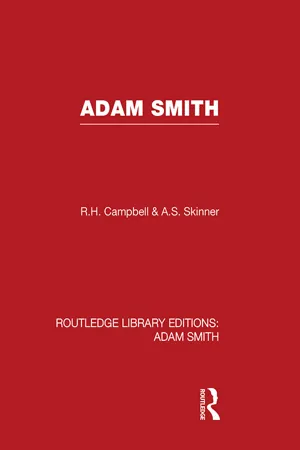
- 236 pages
- English
- ePUB (mobile friendly)
- Available on iOS & Android
eBook - ePub
Adam Smith
1 Kirkcaldy
DOI: 10.4324/9780203092736-1
The burgh of Kirkcaldy was well-established by the 1720s. Though alleged to be ‘one of the most ancient burghs in Scotland’ as early as 1304, the claim may have been exaggerated since the town's evolution was protracted, its final charter as a royal burgh being granted on 5 February 1644.1 On the Forth, and particularly in south-east Fife, Kirkcaldy's status was by no means unique, being one of a string of nine royal burghs along the coast stretching from Crail to Burntisland. Some were so close to each other, as was Dysart to Kirkcaldy, that they gradually merged. Interspersed between the royal burghs were burghs of barony and of regality – Leven, Methil, Aberdour, Wester Wemyss – many but not all chartered in the seventeenth century and soon to provide a challenge to the ancient established rights and privileges of the royal burghs. A number of geographically separate and distinct non-burghal communities, in many cases with different economic interests and social structure, lay close to Kirkcaldy and were effectively linked to it, though not even in the same ecclesiastical parish: for example Linktown in the parish of Abbotshall to the southwest and Pathhead and Gallatown in the parish of Dysart to the northeast. The parish of Kirkcaldy itself was small, with a population of 2,296 when Alexander Webster carried out his census in 1755, but geographically it was appropriate to designate it the ‘lang toon’.
The administration of the burgh lay in the hands of the town council, with responsibilities covering the usual fields of ecclesiastical provision, poor relief and, of particular relevance to Adam Smith, the burgh school. Like many another, the burgh was not always well administered. In the year of Smith's birth, the existing tenants of the burgh lands could not pay their rents and application was made to the Convention of Royal Burghs for help to pay the cess or taxes levied on the burgh. At the same time, the pier, so vital for the local economy, needed repair, so that the renunciation of leases was accepted and the lands feued.2 In these conditions parsimony was always a continuous and guiding principle of administration. Though the privileges of burghs such as Kirkcaldy were not subjected to major reforms until the nineteenth century, many were whittled away earlier by changing economic conditions. The long-standing reputations of both the Forth and Fife as centres of Scottish trade suffered temporary interruptions in the Civil War and Interregnum (when Kirkcaldy reputedly lost heavily). Then a more serious long-term decline set in, most evidently in the fishing ports of Crail and Pittenweem. From the mid-1680s Kirkcaldy's established position and reputation were also challenged as local landowners exploited the mineral resources of their estates and promoted the coal trade of Leven, Methil, Aberdour and Wester Wemyss. By the later seventeenth century the carrying trade in which Kirkcaldy and Burntisland specialised was suffering and in 1692 the antiquated nature of Kirkcaldy's shipping was cited as an example of the port's decay. In the long run the growing challenge of the ports on the west of Scotland was to prove more important still. While the Forth still led in many ways, the buoyant trade was in the west and with the New World.
In the 1720s, the community was still dominated by old and traditional ways but showed the symptoms of the transformation which eventually engulfed it. The town council carried on in its self-perpetuating, oligarchic ways, little affected even by changes in its parliamentary representation; the chief manufacture in the adjacent villages was nailmaking, still organised on its old domestic basis, and whatever the encouragement and progress of textiles, especially linen, the activity was still trade.
Adam Smith was born in a house in the High Street, though not the one he was later to occupy. The date of his birth is uncertain, although it is known that he was baptised on 5 June 1723. His father, another Adam, was twice married. His first wife was Lilias Drummond, the eldest daughter of Sir George Drummond, of Milnab, Provost of Edinburgh. She died around 1717, leaving one child, Hugh, who was born in 1709 and died unmarried in 1750. Since Hugh made no disposition of his property, his half-brother Adam was served as heir. The second marriage, to Margaret Douglas, was in 1720 but, before their only child was born, the father died on 25 January 1723.
The origins of Adam Smith's paternal family lie deep in Aberdeenshire, in the minor landed but well-established families of the Smiths of Rothiebirsben, Inveramsay and Seaton. His immediate ancestors were in Seaton, held by grandfather John Smith, who had a numerous family, of which Adam Smith, senior, was the youngest. As was common among many of the smaller landed families, its members held a variety of official posts. Smith's uncle, Alexander, a writer in Edinburgh, was General Collector of Taxation in Scotland and Postmaster-General. His cousins included William Walker, an influential burgess in Aberdeen, and William Smith, who among other offices was secretary to the Duke of Argyll, at a time when Argyll was chief dispenser of patronage in Scotland. Kinsmen – of the Inveramsay line – were regents at King's and at Marisehal Colleges.
Adam Smith's mother, Margaret Douglas, came of a more easily identified and better-connected landed family from Fife. Her father was the second son of Sir William Douglas of Kirkness, an estate settled on his fourth son – Smith's great-great-grandfather – by Sir William Douglas of Loch Leven, when he succeeded as fifth Earl of Morton. The maternal grandfather married Helen Forrester of Strathenry as her second husband, and after her death he married Susan, daughter of Lord Burleigh, in 1688. Their daughter Margaret was baptised on 17 September 1694.
The ancestry of Adam Smith's parents was not obscure. His mother's fortune was more substantially based on the land, which was then the source of so much power, and her father sat in the Scottish Parliament from 1703 until his death in 1706. But her husband's source of distinction came more from his association with the ranks of minor officialdom. The life of Adam Smith, senior, showed a progression very similar to that of many of his relatives. He was born in 1679. Studies at King's College, Aberdeen, and possibly at Edinburgh, were followed by an adventurous voyage to Bordeaux, which included shipwreck. His appearance as private secretary to Hugh Campbell, Earl of Loudoun, who became Secretary of State for Scotland in 1705, showed that he was bound for higher office, and in March 1707 he was admitted a Writer to the Signet. In the following month a Commission was issued appointing him to the post of Clerk of the Court Martial in Scotland. The Clerk provided a general surveillance of legal procedure and was entitled to refer in his report to any legal matter to which he considered the court had failed to give adequate attention. As the clerkship was only a part-time post, Smith continued to serve as private secretary to Loudoun, until he passed that office to his nephew William Smith early in 1714. The occasion was his appointment as Comptroller of Customs at Kirkcaldy. At the same time his cousin Hercules moved there as Collector from the same office at Montrose. The Collector was the senior officer, with the Comptroller acting as a check on him, though they combined to enforce the legislation.
As both Clerk of the Court Martial and as Comptroller of Customs at Kirkcaldy, Adam Smith was placed in a comfortable position. His income from the former office was £137.5s, but his income from the latter is difficult to determine because the nominal amount was exceeded by various fees, especially the one shilling in each pound of the value of any goods detected being brought in duty free. The cost of paying a clerk had to be deducted, but in aggregate Adam Smith's total emoluments must have been almost £300 sterling a year, giving the family a degree of affluence. Other evidence, which emerged when Adam Smith, senior, died, shows the standing of the family. On his death the father had a small library of less than 100 volumes, of which about one-third were works of theology and devotion, while the remainder covered a wide spread of interests. An elaborate will appointed an impressive range of friends and relations as executors and tutors. The details of the will, dated 13 November 1722, are less important than the evidence it provides of a man of social standing and some substance.
Of Smith's boyhood in Kirkcaldy practically nothing of detail is known from direct evidence. Subsequent commentators indicate that the undoubtedly close and lasting links between Smith and his mother were established in these early years in Kirkcaldy, the intimacy of the links being hardly surprising in the case of an only and posthumous child. Information on his half-brother Hugh is even more sparse. He was at a boarding school in Perth the year after Adam Smith's birth and seems to have suffered from ill health, which led his tutors to hold that Kirkcaldy was not a suitable place for him to live. It is probable, therefore, that there was little contact between the two half-brothers and that the family in Kirkcaldy consisted effectively of the mother and child.
In 1731 or 1732 Smith began his own educational career when he entered the burgh school. Since Kirkcaldy was neither geographically extensive, nor heavily populated, its educational provision was as adequate as in many other parts of Scotland and in 1818, with twelve day schools in addition to the parish school, it was reported that: ‘There are ample means of education for all who desire it.’3 But a major hazard of the path of educational progress in Scotland was the competence of the schoolmaster, always a matter of some doubt when schoolmastering was often a path to better things. But Smith was probably fortunate in his schoolmaster David Miller. Miller was remotely linked to Smith's mother by marriage, and had come from Cupar to Kirkcaldy as part of an attempt by the town council to build up the school. In 1733 the council set out a detailed minute on ‘the Method of Teaching and the Regulations to be observed’, but it is doubtful how far the schoolmaster and his assistant were able to implement the complicated arrangements set out for the work of six classes, chiefly instructed in Latin, and all in two cramped rooms. Of Smith's efforts under this hardy regime the only surviving evidence is his copy of a Latin textbook Eutropius, dated 1733. Miller and his assistant were sufficiently able to instruct the young Smith, and he to survive their instruction, not only without harm but with sufficient retrospective admiration that he was able to commend the parish schools of Scotland as an example to be followed to offset the harmful effects of the division of labour. However, his virtually uninterrupted drilling in Latin vocables in the parish school may have led him to suggest a minor change in the curriculum.
In Scotland the establishment of such parish schools has taught almost the whole common people to read, and a very great proportion of them to write and account… If in those little schools the books, by which the children are taught to read, were a little more instructive than they commonly are: and if, instead of a little smattering of Latin; which the children of the common people are sometimes taught there, and which can scarce ever be of any use to them_ they were instructed in the elementary parts of geometry and mechanicks, the literary education of this rank of people would perhaps be as complete as it can be.4
The burgh school of Kirkcaldy set Smith on an educational path which led to international distinction; it also gave him some lasting friendships, some of which were rooted in the attendance of a remarkable group of boys at the burgh school at much the same time. Since no register survives it is not certain how far attendance at the burgh school may have overlapped, especially since some of the friends of Kirkcaldy days were not his exact contemporaries.
Two of these acquaintances who achieved some distinction in public life, but whom Smith esteemed very differently, were sons of Oswald of Dunnikier, who, as the chief local landowner, dominated the life of the community. The links between the Oswald and Smith families were well-established and indicated the acceptance of the Smiths in the society of the lesser landed proprietors of Fife. When Smith's father died, Dunnikier was then held by James Oswald, sometime provost of Kirkcaldy, MP from 1702 to 1707 in the last Parliament before the Union (against which he voted consistently) and subsequently in the Union Parliament from 1710 to 1715. He witnessed the will of Adam Smith senior, became one of the active curators (or trustees) appointed under it, acted as their agent, but did not survive to discharge his duties for long. His son James succeeded to Dunnikier when still a minor. Adam Smith was a near contemporary of James (1715–1769) and of his brother John (?–l780), whose respective careers took them far from Kirkcaldy but in different directions. James was a member of parliament from 1741 until his death and a privy councillor from 1763, Commissioner of the Navy from 1745 to 1747 and then successively from 1751 until 1767 Lord of Trade, Lord of Treasury and Joint Vice-Treasurer of Ireland. John, the younger brother, was successively Bishop of Clonfert and Kilmacduagh, Dromore and of Raphoe. The link between Smith and James Oswald was obviously close and remained so. He was someone to whom Smith wanted to introduce his acquaintances: be it the Count de Sarsfield,5 or the young William Johnstone, later to acquire fame and fortune under the name of Pulteney, but whom Smith commended to Oswald in 1752 as someone of many estimable virtues ‘… as much improved as study, and the narrow sphere of acquaintance which this country affords, can improve it. He had, first when I knew him, a good deal of vivacity and humour, but he has studied them away.’6 The links were not only those of personal respect and esteem. James Oswald was an acute commentator on economic problems. His views were sought by Hume on some of his essays on economic subjects which were published as Political Discourses in 17527 and, on the authority of Dugald Stewart, Smith himself acknowledged in a manuscript no longer extant that he had derived the division of price into its component parts of rent, wages and profits of stock from him.8 The links between Smith and James Oswald may perhaps be best illustrated by one of the many witticisms with which Hume greeted the publication of the Theory of Moral Sentiments: ‘Oswald protests that he does not know whether he has reap’d more Instruction or Entertainment from it: But you may easily judge what Reliance can be put on his Judgement, who has been engaged all his Life in public Business and who never sees any Faults in his Friends.’9 If the links with James Oswald were close, those with his episcopal brother, and nearer contemporary, were not. ‘The Bishop is a brute and a beast and unmerited preferment has rendered him, it seems, still more so.’ In the same letter to Hume, he was simply ‘this haughty Blockhead’.10
Another family of note in the Kirkcaldy of Smith's youth was that of Adam, the architects. The greatness of Robert Adam (1728–92) has tended to overshadow the distinguished contribution of other members of the family. His father William was the King's mason and architect in Scotland, sufficiently well-established that he was able to afford a grand tour for Robert and James after they had served their apprenticeship with him. His four sons all followed in the family profession. Firm evidence of direct links between Smith and the Adam family does not exist as it does in the case of James Oswald, but there are occasional references in the correspondence of the circle of which they were all part, although the links in this case are general and not of the same particular detail as with the Oswalds.
A third family from which contemporaries of Smith made their mark much later, though in a more restricted sphere than the Oswalds or the Adams, was that of John Drysdale, minister of the second charge from 1712 to 1726. His son John became minister of the Tron Church in Edinburgh and Moderator of the General Assembly in 1773 and 1784; a leading moderate, his reputation, unlike the Oswalds and Adams, was built only in Scotland and even there it soon faded. His brother George made a greater contribution to the biographical knowledge of Smith by being the source of the story, handed on through Dugald Stewart, that Smith was stolen by gypsies in 1726 from Strathenry, the home of his mother's family.
Notes
- 1. G.S. Pryde, The Burghs of Scotland (London, 1965), ...
Table of contents
- Cover Page
- Half-title Page
- Title Page
- Copyright Page
- Table Of Contents
- Preface
- 1. Kirkcaldy
- 2. Smith as a Student
- 3. Edinburgh
- 4. The Move to Glasgow
- 5. University Administration
- 6. The City of Glasgow
- 7. Lectures on Rhetoric and the Considerations Concerning the First Formation of Languages
- 8. Early Writings
- 9. The Theory of Moral Sentiments
- 10. Lectures on Jurisprudence
- 11. Tutor to the Duke of Buccleuch
- 12. London and Kirkcaldy
- 13. London, 1773–1776
- 14. The Wealth of Nations
- 15. The Death of Hume
- 16. Commissioner of Customs
- 17. Last Days
- Index
Trusted by 375,005 students
Access to over 1.5 million titles for a fair monthly price.
Study more efficiently using our study tools.
Frequently asked questions
Yes, you can cancel anytime from the Subscription tab in your account settings on the Perlego website. Your subscription will stay active until the end of your current billing period. Learn how to cancel your subscription
No, books cannot be downloaded as external files, such as PDFs, for use outside of Perlego. However, you can download books within the Perlego app for offline reading on mobile or tablet. Learn how to download books offline
Perlego offers two plans: Essential and Complete
- Essential is ideal for learners and professionals who enjoy exploring a wide range of subjects. Access the Essential Library with 800,000+ trusted titles and best-sellers across business, personal growth, and the humanities. Includes unlimited reading time and Standard Read Aloud voice.
- Complete: Perfect for advanced learners and researchers needing full, unrestricted access. Unlock 1.5M+ books across hundreds of subjects, including academic and specialized titles. The Complete Plan also includes advanced features like Premium Read Aloud and Research Assistant.
We are an online textbook subscription service, where you can get access to an entire online library for less than the price of a single book per month. With over 1.5 million books across 990+ topics, we’ve got you covered! Learn about our mission
Look out for the read-aloud symbol on your next book to see if you can listen to it. The read-aloud tool reads text aloud for you, highlighting the text as it is being read. You can pause it, speed it up and slow it down. Learn more about Read Aloud
Yes! You can use the Perlego app on both iOS and Android devices to read anytime, anywhere — even offline. Perfect for commutes or when you’re on the go.
Please note we cannot support devices running on iOS 13 and Android 7 or earlier. Learn more about using the app
Please note we cannot support devices running on iOS 13 and Android 7 or earlier. Learn more about using the app
Yes, you can access Adam Smith by R. H. Campbell,A. S. Skinner in PDF and/or ePUB format, as well as other popular books in Business & Business General. We have over 1.5 million books available in our catalogue for you to explore.