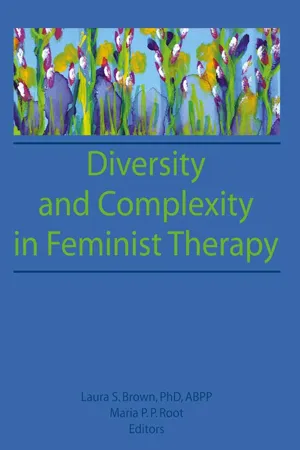
Diversity and Complexity in Feminist Therapy is an unprecedented new book that focuses on incorporating, appreciating, and building on the differences among women. Multicultural in content and authorship, this intellectually and emotionally stimulating volume breaks new ground in the development of theory in feminist therapy. Chapters run the gamut from highly theoretical works that challenge us to examine the validity of current male, Western psychological theories, to the very personal story of one woman's struggle with oppression and her respect for the differences between her experiences of oppression and other women's experiences. You will also find provocative, creative, and diverse chapters that address women's development as it relates to their ethnic, religious, socioeconomic, sexual, and age differences. The one pervasive truth throughout this unique book is that feminist therapy must be based on the experiences of all women in order to be truly representative of women in the United States. Diversity and Complexity in Feminist Therapy is a first step in moving feminist therapy to a more inclusive, global perspective and back into a more political and activist stance against the oppression that we all want to defeat. more from mq:
introduces feminist therapists and other interested feminist behavioral scientists to an anti-racist and multicultural perspective on feminist therapy, both at the level of theory and practice. This volume is unique in several ways. One of them is in the emphasis on the development of a theoretical model for feminist therapy. While much has been and continues to be written about applications of feminist therapy, theory-building has been neglected. This volume focuses on the necessity of taking an explicitly anti-racist and multicultural perspective for such theory to be truly feminst.
A second unique aspect--very close and detailed attention to feminist therapy practice with people of color, both within and outside of US culture. While this issue has been addressed in a piece-meal fashion elsewhere, or has been addressed primarily by activists challenging racism within feminist therapy, this volume offers the work of feminist therapists themselves applying feminist analyses and principles.
Volume is also unique in the degree to which its author represent a diverse group within feminist therapy. This volume is not only multicultural in its intent, but also in its creation.HPP Diversity and Complexity in Feminist Therapy is an unprecedented new book that focuses on incorporating, appreciating, and building on the differences among women. Multicultural in content and authorship, this intellectually and emotionally stimulating volume breaks new ground in the development of theory in feminist therapy. Chapters run the gamut from highly theoretical works that challenge us to examine the validity of current male, Western psychological theories, to the very personal story of one woman's struggle with oppression and her respect for the differences between her experiences of oppression and other women's experiences. You will also find provocative, creative, and diverse chapters that address women's development as it relates to their ethnic, religious, socioeconomic, sexual, and age differences. The one pervasive truth throughout this unique book is that feminist therapy must be based on the experiences of all women in order to be truly representative of women in the United States. Diversity and Complexity in Feminist Therapy is a first step in moving feminist therapy to a more inclusive, global perspective and back into a more political and activist stance against the oppression that we all want to defeat.
- 350 pages
- English
- ePUB (mobile friendly)
- Available on iOS & Android
eBook - ePub
Diversity and Complexity in Feminist Therapy
About this book
Information
Towards Understanding the Psychology of the Filipino
Elizabeth Protacio Marcelino, PhD
SUMMARY. This article describes the development of a new consciousness in Philippine psychology called “Sikolohiyang Pilipino” (Filipino Psychology). It attempts to give national form and substance to the scientific discipline of psychology by critically examining the strong influence of American psychological models in Philippine psychology and explains how the practical applications of “Sikolohiyang Pilipino” in therapy differ from the Western methods. It presents an alternative framework of looking at human behavior particularly in the context of non-Western cultures and identifies key concepts in understanding the Filipino's mind, personality, and behavior. It elaborates on indigenous research methods that are more relevant and appropriate to Philippine realities.
I am often confronted with the question, “Is there really such a thing as Filipino Psychology?” At a very simple level, one could say, “There is a Filipino Psychology as long as there are Filipinos.” But that is begging the question and further leads to another question, “Who is the Filipino?”
If one turns the pages of Western history books, it is written that there were no Filipinos before the Spaniards came to our shores in 1521 (Constantino, 1975). The term “Filipino” did not exist until the latter part of Spanish colonial rule. When first used, “Filipino” did not refer to the people inhabiting the archipelago in general, but to the “creoles” or the Spaniards born in the Philippines. It was, then, an elitist term used to distinguish a group of persons who were above the natives but not quite equal in status with the “peninsulares” or the Spanish officialdom and the clergy.
One could answer the above question in a legal sense and define the Filipino on the basis of geographical origin, birth, or blood. Though very convenient and simplistic, this definition would be far from adequate from a psychological perspective. One could simply enumerate the many and varied traits and characteristics possessed by the Filipinos, but these would not say much either. There may be other groups of people who also possess these traits and characteristics, differing only in the labels attached to them. In this case there is little significance in calling them uniquely “Filipino.” Perhaps one can loosely state like Munoz (1971) that “A Filipino is one who thinks, feels and says he is.” This definition, although broad and all encompassing, does not face the issue head-on.
A BRIEF HISTORY OF PSYCHOLOGY IN THE PHILIPPINES
To approach the problem of Filipino identity from the point of view of psychology, it is necessary to seriously consider the history of psychology in the Philippines. Psychology in the Philippines has both a long and short history. One finds indigenous psychology cataloged in a written history even before the Spaniards came among the “babaylans” and the “catalonans” (high priest and priestess) (Enriquez, 1977). However, one can only share the despair and anger of many Filipino scholars in reading Chirino's account (1604) of how members of the Jesuit order destroyed hundreds of Tagalog manuscripts — an act which after more than 300 years is still unforgivable.
Psychology as an academic discipline started in the Philippines about the turn of the century when the United States as colonizer came to the country and established a comprehensive educational system using English language as the primary medium of instruction (Lagmay, 1984). It is important to note that all other Philippine institutions developed concomitantly within the framework of the English language.
The spread of American culture and the Westernization of Philippine education led to the assumption that the Americans brought psychology to the Philippines together with their policy of “benevolent assimilation.” If we accept this claim, psychology, then, is a direct importation from the West, from theory to method to practice. It is no surprise then that Americans (Sechrest & Guthrie, 1974) feel at home writing about “psychology of, by and for the Filipino” without being immersed in the native culture and without making an effort to learn the local language.
As a scientific discipline, psychology is generally viewed as a continuation of the development of psychology in the West. Historians of psychology, wittingly or unwittingly, drop the word “Western” when they write about the history of Western psychology. On the other hand, “Asian psychology” is always properly designated as such. This is understandable if the audience consists exclusively of Western scholars and readers. These above assumptions could also spring from a well-meaning interest in the people of a former colony. But the fact remains that the history of a relevant psychology, like the history of all colonized peoples, has to be rewritten. Alternative perspectives from non-Western psychologies should be seriously taken into consideration.
SIKOLOHIYANG PILIPINO: A NEW CONSCIOUSNESS IN PSYCHOLOGY
“Sikolohiyang Pilipino” (Filipino Psychology) began in the early ’70s initially as a protest against Philippine psychology's colonial character and the uncritical acceptance of American psychological models. With American textbooks in psychology, Filipinos began learning not only American psychology but a new culture. A major basis for perpetuating the American orientation of psychology in the Philippines is the use of English language in teaching and research. Psychology graduates who generally uphold and are dependent on American theories and methods are unable to perceive the limitations of the English language. They have no chance at all to think in the Filipino language and to formulate theories based on the Filipino people's experiences. A vicious cycle is thus formed as they pursue their careers in and out of the academe, further reinforcing the American orientation. This has resulted in a psychology that is elitist, i.e., limited to an elite group who can hardly communicate with the larger non-English speaking mass of people.
While theories and methods all over the world may be somewhat similar, real life settings of behavior vary radically from one cultural group to another. There is nothing wrong in studying foreign theories and methods and updating oneself on the developments in psychology in other countries. But these should only serve as guides and should not be mechanically adopted and applied. These psychologies are valuable as they inform the reader of the culture within which they originate. Acceptance of American psychological theories and methods as universal has obscured the necessity of examining the applicability of these theories to the objective realities and nuances of Filipino life and culture. While it is true that psychologists in academia are no longer contented with research on sophomore students or white rats, this is not enough data to develop a truly indigenous psychology. Field research and cross-cultural research, although important in generating a broader data-base, are still far from adequate in establishing a universal psychology.
“Sikolohiyang Pilipino” is an attempt by some Filipino psychologists to examine the ways in which one can give national form and substance to the scientific discipline of psychology. Giving a national character to psychology in the Philippines not only meets the requirement of fully appreciating Philippine life and culture, but it is also a contribution to the goal of evolving a universal psychology. This is the only way that psychology can be relevant to the needs and aspirations of the Filipino people, as all sciences should be.
As a commitment to this goal, “Sikolohiyang Pilipino” urges Filipino psychologists to confront social problems and national issues as part of their responsibility as social scientists. Thus, “Sikolohiyang Pilipino” emerged among those who criticized the American orientation of education in the Philippines and the use of English in teaching and research. As Enriquez and Marcelino (1984) strongly articulated:
The colonial relationship between the USA and the Philippines demonstrate that language is power. With the imposition of the English language, the country became dependent on a borrowed language that carries with it the dominant ideology and political-economic interests of the USA. With the dependence of the country on a borrowed language, it became dependent, too, on foreign theories and methods underlying the borrowed language, thus, resulting in a borrowed consciousness. The people's values were then more easily modified so that they equate foreign interest with national interest. Thus, it became easier for the USA to further subjugate the Filipino people and impose its will on them.
THE IMPORTANCE OF LANGUAGE IN PHILIPPINE PSYCHOLOGY
Language is not merely a tool for communication nor a neutral system of signs and symbols. Each language is partisan to the values, perspectives, and rules of cognition of a particular class of society. One need not completely agree with the Sapir-Whorf hypothesis (1940) to be convinced of the clear connection between language and culture. It is for this reason that one's faith in language leads to the belief that meaningful concepts of understanding society and human behavior are probably most identifiable in language.
Take the case of sexism in language. In the last three decades, the feminists, particularly in the West, have created considerable furor over sexism in the English language. Anyone who tries to learn German, Spanish, or Japanese, to name a few other languages, soon realizes the biases in these languages favor the male gender.
In an extensive and revealing study, Estrada (1981) showed that the original Tagalog language (one of the eight major languages spoken in the Philippines) does not contain sexist biases and reflects the equal treatment given to both male and female. Unfortunately, however, Spanish and American influences slowly introduced sexism in the language as Tagalog and other Philippine languages assimilated a sexist bias in favor of males.
To illustrate the former point, Estrada (1981) makes the observation that most Filipinos, even those presumably well-schooled in English, frequently interchange the use of he/she, her/his in ordinary conversation. This curious phenomenon can be explained by the fact that Tagalog does not have equivalents for the English he/she, etc. Tagalog only has “siya” or “kanya” or the formal “sila” or “kanila.” She further elaborates that the other major languages spoken in the Philippines also do not have he/she or her/his equivalents either.
Moreover, Estrada (1981) asserts that if sexism was an element at all in the language, it would manifest itself in the realm of kinship. Tagalog has no specific sex-linked terms for the most important kin. For example, there is only one word “pamangkin” to mean niece or nephew. The sex of the person referred to may be established by attaching the proper qualifier “babae” (female) or “lalake” (male) to the kinship term. From the entire system of interlocking kin for which there is precise terminology only two are gender-marked and are not borrowed and these are primary ones, “ama/ina” (father/mother).
She goes on to prove her thesis that Tagalog is generally non-sexist by showing examples in the various domains of Philippine life and culture specifically focusing on the following: forms of address, terms of endearment, sexual terminology, professions/occupations, learning in early childhood, swearwords/curses, mythology and folk medicine. If Tagalog does show bias, it is more ageist than sexist.
To illustrate the latter point, the terms “lolo/lola” and their derivative “lelong/lelang,” “tiyo/tiya” and their derivatives tiyuhin/tiyahin are from the Spanish “abuelo/abuela, tio/tia” respectively. The term “maybahay” now commonly used to mean housewife formerly referred to either husband or wife (Santiago, 1977). The marking of “maybahay” as feminine is an instance of what Estrada sees as the increasing chauvinization of Tagalog.
VALUES AND THE CONTINUING MIS-EDUCATION OF THE FILIPINO
Earlier work on Philippine values identified some important concepts in understanding Filipino behavior. Lynch (1964) proposed the construct of “smooth interpersonal relations” as acquired and perceived through “pakikisama” (adjustment to the will of the majority). Kaut (1961) singled out “utang na loob” (debt of gratitude) as a key concept in Tagalog interpersonal relations. “Hiya” was interpreted by Fox (1956) as “self-esteem,” by Bulatao (1964) as a kind of anxiety and fear of being left exposed, and by Silbley (1965) as “shame”—just to name a few of many other frequently mentioned values.
However, Enriquez (1977) pointed out that in spite of the token use of...
Table of contents
- Cover
- Half Title
- Title Page
- Copyright Page
- Table of Contents
- About the Editors
- Editorial Introduction
- The Meaning of a Multicultural Perspective for Theory-Building in Feminist Therapy
- Approaching a Feminist-Principled Paradigm in the Construction of Personality Theory
- Paths Toward Diversity: An Intrapsychic Perspective
- On Creating a Theory of Feminist Therapy
- A Japanese View of Dependency: What Can Amae Psychology Contribute to Feminist Theory and Therapy?
- Is Separation Really So Great?
- Towards Understanding the Psychology of the Filipino
- An Analysis of Domestic Violence in Asian American Communities: A Multicultural Approach to Counseling
- Ethnic and Cultural Diversity: Keys to Power
- Compounding the Triple Jeopardy: Battering in Lesbian of Color Relationships
- Resolving “Other” Status: Identity Development of Biracial Individuals
- What Has Gone Before: The Legacy of Racism and Sexism in the Lives of Black Mothers and Daughters
- Perceptions of the Sexual Self: Their Impact on Relationships Between Lesbian and Heterosexual Women
- Developing a Feminist Model for Clinical Consultation: Combining Diversity and Commonality
- Feminist Psychotherapy and Diversity: Treatment Considerations from a Self Psychology Perspective
- Diversifying Feminist Theory and Practice: Broadening the Concept of Victimization
- White Feminist Therapists and Anti-Racism
- Turning the Things That Divide Us into Strengths That Unite Us
Trusted by 375,005 students
Access to over 1.5 million titles for a fair monthly price.
Study more efficiently using our study tools.
Frequently asked questions
Yes, you can cancel anytime from the Subscription tab in your account settings on the Perlego website. Your subscription will stay active until the end of your current billing period. Learn how to cancel your subscription
No, books cannot be downloaded as external files, such as PDFs, for use outside of Perlego. However, you can download books within the Perlego app for offline reading on mobile or tablet. Learn how to download books offline
Perlego offers two plans: Essential and Complete
- Essential is ideal for learners and professionals who enjoy exploring a wide range of subjects. Access the Essential Library with 800,000+ trusted titles and best-sellers across business, personal growth, and the humanities. Includes unlimited reading time and Standard Read Aloud voice.
- Complete: Perfect for advanced learners and researchers needing full, unrestricted access. Unlock 1.5M+ books across hundreds of subjects, including academic and specialized titles. The Complete Plan also includes advanced features like Premium Read Aloud and Research Assistant.
We are an online textbook subscription service, where you can get access to an entire online library for less than the price of a single book per month. With over 1.5 million books across 990+ topics, we’ve got you covered! Learn about our mission
Look out for the read-aloud symbol on your next book to see if you can listen to it. The read-aloud tool reads text aloud for you, highlighting the text as it is being read. You can pause it, speed it up and slow it down. Learn more about Read Aloud
Yes! You can use the Perlego app on both iOS and Android devices to read anytime, anywhere — even offline. Perfect for commutes or when you’re on the go.
Please note we cannot support devices running on iOS 13 and Android 7 or earlier. Learn more about using the app
Please note we cannot support devices running on iOS 13 and Android 7 or earlier. Learn more about using the app
Yes, you can access Diversity and Complexity in Feminist Therapy by Maria P P Root,Laura Brown in PDF and/or ePUB format, as well as other popular books in Psychology & Mental Health in Psychology. We have over 1.5 million books available in our catalogue for you to explore.