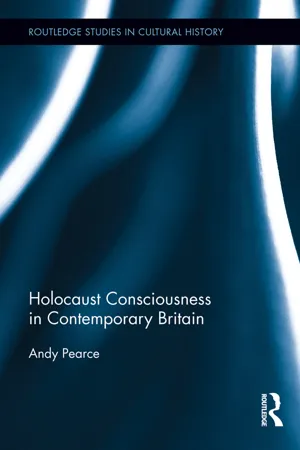
The Holocaust is a pervasive presence in British culture and society. Schools have been legally required to deliver Holocaust education, the government helps to fund student visits to Auschwitz, the Imperial War Museum's permanent Holocaust Exhibition has attracted millions of visitors, and Britain has an annually commemorated Holocaust Memorial Day. What has prompted this development, how has it unfolded, and why has it happened now? How does it relate to Britain's post-war history, its contemporary concerns, and the wider "globalisation" of Holocaust memory? What are the multiple shapes that British Holocaust consciousness assumes and the consequences of their rapid emergence? Why have the so-called "lessons" of the Holocaust enjoyed such popularity in Britain? Through analysis of changing engagements with the Holocaust in political, cultural and memorial landscapes over the past generation, this book addresses these questions, demonstrating the complexities of Holocaust consciousness and reflecting on the contrasting ways that history is used in Britain today.
- 324 pages
- English
- ePUB (mobile friendly)
- Available on iOS & Android
eBook - ePub
Holocaust Consciousness in Contemporary Britain
1 Introduction
British Holocaust Consciousness—from Past into Present
As we move further into the second decade of a new millennium, the history and memory of National Socialism’s ‘defining act’ has a prominence none could have foreseen.1 Indeed, in an age where perpetual change and incessant motion are the norm, the continued diffusion of ‘the Holocaust’ has become an unexpected constant; a social and cultural penchant which lays bare our obsessions, our insecurities, and our politics. That with due caution we can speak in such a sweeping manner is not simply because the annihilation of European Jewry has ‘gone global’;2 instead, it is testament to how this man-made catastrophe now stands as the very embodiment of early twenty-first century globality.
For the contemporary British reader the Holocaust is a widespread and visible presence. It is taught in schools, colleges, and universities; ‘seen’ on cinema and television screens; found in bookstores and libraries; and approached through museums, memorials, and acts of public commemoration. How do we account for this state of affairs, and what relation does it have to developments elsewhere? What are the aims and objectives of all this activity, how is it sustained, and by whom? In what ways are we really, truly, ‘conscious’ of the Holocaust and how (if at all) does this consciousness effect our lives?
These and related questions rest at the very core of this book. In a spirit akin to Peter Novick’s work on American collective memory of the Holocaust, my principal interest lies in why and how we have arrived at this point.3 I will be arguing that during the last quarter of the twentieth century thinking about and thinking with the events now commonly termed ‘the Holocaust’ underwent a profound transformation in Britain. Whereas during the first half of the postwar period awareness of and interest in the fate of the Jews under Nazism was somewhat niche, jumbled, and prone to fluctuation, from the mid-1970s onwards this gradually reversed. Slowly but surely popular and political intrigue grew in British culture, finding articulation and organization within an orientational framework we will term ‘Holocaust consciousness’.
The shift was inseparable from the wider, transnational explosion of Holocaust memory. But, in contrast to other nations, Britain’s ‘turn’ to the Holocaust followed an incongruous course. Change was sporadic and localised at first. Representations increased within certain cultural spheres, but not others. Sometimes representational activity was clear and explicit, on other occasions it was more subsumed and subliminal. In certain cases representational acts barely registered; at other times they elicited a spectrum of responses, generating controversy and provoking instances of deep thinking. For a long time however ‘the Holocaust’ simply passed a large number by. Accordingly, a seismograph of Holocaust consciousness would be one of multiple peaks and troughs, reflecting a complicated relation between long- and short-term factors, domestic and foreign forces, structural dynamos and human intention.
Important foundations were laid in the late 1970s and 1980s, but real momentum was not generated until a process of popularisation began in earnest in the mid-1990s. A key engine for change was cultural and political institutionalisation, which accelerated in the late 1990s and reached an apex in 2000–2001. By this time there was no singular, monolithic collective memory of the Holocaust in Britain, nor was there a one-size-fits-all Holocaust consciousness. Instead, Holocaust consciousness existed as a multifaceted and hotly contested collection of cultural expressions and memories.
Michael Rothberg’s schema for mapping the ‘multidirectionality’ of memory offers us a template for visualising this multiplicity.4 Were we to conceive a multidirectional matrix with one axis demarcating agents of production (extending from the grass-roots to the elite) and the other axis signifying the spectrum of intended aims and outcomes (from the cognitive and epistemological, to the affective and moral), we could emplot examples of memory-work and observe differences in texture and tone between exercises sponsored by the State and those less coloured by high politics. We would also see how cultural manifestations of the Holocaust resist neat division into polar opposites of ‘high’ vs. ‘low’, ‘political’ vs. ‘organic’ and are rather distinguished by their pebbledash spread.
This patchwork-quilt quality is exclusive to neither Britain nor Holocaust memory. It is indicative of how ‘there are several collective memories’ among any one group of people,5 and reflects both ‘the great internal heterogeneity of nation culture’ and the transculturality of our contemporary world.6 Diversity has consequences, however; especially when a social or political elite seeks cultural hegemony. This was true of the late 1990s and early 2000s when the Labour Government sought to position Britain as ‘one of the leading lights’ in international Holocaust politics.7 The result, we will come to see, was heightened cultural conflict.
The book in your hands is conceived as a work of history—a historical enquiry not only into the postwar history of the Holocaust, but also into postwar British and European society. Yet as a piece of scholarship it also traverses a number of different disciplines and employs a range of methodologies. In part this is because a number of its aims and objectives position it within the orbit of “memory studies” while its approach draws on and utilises the ‘conceptual toolbox’ academic study of memory has begun to produce.8 This fusion of empirical research and theoretical frameworks is as it should be: as Peter Burke remarks, ‘without the combination of history and theory we are unlikely to understand either the past or the present’.9
Burke’s words are a guiding principle throughout this book, for an underlying concern is the intersection of theory and reality. Since concepts and context are of paramount importance, the remainder of this introductory chapter is given over to establishing the theoretical constructs we will be working with and the historical back-story to our investigation. I will begin by briefly surveying the key theories which underpin the book, outlining notions of collective and cultural memory before forwarding a model of Holocaust consciousness. We will then move to sketch the history of Holocaust memory in postwar Britain, focusing on a period from 1945 through to the mid-1970s.
This ‘pre-history’ will prove essential for our understanding of what changed, when, how and why in the years running from the mid-1970s to 2001—the epoch the bulk of this book is given over to. The task of examining the ways in which Holocaust consciousness emerged in these years will be approached by analysing various ‘vectors’ of British culture.10 These are broadly organized thematically, making up the three sections of the book. Finally, our study will conclude with reflections on what has happened to Holocaust consciousness in Britain during the first decade and a half of the twenty-first century.
THEORETICAL FOUNDATIONS AND KEY CONCEPTS
In 1991, George M. Kren and Leon H. Rappoport reviewed the published proceedings of the first Remembering for the Future conference held in Oxford, England, in 1988. They argued the appearance of associated anthologies and compendiums suggested Holocaust studies was ‘entering a new phase of monumental text-building or “megahistory”’. This was ‘something new in the field’, for the ‘outpouring of dreadnought scholarship’ gestured to Holocaust studies ‘putting on weight’ and developing a ‘midlife spread’.11
The recent spate of collections and readers on ‘memory studies’ suggest Kren and Rappoport’s ruminations may have new application. Although at the time of their review Charles S. Maier was already speaking of a ‘surfeit of memory’ within Western society,12 it is only over the past twenty years that scholarly interest has led to a burgeoning secondary literature and ‘memory’ entering into university course-lists. Academics working on memory have also managed to navigate strident criticisms during this period, with memory scholarship emerging not merely unscathed but in some ways more vigorous than before.13
Today, memory studies seems to be in rude health; reasonably secure, formally organized, institutionalised through dedicated journals and research centres. It is a somewhat misleading appearance. Memory has been of interest to thinkers for millennia, and memory studies is a ‘nascent’ field;14 if, indeed, that is what it is. Astrid Erll suggests memory studies actually be understood as ‘not merely a multidisciplinary field, but fundamentally an interdisciplinary project’.15 Following Erll’s lead, memory studies is perhaps best conceived as an ongoing, formative dialogical space; a veritable meeting place where perspectives on the processes and procedures by which the past is made manifest in the present are traded and forged.
Memory and Modernity
The objects of interest within memory studies are the exchange, interaction, and relationship of memory between individuals. The origins of this societal concern lie in the turn of the twentieth century, with the new discipline of sociology important in furrowing a theoretical landscape for memory study.16 Impetus was added by a sense of acute ‘memory crisis’ running throughout the ‘long’ nineteenth century. Richard Terdiman recounts how for contemporaries faced with massive ruptures and upheavals to the fabric of daily life, ‘recollection had ceased to integrate with consciousness’. Instead there was ‘too little memory, and too much’.17
This genesis introduces us to the critical nexus between memory and modernity. Modernity, as Peter Osborne argues, must be approached as ‘a qualitative not chronological category’.18 It is one Reinhard Koselleck shows to be tied to understandings and perceptions of historical time. In his writings on the frühe Neuzeit (a period running from around 1500 to 1800) Koselleck tracks a ‘temporalization of history’ from which ‘modernity is formed’ and ‘modern time’ emerges.19 This wholly new way of experiencing and ordering the world carried fundamental consequences. Where previously eschatology conditioned understandings of time and space, modern temporality was imbued with ‘a genuinely historical meaning, distinct from mythical, theological, or natural chronological origins’.20 ‘The past’, in the words of Hayden White, now became ‘the place where humanity finds its identity and essence and aim’.21 Running parallel was the dawn of History as the ‘collective singular’ and academic endeavour,22 all of which added to the sense of the beginnings of a new found historicity: that ‘social mode of being in the world marked by a particular experience of temporality’.23
The changes wrought by modernity and modern time reconfigured the relationship between the ‘space of experience’ and the ‘horizon of expectation’. Koselleck explains how in the former ‘experience is present past, whose events have been incorporated and can be remembered’. In the latter, ‘the future [is] made present; it directs itself to the not-yet, to the nonexperienced, to that which is to be revealed’. Taken together, Koselleck argues these two realms ‘simultaneously constitute history and its cognition’ while between them emerges ‘the inner relation between past and future or yesterday, today or tomorrow’.24 What happened with modernity then was the opening up of a gap between these polarities. Since the past no longer determined an anticipated or imagined future new vistas appeared, mediated only by progressive ideas about the directional flow of history.25
Collective Memory, Lieux de Mémoire, Cultural Memory
Koselleck’s ideas of ‘spaces of experience’ and ‘horizons of expectation’ are valuable conceptual boundary markers for approaching how modern man made sense of his position within the world and the aggregate of worldly events. They do not account for how and why particular events are incorporated within a collective’s ‘space of experience’. For this we must turn to the scholarship of Maurice Halbwachs and his notion of collective memory.
The status accorded to Halbwachs may not be commensurate with how scholars have employed and applied his writings.26 Similarly, the mythology surrounding him and his work has overlooked the contribution of others and ignored how Halbwachs himself revised aspects of ‘collective memory’ after introducing the concept.27 Nonetheless, Halbwachs rightly remains the starting point for any attempt to think through how memory functions socially.
Halbwachsian collective memory is predicated on the idea ‘it is in society that people normally acquire their memories. It is also in society that they recall, recognize and localize their memories’.28 In turn, it follows that ‘without social frameworks to sustain them, individual memories wither away’,29 for to quote Paul Ricoeur ‘one does not remember alone’.30 These social dynamics render collective memory changeable. As Halbwachs’ colleague Marc Bloch clarified, ‘collective memory, like the individual memory, does not preserve the past precisely; it is constantly reconstructing and reformulating in light of the present’.31 Because of this malleability Halbwachs distinguished collective memory from history. The former he regarded as animate, organic, and ‘living’: a ‘current of continuous thought whose continuity is not at all artificial’, and was subsequently more authentically and intimately connected with the past. The latte...
Table of contents
- Cover Page
- Half Title page
- Series page
- Title Page
- Copyright Page
- Contents
- Acknowledgements
- 1 Introduction: British Holocaust Consciousness—from Past into Present
- Part I Education
- Part II Memorialisation, Musealization, Commemoration
- Part III The Cultural Hinterland
- Selected Bibliography
- Index
Trusted by 375,005 students
Access to over 1.5 million titles for a fair monthly price.
Study more efficiently using our study tools.
Frequently asked questions
Yes, you can cancel anytime from the Subscription tab in your account settings on the Perlego website. Your subscription will stay active until the end of your current billing period. Learn how to cancel your subscription
No, books cannot be downloaded as external files, such as PDFs, for use outside of Perlego. However, you can download books within the Perlego app for offline reading on mobile or tablet. Learn how to download books offline
Perlego offers two plans: Essential and Complete
- Essential is ideal for learners and professionals who enjoy exploring a wide range of subjects. Access the Essential Library with 800,000+ trusted titles and best-sellers across business, personal growth, and the humanities. Includes unlimited reading time and Standard Read Aloud voice.
- Complete: Perfect for advanced learners and researchers needing full, unrestricted access. Unlock 1.5M+ books across hundreds of subjects, including academic and specialized titles. The Complete Plan also includes advanced features like Premium Read Aloud and Research Assistant.
We are an online textbook subscription service, where you can get access to an entire online library for less than the price of a single book per month. With over 1.5 million books across 990+ topics, we’ve got you covered! Learn about our mission
Look out for the read-aloud symbol on your next book to see if you can listen to it. The read-aloud tool reads text aloud for you, highlighting the text as it is being read. You can pause it, speed it up and slow it down. Learn more about Read Aloud
Yes! You can use the Perlego app on both iOS and Android devices to read anytime, anywhere — even offline. Perfect for commutes or when you’re on the go.
Please note we cannot support devices running on iOS 13 and Android 7 or earlier. Learn more about using the app
Please note we cannot support devices running on iOS 13 and Android 7 or earlier. Learn more about using the app
Yes, you can access Holocaust Consciousness in Contemporary Britain by Andy Pearce in PDF and/or ePUB format, as well as other popular books in History & British History. We have over 1.5 million books available in our catalogue for you to explore.