- 272 pages
- English
- ePUB (mobile friendly)
- Available on iOS & Android
eBook - ePub
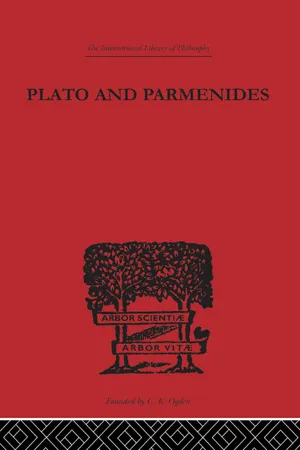
Plato and Parmenides
About this book
This is Volume III of ten in a series on Ancient Philosophy. First published in 1939, it looks at Parmenides' 'Way of Truth' and Plato's 'Parmendies' translated with an Introduction and a running commentary.
Information
THE PARMENIDES
IN the series of Plato’s writings the Parmenides, as is now generally agreed, stands with the Theaetetus between the middle group (Meno, Phaedo, Symposium, Republic, Phaedrus), and those later dialogues, Sophist, Statesman, Timaeus, Philebus, Laws, which are distinguished by a marked change of style.1 Whether it was written before or after the Theaetetus or at the same time, Plato, as M. Dies remarks,2 has left no doubt that it was meant to be read before the Theaetetus, which is itself linked to the Sophist and Statesman. The meeting of the young Socrates with Parmenides and Zeno is alluded to at Theaet. 183E, and again recalled in the Sophist (217C) in terms that can only refer to our dialogue. The Parmenides thus introduces the series of works in which Plato, for the first time, confronted his own characteristic doctrine with the chief systems of his predecessors, and submitted these to a critical examination. The greatest, in his estimation, was Parmenides. In the first part he allows Parmenides to bring objections against the theory of Forms. In the second part he subjects Parmenides’ own premisses and conclusions to the most searching scrutiny.
126A–127A. THE INTRODUCTORY NARRATIVE
The whole dialogue is related by Cephalus of Clazomenae, a person otherwise unknown, to an unspecified audience. Cephalus has visited Athens to hear from Antiphon, Plato’s half-brother, an account of a meeting between Socrates and the two Eleatics, Parmenides and Zeno. Antiphon is said to have learnt the conversation which took place at this meeting from Pythodorus, one of the generals sent by Athens to Sicily in 427 B.C. at the request of the Leontines. We learn from Alcibiades I, 119A, that Pythodorus and Callias had each paid Zeno a hundred minae for his instruction, and Plutarch (Pericles, 4) says that Pericles had heard Zeno discourse. There is thus independent evidence for Zeno’s residence in Athens. Whether Pythodorus had ever really entertained Parmenides as well as Zeno is not known; the scene of a conversation which is not merely imaginary but impossible is no evidence for historical fact. Plato intends to submit that theory of Forms which he had already put into Socrates’ mouth in the Phaedo to the criticism of Parmenides himself, whom he regarded as a much greater man than Zeno. At the latest date when Parmenides could have visited Athens Socrates would still be ‘quite young’, perhaps twenty. The meeting, accordingly, must be placed round about 450 B.C. For some reason Plato preferred not to cast the dialogue into straightforward dramatic form. He may have felt that the elaborate explanation of how it came to be handed down might help the reader to overlook the impossibility that a conversation even remotely resembling this one should ever have occurred. Even those scholars who ascribe the theory of Forms to Socrates cannot consistently hold that when Socrates was twenty that theory had already taken the shape it wears in the Phaedo on the day of his death, fifty years later.
The subject of the dialogue is, to last degree, prosaic; and it is written throughout in the plainest conversational style, as far removed as possible from the lyrical manner of its near neighbour, the Phaedrus. Even Parmenides’ reference to the veteran chariot-horse in Ibycus’ poem (137A) stands out like a single patch of colour on a grey background.
CEPHALUS
126. After leaving our home at Clazomenae we arrived at Athens and met Adeimantus and Glaucon in the marketplace. Adeimantus took my hand; Welcome, Cephalus, he said; if there is anything we can do for you here, you must let us know.
Well, I replied, I have come for that very purpose: there is something you and your brother can do for me.
Please tell us what it is.
B. What, I asked, was the name of your half-brother on the mother’s side? I cannot remember. He was only a child, you know, when I was here before, and that is a long while ago now. His father’s name was Pyrilampes, I think.
Yes; and his own is Antiphon. But why do you ask?
My companions here, I answered, are fellow-citizens of mine, deeply interested in philosophy. They have been told that Antiphon has been much in the company of someone C. called Pythodorus, who was a friend of Zeno’s, and that Pythodorus has related to him that conversation which Socrates once had with Zeno and Parmenides. 126C. Antiphon is said to have heard it so often that he can repeat it by heart.
That is true.
Well, said I, that is what we want—to hear that conversation.
There is no difficulty about that, he replied. Before he was grown up, Antiphon worked hard at getting that conversation by heart, though nowadays he takes after his grandfather of the same name and devotes most of his time to horses. If you like, let us go and see him. He has just gone home from here; his house is close by, in Melite. 127. So we set out to walk there. We found Antiphon at home, giving instructions to a smith about making a bit or something of the sort. When he had done with the man, and his brothers began to tell him what we had come for, he recognised me from his memory of my earlier visit and said he was glad to see me. We then asked him to repeat the conversation. At first he was reluctant; it was no easy matter, he said. However, he ended by telling us the whole story.
THE CONVERSATION
127A–D. Antiphon repeats Pythodorus’ account of the meeting
127. According to Antiphon, then, this was Pythodorus’ account. Zeno and Parmenides once came to Athens for the Great B. Panathenaea.1 Parmenides was a man of distinguished appearance. By that time he was well advanced in years, with hair almost white; he may have been sixty-five. Zeno was nearing forty, a tall and attractive figure. It was said that he had been Parmenides’ favourite. They were C. staying with Pythodorus outside the walls in the Ceramicus. Socrates and a few others 2 came there, anxious to hear a reading of Zeno’s treatise, which the two visitors had brought for the first time to Athens. Socrates was then quite young. Zeno himself read it to them; Parmenides at the moment had gone out. The reading of the arguments D. was very nearly over when Pythodorus himself came in, accompanied by Parmenides and Aristoteles, the man who 127D. was afterwards one of the Thirty; so they heard only a small part of the treatise. Pythodorus himself, however, had heard it read by Zeno before.
127D–128E. The contents and character of Zeno’s treatise
127D. When Zeno had finished, Socrates asked him to read once more the first hypothesis of the first argument.1 He did so, and Socrates asked: What does this statement mean, E. Zeno? ‘If things are many,’ you say, ‘they must be both like and unlike. But that is impossible: unlike things cannot be like, nor like things unlike.’ That is what you say, isn’t it?
Yes, replied Zeno.
And so, if unlike things cannot be like or like things unlike, it is also impossible that things should be a plurality; if many things did exist, they would have impossible attributes. Is this the precise purpose of your arguments—to maintain, against everything that is commonly said, that things are not a plurality? Do you regard every one of your arguments as evidence of exactly that conclusion, and so hold that, in each argument in your treatise, you are giving just one more proof that a plurality does not exist? 128. Is that what you mean, or am I understanding you wrongly?
No, said Zeno, you have quite rightly understood the purpose of the whole treatise.
I see, Parmenides, said Socrates, that Zeno’s intention is to associate himself with you by means of his treatise no less intimately than by his personal attachment. In a way, his book states the same position as your own; only by varying the form he tries to delude us into thinking that his thesis is a different one. You assert, in your poem, that B. the All is one; and for this you advance admirable proofs. Zeno, for his part, asserts that it is not a plurality; and he too has many weighty proofs to bring forward. You assertunity, he asserts no plurality; each expresses himself insuch a way that your arguments seem to have nothing in common, though really they come to very much the same thing. That is why your exposition and his seem to berather over the heads of outsiders like ourselves.
Yes, Socrates, Zeno replied; but you have not quite C. seen the real character of my book. True, you are as quickas a Spartan hound to pick up the scent and follow the trail of the argument; but there is a point you have missed at 128C. the outset. The book makes no pretence of disguising from the public the fact that it was written with the purpose you describe, as if such deception were something to be proud of. What you have pointed out is only incidental; the book is in fact a sort of defence of Parmenides’ argument against D. those who try to make fun of it by showing that his supposition, that there is a One, leads to many absurdities and contradictions. This book, then, is a retort against those who assert a plurality. It pays them back in the same coin with something to spare, and aims at showing that, on a thorough examination, their own supposition that there is a plurality leads to even more absurd consequences than the hypothesis of the One. It was written in that ...
Table of contents
- Cover Page
- Half Title page
- Series Page
- Title Page
- Copyright Page
- Preface
- List of Abbreviations
- Contents
- Introduction
- The Parmenides
- Index
Trusted by 375,005 students
Access to over 1.5 million titles for a fair monthly price.
Study more efficiently using our study tools.
Frequently asked questions
Yes, you can cancel anytime from the Subscription tab in your account settings on the Perlego website. Your subscription will stay active until the end of your current billing period. Learn how to cancel your subscription
No, books cannot be downloaded as external files, such as PDFs, for use outside of Perlego. However, you can download books within the Perlego app for offline reading on mobile or tablet. Learn how to download books offline
Perlego offers two plans: Essential and Complete
- Essential is ideal for learners and professionals who enjoy exploring a wide range of subjects. Access the Essential Library with 800,000+ trusted titles and best-sellers across business, personal growth, and the humanities. Includes unlimited reading time and Standard Read Aloud voice.
- Complete: Perfect for advanced learners and researchers needing full, unrestricted access. Unlock 1.5M+ books across hundreds of subjects, including academic and specialized titles. The Complete Plan also includes advanced features like Premium Read Aloud and Research Assistant.
We are an online textbook subscription service, where you can get access to an entire online library for less than the price of a single book per month. With over 1.5 million books across 990+ topics, we’ve got you covered! Learn about our mission
Look out for the read-aloud symbol on your next book to see if you can listen to it. The read-aloud tool reads text aloud for you, highlighting the text as it is being read. You can pause it, speed it up and slow it down. Learn more about Read Aloud
Yes! You can use the Perlego app on both iOS and Android devices to read anytime, anywhere — even offline. Perfect for commutes or when you’re on the go.
Please note we cannot support devices running on iOS 13 and Android 7 or earlier. Learn more about using the app
Please note we cannot support devices running on iOS 13 and Android 7 or earlier. Learn more about using the app
Yes, you can access Plato and Parmenides by Francis MacDonald Cornford in PDF and/or ePUB format, as well as other popular books in Filosofía & Historia y teoría filosóficas. We have over 1.5 million books available in our catalogue for you to explore.