- 520 pages
- English
- ePUB (mobile friendly)
- Available on iOS & Android
eBook - ePub
About this book
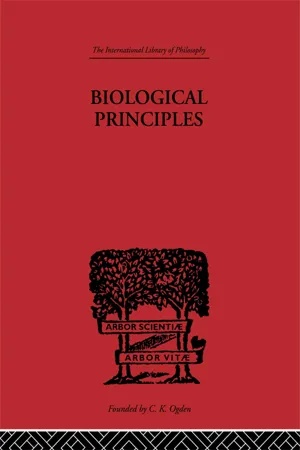
First published in 2000. This is Volume VI of six in the Library of Philosophy series on the Philosophy of Science. Written in 1929, using the initial ideas of A.N. Whitehead, this book on Biological Principles includes the concept of abstraction methodology in biology. This expands into an investigation into the general problems of the theory of knowledge, difficulties in biological knowledge and finally suggestions towards a resolution of certain traditional biological conflicts.
Information
PART I
THE DATA OF NATURAL SCIENCE
and
PRINCIPLES OF SYSTEMATIZATION
CHAPTER I
PHENOMENALISM AND KINDRED DOCTRINES
1
PHENOMENALISM has had a considerable influence on modern thought especially in scientific circles. This influence is to be seen not only in the writings of those who have studied phenomenalism and embraced its point of view, but it is also discernible in current writers who do not appear to be fully aware either of the source of their opinions or of the implications which the phenomenalistic doctrines commit them to. The leading spirit in this movement has been Ernst Mach. He comes nearest to being a ‘pure’ phenomenalist. But I shall also extend the term ‘phenomenalist’ to a number of other writers who profess beliefs which are similar, in their consequences for science, to this. The doctrine is best known in this country through Professor Karl Pearson. There are important differences between the views of Mach and Pearson but these do not affect their conclusions and their attitude towards science.
Mach’s best known book The Analysis of Sensations was first published in 1885, but I shall use the fifth German edition as a basis for the following remarks. It should be said at once that it is extremely difficult to criticize Mach’s views because it is impossible to pin him down to definite assertions. When we think we have found one and that we are beginning to understand the position we find in another place that what seemed to be a definite assertion was, in reality, only intended to be expressive of a ‘provisional point of view.’ In fact Mach definitely says in more than one place that he does not offer a system of philosophy but only a provisional attitude in which science, freed from all awkward questions, will be able to pursue its investigations in peace. This seems to be a characteristic common to most of the phenomenalistic writers, and consequently the critic is committed to all the difficulties of a guerilla warfare. So true is this that Dr. Broad, in his examination of phenomenalism in Perception Physics and Reality is compelled, in order to criticize the doctrine, to invent arguments for it himself!
In the Preface to the fourth German edition of Die Analyse the Author states:
‘When, about thirty-five years ago, I succeeded, by overcoming my own prejudices, in firmly establishing my present position and in setting myself free from the greatest intellectual discomfort of my life, I attained thereby to a certain satisfaction.’1
This ability to give freedom from intellectual discomfort, is, as we shall see, one of the great claims of phenomenalism. We shall find that the discomfort in question arises from an appreciation of the difficulties of certain problems around which metaphysical inquiry has turned since the beginning of the modern era. Those who have not experienced this discomfort will not, of course, feel much need for the solace offered by phenomenalism, and it will be difficult for them to take much interest in a criticism of that doctrine unless the nature of the original problem is brought home to them. The question which seems to have occasioned so much discomfort to Mach is the question of the relation between the ‘physical’ and the ‘psychical’. He believed he had found a way out of this difficulty which showed the problem to be an illusory one, and one which could, therefore, be safely neglected by science. All such problems he considers to be either non-existent or illusory and insoluble. Now it is, I think, very important to note that the starting point for Mach’s inquiries was not the problem of knowledge—not an attempt to answer what I have called ‘Mill’s question’ in order to find a firm foundation for knowledge—but an attempt to overcome a metaphysical difficulty which had occasioned him ‘intellectual discomfort’. But it was by means of a theory about knowledge that he tried to do this, and that is why his views are important for the present inquiry. Nevertheless it is well to bear in mind the metaphysical motive which underlies it.
Mach begins by examining the notion of a physical ‘object’, ‘body’, or ‘thing’. He employs much the same kind of arguments as have been familiar since the time of Berkeley to show that all claims to knowledge of a persisting thing apart from its colour, shape, and other qualities is illusory and idle. Therefore he considers that we should be content with regarding it as simply a collection of ‘sensations’ or ‘elements’ as he calls them, which happen to be momentarily connected together, without attempting to account for why they go together. That attempt he considers to be extra-scientific or metaphysical.
‘We see an object having a point S. If we touch S, that is, bring it into connexion with our body, we receive a prick. We can see S, without feeling the prick. But as soon as we feel the prick we find S on the skin. The visible point, therefore, is a permanent nucleus, to which the prick is annexed, according to circumstances, as something accidental. From the frequency of analogous occurrences we ultimately accustom ourselves to regard all properties of bodies as “effects” proceeding from permanent nuclei and conveyed to the ego through the medium of the body; which effects we call sensations. By this operation, however, these nuclei are deprived of their entire sensory content, and converted into mere mental symbols. The assertion, then, is correct that the world consists only of our sensations. In which case we have knowledge only of our sensations, and the assumption of the nuclei referred to, or of a reciprocal action between them, from which sensations proceed, turns out to be quite idle and superfluous.’1
It must be understood that Mach does not deny the great practical simplicity and utility of the notion of the physical thing, but he considers that it is scientifically inadmissible because it leads to unsurmountable philosophical problems. He next directs the same sort of criticism against the notion of a persisting ‘self’, ‘ego’, or ‘subject’ who is ordinarily said to ‘have’ or ‘sense’ or ‘experience’ these sensations, as Mach calls them.2 This, too, he considers, consists, on an ultimate analysis, of a series of ‘elements’ or sensations, composed, either of those alone which we call private or ‘subjective’ experiences, such as pleasure and pain, desires, etc., or of those in conjunction with the sensations of colour, touch, etc., which we suppose ourselves to perceive by means of the bodily senses. But in these cases, too, all we know are the ‘elements’ and there is no need to suppose any sort of enduring self or ego who ‘has’ them.
‘The primary fact is not the ego, but the elements. … The elements constitute the I. I have the sensation green, signifies that the element green occurs in a given complex of other elements (sensations, memories). When I cease to have the sensation green, when I die, then the elements no longer occur in the ordinary familiar association. That is all. Only an ideal mental-economical unity, not a real unity, has ceased to exist.1

‘If a knowledge of the connexion of the elements (sensations) does not suffice us, and we ask Who possesses this connexion of sensations, Who experiences it? then we have succumbed to the old habit of subsuming every element (sensations) under some unanalysed complex, and we are falling back imperceptibly upon an older, lower, and more limited point of view.2
‘… if we take the ego simply as a practical unity, put together for purposes of provisional survey, or as a more strongly cohering group of elements, less strongly connected with other groups of this kind, questions like those above discussed will not arise, and research will have an unobstructed future.’3
‘For us, therefore, the world does not consist of mysterious entities, which by their interaction with another, equally mysterious entity, the ego, produce sensations, which alone are accessible. For us, colours, sounds, spaces, times … are provisionally the ultimate elements, whose given connexion it is our business to investigate. It is precisely in this that the exploration of reality consists. In this investigation we must not allow ourselves to be impeded by such abridgments and delimitations as body, ego, matter, spirit, etc., which have been formed for special, practical purposes and with wholly provisional and limited ends in view.’4
These passages will suffice to convey the essentials of Mach’s doctrine. The whole contents of human experience—whether it be the experience of the external world which we appear to share with others, or the experiences which are private to ourselves—are thus all analysed into elements which are all declared to be ultimately of the same nature. Conseqeuntly ‘the great gulf between physical and psychological research persists only when we acquiesce in our habitual stereotyped conceptions.’ All awkward questions thus disappear, and the task of science stands out clearly as one simply of describing the connexions of these elements. If we happen to be investigating the connexions between elements both belonging to what in our bad old habits we call the external world then we are pursuing physics. But if one lies in the outside world and the other ‘passes through my skin’ (p. 16) then we are psychologists. There is, according to Mach, no fundamental difference that need trouble us—it is all a matter of connexion between elements. The only point of importance which is to decide between one description and another is one of economy. The object of science is to effect an economy of thought. On p. 29 Mach says:
‘The biological task of science is to provide the fully developed human individual with as perfect a means of orientating himself as possible. No other scientific ideal can be realized, and any other must be meaningless.’
It is extremely difficult to find anything positive in all these assertions. They consist for the most part of denials based on traditional arguments which Mach takes over from his predecessors without any attempt to discover a flaw in them. Mach does not assert consistently that only the ‘elements’ exist but that these are all that we know plus their connexions. But these connexions are themselves, according to Mach, also ‘sensations’—at least in the case of spaces and times, and hence only elements among other elements. How we classify these elements is, for Mach, purely a matter of convenience. The method of everyday life, which regards one set as qualities and properties of physical bodies, and the other as belonging in some way to a ‘person’ or ‘self’, is, according to Mach, quite indispensable—why he does not say—for our daily needs, but useless for science because it leads to insoluble difficulties. Science must therefore treat them all on the same footing, and find a way of dealing with them which is independent of these assumptions, and the only guiding principle we require for this purpose is that of ‘economy’—a principle which plays a great part in phenomenalistic writings. If two schemes are equally successful in accounting for the connexions of the elements, and in predicting what sensations ‘we’ are to ‘expect’ (whatever that may mean), preference is to be given to the one which is most economical of thought. This throws light on that intellectual discomfort to which reference has already been made. It is because they cost him so much intellectual labour that Mach objects so strongly to the doctrines he wishes to overthrow. Science is offered as an intellectual labour-saving device.
Some critics represent Mach as holding the view that only sensations exist: that reality simply consists of sensations (in his sense) and nothing more. If this were the case we should know exactly where we stood with Mach, and it would not be difficult to criticize him. But if this is the case it seems impossible to understand what he means when, for example, he says, as in the passage last quoted on p. 89, that the biological task of science is to provide ‘as perfect a means of orientating himself’ as possible for the ‘human individual.’ It is true that Mach does not say to what the human individual is to orientate himself, but as he speaks of the biological task of science he presumably means his environment. Now although he has said that the environment is to be regarded as a series of ‘elements’ and the human body and ‘ego’ as also a series of elements of the same fundamental nature, he has also said that this is only a ‘provisional’ point of view for the purpose of mental economy and for the avoidance of intellectual discomfort. Consequently, when he speaks of the human individual orientating himself to his environment he is presumably to be understood in some realistic sense, otherwise what does he mean? What can be meant by one set of sensations as such orientating itself to another set? Again Mach frequently appeals to the doctrine of evolution to account for various human mental characteristics. For example, he wishes to show that the pursuit of science is a development from processes which are to be recognized even in much less highly-evolved animals. But what meaning can we give to evolution if it is not to be understood realistically, i.e. as a process which has happened in real animals and plants at a time when there were no human individuals to know and think about them? If evolution is only an explanatory fiction for accounting for the connexions between sensations (which is the case with all scientific explanations according to Mach) then we cannot employ it as if it were more than a fiction for economizing thought. On the other hand, in interpreting it realistically we are clearly going beyond our immediately given ‘sensations’ because no one, not even a phenomenalist, has contended that evolution is a ‘sensation.’ It is an interpretation. But an interpretation of what? A phenomenalist must answer: of sensations, since these are all we know. In that case it stands on exactly the same footing as other scientific interpretations, i.e. it is simply a device for describing the connexions of elements and beyond these elements there is nothing, if as Mach says: ‘The assertion, then, is correct that the world consists only of our sensations.’ I find it quite impossible to reconcile Mach’s doctrines with his use of the notion of evolution. We shall encounter the same difficulty in other phenomenalistic authors. In regard to this question they seem to wish to have the best of both worlds. It is interesting to note what F. H. Bradley has said on this point.
‘And, when we hear of a time before organisms existed, that, in the first place, should mean organisms of the kind that we know; and it should be said merely with regard to one part of the Universe. Or, at all events, it is not a statement of the actual history of the ultimate Reality, but is a convenient method of considering certain facts apart from others.’1
Thus, according to Bradley, evolution is to be interpreted phenomenalistically. He recommends phenomenalism as a doctrine for science. Science, apparently, is not able to tell us anything about reality. That is solely the business of metaphysics. The province of natural science ‘does not fall outside phenomena.’ And ‘in order to understand the coexistence and sequence of phenomena, natural science makes intellectual construction of their conditions. Its matter, motion, and force are but working ideas, used to understand the occurrence of certain events. To find and systematize the ways in which spatial phenomena are connected and happen—this is all the mark which these conceptions aim at.’ Thus ‘while metaphysics and natural science keep each to its own business, a collision is impossible.’ But Bradley, while thus recommending phenomenalism as the proper standpoint for natural science proceeds next to show the inability of such a doctrine to account for all the facts of experience, i.e. to undertake the task of philosophy. But Mach makes no such claims. He expressly says: ‘Es gibt vor allem keine Machsche Philosophie.’ He repeatedly states that it is only a provisional attitude for science, although he does not attempt to conceal his belief that no other attitude is possible. Moreover there are professed philosophers who have worked ...
Table of contents
- Cover
- Half Title
- Title Page
- Copyright Page
- Table of Contents
- Introduction
- Preface
- GENERAL INTRODUCTION
- PART I THE DATA OF NATURAL SCIENCE AND THE PRINCIPLES OF SYSTEMATIZATION OF SCIENTIFIC KNOWLEDGE
- PART II PROBLEMS OF BIOLOGICAL KNOWLEDGE
- BIOGRAPHICAL NOTE
- INDEX OF AUTHORS
- SUBJECT INDEX
Trusted by 375,005 students
Access to over 1.5 million titles for a fair monthly price.
Study more efficiently using our study tools.
Frequently asked questions
Yes, you can cancel anytime from the Subscription tab in your account settings on the Perlego website. Your subscription will stay active until the end of your current billing period. Learn how to cancel your subscription
No, books cannot be downloaded as external files, such as PDFs, for use outside of Perlego. However, you can download books within the Perlego app for offline reading on mobile or tablet. Learn how to download books offline
Perlego offers two plans: Essential and Complete
- Essential is ideal for learners and professionals who enjoy exploring a wide range of subjects. Access the Essential Library with 800,000+ trusted titles and best-sellers across business, personal growth, and the humanities. Includes unlimited reading time and Standard Read Aloud voice.
- Complete: Perfect for advanced learners and researchers needing full, unrestricted access. Unlock 1.5M+ books across hundreds of subjects, including academic and specialized titles. The Complete Plan also includes advanced features like Premium Read Aloud and Research Assistant.
We are an online textbook subscription service, where you can get access to an entire online library for less than the price of a single book per month. With over 1.5 million books across 990+ topics, we’ve got you covered! Learn about our mission
Look out for the read-aloud symbol on your next book to see if you can listen to it. The read-aloud tool reads text aloud for you, highlighting the text as it is being read. You can pause it, speed it up and slow it down. Learn more about Read Aloud
Yes! You can use the Perlego app on both iOS and Android devices to read anytime, anywhere — even offline. Perfect for commutes or when you’re on the go.
Please note we cannot support devices running on iOS 13 and Android 7 or earlier. Learn more about using the app
Please note we cannot support devices running on iOS 13 and Android 7 or earlier. Learn more about using the app
Yes, you can access Biological Principles by J.H. Woodger in PDF and/or ePUB format, as well as other popular books in Philosophy & Philosophy History & Theory. We have over 1.5 million books available in our catalogue for you to explore.