- 544 pages
- English
- ePUB (mobile friendly)
- Available on iOS & Android
eBook - ePub
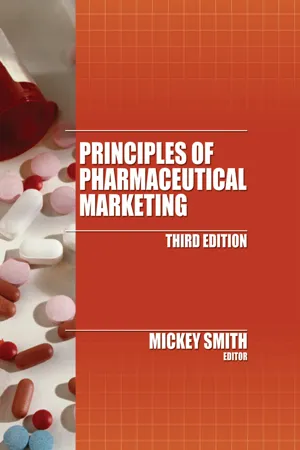
Principles of Pharmaceutical Marketing
About this book
Principles of Pharmaceutical Marketing, Third Edition offers the perspectives of both those who teach and those who practice pharmaceutical marketing. This reflects the need for and the effort to provide the most relevant "real world" approach to this complex and fascinating field. This text is designed for undergraduate students in pharmacy whose background in marketing is limited, those actually involved in pharmaceutical marketing, and anyone desiring an introduction to the intricacies involved in the marketing of pharmaceutical products.
The Pharmaceutical Market
Chapter 1
Introduction to Pharmaceutical Marketing
The twentieth century will be remembered for many technological achievements, including a greater understanding of the atom’s structure, the information explosion that has resulted from advances in computer technology, and the information obtained from space explorations. When measured in terms of its impact on people’s lives, though, the twentieth century “might just as well be called the ‘drug age’.”1
Although drugs and drugs alone cannot be considered to be the sole reason for the progress in medicine achieved in the twentieth century, a glance back to as recently as 40 years ago indicates that “At that time, there were no antibiotics, no corticoids, few sulfa drugs, few vitamins, no tranquilizers, no antihypertensives, no antihistamines, no oral contraceptive drugs, no effective oral diabetic drugs, no prophylactic drugs for gout, no potent active oral diuretics, no drugs to lower the level of blood lipids and cholesterol in the plasma, and no vaccines against polio, measles or mumps.”2 Many great strides, however, have been made in the last 40 years. Not only have many of the debilitating diseases now been controlled or eradicated, but many experts agree that by the end of this century pharmaceuticals may be of even greater importance in our lives because of anticipated major breakthroughs in the fields of neurobiology, immunology, molecular biology, cellular differentiation, cell membrane studies, and genetics.3, 4 No wonder Chain, the Nobel prize-winning biochemist, has labeled drugs as “one of the greatest blessings—perhaps the greatest blessing—of our time.”5
Although everyone, whether friend or foe of the pharmaceutical industry, recognizes the contribution of the industry to the health and welfare of the public, it is important to realize that all the developments in the pharmaceutical field and the availability of pharmaceuticals to the general public have not merely occurred by chance. Although most of the praise is accorded to those in the pharmaceutical industry concerned with research and development, few appreciate the contributions made by the pharmaceutical marketing system (and by many working within this system) in making these drugs available at the right time, at the right place, in the right quantity, at a reasonable price, and with the right information. This lack of appreciation for the pharmaceutical marketing function or system stems from many misconceptions and barriers to marketing in the pharmaceutical industry, and from the lack of understanding of the meaning of the term “pharmaceutical marketing.”
Misconceptions About and Barriers to Marketing in the Pharmaceutical Industry
After having read this book you will be able to evaluate and criticize pharmaceutical marketing practices, so some of the most common misconceptions about and barriers to marketing in the pharmaceutical industry will be discussed in this section.
Marketing for Drug Products, Not for Pharmaceutical Services
The term “marketing” is commonly associated with the marketing of goods—i.e., physical products only. Thus, a common myth in regard to marketing is that only physical products can be marketed, and not services. This is why many professionals, including clinical pharmacists, believe that only pharmaceutical manufacturers and distributors such as wholesalers and “druggists” should deal with marketing of pharmaceuticals, and that professionals involved in providing clinical services should avoid marketing. Marketing approaches are now being adopted by various service professions, such as insurance, banking, and hospitals. Marketing activities are essential for all exchanges undertaken for the purposes of want satisfaction. Although many of these exchanges involve physical products, such as goods, marketing can be used for all products—goods, services, and ideas—that have want-satisfying capabilities.6
Commercialism, and Lack of Professionalism
Many health-care professionals have a strong disdain for commercialism because they believe that their primary motivation for adopting the profession was not “money” but “service.” Regardless of their motivation, all professionals, including clinical pharmacists, recognize the inevitable fact that some equitable charge must be established for the services provided. The charge establishment—pricing—is an integral part of the marketing of any product.
This disdain for marketing is further enhanced by some professional organizations, as has been done by the American Pharmaceutical Association (APhA), through prohibitions on soliciting professional practice by means of advertising by their members. The pros and cons of such prohibitions on professionals could be argued at length, and the courts have now recognized that such prohibitions are unconstitutional.7
“Drug Pushing”
Many critics of pharmaceutical marketing have argued that marketing efforts, especially the advertising and promotional practices of the pharmaceutical industry, encourage pill-taking or pill-prescribing behavior in all problem situations. Such irrational behavior on the part of patients and physicians is blamed on the “drug-pushing” efforts of the pharmaceutical companies, who create an artificial demand for products. Instead of outlining the details of these allegations, the following reflection by Dr. Halberstam on the issue may be worth remembering:
The reliable studies which have been done on both OTC and prescription drugs used in the United States have shown that Americans tend to be conservative in the use of drugs, and that there is strong Puritan ethic which operates to make Americans endure suffering when they would otherwise seek pharmaceutical relief…. The accusation that we are an overmedicated society or a nation of “junkies” is just a little slogan that people who know a little bit about pharmaceutical usage have picked up…. Rather than being junkies, we are a nation of puritans, who somehow feel that it is proper to suffer.8
Unproductive Use of Resources
Because pharmaceutical marketing expenditures do not result in any visible change in the form of the product, it has been argued that all these expenditures should be considered as an unproductive use of resources. What is not recognized in this argument is that these marketing activities create the intangible utilities of time, place, and possession. Although the intangible utilities do not visibly change the drug product, they add significantly to the value of the product from the purchaser’s viewpoint.
Some critics have not only ignored the intangible values created by pharmaceutical marketing expenditures, but have argued that these expenditures are designed to give suppliers control over the demand curve. Because “such outlays are not likely to enhance the intrinsic value of the prescription and hence, improve the patient’s welfare,”9 they should be viewed as “redundant.” This analysis does not take into consideration the fact that value in use is only one of the demand factors that affects the price determination. Furthermore, the patient’s welfare, from his own and the physician’s perspective, is a function of the perceived value as well as of the intrinsic value of the prescription. Because the perceived value can be viewed as a simple ratio of perceived quality and perceived price, the “value” of a drug (and thus the patient’s welfare) can be improved by pharmaceutical marketing expenditures that lead to an increase in the perceived quality of the prescription.*
Inefficiency and Ineffectiveness
The term “efficiency” refers to the achievement of objectives through minimum resource expenditures, and the term “effectiveness” refers to the maximization of stated objectives. Table 1-1 illustrates the relationship of efficiency and effectiveness criteria to a few pharmacy-related activities. If patient welfare is the ultimate objective, it can be argued that the existence of too many marginal pharmacies and too many “me-too” drugs provide evidence of the inefficiency of our pharmaceutical marketing system. Similarly, the existence of too many drugs for the treatment of a single disease and the absence of drugs for the treatment of many of the known diseases can be regarded as the ineffectiveness of pharmaceutical marketing. Although this criticism, of the existence of the inefficiency and ineffectiveness of pharmaceutical marketing, is not completely unfounded, it should be recognized that this is the price to be paid for selecting freedom of enterprise under a market economy over the alternative of paternalism under a centrally directed economy. The alternative, however, does not guarantee optimal efficiency and effectiveness for the pharmaceutical marketing system either.
TABLE 1-1. Efficiency vs. Effectiveness
| EFFECTIVENESS* | ||
| HIGH | LOW | |
| | ||
| HIGH | Training 5 clinical pharmacists a year for ambulatory care setting to work with physicians in a group medical practice, with the American Medical Association obtaining employment for them upon graduation. | Training pharmacists to provide only drug distribution services. |
| EFFICIENCY† | | |
| LOW | Requiring 30 minutes of pharmacist consultation with all patients for any symptom. | Spending $10 million on a campaign to pass a legislation requiring every chain drugstore to have a Pharm. D. on duty in Ohio, and not finding anybody to sponsor the bill. |
* Effectiveness is the optimum attainment of the stated objective.
† Efficiency is the minimization of resource expenditure necessary to achieve objective.
Market, Marketing, and Pharmaceutical Marketing
Because pharmaceutical marketing is only a branch of the field of marketing, it is essential to define the term “marketing”. Furthermore, because all theoreticians and businessmen would agree that marketing definitely has something to do with “dealing in a market,” this section begins by discussing four different connotations of the term “market”: place connotation, size connotation, economic connotation, and business opportunity connotation.*
A common use of the term “market” is in terms of a place. For example, the Columbus, Ohio, market for over-the counter drugs (OTCs) refers to a specific geographic area in which the exchange of drugs takes place between buyers and sellers. Although geographic market area determination for a firm is logically appealing and necessary for many small businesses, modern communication technology obviates the fundamental requirement of place connotation of market, that exchange between buyers and sellers takes place in a specific geographic area.
The size connotation of market is normally explained in terms of number of people or dollars, or quantity volume of a product. This definition of market is commonly used by researchers who are interested in investigating the pharmaceutical market place. Although some have used the four-digit Standard Industrial Classification (SIC) of the Bureau of the Ce...
Table of contents
- Cover Page
- Half Title page
- Title Page
- Copyright Page
- Dedication
- Preface
- Contributors
- Contents
- Part I The Pharmaceutical Market
- Part II The Pharmaceutical Product
- Part III Distribution Channels
- Part IV Competitive Practices
- Part V Controls
- Suggested Readings
- Index
Trusted by 375,005 students
Access to over 1.5 million titles for a fair monthly price.
Study more efficiently using our study tools.
Frequently asked questions
Yes, you can cancel anytime from the Subscription tab in your account settings on the Perlego website. Your subscription will stay active until the end of your current billing period. Learn how to cancel your subscription
No, books cannot be downloaded as external files, such as PDFs, for use outside of Perlego. However, you can download books within the Perlego app for offline reading on mobile or tablet. Learn how to download books offline
Perlego offers two plans: Essential and Complete
- Essential is ideal for learners and professionals who enjoy exploring a wide range of subjects. Access the Essential Library with 800,000+ trusted titles and best-sellers across business, personal growth, and the humanities. Includes unlimited reading time and Standard Read Aloud voice.
- Complete: Perfect for advanced learners and researchers needing full, unrestricted access. Unlock 1.5M+ books across hundreds of subjects, including academic and specialized titles. The Complete Plan also includes advanced features like Premium Read Aloud and Research Assistant.
We are an online textbook subscription service, where you can get access to an entire online library for less than the price of a single book per month. With over 1.5 million books across 990+ topics, we’ve got you covered! Learn about our mission
Look out for the read-aloud symbol on your next book to see if you can listen to it. The read-aloud tool reads text aloud for you, highlighting the text as it is being read. You can pause it, speed it up and slow it down. Learn more about Read Aloud
Yes! You can use the Perlego app on both iOS and Android devices to read anytime, anywhere — even offline. Perfect for commutes or when you’re on the go.
Please note we cannot support devices running on iOS 13 and Android 7 or earlier. Learn more about using the app
Please note we cannot support devices running on iOS 13 and Android 7 or earlier. Learn more about using the app
Yes, you can access Principles of Pharmaceutical Marketing by Mickey C. Smith,Mickey C. Smith Ph.D. in PDF and/or ePUB format, as well as other popular books in Business & Business General. We have over 1.5 million books available in our catalogue for you to explore.