The advent of Internet marked a significant change in how users and customers can be involved in the innovative process. History is rife with examples of how users innovate, but Internet and its associated communication technologies brought radically new means for individuals to interact rapidly and at little cost in communities that spur new innovations. These communities are initiated and governed by people that differ in their motivations for taking part and participate to varying degrees. Such communities are outside the immediate control of companies seeking to develop open innovation strategies aimed at harnessing their work. This book brings together distinguished scholars from different disciplines: economics, organization theory, innovation studies and marketing in order to provide an improved understanding of how technological as well as symbolic value is created and appropriated at the intersection between online communities and firms. Empirical examples are presented from different industries, including software, services and manufacturing. The book offers food for thought for academics and managers to an important phenomenon that challenges many conventional wisdoms for how business can be done. This book was published as a special issue of Industry and Innovation.
eBook - ePub
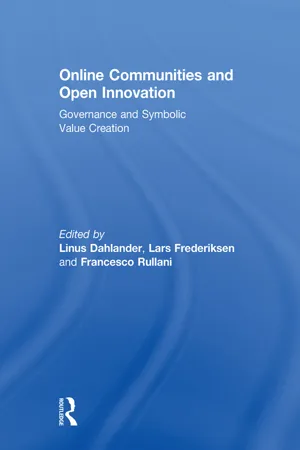
Online Communities and Open Innovation
Governance and Symbolic Value Creation
- 122 pages
- English
- ePUB (mobile friendly)
- Available on iOS & Android
eBook - ePub
Online Communities and Open Innovation
Governance and Symbolic Value Creation
Online Communities and Open Innovation: Governance and Symbolic Value Creation
Introduction
How can firms make use of online communities as part of an innovation strategy aimed at leveraging resources and ideas outside the four walls of the enterprise? Online communities are today a widespread phenomenon that takes a variety of forms. Free and open source software is probably the most well-known case, where geographically dispersed individuals collectively develop new software and produce innovation. In 1991 Linus Torvalds founded the Linux kernel, the heart of an operating system with the ability to have a real impact on Microsoft’s market share. Torvalds’ initial ideas led to the building of a community that collectively developed the Linux kernel. From the original incorporation of some 10,000 lines of source code, by 2005 the community had developed more than 6,000,000 lines of code. But online communities are more than simply free and open source software. For instance, social networking sites such as Facebook and MySpace, which have memberships of millions, have grown rapidly, allowing individuals to share experiences and socialize with each other. From initially being exclusively for participation by Harvard students, Facebook, according to recent estimates, now has more than 60 million users worldwide. The popular press has been swift to document these successes, and it is tempting to conclude that online communities have great potential. Yet, their diversity, in terms of objectives, typology of organization, production and reasons behind individuals’ use of them, is becoming obvious.
Using different theoretical lenses, a growing body of literature in social sciences attempts to unfold this phenomenon (see, e.g. recent special issues in Research Policy, 2003; Management Science, 2006; and Organisation Studies, 2007). Much of the research on online communities suggests that the nature of these communities with permeable boundaries and self-organization makes them a new powerful locus of collective creativity and innovation (Lee and Cole, 2003). This is because individuals distributed across the globe can work with other individuals with whom they have affinities and shared interests. There has been much less research on how firms use communities where they have limited control, which might even jeopardize their competitive advantage, as part of their business models.
In recent years, a growing number of papers has adopted the open innovation concept to highlight that innovation processes span organizational boundaries. As Chesbrough (2003: XXIV) puts it: “firms can and should use external ideas as well as internal ideas, and internal and external paths to market, as the firms look to advance their technology”. This stream of research highlights that firms have to rely on ideas from the external environment to stay abreast of competition (Chesbrough, 2003). Research on open innovation focuses on situations where firm boundaries are permeable, resulting in an interactive and distributed innovation process in which ideas, resources and individuals flow in and out of organizations (Laursen and Salter, 2006). Some contributions to this line of thinking suggest that firms can adopt strategies to integrate ideas that originate from communities, into their internal processes (Dahlander and Wallin, 2006; Jeppesen and Frederiksen, 2006). Firms can act strategically, by selectively revealing internal resources (Henkel, 2006) or by establishing communities to enable individuals to start using their products (Jeppesen and Frederiksen, 2006).
Online communities, therefore, can constitute an important external source of innovation for those firms able to implement a constructive relationship with them (Dahlander and Magnusson, 2005). Individuals in these communities may not only be able to develop innovations that can be integrated into the firm, but also may come up with new perspectives on and ways of framing problems. The community may develop a shared and mutual understanding of what it is about, what in the new product design or features is valuable; it may create product/firm loyalty and establish among community participants a sense of belonging and meaning (Rindova and Petkova, 2007).
Despite these benefits, there is also a range of challenges for firms that adopt the open innovation approach (Chesbrough, 2006). This is particularly evident when managing online communities as individuals participating in these communities are beyond the firms’ hierarchical realms. Individuals can decide where to work, who to work with and what to work on, making it difficult for firms to steer the direction of development (Dahlander and Wallin, 2006). Moreover, in online communities the social processes behind members’ participation are intrinsically dissipative because in such self-organized processes, many individuals have to be mobilized to make the most productive ones emerge (David and Rullani, forthcoming). This greatly increases the resources firms have to pour into these communities, and increases the risk of such investments. A large number of involved parties with misaligned goals, different capabilities and diverse degrees of involvement, raise the issue of governance of online communities.
In order to advance our understanding of the open and distributed nature of the innovation process taking place through online communities, this Special Issue revolves around the two themes identified above as crucial: (1) the importance of conceptually including the symbolic value of the artefacts in the innovation process, as online communities can be fundamental tools by which firms can innovate in this sphere thickening the symbolic value of their product; and (2) the issue of governance and how it is associated with the way in which firms try to harness these communities. Both themes have been relatively unattended by earlier research. The papers in this issue were selected precisely on the basis of the questions and answers they might generate with respect to these overall themes.
We structure this editorial piece as follows. We begin by placing the collection of papers within the themes of governance and symbolic value creation. We then conclude by charting areas for future research.
Theme I: Governance in Online Communities
Many scholars are interested in how online communities are governed. Sometimes these communities emerge quickly and appear to be successful, without the reporting mechanisms and organization charts visible within firms (Fleming and Waguespack, 2007). Firms are often involved in online communities as the protagonists of a single community (Jeppesen and Frederiksen, 2006), hosts of a system composed by a myriad of project-centred communities (David and Rullani, 2008) or collaborators integrated in an existing community (Dahlander and Wallin, 2006).
Research on governance in online communities looks at how individuals in these communities make collective decisions about future directions, control and coordination (see, e.g. the discussion by Markus, 2007). Dealing with governance is not a simple matter, as it is clearly a composite and dynamic concept, based on the nexus between very neterogeneous actors (O’Mahony & Ferraro, 2007; Shah, 2006). The dimensions that it is necessary to take account of are several, and their links are not always clear.
The paper by Langlois and Garzarelli, “Of Hackers and Hairdressers: Modularity and the Organizational Economics of Open-Source Collaboration”, is the first paper in this Special Issue and sets the stage for a discussion on governance in online communities, allowing us to tease out what are the important dimensions. In this mainly conceptual paper, the authors employ the empirical illustration of an open source online community to explore the generic question in organizational economics of how the division of intellectual labour is based on a trade-off between modularity (i.e. specialization) and the opportunity to integrate various individually developed components of knowledge. The paper claims that the trade-off allows the individuals populating the open source community to exchange efforts rather than products, under a regime in which the providers of code self-identify themselves as suppliers of products in a market, rather than employees in a firm. Through their discussion, Langlois and Garzarelli build a useful two-by-two matrix of product vs. efforts on one axis and self-identification of contributors vs. no self-identification on the other. In this matrix the firm, the market, outsourcing and voluntary production as it occurs in open source communities are situated and, hence, presented as different modes of innovation production.
This provokes a series of questions on how communities can be managed when the connection between incentives—that is, the voluntary basis upon which the community is built—and the particular dynamics of the organization of labour in an open community—exchanging effort and not product—is taken into account. Firms and communities have diverse and sometimes incommensurable goals (O’Mahony, 2003), and it is a challenge for firms to derive benefits from working with communities.
The West and O’Mahony paper, “The Role of Participation Architecture in Growing Sponsored Open Source Communities”, offers an answer to the previous implicit question about governance structures and the contradictions of a series of open source communities classified according to the typologies of firms’ participation in these communities. Based on a qualitative study the paper shows that firm-sponsored online communities or open source online communities initiated by a firm, differ from organically grown open source communities. To demonstrate the differences between these two archetypical forms of open source online communities West and O’Mahony develop the concept of “participation architecture”. The concept is created by the joining together of three important design dimensions for the coordination of tasks and communication in an online community: management of intellectual property rights, development approach and model of community governance. The study makes it explicit that various participation architectures exist in the two kinds of open source communities. The authors find that corporate sponsorship in open source communities influences the design and evolution of them and that this affects: (1) the degree of transparency of community participants to follow the community’s collective process of development; and (2) accessibility for participants, to contribute to code development. Despite oftentimes trying to imitate the organization and design of organic open source communities, firm-sponsored communities face the classic tension between control and growth. This is because firms that are sponsoring an open source community struggle to maintain an open structure supportive of growth in the community in parallel with managing and maintaining control over the direction of and the activities taking place in the open source online community. For example, a firm sponsoring a community may define and potentially limit the opportunity structure for others to enter the community, as well as deciding who has access to the code/core of the community. The final contribution of this paper to the debate invoked in this Special Issue demonstrates that it is rarely the technical architecture and set-up of online communities that single-handedly determines participation frequency and structure. To better understand the differences in the character and quality of participation in different types of online communities, and thus be better informed about how innovation through these communities is managed and incentivized, we need to note that the organizational structure hinges upon the community sponsor’s decisions regarding the design of governance mechanisms.
The paper by den Besten and Dalle provides an opportunity to explore this issue from a different perspective, taking a very timely phenomenon as the empirical setting. Stretching the argument presented in the paper by West and O’Mahony, they offer an intuition on the relationship between organizational structure and governance of online communities: the coordination devices the community uses in its everyday work embodies, “expresses”, its (implicit or explicit, consciously or unconsciously taken) decisions relative to governance. Evaluating the role of these mechanisms in the effectiveness of the community activity develops into an interesting exercise, as it suggests visions of new ways—and new mechanisms—by which firms can realize the effective governance of an online community.
The paper by den Besten and Dalle focuses on the exciting example of Wikipedia, the online encyclopaedia, developed at tremendous pace by a vibrant online community. From its inception in 2001 to the end of December 2007, the Wikipedia community had collectively written an astonishing 9 million plus articles, in over 200 languages. Interest has surged among organization and management theorists to understand how the community’s efforts have been organized to develop at this pace. The paper studies Simple Wikipedia—an offspring of Wikipedia—which develops articles written in Basic English, aimed at children, people with learning disabilities and individuals who are not fully literate in English. Simple Wikipedia has a mechanism that allows members to label pages as “unsimple”, to ensure readability. Using an impressive data-set of more than 25,000 pages written by almost 20,000 contributors, the paper investigates how this labelling influences the readability of articles. The paper adopts methods used in linguistics and information science, such as the Flesch formula, which measures the readability of articles, counting the number of syllables per word and the number of words per sentence in texts. The results suggest that labelling plays a key—yet insufficient—role in ensuring articles are readable. The implications, suggested by the authors, are that an artificial companion—configured as a managerial and editorial assistant—could be developed using the relatively straightforward metrics suggested in the paper. These companions could continue work left unattended by members of the community, and also free up time for them to do more creative tasks.
Because such mechanisms as the companion mentioned above, would have an impact on the content of the everyday work of contributors, it could also be used to shape the governance of the community. Drawing on the Simple Wikipedia example analysed by den Besten and Dalle, we can imagine a wider application of “bots” able to grease the coordination between contributors. Once the “bots” are set, only certain tasks will be left to human coordination and discussion—for instance, to confrontation of different interests—while other issues will be “hidden” and taken care of by the automatic procedures for specific tasks. This would have a great impact on the evolution of governance structure in online communities.
Theme II: Different Types of Value Creation in Online Communities
The literature has underlined the role of users as innovators. The usual perspective uncovers the role of lead users as those individuals whose everyday life is affected by the consumption of the firm’s product, and who have the skills to modify and personalize the product. The innovation process, however, most of the time is described as “atomistic”: the user tries to match her needs with the features of the product, and produces a modified version of it. Users in online communities are embedded in a social environment where they can get advice from others to solve particular problems. As suggested by the user innovation literature, communication plays a function as a propagation device, distributing innovative features or voicing needs in the user community and eventually carrying them to the firm. While being sympathetic to this argument, we would contend that communication among users is more than this. In other words, we need to look at the communication that was going on before, during and after Schumpeterian inventions and innovations proliferated, because that is the mechanism that joins together the two processes allowing invention and innovation to link up to produce the potential to become both creative and valuable.
In line with this perspective an emergent view on value creation in the context of innovation is that consumers or potential consumers are not only attracted to the functional aspects and features of products (Rindova and Petkova, 2007). Issues such as symbolic and aesthetic value as well as sense-making qualities seem equally important for creating value through successful product development (Ravasi and Rindova, 2007). The literature on user innovation and online communities, in our view, has frequently focused perhaps too narrowly on innovation as improvements to technological features and innovative task partitioning, and seldom recognized that innovation and invention in online communities also takes place through communication among participants and thus through the recombination of ideas, voicing of future product wants and convergence towards a common perception of what is valuable. Being part of the community and making sense of one’s practices wi...
Table of contents
- Cover
- Half Title
- Title Page
- Copyright Page
- Table of Contents
- 1. Online Communities and Open Innovation: Governance and Symbolic Value Creation
- 2. Of Hackers and Hairdressers: Modularity and the Organizational Economics of Open-source Collaboration
- 3. The Role of Participation Architecture in Growing Sponsored Open Source Communities
- 4. Keep it Simple: A Companion for Simple Wikipedia?
- 5. Communities of Consumption and Made in Italy
- 6. Leveraging Lead User Knowledge in Software Development—The Case of Weblog Technology
- 7. Getting Clear About Communities in Open Innovation
- Index
Trusted by 375,005 students
Access to over 1.5 million titles for a fair monthly price.
Study more efficiently using our study tools.
Frequently asked questions
Yes, you can cancel anytime from the Subscription tab in your account settings on the Perlego website. Your subscription will stay active until the end of your current billing period. Learn how to cancel your subscription
No, books cannot be downloaded as external files, such as PDFs, for use outside of Perlego. However, you can download books within the Perlego app for offline reading on mobile or tablet. Learn how to download books offline
Perlego offers two plans: Essential and Complete
- Essential is ideal for learners and professionals who enjoy exploring a wide range of subjects. Access the Essential Library with 800,000+ trusted titles and best-sellers across business, personal growth, and the humanities. Includes unlimited reading time and Standard Read Aloud voice.
- Complete: Perfect for advanced learners and researchers needing full, unrestricted access. Unlock 1.5M+ books across hundreds of subjects, including academic and specialized titles. The Complete Plan also includes advanced features like Premium Read Aloud and Research Assistant.
We are an online textbook subscription service, where you can get access to an entire online library for less than the price of a single book per month. With over 1.5 million books across 990+ topics, we’ve got you covered! Learn about our mission
Look out for the read-aloud symbol on your next book to see if you can listen to it. The read-aloud tool reads text aloud for you, highlighting the text as it is being read. You can pause it, speed it up and slow it down. Learn more about Read Aloud
Yes! You can use the Perlego app on both iOS and Android devices to read anytime, anywhere — even offline. Perfect for commutes or when you’re on the go.
Please note we cannot support devices running on iOS 13 and Android 7 or earlier. Learn more about using the app
Please note we cannot support devices running on iOS 13 and Android 7 or earlier. Learn more about using the app
Yes, you can access Online Communities and Open Innovation by Linus Dahlander,Lars Frederiksen,Francesco Rullani in PDF and/or ePUB format, as well as other popular books in Business & Business General. We have over 1.5 million books available in our catalogue for you to explore.