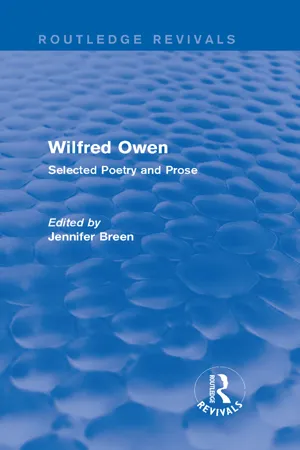
First published in 1988, this annotated selection of Wilfred Owen's poetry and prose provides a comprehensive one-volume text of his best work. As well as the war poems, it includes illuminating early pieces such as 'Impressionist' and 'Little Claus and Big Claus', which illustrate Owen's early command of satire and narrative. The prose includes Owen's well-known draft Preface and a wide range of his letters, showing the devotion he felt for his mother, his poetic development after meeting Siegfried Sassoon, and, above all, his war experiences. With a detailed introduction and helpful commentary, this timely reissue will be of particular value to A-Level and undergraduate students with an interest in the work of Wilfred Owen, his contemporaries, and the context of the First World War.
- 268 pages
- English
- ePUB (mobile friendly)
- Available on iOS & Android
eBook - ePub
About this book
Information
WILFRED OWEN
Selected Poetry and Prose
SONNET WRITTEN AT TEIGNMOUTH, ON A PILGRIMAGE TO KEATS’S HOUSE
Three colours have I known the Deep to wear;
’Tis well today that Purple grandeurs gloom,
Veiling the Emerald sheen and Sky-blue glare.
Well, too, that lowly-brooding clouds now loom
In sable majesty around, fringed fair
With ermine-white of surf: to me they bear
Watery memorials of His mystic doom
Whose Name was writ in Water (saith his tomb).
Eternally may sad waves wail his death,
Choke in their grief ’mongst rocks where he has lain,
Or heave in silence, yearning with hushed breath,
While mournfully trail the slow-moved mists and rain,
And softly the small drops slide from weeping trees,
Quivering in anguish to the sobbing breeze.
| April 1911 | JS, 1983 |
IMPRESSIONIST
Although his speech ran suavely as a valse
His empty heart gave hollow echoes, false
As ring the vacant city’s, late at night.
His narrow eyelids shot suspicious light:
As might the shutters of an evil house.
The more ‘good taste’ might scavenge, scrub and souse
The alleys of his mind to disembarrass:
The more it left them stony-stark, – like Paris.
And as the erections of his life grew high
And new ambitions piled up fast and thick
So narrower was his knowledge of the sky
So denser was his air with dust of brick.
He valued every man at market price:
Large public parks laid out by legislature
Were his idea and cognisance of Nature.
Neat cemeteries his garden of paradise.
| November 1911–May 1912 | JS, 1983 |
LITTLE CLAUS AND BIG CLAUS
There dwelled within a village, once, two men,
Whose names alike were Claus. Four stalwart mares
Had one; the other but a single nag.
Wherefore the richer wight Big Claus was called,
While men, if e’er they stayed to speak of him,
Would style his neighbour Little Clans. Now hark,
And you shall hear how fared it with them both,
For some do say my story is the truth.
All week, poor Little Claus would plough for Big,
Lending his only horse; and then, in turn,
Big Claus would help one day in seven, with all
His team at work. Oh, proudly Little Claus
Curled the lithe whip over the horses five
On Sundays. Were they not his, that day?
And, when the morning sun was warm, and mist
Rose from the fresh furrows like the horses’ steam,
While bells out-clamoured hungrily for folk
To fill the void and cavernous church, his heart
Would swell with pride to see the passers-by
Watching his labour; and he smacked his whip
And cried out ‘Gee ho, my five horses.’ ‘Nay,’
Quoth Big Claus. ‘That ye must not say, for one
Alone is thine.’ Alas, no sooner came
Another well-clad churchman by, than Claus
Forgot the prohibition and its giver,
Forgot to guide the ploughshare even, and sang,
Not to the team but to the onlooker,
‘Gee ho! my five horses!’
‘Say it again,’
Growled Big Claus, menacing, and nodding slow
His head, much like the toiling nag itself,
‘And I will knock thy beast upon the pate,
And make an end of it.’ Then Little Claus
Ploughed on in silence; till a company
Of pleasant friends crossed o’er the fields, and called
Good-morrow to the tiller at his toil.
Pride set his thoughtless face once more aflush;
Full grandly he replied, and as they passed,
Briskly he clacked his whip. ‘Gee ho!’ he sang.
‘Gee ho! my five horses.’ Not a word
Spoke Big Claus, but he snatched a hammer up
And smote the hapless creature sudden-dead.
Oh, pitifully Little Claus did weep
To see his one horse dead, and reck his loss.
But afterwards he stripped away the hide
And dried it, till it stiffened in the wind;
Then packed it, slung the bag upon his back
And set foot to a neighbouring town to sell.
The afternoon o’ertook him on his way,
And with it, curdling storm clouds. ’Mid deep brakes
The tempest trapped him; and he wandered wide
Below dark sky and darker woods. At length
Firm shadows and a bar of yellow light,
Shining atop of shutters, beckoned him
Towards a farm. His knocking brought the Wife
To door; but ‘No!’ said she, an unknown man
She could not lodge, the Farmer being from home.
Claus turned round slowly from the sharp-slammed door,
And crept upon a thatch-roofed shed close by;
Whence, as he lay, and twisted him about,
He saw, above the scanty shutters, full
Into the kitchen; saw a table spread
With meats and fish and wine; and one there sat –
A Sexton – plying merrily his fork,
The whiles the Woman kept his glass abrim.
Claus watched, lamenting loud, and scarcely heard
The clatter of a heavy horse below.
This, the Farmer’s horse, returning. He
Was a worthy man, but long he nursed
A curious prejudice against all Sextons,
Till the bare sight of one would make him mad.
So therefore did the Wife regale this one,
The Farmer absent; therefore, too, she now,
At his return, hustled the graveyard-man
Into an empty chest, and thrust the meats
Into the oven, the wines behind the stove.
‘Alack,’ moaned Little Claus, when all the feast
So vanished. ‘Who’s above?’ the Farmer cried.
‘Why liest thou there? Come, rather, in with me.’
Then Claus begged leave to spend the night with him.
‘Yea, that thou shalt do; but first we must eat,’
Said he; and blithely ’gan to sup a dish
Of gruel, which the Woman set before them.
But Claus still hungered tigerishly for all
Those gravied savouries; and relished ill
The milky groats. So now he placed his foot
Upon his bag, which lay beneath the board;
Making it squeak; and when it squeaked, said ‘Hush!’
But saying so, trod harder, and called forth
Still louder noise. ‘Hulloa!’ said his host.
‘What hast thou, in thy bag?’
‘A wizard dwells
In this my bag,’ said Claus; ‘and wot ye now
What he is saying? Why that we should not
Be spooning gruel, when he’s conjured up
Roast meat and pastries hot, inside thy oven there.’
‘Zounds!’ said the Farmer, peering in the stove.
Mutely the Woman drew her cooking forth
And so they ate. Again the enchanter spoke
In voice of chirping leather; telling now
Of three full wine jars, conjured by the stove.
Tongue-tied and fidgeting, the Wife fetched out
Her...
Table of contents
- Cover
- Half Title
- Title Page
- Copyright Page
- Original Title Page
- Original Copyright Page
- Table of Contents
- Acknowledgements
- Introduction
- List of abbreviations
- WILFRED OWEN: SELECTED POETRY AND PROSE
- Critical commentary
- Reading list
- Notes
Trusted by 375,005 students
Access to over 1.5 million titles for a fair monthly price.
Study more efficiently using our study tools.
Frequently asked questions
Yes, you can cancel anytime from the Subscription tab in your account settings on the Perlego website. Your subscription will stay active until the end of your current billing period. Learn how to cancel your subscription
No, books cannot be downloaded as external files, such as PDFs, for use outside of Perlego. However, you can download books within the Perlego app for offline reading on mobile or tablet. Learn how to download books offline
Perlego offers two plans: Essential and Complete
- Essential is ideal for learners and professionals who enjoy exploring a wide range of subjects. Access the Essential Library with 800,000+ trusted titles and best-sellers across business, personal growth, and the humanities. Includes unlimited reading time and Standard Read Aloud voice.
- Complete: Perfect for advanced learners and researchers needing full, unrestricted access. Unlock 1.5M+ books across hundreds of subjects, including academic and specialized titles. The Complete Plan also includes advanced features like Premium Read Aloud and Research Assistant.
We are an online textbook subscription service, where you can get access to an entire online library for less than the price of a single book per month. With over 1.5 million books across 990+ topics, we’ve got you covered! Learn about our mission
Look out for the read-aloud symbol on your next book to see if you can listen to it. The read-aloud tool reads text aloud for you, highlighting the text as it is being read. You can pause it, speed it up and slow it down. Learn more about Read Aloud
Yes! You can use the Perlego app on both iOS and Android devices to read anytime, anywhere — even offline. Perfect for commutes or when you’re on the go.
Please note we cannot support devices running on iOS 13 and Android 7 or earlier. Learn more about using the app
Please note we cannot support devices running on iOS 13 and Android 7 or earlier. Learn more about using the app
Yes, you can access Wilfred Owen (Routledge Revivals) by Jennifer Breen in PDF and/or ePUB format, as well as other popular books in Literature & European Literary Collections. We have over 1.5 million books available in our catalogue for you to explore.