A dynasty of high ability and great charm, the Stuarts exerted a compelling fascination over their supporters and enemies alike. First published in 1991, this title assesses the influence of the Stuart mystique on the modern political and cultural identity of Scotland. Murray Pittock traces the Stuart myth from the days of Charles I to the modern Scottish National Party, and discusses both pro- and anti-Union propaganda. He provides a unique insight into the 'radicalism' of Scottish Jacobitism, contrasting this 'Jacobitisim of the Left' with the sentimental image constructed by the Victorians. Dealing with a subject of great relevance to modern British society, this reissue provides an extensive analysis of Scottish nationhood, the Stuart cult and Jacobite ideology. It will be of great interest to students of literature, history, and Scottish culture and politics.
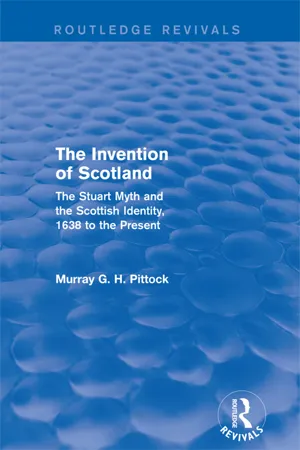
eBook - ePub
The Invention of Scotland (Routledge Revivals)
The Stuart Myth and the Scottish Identity, 1638 to the Present
- 198 pages
- English
- ePUB (mobile friendly)
- Available on iOS & Android
eBook - ePub
The Invention of Scotland (Routledge Revivals)
The Stuart Myth and the Scottish Identity, 1638 to the Present
About this book
Information
1
The divided myth and the drift to Union
THE CLAIMS OF THE KING
Then from your fruitfull race shall flow
Endless succession,
Scepters shall bud, and Laurels blow
’Bout their Immortal Throne.
CHORUS
Propitious starres shall crowne each birth,
Whilst you rule them, and they the Earth.
Carew, Coelum Britannicum (1634)
The Martyr’s blood was said of old to be
The seed from whence the Church did grow.
The Royal Blood which dying Charles did sow
Becomes no less the seed of Royalty.
Abraham Cowley
We fought no crownes … we loved no new masters. Had our throne been voyd, and our voyces sought for the filling of Fergus’s chaire, we would have died ere any other had sitten down on that fatall marble bot Charles alone.
Rev. Robert Baillie, speaking of the Covenanters1
As I suggested in the Introduction, the roots of the Stuart myth lie in the history of the dynasty, not in the later accretions of sentiment. No British royal family were praised as they were praised; none denigrated as they were denigrated. Charles I was to his courtiers, poets, and apologists the ruler of the stars, to be praised above them; to the regicides he was the Man of Blood, chief of the Malignants, the unflattering term bestowed on all who actively supported him.
He was not alone among his dynasty in being described in terms of paradoxical extremes. James VI and I is famously known as ‘the wisest fool in Christendom’; Mary of Scots, Charles’s grandmother, is judged controversially by posterity as by her contemporaries: was she foolish murderess or wronged beauty? It was seriously proposed that James II be canonized; yet to many of his subjects he was an arbitrary tyrant. Even Charles II, the least unpopular of his dynasty in England, was the Merry Monarch to some, and the ‘mansworn tyrant’ to others. The Earl of Rochester characterized his mercurial temperament in the famous lines:
God bless our good and gracious King,
Whose promise none relies on;
Who never said a foolish thing,
Nor ever did a wise one.2
In popular tradition, Charles II and James I are seen as the secular Stuarts, contradictory creatures of folly and wisdom. Charles I and James II are seen as the sacred Stuarts, contradictory creatures of sanctity and tyranny. One became one of the few distinctively Anglican saints; the other was proposed for canonization. On the other hand, both were unable to keep their thrones despite ruling one of the most socially and politically conservative countries in Europe: England.
Neither this chapter nor this book will deal with the Stuart myth in England, which, long neglected, is now a province to which other pens are heirs. However, it is important to realize that the cult of Bonnie Prince Charlie is not unique. The doom-laden prince aspiring to a glory nearly attained, but by fate placed beyond his reach, is not an image confined to the sentimentality of Scottish shortbread tins. It is something endemic in the reaction of both contemporaries and historians in Scotland, England, and elsewhere to the family of Stuart itself and its fatal attraction:
Si quelque chose … justifie ceux qui croient a une fatalite a laquelle rien ne peut se soustraire, c’est cette suite continuelle de malheurs qui persecute la maison des Stuarts pendant plus de trois siècles.
Voltaire3
Voltaire was an ardent supporter of, and propagandist for, the Stuarts. Charles Edward appears in Candide as an example of the most unfortunate of kings. Voltaire shared the fascination which many of those who fought or wrote for the Stuarts experienced: their charm and their misfortunes, their sacred convictions and earthly defeat, their willingness to put principle before pragmatism in their politics, marked them out as different. This mystique persists: historians of the present century have often been as pro- or anti-Stuart as those of the past.4 Until we understand this, we cannot begin to understand the Stuart myth, nor the manner in which it competes with the myths of the Glorious Revolution, Imperial Britain, and Unionism which officially superseded it.
‘Myth’ is the appropriate term: none of the concepts mentioned above have settled interpretations. Our attitudes to them all fluctuate from generation to generation, and passionate convictions, scarcely rooted in historical fact, sway the minds of many on these issues.5 The relevance to Irish politics (in symbolic rather than factual terms) of the years 1689–90 is only one example.
The Stuart myth is no accretion of sentimental Jacobitism: it was contemporaneous with Stuart rule, not merely nostalgic. The Stuarts were, from 1603 at least, clad in a mystique they did much to design. The facts of the Cavalier or Jacobite cause are ultimately incomprehensible without reference to the motivating ideology of sacred kingship, antique right, and manifest destiny which the Stuart kings developed. The images and beliefs they nourished are not, even now, without continuing power. In Scotland these still haunt the concept of national identity itself. That is a measure of their enduring effect, and the subject of this book.
History’s temptation to design its conclusions through hindsight can tend to abandon any sense of contemporaneity with events in favour of an orderly reading of them. The orderly reading of the Stuarts which has been long available is that of the Lost Cause: the story of a dynasty doomed by incompetence and circumstances. Recent historians have challenged this argument from results in suggesting that, right into the eighteenth century, there was no contemporary sense that the Jacobite cause was fated to defeat.6 While this view has proved a valuable corrective to the traditional one, it is nevertheless the case that the Stuart cause itself had a strong sense of history and hindsight. Some supporters of the Stuarts did dwell in the past long before their cause was lost, because the past was part of the validation both of the antiquity of their royal line and of the sacred and priest-like nature of their kingship, which in part derived from the ancient ideals of the Old Testament. Nostalgia characterizes lost causes: but in Stuart ideology it was an antecedent fact. The deplorable pictures of the Scottish royal line which hang in Holyrood, commissioned in 1684, are a display of this concern with sheer antiquity, paralleled in England by James and Charles’s claims to descend from Trojan Brutus, and their resultant manifest destiny as kings of all Britain. They were indeed to be Arthur returned, the saviour-rulers brought by destiny.7
The masques performed at Charles I’s court presented the monarchy as ‘a compromise between the Neoplatonic extremes of Ideal Forms and the diminished reality of earthly appearances’: a kind of realpolitik Platonism, with the Stuarts as philosopher-kings.8 The visible beauty of the masques served as spiritual propaganda for a myth of an elevated, glittering, spiritually and intellectually aloof monarchy. Charles’s interest in and commitment to iconic representations of himself in literature and painting had become an overt element in court propaganda by the late 1620s.9 Not only was the monarch depicted as a Platonic hero, a philosopher and judge in his temporal body; his timeless body too, that of the king as symbol of God’s power on earth, was held up for veneration by the ecclesiastical establishment. Archbishop Laud’s enthusiasm for visible decoration in the Anglican church was summarized in his tribute to ‘the beauty of holiness’. The phrase came from the Psalms, but Laud’s ‘understanding of it was informed by … Neoplatonic commonplaces’. Thus a complementary ideological vision of a supreme king representing supreme authority and beauty both in Church and State was worked out. Charles was constitutionally head of the Anglican church. Now he was symbolically head of it too: ‘Laud’s faith in the power of beauty was the religious analogue to Charles’s reliance on icons as a means of governing.’10
King and Archbishop worked in tandem to provide an invulnerable image of the monarchy as ‘God’s ruling agent … bringing together heaven and earth’. The ‘enraptured union’ of State and Church was represented by the iconic images of Stuart majesty,11 sometimes showing Charles seated upon a white horse, as is the Word of God, ‘Faithful and True’, in the Book of Revelation:
I saw heaven standing open and there before me was a white horse, whose rider is called Faithful and True. With justice he judges and makes war. His eyes are like blazing fire, and on his head are many crowns. He has a name no-one but he himself knows. He is dressed in a robe dipped in blood, and his name is the Word of God. The armies of heaven were following him.
Revelation 19: 11–14 (New International Version)
If this kind of symbolism was in Charles’s mind, it can be said that his descendants did not abandon this self-image; and when Charles Edward rode into Carlisle to take possession of the city in 1745, he chose a white horse as his mount.12 Charles I took pains to present himself as the ‘white king’: crowned in white he was later buried in a snowstorm, his robe too literally ‘dipped in blood’, that of his martyrdom.13
The Stuart family’s power to fascinate was not born with Charles I, but his ultimate personal defeat tempts us to underestimate the enduring power of his propaganda, and the sway it obtained not only over his own, but future generations. ‘Divine Right’ was not a governmental formula: it was a sacred talisman. Moreover, it was one with actual transforming power:
Our Charles, blessed alchemist! (though strange
Believe it, future times!) did change
The iron-age of old
Into an age of gold!
Cowley’s view of Charles as a ‘blessed alchemist’, who could transmute base metal into gold through holy power, is an example of the view of the Stuarts as fertility magicians; kings who could deliver countries from famine to prosperity, returners of a pastoral golden age.14 This view became popular in eighteenth-century Scotland, when the Union was blamed for the economic state of the country.
There is no need to dismiss Cowley’s praise as poetic flattery. It is too frequently paralleled elsewhere by less interested parties. Charles’s enthusiasms for art and literature were like his enthusiasms for masques and Laudianism: an enthusiasm for the portrayal of his kingship, through the nearest things to the modern media available in the 1630s. This is not to say that Charles was calculating, and had no genuine feeling for what he professed. He reached back into antiquity to justify in the depictions he authorized the sacred and stable nature of his regime. The Anglican church was given a more catholic atmosphere in order to recall the orthodoxy of the past, and Charles’s patronage of art and letters revived earlier royal practice reaching back to the age of Augustus. As king, Charles sought to show himself as the renewer of the life of the state; as head of the church, he displayed himself as a renewer of the life of the spirit. The power of beauty conveyed in the slogan ‘the beauty of holiness’ governed both: ‘In the whole picture of the Cavalier world there is a grace in life and in death which must appeal to those who love beauty in the reality and the spirit.’15 It was the power of beauty which the king’s image emphasized in both sacred and secular propaganda.
Helped by a long period of peace, Charles’s efforts in the direction of image-building were successful: ‘O those were Golden dayes!’ was not an infrequent reaction to the period of his rule. Once the Civil War had supervened, such reactions intensified, and the past ‘acquired a magical beauty’ in the eyes of Royalist sympathizers.16
The Civil War did supervene of course. In terms of the image of the Stuarts, one of the war’s main legacies was to emphasize their role as guardians of a peaceful, fertile land, an ‘ideal landscape … a state of Nature’, which enshrined both the qualities of tradition and those of renewal to be found in the Caroline government’s administration.17 The ‘incensed, stormie Age’ rendered a cult of rural retreat both a symbolic statement and a political necessity for alarmed Royalists:
Where shall I goe
Or whither run
to shun
This publique overthrow?
asked Robert Herrick.18 The answer lay in rural retreat, and privacy relative to the urban uncertainty of Parliamentary London and Covenanting Edinburgh.
Divine right theory’s implications for the positive values of the hierarchy to be found in Nature and rural society had appealed to pro-Stuart writers from Ben Jonson onwards, and gave rise both to the ‘great house’ and the topographical poem. Place and locale were important to Stuart concepts of identity: they were possessed of traditions (folktales for example), and remained unaltered through time despite the changes in the lives of those who lived in them. To the Stuarts, divine right had this kind of unchanging and natural authority. Their apologists associated the dynasty closely with metaphors of the enduring and renewing powers of Nature. The threat to traditional communities and landholdings voiced by more extreme elements in Cromwell’s army underlined this connection. Perhaps as a result, ‘the number and quality of retirement and garden poems’ in the period 1640–60 show a marked pro-Royalist stance. In the central years of the period ‘political disaster is commonly presented as a Fall, ruining the landscape as the first Fall was supposed to have done.’ This theological interpretation of Stuart collapse was an evocation of precisely the ideology Charles had done so much to propagate. It was one shared by many writers, who projected ‘a dream of undiminished squirearchy’ and other strategies as an attempt to preserve human stewardship of the collapsing Eden of Britain. Herrick is one of the first to adopt the oak (an ancient pagan and Christian symbol) as a symbol for the Stuart king (thus associating him with longevity, stability, and natural force). John Denham’s famous topographical poem ‘Cooper’s Hill’ ‘brings into focus the scattered … themes of earlier poetry – Jonson’s moralized estates, Drayton’s loose blend of regional history and geography, Waller’s praise of royalist architecture.’ In this context the liberty and fertility of the land plays a central role in defining the Stuart identity in terms of ancestral community (Jonson’s ‘estates’, Drayton’s ‘regional history’) and innovative renewal and preservation (Waller’s ‘praise of royalist architecture’). It is a ‘myth of origin’, but also one of continuity: ‘the hyperbolic landscape … embodies the desire to invest the state with the qualities of nature, innocent, self-renewing and inviolable.’19
This rural ideology had its counterpart in Stuart political practice, which frequently sustained such images in action. One of the charges brought against Archbishop Laud before his execution in 1645 cited his opposition to enclosures, the early capitalist transformation of the use of land which was driving peasants out of their old communities. This opposition, although not consistently part of Stuart practice, was characteristic of the support their regime wished to be seen to offer to traditional habits and customs. This was, as we shall see, one of the prime causes of the enduring influence of the Stuart myth in Scotland: the importance of tradition, and the abstraction from it of positive values for the present. In Laud’s case, his opposition to the enclosure movement has been taken ...
Table of contents
- Cover
- Half Title
- Title Page
- Copyright Page
- Original Copyright Page
- Dedication
- Table of Contents
- Acknowledgements
- Introduction
- 1 The divided myth and the drift to Union
- 2 Good corn upon the rigs? The underground world of Jacobite culture in eighteenth-century Scotland
- 3 The invention of Scotland
- 4 Reality and romance
- 5 A nation once again? Scotland since 1918
- Notes
- Select Bibliography
- Index
Trusted by 375,005 students
Access to over 1.5 million titles for a fair monthly price.
Study more efficiently using our study tools.
Frequently asked questions
Yes, you can cancel anytime from the Subscription tab in your account settings on the Perlego website. Your subscription will stay active until the end of your current billing period. Learn how to cancel your subscription
No, books cannot be downloaded as external files, such as PDFs, for use outside of Perlego. However, you can download books within the Perlego app for offline reading on mobile or tablet. Learn how to download books offline
Perlego offers two plans: Essential and Complete
- Essential is ideal for learners and professionals who enjoy exploring a wide range of subjects. Access the Essential Library with 800,000+ trusted titles and best-sellers across business, personal growth, and the humanities. Includes unlimited reading time and Standard Read Aloud voice.
- Complete: Perfect for advanced learners and researchers needing full, unrestricted access. Unlock 1.5M+ books across hundreds of subjects, including academic and specialized titles. The Complete Plan also includes advanced features like Premium Read Aloud and Research Assistant.
We are an online textbook subscription service, where you can get access to an entire online library for less than the price of a single book per month. With over 1.5 million books across 990+ topics, we’ve got you covered! Learn about our mission
Look out for the read-aloud symbol on your next book to see if you can listen to it. The read-aloud tool reads text aloud for you, highlighting the text as it is being read. You can pause it, speed it up and slow it down. Learn more about Read Aloud
Yes! You can use the Perlego app on both iOS and Android devices to read anytime, anywhere — even offline. Perfect for commutes or when you’re on the go.
Please note we cannot support devices running on iOS 13 and Android 7 or earlier. Learn more about using the app
Please note we cannot support devices running on iOS 13 and Android 7 or earlier. Learn more about using the app
Yes, you can access The Invention of Scotland (Routledge Revivals) by Murray G. H. Pittock in PDF and/or ePUB format, as well as other popular books in Politics & International Relations & British History. We have over 1.5 million books available in our catalogue for you to explore.