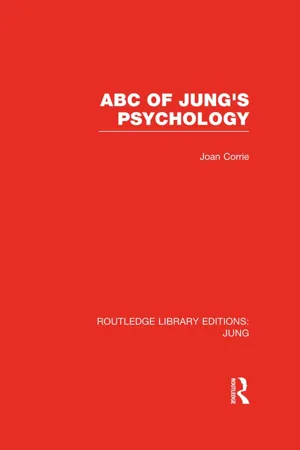
Originally published in 1927, this little book was an attempt to present to the layperson, the principal psychological views and theories of C.G. Jung. It is written in simple and nontechnical language for those less familiar with psychology and who would have found the more scientific Collected Works inaccessible. Today it can be read and enjoyed in its historical context.
- 84 pages
- English
- ePUB (mobile friendly)
- Available on iOS & Android
eBook - ePub
ABC of Jung's Psychology (RLE: Jung)
About this book
Information
CHAPTER IThe Mind and its Structure
DOI: 10.4324/9781315761220-1
The human psyche, or mind, is not a homogeneous whole. Part of it we are aware of as consciousness; the greater part we do not know at all, except through its effects, for we are not conscious of its operations. The apt simile of an iceberg has been used to illustrate this point. As is the top of an iceberg protruding one-tenth of its bulk above the surface of the water to the vast remainder sunk in the ocean depths, so is the conscious to the unconscious mind—relatively a very small thing.
The centre of consciousness, its focal point, is the ego; and consciousness is simply awareness of relations between its contents and the “I” who perceives them. It is I who am aware of the sense-perceptions, the thoughts, feelings, and memories within my field of consciousness at any given moment. Without this relatedness of the ‘I’ psychic processes may be active, but they are no longer conscious. The ego, however, is not the subject or self. That includes the entire psyche, both conscious and unconscious.
That part of the conscious mind which comes into relation with the external world is the personality, or persona 1. It is the individual's mode of adaptation to the world, his character as it appears to be and as he often himself conceives it; but it is by no means the whole of his character, for it leaves out the unconscious elements. The persona is formed by environment, by training, by all the various reactions to external reality, and by the selection of such conscious psychic elements as are consonant with the man's aim in life. When the ego is identified with the persona; i.e. when the individual regards himself as being only what he seems to be to himself and to others, his apprehension of his own nature is extremely limited and onesided, for he is in reality at once much greater—and much smaller—than he imagines. We speak of certain inconsistencies of conduct as being so ‘unlike’ a particular person. They are only unlike his usual adaptation, or persona, and are perfectly consistent with his character as a whole. This identification is very frequent, and is sometimes responsible for the tragedies which occur from time to time when some honoured name is dragged in the dust in consequence of conduct running counter to the law or to morality, and which is in opposition to the individual's life-long behaviour. Had he known more of the unconscious possibilities within him, it would probably never have happened.
The unconscious part of the psyche is divided by Jung into personal and collective. The former contains everything that has been acquired during the person's life-time which has not been retained in the conscious. Everything that he has forgotten or has repressed, i.e. intentionally put out of mind on account of its painful or unpleasant nature, is there below the threshold. The wishes which are incongruous with his character as he conceives it, or desires it to be, are in the personal unconscious, as well as whatever is unconsciously perceived, thought, or felt.
It will readily be discerned that the unconscious is thus compensatory to the conscious mind. All those elements of character which are weak or lacking in the persona are to be found in the unconscious attitude which balances it. Every exaggerated quality in the conscious will be compensated in the unconscious by its opposite. For instance, an aggressive, domineering person will be unconsciously mild, or even timid, on the other side: which is the reason why a man may be a tyrant to those who work under him and be hen-pecked at home. His overbearingness is the shield of his defence from the world. When the ascetic has succeeded in repressing the evil side of his nature, he may be assured that it is flourishing below the threshold—all the more dangerous because no longer faced consciously. For the truth is, that man by nature is neither black nor white, but grey; and he who believes that the darker shades can be eliminated by the simple process of forgetting or refusing to acknowledge them is apt to be reminded by some sudden irruption from the unconscious. The threshold is relative, and the contents below are always striving to rise into consciousness.
Unconscious motives frequently prompt actions which we consciously ascribe to quite other—and generally better—motives. These give rise to those slips of speech or action which are known as psychopathological errors. An interesting example of the former is given by Dr van der Hoop of Amsterdam in his book Character and the Unconscious.2 One of his patients who was not very well off said to him one day on leaving his consulting-room_ ‘I have no money with me to-day to pay your fee, but I will forget it next time.’ A patient of the late Dr Constance Long said to her on one occasion: ‘My illness is spoiling my life, and I don't want to get well.’ There was an unconscious motive for continuing to be ill.
I have said that the mind as a whole is not homogeneous; but when we come to the collective unconscious we come to a universal and uniform substratum common to all humanity, because it is the historical background from which every mentality has evolved. Man is the ‘heir of all the ages’ by virtue of the collective unconscious. It is the soil formed by age-long deposits of mental processes in which the roots of the psyche are deeply imbedded. It is ‘that remnant of ancient humanity and the centuries-old past in all people, namely, the common property left behind from all development which is given to all men, like the sunshine and the rain.’3 Every experience passed through by man in his long ascent from lower forms of life has left its mark in the psyche; for even as physically the germ-cells pass unchanged from one generation to another, so traces of experiences lived through ancestrally, and repeated millions of times, are imprinted in the structure of the brain, and, handed down through the centuries, reappear in dreams and in otherwise unaccountable reactions. The mind of the new-born babe is no mere tabula rasa, but contains all the potentialities derived from his heritage human and prehuman. He brings his instincts with him, for he knows as well how to nourish himself on the first day of life as on the last.
Primeval man faced by the stupendous forces of nature against which his puny strength was useless, and surrounded by objects full of awe and mystery, apprehended his world in terms of spirit, energy, gods, demons, ghosts, dragons, etc. Such images imprinted in the brain substance evolved into sun and moon-myths, vegetation-myths, myths of gods and their death and resurrection, or of fire brought from heaven—themes found everywhere among all peoples. These imprints Jung names primordial images or archetypes. They are the forms into which repeated ancestral experiences have moulded the typically human mode of apprehension. Modern man with his scientific grasp of natural law no longer has need of myth, but the images of the past survive in his unconscious, reappear in his dreams, and constantly affect his life, because, though no effort of will can bring up any part of the collective unconscious into consciousness, its contents are always striving to rise and succeeding in ways unsuspected.
Since the unconscious contains the past, it must also contain the germs of the future. All the possibilities of the individual are contained within it: some never realized, others latent until the time is ripe for their development. The inspiration of the artist, the writer, the orator, as also of the scientist himself, rises from the collective unconscious. It has forgotten nothing that has happened since Pithecanthropus (the man-ape) appeared on the earth. It is illimitable in extent. If this statement should appear to be an exaggeration, I would refer the reader to the laboratory experiments of Dr Eugene Osty of Paris and the late Dr Geley.
Further, the c...
Table of contents
- Cover Page
- Half-Title Page
- Title Page
- Copyright Page
- Title Page
- Copyright Page
- Dedication Page
- Table of Contents
- Note
- Chapter I The Mind and Its Structure
- Chapter II The Mind and Its Functions
- Chapter III The Mind and Its Disturbances
- Chapter IV The Significance of Dreams
Trusted by 375,005 students
Access to over 1.5 million titles for a fair monthly price.
Study more efficiently using our study tools.
Frequently asked questions
Yes, you can cancel anytime from the Subscription tab in your account settings on the Perlego website. Your subscription will stay active until the end of your current billing period. Learn how to cancel your subscription
No, books cannot be downloaded as external files, such as PDFs, for use outside of Perlego. However, you can download books within the Perlego app for offline reading on mobile or tablet. Learn how to download books offline
We are an online textbook subscription service, where you can get access to an entire online library for less than the price of a single book per month. With over 1.5 million books across 990+ topics, we’ve got you covered! Learn about our mission
Look out for the read-aloud symbol on your next book to see if you can listen to it. The read-aloud tool reads text aloud for you, highlighting the text as it is being read. You can pause it, speed it up and slow it down. Learn more about Read Aloud
Yes! You can use the Perlego app on both iOS and Android devices to read anytime, anywhere — even offline. Perfect for commutes or when you’re on the go.
Please note we cannot support devices running on iOS 13 and Android 7 or earlier. Learn more about using the app
Please note we cannot support devices running on iOS 13 and Android 7 or earlier. Learn more about using the app
Yes, you can access ABC of Jung's Psychology (RLE: Jung) by Joan Corrie in PDF and/or ePUB format, as well as other popular books in Psychology & Mental Health in Psychology. We have over 1.5 million books available in our catalogue for you to explore.