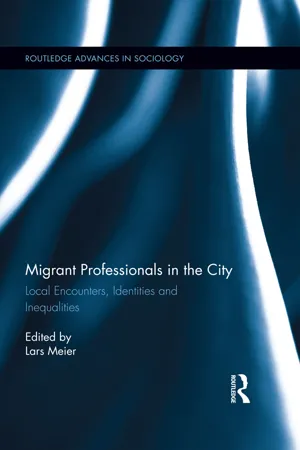
The migration of professionals is widely seen as a paradigmatic representation and a driver of globalization. The global elite of highly qualified migrants—managers and scientists, for example—are partly defined by their lives' mobility. But their everyday lives are based and take place in specific cities. The contributors of this book analyze the relevance of locality for a mobile group and provide a new perspective on migrant professionals by considering the relevance of social identities for local encounters in socially unequal cities. Contributors explore shifting identities, senses of belonging, and spatial and social inequalities and encounters between migrant professionals and 'Others' within the cities. These qualitative studies widen the understanding of the importance of local aspects for the social identities of those who are in many aspects more privileged than others.
eBook - ePub
Migrant Professionals in the City
Local Encounters, Identities and Inequalities
- 262 pages
- English
- ePUB (mobile friendly)
- Available on iOS & Android
eBook - ePub
About this book
Information
1
Introduction
Local Lives, Work and Social Identities of Migrant Professionals in the City
This book is about the local everyday life of migrant professionals. It analyzes the relevance of locality for a mobile group and considers the relevance of migrant social identities for local encounters in socially unequal cities. By doing so this book aims to provide a new perspective on migrant professionals by analyzing their local practices in specific cities and by introducing the relevance of locality for everyday practices, encounters and for identities of those too often conceptualized as a placeless elite. By grounding their everyday practices in specific cities, social and spatial inequalities within the cities become evident. This is because the different groups of migrant professionals within this book are considered as having specific identities, such as class, ethnicity and gender, that are relevant for the kind of encounters with ‘others’ and ‘other’ spaces within the cities.
The Rise of Mobility and the Migration of Professionals
The migration of qualified professionals is not a completely new phenomenon, and people such as scientists traveling between universities, highly qualified refugees fleeing from one country to another, white imperial colonizers, adventurers (Phillips 1997) or development workers come to mind. Qualified managers and engineers were actors in exploitation processes during the age of imperialism (King 1990) and in the later manufacturing work outsourced from industrial societies to developing countries in a “new international division of labor” since the 1970s (Fröbel, Heinrichs and Kreye 1980).
Today migrant professionals have transformed toward becoming a more diverse group with regard to gender, ethnicity, education, country of origin and migration destination. In general the migration of highly skilled professionals has sharply risen in the last few decades. A recent report found that in the last decade the number of tertiary educated immigrants in the Organisation for Economic Co-operation and Development (OECD) rose by 70% to 27.3 million. In 2010–2011 about 30% of all migrants in the OECD were highly educated (OECD-United Nations Department of Economic and Social Affairs [UNDESA] 2013).1
The main reasons for the migration of professionals today were identified as follows: First, intensified globalization processes and border-crossing flows; second, a general increase in formal qualifications; third, social and economic transformations in some regions due to crises; and, fourth, today’s consideration of migration as a necessary qualification and as a resource for a further career.
First, today the migration of professionals is widely seen as a paradigmatic representation and a driver of globalization. The global elite of highly qualified migrants—managers or scientists for example—are mainly defined by their mobility as being super-mobile (Elliott and Urry 2010; Birtchnell and Caletrío 2014).With their extraordinary mobility they are examples par excellence of members of today’s societies, which are considered to have developed into mobile societies (Urry 2000, 2007) because of the development of communication, transport and travel technology in an era of “flexible accumulation” (Harvey 1989). David Harvey (1989) demonstrated that such “time-space compression” is accompanied by new forms of organization and production, such as just-in-time delivery and a reduction in the turnover time of capital. The rising spatial border-crossing “spaces of flows” (Castells 1996) of capital, commodities or information are also accompanied by migration of those working as highly qualified professionals in institutions such as political organizations, universities or research centers; transnational companies; and financial institutions. Hereby this group might take responsibility for the organization of economic activities away from the headquarters of transnational companies and might be involved in training local staff.
The migration of professionals is not a one way from more to less developed regions. Saskia Sassen (1988) demonstrated that migration toward the United States often follows financial investments or military activities of the United States in other countries. Established networks of goods, information and capital between regions create networks for migration between the regions. The so-established transnational migration networks span different spatial settings and national states. While frequently moving or communicating between the localities migrants are conducting their lives in different regions and countries. This is discussed as new transnational spaces2 and as networks that span global cities (Sassen 2001) or world cities (Taylor 2004) by crossing spatial and national borders. These new types of cities are seen as the new global centers or knots in these global networks. This is mainly because the offices and headquarters of the main corporate networks are based in those cities, and global control functions are concentrated there. It was demonstrated that with an intensified space of flows, on one hand, and with the rise of importance of some urban centers, on the other, the migration of professionals particularly between, but also, in general, toward, these urban centers has risen as well (Friedmann 1995; Beaverstock 2012).
Second, another reason for the increase of migration of professionals can be found in a general increase in tertiary education levels in many countries. Thus, if, in general, the level of formal education rises in a society, it is no surprise that the level of formal education also increases for the segment of society that is migrating. This general trend toward more formal education is conceptualized on society level as a transformation to knowledge societies (Stehr 1994), in which knowledge considered useful knowledge for working in the tertiary sector of “post-industrial societies” is more valued (Bell 1974). On the level of new social groups with specific everyday practices, this is exemplified by a rise of consumption-orientated “new middle classes” (Fernandes 2006; Lange and Meier 2009) in former developing countries. However, it is a group of people more socially diverse than general classifications such as “the new rich” (Robison and Goodman 1996; Goodman 2008) imply. For instance, it was demonstrated that the consumption practices of a huge fraction of the new middle classes in Mumbai is mainly credit based (Nijman 2006). Such a credit-based rise of consumption practices, especially in housing, can be seen in many countries worldwide and is more than a symbol of the recent economic crisis.
This leads to a third reason for the recent increase in highly educated migrants. The economic crisis with a heavy rise of unemployment in many countries in southern and eastern Europe led to heavy job losses also for those employed or at least trained as tertiary-educated people and has led to a general rise in migration (OECD-UNDESA 2013). Social and economic transformations are spatially unequal and create new spatial settings with new possibilities for the employment of migrant professionals or, in the other case, spatial settings without the former employment possibilities. Even if a high formal education is the best insurance against unemployment and people with lower formal qualifications are affected much more by unemployment, the formally highly qualified are also not safe and may find better job and career possibilities in other countries. The impact of the recent economic crisis in those countries hit hardest is especially relevant for migrants, including some migrant professionals. Therefore, in some cases, a return migration might be an option for securing a better job or for general employment. A study on return migration in the enlarged European Union (EU) suggests that brain circulation between sending and receiving countries is a relevant phenomenon in the crisis because returned migrants are likely to migrate again with respect to the economic situation (Zaiceva and Zimmermann 2012).
A fourth reason for the rise in the migration of professionals is that a migration experience is today considered as more relevant and necessary as a resource and qualification for a further career. This might also include the motivation to experience something that can then be told to others in the country of origin, which helps to facilitate distinction. Distinction is an improvement of social status by attributes that are widely appreciated (Bourdieu 1984). Often, the experience of going abroad and presenting oneself as a cosmopolitan with an “openness to new experiences” (Hannerz 1996, 106) grants the migrant a certain distinction compared to those not going abroad and helps to accumulate cultural capital as an element within social stratification (the relevance of distinction is analyzed in Chapter 9 in this volume by Mulholland and Ryan).
The conditions of work have been transformed worldwide in the last few decades. The degree of transformations is disputable and Beck’s (2000) notion of a “Brazilianization of the West” with a complete move toward nonstandard work is clearly over the top, while standard employment with permanent contracts is still the norm in many countries. But, in general, reductions in standard employment with a substantial rise of rates in more flexible and precarious work forms such temporary, part-time and self-employment are evident. The rising insecurity of work and flexible project-based work (Boltanski and Chiapello 2005) is considered to have bad consequences for identity (Sennett 1998). Work life became more and more a project, the success of which was depressingly felt as being the responsibility of the individual (Ehrenberg 2010). Today the step abroad is considered a central aspect of such an individual’s career project, which will at the very least lead hopefully to professional success. With recent socioeconomic transformations, it is especially the case for highly skilled people that the experience of migration and working abroad is considered an advantage on the curriculum vitae and is therefore often actively sought.
Different Definitions and Why the Term Migrant Professionals is Used
As different as the reasons for the migration of professionals are the terms in use to characterize this group. To some extent, the different terms reflect the specific reasons for migration and often implicitly include only a specific range of migrant professionals.
In general, there is a confusion of terms for classifying the group of highly qualified migrants. In use are terms such as “expatriates” (Cohen 1977; Beaverstock 1996; Fechter 2010;; Leonard 2010; Fechter and Walsh 2012), “highly skilled migrants” (Salt 1997; Lan 2011; Eich-Krohm 2013), “skilled international migrants” (Findlay et al. 1996), “skilled migrants” (Kofman and Raghuram 2005; Scott 2006; Kennedy 2008), “transnational elite” (Beaverstock 2002; Willis et al., 2002), “transnational capitalist class” (Sklair 2001), “transnational professionals” (Nowicka 2006; Coles and Fechter 2007) or “developed world migrants” (White 1998). The differences are vague and not specified in detail. I want to specify and give the reason why the term migrant professionals is in use for this book.
A common characteristic of these terms is that they pertain to show a difference from those classed as general migrants. This difference in relation to migrants who are not highly qualified or lack a formal qualification approved and respected in the destination country is the central fact that forms this special group of migrants. It is a high, formal qualification accepted in the destination country that enables migrants to work in a suitable occupation. However, not all highly skilled migrants are lucky enough to secure a professional position suited to their qualifications. This is because some countries do not accept formal qualifications from some countries of origin, with the result of a deskilling of the migrant’s qualification. But even if the formal qualification is accepted, it is still possible that the skilled migrants will not obtain a job that fits their qualification and end up unemployed or in jobs that require only a low formal qualification. Unlike the term migrant professionals, the term skilled migrants does not differentiate this group and includes those not securing professional employment in the host country (or skilled students). As the focus in this book is on those employed as professionals, it only includes those whose formal high skill is accepted and that allows them to hold a relatively high status with an attractive social position in the host country. Unlike low-skilled migrants, this group receives preferential treatment from host countries (Yeoh 2006) and relatively liberal immigration regulations, giving them easy access to the local job market or even allowing them to bring along family members, including children and spouses, who are considered in Chapter 3 by Gabrielle Désilets and in Chapter 7 by Lisa Toccafondi Shutt (see also Arieli 2007; Coles and Fechter 2007).
As one of the main aims of their decision to migrate is to work as a professional, this group differs from those migrants considered affluent “lifestyle migrants” who migrate not for work but with the aim to enhance their quality-of-life (Benson and O’Reilly 2009).
The term expatriates also has a specific meaning and is mainly used for those skilled white “Westerners” migrating from “developed to ...
Table of contents
- Cover
- Title
- Copyright
- Contents
- Figures
- Acknowledgments
- 1 Introduction: Local Lives, Work and Social Identities of Migrant Professionals in the City
- PART I Considerations of the City
- PART II Local Incorporation and Work
- PART III Local Encounters and Identities
- Contributors
- Index
Trusted by 375,005 students
Access to over 1.5 million titles for a fair monthly price.
Study more efficiently using our study tools.
Frequently asked questions
Yes, you can cancel anytime from the Subscription tab in your account settings on the Perlego website. Your subscription will stay active until the end of your current billing period. Learn how to cancel your subscription
No, books cannot be downloaded as external files, such as PDFs, for use outside of Perlego. However, you can download books within the Perlego app for offline reading on mobile or tablet. Learn how to download books offline
Perlego offers two plans: Essential and Complete
- Essential is ideal for learners and professionals who enjoy exploring a wide range of subjects. Access the Essential Library with 800,000+ trusted titles and best-sellers across business, personal growth, and the humanities. Includes unlimited reading time and Standard Read Aloud voice.
- Complete: Perfect for advanced learners and researchers needing full, unrestricted access. Unlock 1.5M+ books across hundreds of subjects, including academic and specialized titles. The Complete Plan also includes advanced features like Premium Read Aloud and Research Assistant.
We are an online textbook subscription service, where you can get access to an entire online library for less than the price of a single book per month. With over 1.5 million books across 990+ topics, we’ve got you covered! Learn about our mission
Look out for the read-aloud symbol on your next book to see if you can listen to it. The read-aloud tool reads text aloud for you, highlighting the text as it is being read. You can pause it, speed it up and slow it down. Learn more about Read Aloud
Yes! You can use the Perlego app on both iOS and Android devices to read anytime, anywhere — even offline. Perfect for commutes or when you’re on the go.
Please note we cannot support devices running on iOS 13 and Android 7 or earlier. Learn more about using the app
Please note we cannot support devices running on iOS 13 and Android 7 or earlier. Learn more about using the app
Yes, you can access Migrant Professionals in the City by Lars Meier in PDF and/or ePUB format, as well as other popular books in Social Sciences & Emigration & Immigration. We have over 1.5 million books available in our catalogue for you to explore.