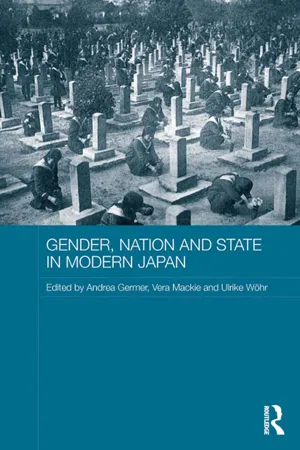
Gender, Nation and State in Modern Japan makes a unique contribution to the international literature on the formation of modern nation–states in its focus on the gendering of the modern Japanese nation-state from the late nineteenth century to the present. References to gender relations are deeply embedded in the historical concepts of nation and nationalism, and in the related symbols, metaphors and arguments. Moreover, the development of the binary opposition between masculinity and femininity and the development of the modern nation-state are processes which occurred simultaneously. They were the product of a shift from a stratified, hereditary class society to a functionally-differentiated social body. This volume includes the work of an international group of scholars from Japan, the United States, Australia and Germany, which in many cases appears in English for the first time. It provides an interdisciplinary perspective on the formation of the modern Japanese nation–state, including comparative perspectives from research on the formation of the modern nation–state in Europe, thus bringing research on Japan into a transnational dialogue. This volume will be of interest in the fields of modern Japanese history, gender studies, political science and comparative studies of nationalism.
eBook - ePub
Gender, Nation and State in Modern Japan
- 316 pages
- English
- ePUB (mobile friendly)
- Available on iOS & Android
eBook - ePub
Gender, Nation and State in Modern Japan
About this book
Information
1 Introduction
Gender, nation and state in modern Japan
Gendering the nation-state
To most people in the modern world the categories of gender and nationality seem natural and self-evident. However, historical scholarship has demonstrated that the categories of ‘gender’ and ‘nation’ are culturally constructed and historically contingent. We are now very familiar with Benedict Anderson’s oft-quoted phrase that nationalism involves the construction of an ‘imagined community’, whereby a group of people from disparate backgrounds come to imagine themselves as sharing certain characteristics and traditions which constitute their belonging to the imagined community of the nation. In a suggestive passage, Anderson (1991: 5) explains that we have a ‘nationality’ in much the same way as we have a ‘gender’: pointing to the importance of both of these categories for individual identity formation, but also suggesting the constructedness of both of these categories. Unfortunately, however, Anderson pays little attention to the ways in which gendered identities and national identities are mutually constitutive: that national identities, in other words, are experienced in gender-specific ways in different national contexts (Pierson 2000: 41; Germer 2007: 39). In this volume we explore the historical construction and mutual imbrication of the categories of nation, state and gender in modern Japan.
The nation has been described as an ‘invention’ by the state or other actors within society (Hobsbawm and Ranger 1983: 7; on Japan see Vlastos 1998; Fujitani 1996), or as ‘an imagined political community’ (Anderson 1991: 6). Others have emphasised that the nation-state is framed not merely as an inclusive entity of citizens or subjects, but also as an exclusive body defined against other nation-states, non-citizens, or non-subjects (Anthias and Yuval-Davis 1992: 4). Feminist researchers have pointed out that, in fact, nations are gendered (Blom et al. 2000) as are the roles, responsibilities and rights of its citizens or subjects. Men and women have different and unequal relationships to the nation-state. Yuval-Davis and Anthias (1989: 7) explain that women may be mobilised as the biological reproducers of ethnic collectivities, the reproducers of the boundaries of ethnic groups, participants in the ideological reproduction of culture, a focus of ideological discourses, and participants in political processes. V. Spike Peterson (1999: 34–65) reminds us that this also involves sexuality, going so far as to describe a ‘heterosexist’ state which privileges citizens who participate in a family system based on heterosexual marriage and reproduction (see also Parker et al. 1991). Mackie, among others, reminds us that looking at the gendering of the nation and the state involves looking at men and masculinity as well as at women and femininity. She modifies Yuval-Davis and Anthias’ schema to reflect this, and considers men’s roles as fathers and as the undefined ‘centre’ of ethnic collectivities, the different ways in which men and women are addressed in nationalist discourse, and the gender-specific ways in which men and women participate in political processes (Mackie 2003: 112).
All modern nation-states are gendered, and they operate according to the principles of inclusion and exclusion. Governments are interested in regulating gender relations and in the management of sexuality. Indeed, we can add that nation-states manage the physical bodies of their citizens and subjects (Foucault 1980: 138–145; Chakrabarty 1998: 295; Mackie 2003; Mackie 2010: 71–85). Although all modern nation-states are gendered, these processes are worked through in specific ways in specific times and places (Blom 2000: passim). Recent studies have begun to complicate and alter earlier gender-blind narratives of modern Japanese history (Igeta 2000; Mackie 2003; Ujiie et al. 2003; Ueno 2004; Molony and Uno 2005; Frühstück and Walthall 2011). Building on these critical studies, in this volume we pay particular attention to the distinction between nation and state, and to the transformations of the gender order during two major periods: Imperial Japan (1890–1945) and from 1945 to the present.1 These concerns are placed in a transnational frame, through a consciousness that Japan is a former colonising power, and that this history continues to shape relations between Japan and other nation-states in the region. We also provide a transnational and comparative perspective through the inclusion of Sidonia Blättler’s chapter on gender and nation in modern European history.
Nation and state
The state has been defined as a ‘set of institutions specifically concerned with the enforcement of order’ (Gellner 1983: 4), ‘possessing a legitimate monopoly of coercion and extraction in a given territory’ (Smith 2001: 12). Nations, by contrast, have been defined as ‘felt and lived communities whose members share a homeland and a culture’ (Smith 2001: 12). We can distinguish between the nation as an entity with which its citizens have an emotional or cultural identification, and the state as a series of institutions of governance. In practice, however, these dimensions are sometimes difficult to define, and scholars often refer to the hyphenated ‘nation-state’, which combines both of these dimensions. While the distinction between nation and state can help us to analyse the narratives that have shaped modern nation-states and our understanding of them, we must take care not to reify this distinction, thereby naturalising the ‘state’ or the ‘nation’, or other particular concepts of the political community.2
In the Japanese context, there is no simple congruence with discussions of the nation-state in Western languages. Kokumin-kokka is the modern term used to describe the fusion of an ethnic national identity (kokumin, literally ‘people of the nation’) and an administrative apparatus (kokka). Although both residence-based and ‘bloodline’-based definitions of the kokumin existed in modern Japan, the concept of ius sanguinis prevailed and has informed the laws regulating nationality, up to the present (Morris-Suzuki 1998: 187–192; Oguma 2002). In the late nineteenth century the Japanese nation-state was also intimately connected with a particular modern concept of the family, as evidenced by the phrase kazoku-kokka (family-state) (Gluck 1985: 265).
Following the framing of the modern Civil Code (Minpō) in the 1880s and 1890s, there were controversies about the proper form of the family, with the family law codified in the Civil Code of 1898 privileging a monogamous stem family based on patriarchy, patriliny and primogeniture (Hayakawa, Chapter 2). Family law was backed up by the family registration system (koseki). All individuals in Imperial Japan (1890–1945) were registered in a stem family based on kinship ties (unlike feudal households, which had been flexible in the inclusion of servants, adoptees or children born out of wedlock). As Shimazu reminds us, the family registration system ‘was born not in feudalism, but in modern Japan’ (1994: 86), as was the family system itself (Ueno 1994, 2009).
A distinctive feature of how nation and state were defined in modern Japan is the androgyny that was ascribed to the Emperor. The Emperor, who acquired meaning as the core of modern Japan’s national and cultural identity (Mae, Chapter 4), was perceived to embody the historical (constructed as ‘masculine’) as well as the transcendental (constructed as ‘feminine’) aspects of the nation (Morris-Suzuki 1998: 115–119; Kanō 1979: 72; Hayakawa, Chapter 2; on European gendered constructions of nation, see Blättler, Chapter 15). Accordingly, the modern Imperial gaze has been said to have been ‘ambiguously gendered’ as the ‘stare of the patriarch’ and the ‘loving look of the Mother’ (Fujitani 1996: 242). Nevertheless, in structural terms, the Emperor in Imperial Japan was the supreme patriarch and supreme military commander, ruling the nation as the head of an Imperial family based on patriliny and primogeniture. Even in post-1945 Japan, where the family has been reframed in more egalitarian terms, Imperial succession still operates according to patrilineal principles.
The Emperor’s ‘subjects’ were also constructed in gendered terms. As Japanese nouns do not have grammatical gender, the words for citizen and subject are not obviously gendered, unlike those in many European languages. Words like kokumin, shimin, shinmin can refer to both men and women. Each of these terms implies a different relationship between individual and state. In Imperial Japan, individuals were shinmin (subjects of the Emperor) or kokumin. In the Constitution of Japan of 1947, citizens are still described as kokumin, but the term shimin (citizen, literally ‘city person’) gained prevalence in civil society movements against the US–Japan Security Treaty and against polluting industries. During campaigns mounted within local communities in post-war Japan, the term jūmin (resident, denizen) also gained currency. Nevertheless, despite the apparently gender-neutral language, individuals contributed to the nation in gendered ways, whether as shinmin, kokumin, shimin or jūmin (Avenell 2008: 711–742; Koyama, Chapter 5; Wöhr, Chapter 13).
In Third World contexts, the concept of the nation and discourses on nationalism were intimately connected with the liberation from colonial domination. Japan, unlike most other Asian nations, was never formally colonised, but was coerced into signing unequal treaties with the USA and several European powers in the 1850s. These treaties were not revised until the late 1890s. However, it could be argued that Japan was still subject to various forms of cultural imperialism.3 Although national sovereignty was retained, the question of national identity was not so easily resolved, and Japan has continued to display ambivalence towards Europe and the rest of Asia.
Popular perceptions of a state-nation dualism emerged during the final decades of the nineteenth century and were coupled with anti-Western, anti-capitalist attempts to reinvent and rebuild Japan. Sustained intellectual concepts distinguishing between a ‘political state’ and an ‘ethnic nation’ provided for a cultural and ethnic nationalism (minzokushugi) as well as a narrative of internal colonisation of the Japanese people by their own state.4 This kind of thought also informed pre-war feminist positionings between the political state and the ethnic nation (Germer 2013a: 92–115).
Japan was also a colonising power. From the 1870s the boundaries of the Japanese nation-state expanded to incorporate the Ainu people of the former territory of Ezo (present-day Hokkaidō): see Kojima, Chapter 6), the people of the Ryūkyū Islands (present-day Okinawa), and then to include Taiwan (1895), Korea (1910), Pacific territories ceded from Germany at the end of the First World War (1918), the puppet state of Manchukuo (1932), and other territories on the Asian continent in the 1930s and 1940s. Accordingly, concepts of national identity were framed not only with respect to a European ‘other’, but also referenced a series of colonised ‘others’.
Militarising and colonising gender
The forcible opening of Japan in the mid-nineteenth century led to a preponderant interest in issues of national security. Military matters came to form an important focus for national policy and an important element of national identity, as reflected in the slogan fukoku kyōhei (wealthy country and strong army). This was connected with the early implementation of a policy of conscription of adult males for military service. Instead of the feudal status (mibun) system gender moved to the foreground of defining societal and civic obligations in the Meiji period (1868–1912) (Pflugfelder 2012: 963–974; Getreuer-Kargl 1997: 19–58), and universal conscription became one major regulatory factor in the emergence of a conceptually unified male subject identity (Cook 2005: 280). In the Conscription Act (Chōheirei) of 1873 military service was presented as both an obligation and a privilege (Cook 2005: 263; Rokuhara 2005: 81, 84). As Sabine Frühstück shows in Chapter 9, modern military manhood was trained through both the conscription system and the compulsory school system. At the same time, literary and other cultural images of soldiers emerged so that by the beginning of the twentieth century ‘man as soldier’ had become a key dimension of ‘the Japanese’ (Cook 2005: 260).
Male conscription contributed directly to the gendering of political participation and leadership. Nevertheless, there were competing visions of masculinity (cf. Connell 2005a: 76–81), which corresponded to competing visions of the nation: a genteel masculinity associated with the adoption of Western culture, and a more aggressive masculinity associated with what was perceived as a more authentic Japaneseness (Karlin 2002: 41–77; Roden 2005: 73–75).5 In Chapter 3 Jason Karlin examines the figure of the hero as portrayed in historical biographies and adventure novels during the Meiji period. He argues that narratives of heroism in modern Japan have often invoked a popular nationalism which celebrated defiance of state authority. As Kevin Doak (1997) has argued, concepts of cultural and ethnic nationalism initially served as both criticism and populist attack against the political state. By the 1920s, however, such concepts were also exploited by the government to promote and justify the project of Imperial Japan. Karlin shows that heroic narratives were also complicit with the project of colonisation and contributed to the construction of oppositions between Japan and its colonised others.
Whereas men contributed to the nation-state as soldiers and heroes, women were positioned as ‘reproducers of the nation’ (Anthias and Yuval-Davis 1992: 4) or, in vernacular terms, as gunkoku no haha (mothers of the military nation) or aikoku fujin (patriotic women) (Mackie 2003: 31–2, 109–110). During the Asia-Pacific War (1931–1945), young women were obliged to report for work in essential industries. As Frühstück argues in Chapter 9, however, the militarisation of women took place during the early stages of the war, and the possibility of their engaging as combatants at the front was widely addressed. Although the war effort was justified by the very gendered opposition between battle front and home front (whereby the men at the battle front protected the women and children at the home front), the association of military combat with masculinity was challenged in various ways in the final ye...
Table of contents
- Cover
- Half Title
- Title Page
- Copyright Page
- Dedication
- Table of Contents
- List of illustrations
- Acknowledgements
- List of contributors
- Series Editor’s foreword
- 1 Introduction: gender, nation and state in modern Japan
- 2 The formation of modern Imperial Japan from the perspective of gender
- 3 Narratives of heroism in Meiji Japan: nationalism, gender and impersonation
- 4 The nexus of nation, culture and gender in modern Japan: the resistance of Kanno Sugako and Kaneko Fumiko
- 5 Domestic roles and the incorporation of women into the nation-state: the emergence and development of the ‘good wife, wise mother’ ideology
- 6 The making of Ainu citizenship from the viewpoint of gender and ethnicity
- 7 The gendering of work and workers in the process of modernising the textile industry
- 8 The nation at work: gendered working patterns in the Taishō and Shōwa periods
- 9 ‘The spirit to take up a gun’: militarising gender in the Imperial Army
- 10 Women’s professional expertise and women’s suffrage in Japan, 1868–1952
- 11 From natalism to family planning: population policy in wartime and the post-war period
- 12 From mothers of the nation to embodied citizens: gender, nation and reflexive modernisation in Japan
- 13 Gender and citizenship in the anti-nuclear power movement in 1970s Japan
- 14 Salaryman anxieties in Tokyo Sonata: shifting discourses of state, family and masculinity in post-bubble Japan
- 15 Identity politics: gender, nation and state in modern European philosophy
- 16 From personal experience to political activism in the 1970s: my view of feminism
- Index
Trusted by 375,005 students
Access to over 1.5 million titles for a fair monthly price.
Study more efficiently using our study tools.
Frequently asked questions
Yes, you can cancel anytime from the Subscription tab in your account settings on the Perlego website. Your subscription will stay active until the end of your current billing period. Learn how to cancel your subscription
No, books cannot be downloaded as external files, such as PDFs, for use outside of Perlego. However, you can download books within the Perlego app for offline reading on mobile or tablet. Learn how to download books offline
Perlego offers two plans: Essential and Complete
- Essential is ideal for learners and professionals who enjoy exploring a wide range of subjects. Access the Essential Library with 800,000+ trusted titles and best-sellers across business, personal growth, and the humanities. Includes unlimited reading time and Standard Read Aloud voice.
- Complete: Perfect for advanced learners and researchers needing full, unrestricted access. Unlock 1.5M+ books across hundreds of subjects, including academic and specialized titles. The Complete Plan also includes advanced features like Premium Read Aloud and Research Assistant.
We are an online textbook subscription service, where you can get access to an entire online library for less than the price of a single book per month. With over 1.5 million books across 990+ topics, we’ve got you covered! Learn about our mission
Look out for the read-aloud symbol on your next book to see if you can listen to it. The read-aloud tool reads text aloud for you, highlighting the text as it is being read. You can pause it, speed it up and slow it down. Learn more about Read Aloud
Yes! You can use the Perlego app on both iOS and Android devices to read anytime, anywhere — even offline. Perfect for commutes or when you’re on the go.
Please note we cannot support devices running on iOS 13 and Android 7 or earlier. Learn more about using the app
Please note we cannot support devices running on iOS 13 and Android 7 or earlier. Learn more about using the app
Yes, you can access Gender, Nation and State in Modern Japan by Andrea Germer, Vera Mackie, Ulrike Wöhr, Andrea Germer,Vera Mackie,Ulrike Wöhr in PDF and/or ePUB format, as well as other popular books in Scienze sociali & Antropologia. We have over 1.5 million books available in our catalogue for you to explore.