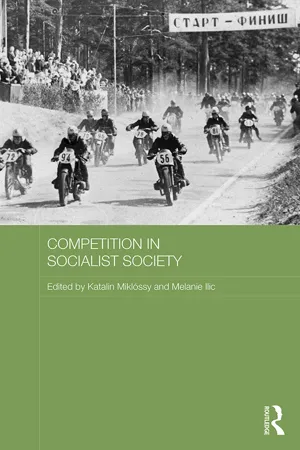
This book explores how the concept of "competition", which is usually associated with market economies, operated under state socialism in the Soviet Union and Eastern Europe, where the socialist system, based on command economic planning and state-centred control over society, was supposed to emphasise "co-operation", rather than competitive mechanisms. The book considers competition in a wider range of industries and social fields across the Soviet bloc, and shows how the gradual adoption and adaptation of Western practices led to the emergence of more open competitiveness in socialist society. The book includes discussion of the state's view of competition, and focuses especially on how competition operated at the grassroots level. It covers politico-economic reforms and their impact, both overall and at the enterprise level; competition in the cultural sphere; and the huge effect of increasing competition on socialist ways of thinking.
- 210 pages
- English
- ePUB (mobile friendly)
- Available on iOS & Android
eBook - ePub
Competition in Socialist Society
About this book
Information
1 ‘To catch up and overtake’ the West
Soviet discourse on socialist competition
In 1957, millions of Soviet citizens heard with utmost amazement the slogan proclaimed by Nikita Khrushchev ‘to catch up and overtake the United States’ (dognat’ i peregnat’ Ameriku), which promised to achieve the construction of communism in the Soviet Union in the following twenty years. Khrushchev first used this slogan at an agriculture conference on 22 May 1957 in Leningrad, where he promised to ‘catch up and overtake America in the per-capita production of meat, milk and butter’ (‘dognat’ i peregnat’Ameriku po proizvodstvu myasa, moloka i masla na dusu naseleniya’). However, the context was rarely mentioned in Soviet publications. The immediate propaganda use of Khrushchev’s slogan also disregarded the fact that it had not been approved by the Plenum of the Central Committee of the Communist Party of the Soviet Union in June 1957. Georgy Malenkov, whose criticism of Khrushchev’s intention to overtake the US was particularly harsh in referring to the state of the Soviet Union’s agricultural production, considered the project ‘unrealistic’ and ‘wrong’.1 However, Malenkov was ousted from the party’s hierarchy later that month by Khrushchev himself. Many decades later, Gorbachev raised a similar criticism when he assessed Khrushchev’s project as unrealistic.2
Khrushchev, in his time, also intended for the slogan to resonate in the Soviet economy far beyond the boundaries of the agricultural sector. At an exhibition showcasing American domestic technology in Moscow’s Sokolniki Park in summer 1959, Soviet citizens had the opportunity to become acquainted with some of the preliminary results of this competition, while receiving free samples of Pepsi-Cola.
Shortly after the American technology exposition in Moscow, Khrushchev visited the United States. In a speech broadcast on American television on 27 September 1959, Khrushchev made the following declaration:
Keep in mind that the average annual speed of industrial growth in the Soviet Union is three to five times greater than in America. Thus, in the next ten to twelve years, we will surpass the US both in absolute volume of production and in per capita production. And in agriculture this goal will be achieved significantly sooner.
During the same visit, Khrushchev touted Soviet successes in space exploration, which he openly linked to the Soviet Union’s possession of a large number of intercontinental ballistic missiles, of which, as he told the Americans, ‘you still have practically none’.3 In fact, it was precisely the success of the first Soviet Sputnik in 1957 and the first human spaceflight by Yuri Gagarin in 1961 that provided a strong stimulus for the United States ‘to catch up and overtake’ the Soviet Union in the space and arms race. For Soviet sciences, Khrushchev’s East–West competition led to a certain opening up of formerly closed domains. Thus, the international competition in the field of cybernetics urged Khrushchev to revive systems theory and the theory of scientific management developed in the 1920s by Aleksandr Bogdanov in his Tektologiya or Universal science of organization, which had been condemned by Stalin at the time because of Bogdanov’s ‘revisionism’.
During the Cold War, and particularly during Brezhnev’s period of office, when anti-American rhetoric such as ‘imperialist encirclement’ and ‘American hegemony’ was widespread in public discourse, the slogan ‘to catch up and overtake’ the West attributed to Khrushchev was heavily used for propaganda reasons. At the same time, however, it was very much ridiculed by mainstream Soviet society, where many were well aware of the fact that the Soviet Union was forced to import grain, meat and machinery from the US and Canada. Yet at the same time, nobody remembered – or wanted to remember – that the slogan ‘to catch up and overtake’ had been repeatedly employed by Stalin, who also referred to its original use by the founder of the Soviet state, Lenin himself.
A short examination of the early history of the use of the slogan will throw some light on the interconnection of socialist competition with the West and the Stalinist construction of socialism in one country, in other words – how the device of ‘learning from the enemy’ constituted an essential factor of Soviet discourse on ‘socialist competition’.
‘Russian backwardness’ and the ‘American tempo’
In the context of the Soviet Union’s forced industrialisation policy and its first Five-Year plan, launched at the end of 1928, Stalin’s address to industrial managers on 4 February 1931 made reference to ‘Russian backwardness’ and to the necessity ‘to catch up and overtake’ economically the most developed capitalist countries, and the US in particular:
To slacken the tempo [of industrialisation] would mean falling behind. And those who fall behind get beaten. But we do not want to be beaten. No, we refuse to be beaten! One feature of the history of old Russia was the continual beatings she suffered because of her backwardness. She was beaten by the Mongol khans. She was beaten by the Turkish, beaten by the Polish and Lithuanian gentry. She was beaten by the British and French capitalists. She was beaten by the Japanese barons. All beat her because of her backwardness, because of her military backwardness, cultural backwardness, political backwardness, industrial backwardness, agricultural backwardness. They beat her because to do so was profitable and could be done with impunity. You remember the words of the pre-revolutionary poet: ‘You are poor and abundant, mighty and impotent, Mother Russia’. Those gentlemen were quite familiar with the verses of the old poet. They beat her, saying: ‘You are abundant’, so one can enrich oneself at your expense. They beat her, saying ‘You are poor and impotent’, so you can be beaten and plundered with impunity. Such is the law of the exploiters – to beat the backward and the weak. It is the jungle law of capitalism. You are backward, you are weak – therefore you are wrong; hence, you can be beaten and enslaved. You are mighty – therefore you are right; hence, we must be wary of you. That is why we must no longer lag behind.
In the past we had no fatherland, nor could we have had one. But now that we have overthrown capitalism and power is in our hands, in the hands of the people, we have a fatherland, and we will uphold its independence. Do you want our socialist fatherland to be beaten and to lose its independence? If you do not want this, you must put an end to its backwardness in the shortest possible time and develop a genuine Bolshevik tempo in building up its socialist economy. There is no other way. That is why Lenin said on the eve of the October Revolution: ‘Either perish, or overtake and outstrip the advanced capitalist countries’. We are fifty or a hundred years behind the advanced countries. We must make good this distance in ten years. Either we do it, or we shall go under.4
This passage, typical of Stalin’s populist, emotional and simplifying style, reflects quite impressively the ideological climate of the industrialisation period. The ‘Bolshevik tempo’, with which he claimed to complete the first Five-Year plan ahead of time, was measured against the ‘American tempo’. Whereas in 1930 no capitalist country reported any domestic growth, the Soviet Union’s economy grew by twenty-five per cent, according to Stalin. The reality, however, was much more complex. The Soviet Union in the early 1930s depended heavily on American, German and, to a lesser degree, British and French technological ‘knowhow’. One can wonder whether Stalin used this long admonition on purpose: to belittle the dependence of the Soviet industrialisation programme on technological input from the West – the so-called ‘American connection’ (which, in fact, implied foreign technological aid) – and to stimulate the drive for the growth in domestic production.
‘We need Americanism and Marxism’
From the outset, Soviet ideology considered the US as the incarnation of capitalism. Before the 1917 revolution, Lenin, together with leading Russian socialists such as Aleksandr Bogdanov, saw in American Taylorism one of the most terrible forms of capitalist exploitation of workers by machines.5 However, the terrible experience of the First World War changed Lenin’s hostility to Taylorism. On the occasion of the ratification of the Brest–Litovsk Peace Treaty on 15 March 1918, Lenin noted that the ‘war taught a great deal’ and that ‘those who have the greatest technical equipment, organisation and discipline, and the best machines, will gain the upper hand’. Therefore, Lenin argued, ‘to live in modern society without machines, without discipline – one has either to master modern techniques or be crushed’.6 Only a few days earlier, on 11 March 1918, Lenin had defined the ‘chief task of our day’ as follows:
Yes, learn from the Germans! … It so happens that it is the Germans who now personify, besides brutal imperialism, the principle of discipline, organisation, harmonious co-operation on the basis of modern machine industry, and strict accounting and control.
And that is just what we are lacking. This is what we must learn. This is just what our revolution needs in order to pass from a triumphant beginning, through a succession of severe trials, to its triumphant goal.7
The same year, in his article The Immediate Tasks of the Soviet Government, Lenin emphasised that the realisation of socialism would be defined by the successful combination of Soviet power with the latest progress of capitalism. To accomplish this, Soviet Russia had to organise ‘the study and teaching of the Taylor system and systematically try it out and adapt it to our purposes’.8 From that point on, Taylorism was regarded by Lenin as an expression of the highest scientific achievement in opening the way towards bringing about the greatest possible rise in labour productivity. In his way, Lenin defined socialism as the ‘power of the Soviets + the order of the Prussian railways + American technology and organisation of trusts, American education, and so forth’.9 In 1920, he announced that ‘more than from other countries we will need American industrial products – locomotives, automobiles, etc.’10
During the Civil War, from the middle of 1918, according to Bailes, Lenin urged the Council of People’s Commissars, which he chaired, to ‘reintroduce labour discipline and to promote applied research and technical education’.11 One part of this programme was the recognition of American efficiency, which for Lenin meant the recognition of the value of the methods of labour and ‘scientific management’ established in the US by Ford and Taylor. The ‘capitalist’ and ‘exploitative’ elements, which formed the basis of the Ford and Taylor methods and which were heavily opposed by workers and trade unionists throughout the Western industrial world in this period, as well as by those on the European left such as Gramsci, were by now declared valid for the ‘construction of socialism’. In 1921, with Lenin’s support and in his presence, the Institute of the Scientific Organisation of Labour (NOT: nauchnaya organizatsiya truda) was founded. It was placed under the direction of Alexei Gastev, a metalworker and the most popular of the worker-poets of the early Soviet period. With the help of NOT and the parallel institution of the Central Labour Institute (CIT: tsentral’nyi institut truda), also founded in 1921 with Lenin’s strong support and placed under the control of the All-Russian Central Council of Trade Unions, the ‘applied science of labour’, labour rationalisation, ‘scientific management’, drive for efficiency and intensity on labour – in short ‘Soviet Taylorism’ – were officially recognised as the politics of labour destined to meet the Soviet Union’s supreme need for higher productivity.12 From now on, official ideology adopted positive references to the concept of ‘amerikanizm’ as a kind of ‘ideology of development’ or ‘ideology of industrialisation’. The term ‘Americanism’ became identical with labour productivity and modernisation, and the ‘American dream’ a metaphor for technology. The US, as the ‘motherland of capitalism’, was considered a paradise of machines and highly developed technology. Nikolai Bukharin, the leading theoretician of the Communist Party, claimed in 1923 that ‘we need Marxism and Americanism’.13 One year later and only several weeks after Lenin’s death, Stalin vaunted in his lectures on the Foundations of Leninism that ‘the combination of Russian revolutionary sweep with American efficiency is the essence of Leninism in Party and state work’.14 In 1924, in an article in Izvestiya, Leon Trotsky proclaimed that ‘American bolshevism will triumph and destroy imperialist Americanism’.15 This positive meaning of ‘Americanism’ and the ‘American connection’ remained valid until the 1930s. The United States was perceived as an industrial civilisation per se. Russians admired its drive and energy, its rationalism and ability to ‘get things done’, its display of power.16 The American sentiment of building a new world seemed close to Soviet Russia’s goal of building a socialist world, a vision particularly elaborated in Soviet belles lettres of the 1920s and 1930s.
Soviet prose, poetry, the arts and photography of this period reflected the attraction exercised by ‘Americanism’ on the Russian mind. Vladimir Mayakovsky, the great futurist poet of the 1920s, summarised his visit to the United States in 1925: ‘America for the USSR ...
Table of contents
- Cover
- Half Title
- Title Page
- Copyright Page
- Table of Contents
- List of illustrations
- Acknowledgements
- Notes on contributors
- List of abbreviations
- Introduction: competition in state socialism
- 1. ‘To catch up and overtake’ the West: Soviet discourse on socialist competition
- 2. Optimal planning, optimal economy, optimal life? The Kosygin reforms, 1965–72
- 3. More efficiency via democracy: debates over reforming the GDR
- 4. The Kirov fishing kolkhoz: a socialist success story
- 5. Selling fashion to the Soviets: competitive practices in Polish clothes export in the early 1960s
- 6. Hotel Intercontinental in Bucharest: competitive advantage for the socialist tourist industry in Romania
- 7. Competing for popularity: song contests and interactive television in communist Hungary
- 8. The World Youth Festival as an arena of the ‘cultural Olympics’: meanings of competition in Soviet culture in the 1940s and 1950s
- 9. Mole holes in the Iron Curtain: the success story of the Krtek animated films
- 10. Women and competition in state socialist societies: Soviet beauty contests
- 11. Concluding remarks: typology and consequences of competition
- Bibliography
- Index
Trusted by 375,005 students
Access to over 1.5 million titles for a fair monthly price.
Study more efficiently using our study tools.
Frequently asked questions
Yes, you can cancel anytime from the Subscription tab in your account settings on the Perlego website. Your subscription will stay active until the end of your current billing period. Learn how to cancel your subscription
No, books cannot be downloaded as external files, such as PDFs, for use outside of Perlego. However, you can download books within the Perlego app for offline reading on mobile or tablet. Learn how to download books offline
Perlego offers two plans: Essential and Complete
- Essential is ideal for learners and professionals who enjoy exploring a wide range of subjects. Access the Essential Library with 800,000+ trusted titles and best-sellers across business, personal growth, and the humanities. Includes unlimited reading time and Standard Read Aloud voice.
- Complete: Perfect for advanced learners and researchers needing full, unrestricted access. Unlock 1.5M+ books across hundreds of subjects, including academic and specialized titles. The Complete Plan also includes advanced features like Premium Read Aloud and Research Assistant.
We are an online textbook subscription service, where you can get access to an entire online library for less than the price of a single book per month. With over 1.5 million books across 990+ topics, we’ve got you covered! Learn about our mission
Look out for the read-aloud symbol on your next book to see if you can listen to it. The read-aloud tool reads text aloud for you, highlighting the text as it is being read. You can pause it, speed it up and slow it down. Learn more about Read Aloud
Yes! You can use the Perlego app on both iOS and Android devices to read anytime, anywhere — even offline. Perfect for commutes or when you’re on the go.
Please note we cannot support devices running on iOS 13 and Android 7 or earlier. Learn more about using the app
Please note we cannot support devices running on iOS 13 and Android 7 or earlier. Learn more about using the app
Yes, you can access Competition in Socialist Society by Katalin Miklóssy,Melanie Ilic in PDF and/or ePUB format, as well as other popular books in Social Sciences & Ethnic Studies. We have over 1.5 million books available in our catalogue for you to explore.