![]()
ABYSSINIA
T
HE descriptions of Ethiopia given by Homer, Herodotus, Diodorus, Strabo and Pliny make it quite clear that they indicated by this name the vast tracts of country in Asia and Africa that were inhabited by dark-skinned and black-faced peoples. These they divided into two groups, Eastern Ethiopians and Western Ethiopians; the former lived in Arabia, Syria, Mesopotamia and India, and the latter in the regions west of the Red Sea, Egypt, and the Sudan. The object of this book is not to deal with all the countries and peoples of “Ethiopia,” but only with two of its countries and their peoples, viz. Kūsh and the Kūshites,
i.e. Nubia and the Nubians, and Abyssinia and the Abyssinians. In the preceding section it has been shown that the Semites of Western Asia knew the position of Kūsh to the south of Egypt, but whether they considered it to be a part of Ethiopia is uncertain. The translators of the Bible into Greek identified Kūsh with Ethiopia (
e.g. in Psalm lxvii. 23, where the Hebrew
is rendered by Αἰθιοπία), and they, like the classical writers mentioned above, apparently knew nothing of Abyssina, or its position, or its people. The name of Ethiopia was definitely given to Abyssinia by those who translated the Bible from Greek into “Ethiopic,”
i.e. Gĕ‘ĕz, and the Hebrew word Kūsh is translated by ’Ītĕyōpĕyā
or Ethiopia. And to this day the Abyssinians call their country Ethiopia, and this name for it appears in the Amharic version of the Scriptures. The old Gĕ‘ĕz version was begun at Aksum, probably soon after the introduction of Christianity into the country. But the region in which Aksum was situated must have had a native name by which it was known to the nations around, and this name was
Habesh, from which the name Abyssinia is derived. The Aksūmites preferred to call their country Ethiopia, and not Habesh, for to them Ethiopia was Kūsh, and the Kūshites had, after their conquest of the Negro tribes, made themselves masters of the greater part of north-east Africa, with perhaps the exception of Egypt. The name of Habesh is derived from that of the Semitic tribe called
Ḥabashat,
, which was one of the most important of the Semitic tribes that crossed the Red Sea from South Arabia, and settled in Africa. Rossini has shown that the original home of the Ḥabashat was Yaman in western South Arabia near the coast of the Red Sea (“Sugli Ḥabashat” in the
Rendiconti della R. Α. dei Lincei, Rome, 1906), and this view is accepted by Enno Littmann (
Deutsche Aksum-Expedition, Berlin, 1913, Bd. I. p. 41). But the Ḥabashat were foreigners, and appear to have been regarded with no great favour by the native population, though they brought with them a civilization which was superior to their own. The name
Habashā is given in modern Amharic dictionaries, and Guidi says it takes the place of the “denominatione nationale ’Ītĕyōpĕyā,” and thinks that it is a very old equivalent for “Abyssinians” (see
Nuova Antologia, 16 Giugno, 1896), and d’Abbadie (
Dictionnaire, Paris, 1881, col. 9) says that this name of Ethiopia is only used by a small number of natives who can speak a little Arabic, but who do not know that it is “injurieux.” It is possible that Habesh represents a very old name of Abyssinia, and some Italian authorities (
e.g. Dr L. de Castro,
Nella Terra dei Negus, Milan, 1915, vol. I. p. 79) think it may mean “bastards,” whilst others are inclined to connect it with the Amharic
wāshā a “cave”’ or “cavern.” There were, as there still are, dwellers in caves in Abyssinia, but it is difficult to see how Habesh can be derived from wāshā. Strabo and others speak of Troglodytes or men who take refuge in caves, but these cannot have been the cave-men of Abyssinia, for Strabo had no knowledge of the existence of Abyssinia. They are far more likely to have been the hill folk to which the Egyptians gave the name of Antiu
and against whom they fought frequently. There is no doubt, for all the authorities agree on this point, that if a native be called “Habashiyy”
he feels insulted, and that it is regarded by the natives generally as an abusive epithet, and a word indicative of the contempt of the speaker for the physical or mental defects of the man whom he addresses. On the other hand the word may only have the general meaning of “common folk,” like the Assyrian
amelu khu-ub-shi, with which, I am informed by Mr Sidney Smith, it has been compared. One thing is certain, namely, that as early as the 4th century of our era Ḥabashat was recognized as a name of Ethiopia.
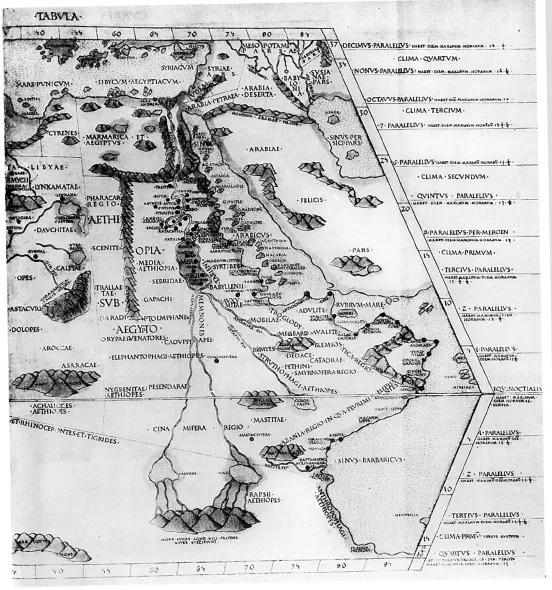
MAP OF EGYPT AND ETHIOPIA ACCORDING TO PTOLEMY THE GEOGRAPHER, SHOWING THE TWO GREAT CENTRAL AFRICAN LAKE, THE MARSHES OF THE NILE AND THE MOUNTAINS OF THE MOON
The extent of Ethiopia-Abyssinia in ancient days is unknown, but according to native tradition it included all the country lying between the Nile and the Red Sea, and from Northern Nubia to the Equator or beyond. Its boundaries on the north and south varied from time to time, especially in the south, and in the Middle Ages disputes over the boundaries, which were frequently followed by wars, were of frequent occurrence. The authority of the Abyssinians over the western coast of the Red Sea must always have been of a shadowy character. The country of Abyssinia is bounded on the north and north-west by Nubia and the Egyptian Sudan; on the north and north-east by the Italian Eritrea, French Somaliland and English Somaliland; and on the south by British East Africa. By a treaty made at Addis Ababa on 15 May, 1902, the frontier between the Sūdān and Abyssinia is marked by a line drawn from Khor Um Hagar (I give the names as spelt by Gleichen) to Galabat, to the Blue Nile, Baro, Pibor, and Akobo rivers, to Helile, thence to the intersection of the 6° north latitude with the 350 longitude east of Greenwich. Menyelek II engaged himself not to construct or allow to be constructed any work across the Blue Nile, Lake Tsānā, or the Sobat river which would arrest the flow of their waters into the Nile, except in agreement with H. B. M.’s Govt, and the Govt, of the Sūdān. He also agreed to the formation of a commercial station in the neighbourhood of Itang on the Baro river, and granted to the British Govt, the right to construct a railway through Abyssinian territory to connect the Sūdān with Uganda. The western frontier of Abyssinia continues from the 6° north latitude, where it intersects the 35° longitude east of Greenwich, towards the south and follows the right bank of the Orno river to Lake Rudolph, and the eastern shore of this lake as far as the 3° north latitude, where the limit of Abyssinia comes to an end. On the east this portion of Abyssinia is bounded by the Italian settlement of Benadir. Thus Abyssinia has lost its sea-coast.
The area of Abyssinia, like its frontiers, has varied considerably from time to time. According to some authorities the country extended from the 7°–17° north latitude in 1868, and from the 33° to the 40° east longitude. But Menyelek II added much territory to his kingdom, and at the present time Abyssinia, as a political kingdom delimited by treaties made between its king and England, France and Italy, extends from the 3° to the 15° (or 16°) north latitude, and from the 35° to the 42° east longitude. The country is somewhat triangular in shape, the narrowest part, which is in the north, being about 300 miles from east to west, and the broadest part, which is in the south, being between 900 and 950 miles from east to west. The area of this triangle was given in 1868 as about 500,000 square kilometres, but now as a result of the additions to the territory of the kingdom it may be said to be about 550,000 square kilometres. Naturally no exact figures can be given, for the country has never been surveyed as a whole.
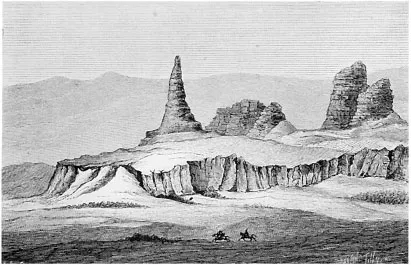
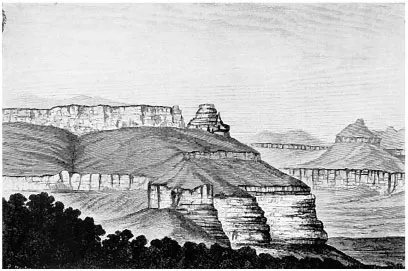
ABYSSINIAN MOUNTAINS WITH “AMBĀS” ‘NEAR ADUA. THE TOWNS AND VILLAGES ON THESE WELL-NIGH INACCESSIBLE MOUNTAINS ARE OFTEN TURNED INTO FORTRESSES, FROM WHICH THE INHABITANTS ARE ABLE TO DEFY THE GOVERNMENT WITH IMPUNITY
FROM THE DRAWING BY A. RAFFRAY (“ABYSSINIE,” PARIS, 1880)
VIEW OF THE FLAT-TOPPED MOUNTAINS OF SAKA AND AMBĀS IN THE COUNTRY OF THE ’ĀGĀW, AND OF A PORTION OF THE TALLARĒ VALLEY
FROM THE DRAWING BY A. RAFFRAY (“ABYSSINIE,” PARIS, 1880)
Divisions of Abyssinia. Travellers and others state that the country is divided into Kingdoms and Provinces. De la Croix enumerates 10 Kingdoms and 10 Provinces; the former are Tigré, Dambia, Begamder, Gojam, Amhara, Enarya, Shoa, Angot, Damot-Dari and Damot-Adari: the latter are Mangasha, Salam, Wagara, Abba-Gale, Walqait, Sagad, Samien, Sloa, Walaga, and Deba. Ludolf mentions 9 Kingdoms and 5 Provinces, and Bruce found there were 4 Kingdoms, viz. Tigré, Amhara, Shoa and Gojam, and 19 Provinces. In Tigré were Enderta, Antalen, Siray, Bahr-Negus and Tigré (Tigray), and in Amhara and other parts of the country were Samien, Waldabba, Begamder, Walaku, Dambia, Damot, Agaumder, Kuara, Enarya, Rās al-Fïl, Thyelga, Sakahala, Guto and Lasta. Salt mentions 3 Kingdoms only, Tigré, Amhara and Shoa. Kingdoms were governed by hereditary feudal chiefs, the king being their overlord, and the Provinces were the possessions or estates of the king. At the present time the Kingdoms are divided into provinces and districts, some of which are governed by hereditary tribal chiefs, each of which has the title “Rās,” and some by officials of various grades and titles. The three kingdoms to-day are Tigray, Amhara and Shoa. In ancient times Tigray in northern Abyssinia was the most important of the three kingdoms, for in it was situated the town of Aksūm (identified by some with the Tηνεσίς of Strabo), which was not only the religious centre of the country, but the capital of the Kingdom. Its seaport was Adulis, the modern Zullah, and it was a rich and prosperous town; in later times it lost its importance, and Adua became the capital. The present capital is Makalay. The principal Provinces of the Kingdom are Ader (capital Adigrat), Antalen, Aruemder, Arsay, Ashangay, Bagalay, Bahr-Negus (capital Digsa), Enderta (capital Makalay, and chief towns Tehelikot and Antalu), Yambela, Gheralta (capital Auzen), Lasta (capital Sakota, chief town Lalibala), Mangasha, Sagad, Salam, Saruy, Shoa, Sorat, Tembien, Tigray Makonen (capital Adua), and Zeluay.
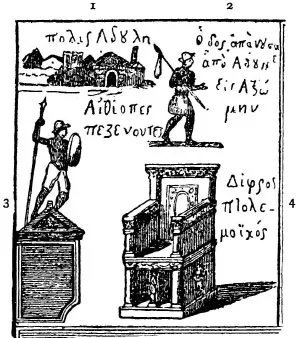
A plate from the XPIΣTIANIKH TOПOГPAϕIA of Cosmas, an Egyptian Monk. Reproduced from the translation by J. W. McCrindle (Hakluyt Society No. XCVIII) London, 1897.
1. The City of Adulē.
2. An Ethiopian travelling from Adulē to Axōmē.
3. The stele with the Greek inscription copied by Cosmas. Above it is a figure of Ptolemy Euergetēs, armed with spear and shield and standing in a warlike attitude.
4. The throne which was ascribed to Ptolemy Euergetēs by Cosmas, but erroneously. The inscription reads ΔίΦρος Πτλεμοϊκός, “Ptolemy’s Chair.”
Amhara, in Central Abyssinia, capital Gondar, which was for many centuries the capital of the whole of Abyssinia, has about 20 Provinces, the most important of which are: Abba-Galay, Alafa, Amhara, Angot, Armathyoho, Athyefer, Begamder (capitals Dabra Tabor, the residence of King John, and Samara, the residence of King Theodore), Gon...