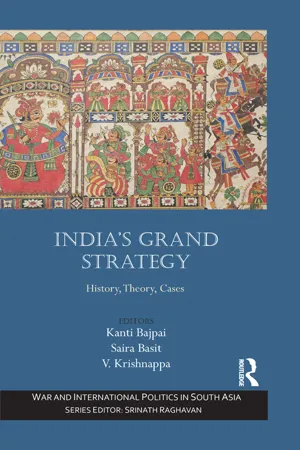
As India prepares to take its place in shaping the course of an 'Asian century', there are increasing debates about its 'grand strategy' and its role in a future world order. This timely and topical book presents a range of historical and contemporary interpretations and case studies on the theme. Drawing upon rich and diverse narratives that have informed India's strategic discourse, security and foreign policy, it charts a new agenda for strategic thinking on postcolonial India from a non-Western perspective. Comprehensive and insightful, the work will prove indispensable to those in defence and strategic studies, foreign policy, political science, and modern Indian history. It will also interest policy-makers, think-tanks and diplomats.
- 596 pages
- English
- ePUB (mobile friendly)
- Available on iOS & Android
eBook - ePub
About this book
Information
PART I
GRAND STRATEGY IN
INDIAN HISTORY
1
‘GRAND STRATEGIC THOUGHT’ IN THE RAMAYANA AND MAHABHARATA

Most Indians inherit a rudimentary knowledge of the Ramayana and Mahabharata stories as part of their cultural DNA. Multiple literary versions thrive, as do oral narrations, at least as numerous as have been Indians themselves through history. Indian politics too uses the vocabulary of the epics – from ramarajya, to describe an ideal polity, to Kurukshetra, to metaphorically describe battlefields in electoral and ideological contexts – as well as stories and characters from the epics feature in polemics and analyses. The significance of the epics extends to all spheres of social life in India, particularly statecraft, since the protagonists were born into princely families and their alienation and accession to power were central elements of the plots of both epics. It is both interesting and useful, therefore, to ask: What was India’s ‘grand strategic thinking’ as revealed in the epics? In answering this question, this chapter explores several related ideas in the context of the Ramayana and the Mahabharata to illuminate the values, worldview and codes of their characters.
Grand Strategic Thought and the Indian Epics: Analytical Challenges
What is grand strategic thought? A simple working definition is surprisingly elusive, in spite of tomes being published on strategy, strategic culture and national strategy. The search for one leads in many directions.1 The architects of this project define grand strategy as the combination of resources a government uses – military, diplomatic, economic, cultural, and political – to achieve the ends of security, however the latter is defined by that society. In the absence of a suitable working definition of ‘grand strategic thought’, this chapter will use the following definition: ‘Grand strategic thought’ refers to the ideas and assumptions drawn from a broader base of values, experiences and preferences that inform a state’s policies, choices, resource use and approach to the world outside in its quest for security.
Concepts and ideas are particular to time and space. Can one take a concept that is the product of a particular historical moment and cultural context to an entirely different time – even mythical time – and space?
Most of the discussion of strategic thought begins with Clausewitz, who belonged to the age of the French Revolution, the Napoleonic wars and the Congress of Vienna. Nation-states in Europe at that time were redefining their boundaries and consolidating their jurisdictions. This situation is similar to that of Asia and Africa in the second half of the 20th century, when modern nation-states came into being in these continents. ‘Strategic’ is applied most often to national armies, ‘strategic culture’ is bound by national borders, and ‘grand strategic thought’ refers to the achievement of state objectives. It is hard to apply these conceptual terms to the mythical age of the epics. In the epics, there are no modern nation-states and there is no well-mapped global cartographic imagination. Both the epics revolve around dharma, the politics of family and the politics of honour; and conflict has more to do with restitution of rights than conquest or domination alone. The quest for suzerainty takes a ritual rather than a purely military form.2
It is also difficult to find an equivalent phrase for ‘strategic thought’, one that holds true across time, space and language. ‘Security’ is one example; but the debate on the meaning of ‘security’ has lent enough clarity to the multiple but valid understandings of the term so that it is possible to operationalise its meaning if not find and use its exact translation in Indian languages.3
Finally, there is the question of whether the ideas of ‘strategy’ and ‘grand strategic thought’ are at all relevant to a globalised world of constant flows – of people, information, money, goods and weapons – that have eroded state monopolies on all three dimensions of order, welfare and legitimacy. Who will make and enforce strategy, for what ends and, indeed, against whom or what?
Ironically, this last issue is what still makes the topic of this chapter interesting. Today’s world, in many ways, resembles the world of the epics more than it does the classical Westphalian world on which strategic studies are predicated. The nature and power of the state is as variable today as it was in the polities described in the Ramayana or the Mahabharata, depending on the ruling elite and the first or one among many institutions and collectives, which are becoming as important as they were in the epics. People wandered between polities, then as now. Today, lines between communities are blurred (which they have always been), but in the world of the epics, the lines were blurred between species too – which may also resemble our growing ecological consciousness. The ability to communicate across the globe existed then as well because the epics were predicated on a bounded universe, but technology has enabled that today and in some ways our world is as small or as large as that of the Ramayana and the Mahabharata. We are as closely linked as the world of the Mahabharata where the war between cousins drew the world into its ambit. Finally, although prevailing moral standards are arguably lower in today’s world, there is a growing consensus on norms and demand for an enforceable morality in politics and government that resonates across contemporary and mythical universes.
The Epics: A Brief Introduction
The Ramayana and the Mahabharata are the two major pan-Indian epics, alive in as many versions as there have been Indians and recounted in daily life, teaching and celebration, through every narrative and art form. Protagonists in both the epics are from the warrior/ruler caste and, therefore, statecraft, politics and conflict form a significant, even central, thread of both narratives although interpersonal factors move the stories forward. This makes the epics an important resource for the study of Indian political ideas, and their continuing relevance is reflected in the use of tropes like ramarajya in contemporary politics.4
THE RAMAYANA
Dasharatha of Ayodhya was childless but, through the performance of a ritual, was blessed with four incomparable and virtuous sons. From an early age, the best of teachers came their way and they learnt both how to use weapons and, more importantly, why and when to use them – to defend the good and the righteous. Even as youth, they were sent to the peripheries of their kingdom to offer protection to ascetics for the completion of important rituals. On the way back to Ayodhya, Rama won the hand of Sita, the princess of Mithila, in a competition to find her a suitor. His brothers also married Sita’s cousins.
As Rama stepped out of his student life into that of a householder, it was deemed appropriate to formally anoint him the heir-apparent. The politics of Dasharatha’s polygamous household decided otherwise. Rama was exiled in fulfillment of a long-forgotten promise and Dasharatha’s second son (by another wife) took his place. Rama, Sita and his brother Lakshmana left for the forest; Rama, in order to keep his father’s word, Lakshmana, to serve his older brother and Sita, to stay with her husband. Their forest sojourn was idyllic, and they spent time with forest-dwelling sages and ascetics. Their exile did not absolve them of their duty to protect, and they found many occasions to use the arms they carried with them.
A chance encounter altered the tenor of their exile and set the stage for the dramatic culmination both of the epic and, in some versions, the purpose of Rama’s life. Shoorpanakha, who was the sister of the king of Lanka, saw Rama in the forest and propositioned him. Rama and Lakshmana toyed with her, sending her back and forth between them, each suggesting the other as more suitable for her. Stung, furious, Shoorpanakha considered Sita to be the reason for her rejection and went on to attack her, whereupon the brothers severed her nose and ears (and in the classic Tamil version, her breasts as well) as retribution. Disfigured and insulted, Shoorpanakha urged her brother, Ravana, to avenge her humiliation. Hostilities came to a head with Sita’s abduction by Ravana. She was held captive in a grove while being alternately threatened and entreated to submit to his advances.
The next trajectory of Rama and Lakshmana’s journey was southward, in search of Sita. En route, they befriended and allied with a community of vanaras (forest-dwellers, commonly depicted as monkeys). One of them, Hanuman, located Sita and tried to negotiate her release, but was insulted and his tail was set on fire. He then used that to burn down Lanka. The vanaras formed Rama’s army and they marched south together. The bridge to Lanka was built with the help of animals and birds, who came to serve the righteous prince.
The next chapter is actually called Yuddha Kanda or ‘War Chapter’. When all diplomatic missions failed, Ravana’s brother defected and sought protection in Rama’s camp. For 10 days, the two sides warred, incurring heavy losses. Finally, Rama’s army won and Ravana was killed. Sita was put through an ordeal of fire to test her chastity before she could return to Rama’s side. By this time, the period of exile had ended too, and Rama returned to Ayodhya where his brother had been his regent.
There is a post-script to this story, a later addition infamous for Sita’s return to exile. We are told that Ayodhya under Rama’s rule enjoyed a utopian idyll, made possible by his perfect adherence to dharma. On hearing that one of his subjects had cast aspersions on his wife’s fidelity during her captivity in Lanka and, by extension, on his ability to place righteousness above his affections, Rama exiled Sita although she was pregnant. In this version, the epic ends with his reunion with his sons, while Sita chooses to leave him rather than prove her chastity all over again.
The standard, some would say original, version of the Ramayana is the one recorded by Valmiki though other versions too have been influential in the linguistic regions to which they belonged – such as the Tamil Ramayana by Kambar, the Bengali Ramayana by Krittibasa or the Hindi Ramcharitmanas by Tulsidas. Details of the story vary, but the main elements of the plot remain the same and if there are small shifts in perspective, the characters remain more or less the same. This paper draws primarily on the Valmiki Ramayana, in its best-selling translation by the Gita Press.5
THE MAHABHARATA
The Mahabharata is a far more complex story than the Ramayana, encompassing many other stories (including that of Rama) and containing cross-references to virtually all of India’s mythological heritage. At its core, it is the story of Bharata’s dynasty and of the internecine rivalry that brought virtually the entire subcontinent to war. The summary in this section cannot do justice to the richness of the epic, which is not merely a single text but an entire tradition in itself.
As the story unfolds, succession to the Kuru throne is complicated in every generation for one reason or another, starting with Yayati who gave the bulk of his kingdom to the one son who would trade his youth for Yayati’s premature ageing. Shantanu promised Satyavati that the sons she bore him would succeed him, and not his first-born. The latter gave up his claim to the throne out of deference to his father’s promise, and also promised not to marry and have children of his own. Bheeshma, as he came to be known, found wives for his brothers and supervised the raising of the children they begot. The elder son, Dhritarashtra, was blind and unable to rule. So, the younger son, Pandu, inherited the throne out of turn, although he was too feeble to live a full life, and eventually was succeeded by Dhritarashtra himself. Dhritarashtra had a 100 sons and Pandu had five.
Raised together, but with the knowledge of their comp...
Table of contents
- Cover
- Half Title
- Title Page
- Copyright Page
- Table of Contents
- Foreword
- Acknowledgements
- Introduction: India’s Grand Strategic Thought and Practice
- Part I: Grand Strategy in Indian History
- Part II: Grand Strategy in Modern India
- Part III: Grand Strategy: Core Interests and Vital Peripheries
- Bibliography
- About the Editors
- Notes on Contributors
- Index
Trusted by 375,005 students
Access to over 1.5 million titles for a fair monthly price.
Study more efficiently using our study tools.
Frequently asked questions
Yes, you can cancel anytime from the Subscription tab in your account settings on the Perlego website. Your subscription will stay active until the end of your current billing period. Learn how to cancel your subscription
No, books cannot be downloaded as external files, such as PDFs, for use outside of Perlego. However, you can download books within the Perlego app for offline reading on mobile or tablet. Learn how to download books offline
Perlego offers two plans: Essential and Complete
- Essential is ideal for learners and professionals who enjoy exploring a wide range of subjects. Access the Essential Library with 800,000+ trusted titles and best-sellers across business, personal growth, and the humanities. Includes unlimited reading time and Standard Read Aloud voice.
- Complete: Perfect for advanced learners and researchers needing full, unrestricted access. Unlock 1.5M+ books across hundreds of subjects, including academic and specialized titles. The Complete Plan also includes advanced features like Premium Read Aloud and Research Assistant.
We are an online textbook subscription service, where you can get access to an entire online library for less than the price of a single book per month. With over 1.5 million books across 990+ topics, we’ve got you covered! Learn about our mission
Look out for the read-aloud symbol on your next book to see if you can listen to it. The read-aloud tool reads text aloud for you, highlighting the text as it is being read. You can pause it, speed it up and slow it down. Learn more about Read Aloud
Yes! You can use the Perlego app on both iOS and Android devices to read anytime, anywhere — even offline. Perfect for commutes or when you’re on the go.
Please note we cannot support devices running on iOS 13 and Android 7 or earlier. Learn more about using the app
Please note we cannot support devices running on iOS 13 and Android 7 or earlier. Learn more about using the app
Yes, you can access India’s Grand Strategy by Kanti Bajpai,Saira Basit,V. Krishnappa in PDF and/or ePUB format, as well as other popular books in Politics & International Relations & World History. We have over 1.5 million books available in our catalogue for you to explore.