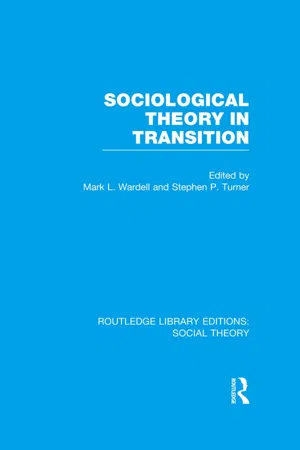
Current sociological theories appear to have lost their general persuasiveness in part because, unlike the theories of the 'classical era', they fail to maintain an integrated stance toward society, and the practical role that sociology plays in society. The authors explore various facets of this failure and possibilities for reconstructing sociological theories as integrated wholes capable of conveying a moral and political immediacy. They discuss the evolution of several concepts (for example, the social, structure, and self) and address the significant disputes (for example, structuralism versus humanism, and individual versus society) that have dominated twentieth-century sociological thought. Their ideas and analyses are directed towards an audience of students and theorists who are coming to terms with the project of sociological theory, and its relationship with moral discourses and political practice. The authors of these essays are sociological theorists from the United States, the United Kingdom and Canada. They are all established, but not 'establishment' authors. The book contains no orthodoxies, and no answers. However, the essays do contribute to identifying the range of issues that will constitute the agenda for the next generation of sociological theorists.
eBook - ePub
Sociological Theory in Transition (RLE Social Theory)
- 188 pages
- English
- ePUB (mobile friendly)
- Available on iOS & Android
eBook - ePub
Sociological Theory in Transition (RLE Social Theory)
About this book
Information
Sociological Theory in Transition
edited by
Mark L. Wardell
Stephen P . Turner
Boston
ALLEN & UNWIN
London Sydney
This volume © M . L. Wardell and S. P. Turner, 1986
This book is copyright under the Berne Convention. No reproduction
without permission. All rights reserved.
without permission. All rights reserved.
Allen & Unwin, Inc.,
8 Winchester Place, Winchester, Mass. 01890, USA
George Allen &. Unwin (Publishers) Ltd,
40 Museum Street, London WC1A 1LU, UK
40 Museum Street, London WC1A 1LU, UK
George Allen Unwin (Publishers) Ltd,
Park Lane, Hemel Hempstead, Herts HP2 4TE, UK
Park Lane, Hemel Hempstead, Herts HP2 4TE, UK
George Allen Unwin Australia Pty Ltd,
8 Napier Street, North Sydney, NSW 2060, Australia
8 Napier Street, North Sydney, NSW 2060, Australia
First published in 1986
British Library Cataloguing in Publication Data
Sociological theory in transition.
1. Sociology
I. Wardell, Mark L. II. Turner, Stephen P.
301′.01 HM24
ISBN 0-04-301205-1
ISBN 0-04-301206-X Pbk
Set in 10 on 11½ point Goudy
by V & M Graphics Ltd, Aylesbury, Bucks
and printed in Great Britain
by Mackays of Chatham
Contents
- Acknowledgements
- Preface Derek Phillips
- PART I
- Introduction: Dissolution of the Classical Project Mark L. Wardell and Stephen P. Turner
- PART II NARROWING OF SOCIOLOGICAL DISCOURSE
- 1 Sociological Nemesis: Parsons and Foucault on the Therapeutic Disciplines John O’Neill
- 2 Sociological Theory and Practical Reason: the Restriction of the Scope of Sociological Theory Nico Stehr
- 3 State, Ethics and Public Morality in American Sociological Thought Arthur J. Vidich and Stanford M. Lyman
- PART III TRADITIONS IN DISSOLUTION
- 4 Sociological Theory and Politics Peter Lassman
- 5 Morality, Self and Society: the Loss and Recapture of the Moral Self Ellsworth R. Fuhrman
- 6 The Concept of Structure in Sociology David Rubinstein
- 7 The Dissolution of the Social? Scott Lash and John Urry
- PART IV PRACTICE AND THE RECONSTRUCTION OF SOCIOLOGICAL THEORY
- 8 Actors and Social Relations Barry Hindess
- 9 Human Rights Theory and the Classical Sociological Tradition Ted R. Vaughan and Gideon Sjoberg
- 10 Hermeneutics and Axiology: the Ethical Content of Interpretation Alan Sica
- PART V
- Epilog Stephen P. Turner and Mark L. Wardell
- References
- Index
Acknowledgements
The quotation from the Bernard Papers is included with the permission of Jessie Bernard and the University of Chicago Library, which we gratefully acknowledge. We are also pleased to express our appreciation for the assistance of Shanti Jayanayagam in the preparation of the manuscript; and to our wives, Hersha Evans-Wardell and Summer Turner.
Preface
In their everyday lives, sociologists often judge various institutional arrangements as good or bad, right or wrong, just or unjust. Further, they discuss, debate, argue and involve themselves in trying to improve the quality of various arrangements. Paradoxically, however, sociology as a discipline is characterized by methodological prohibitions regarding moral commitments and value-judgments. Normative pronouncements by sociologists – in their role as scientists – are to be strenuously avoided.
This emphasis on value-neutrality is widely shared among sociologists. Insisting that the dichotomy between the ‘is’ and the ‘ought’ must be maintained, they claim that only judgments concerning the regularities of empirical phenomena can be true or false, while those judgments pertaining to the normative sphere cannot be considered in this manner. Sociology must be either analytic or empirical and descriptive, but never moral and prescriptive. In a discipline characterized by value-neutrality, then, sociologists are expected to behave as if they were moral skeptics, uncommitted to any specific moral viewpoint. Thus, they stand mute in regard to questions about the most just or humane social organization of society.
Sociologists not only view normative concerns as out of bounds as concerns their own work, they also reject the very possibility of anyone providing answers to questions of a normative nature. Value-judgments are seen as outside the realm of rational inquiry. There is, from this point of view, no way of offering a rational or ‘scientific’ justification for particular conceptions of right or wrong, good or bad, just or unjust. Like Pascal, who observed that ‘What is truth on one side of the Pyrennes is error on the other’, most sociologists believe that normative judgments are not capable of truth or falsity. Thus, questions about the moral standing of a society, or of its political, economic and social institutions, are held to be unanswerable. According to the dominant view in sociology, then, nothing can be said about the justice or injustice of particular patterns of distribution regarding income, housing or health care, or about the legitimacy of one or another political or legal system.
It is probably not surprising that sociologists hold such views about value-judgments and normative theorizing. After all, there was also a long period during which philosophers in the dominant analytic tradition insisted that the normative must be rigidly segregated from the truly philosophical. Ethics, on this reading, was the logical study of the language of morals. The professional philosopher was seen as having no special competence which would allow him or her to make assessments about such things as the justice of a particular institutional arrangement. As was the case in the social sciences, fact and value, description and prescription, were to be strictly separated. Adherence to this rigid dichotomy in philosophy meant, of course, that analytic philosophers were constrained from saying anything at all about concrete moral, social or political issues. Just as in the social sciences, there was a strong commitment to detachment and value-neutrality.
But this earlier agreement between social scientists and analytic philosophers is now a thing of the past. Certainly since the appearance of John Rawls’s A Theory of Justice in 1971 and Robert Nozick’s Anarchy, State, and Utopia three years later, there has been an increasing number of publications in normative ethics. Rejecting value-neutrality and the dictates of positivism and cultural relativism, many contemporary moral and political philosophers engage in theorizing that is openly normative in character. Thus, Rawls is concerned with the nature and aims of a just society; while Nozick focuses on questions about the nature of the state, its origins and its legitimate functions and justifications. And Ronald Dworkin’s Taking Rights Seriously (1977) considers the relationship between morality and the law, asking how morality informs and ought to inform a society’s legal system. These theorists formulate and defend principles and standards which enable us to evaluate particular existing (and imagined) laws and institutions from a moral standpoint independent of those laws and institutions.
At the same time, Foucault, Poulantzas and the Frankfurt theorists have emphasized how power is grounded in wider networks of sexual, familial, ideological and professional relations. They show the importance of confronting questions about the character, tactics and normative standing of various relationships of power and domination. Gadamer and others in the hermeneutic tradition have introduced what has been termed ‘the hermeneutic turn’ in social science. More than anyone else, however, it is Jürgen Habermas who has tried to connect explanatory and normative theorizing with the intention of achieving a theoretical understanding which can be used to transform society. I will say more about his views shortly.
The work of these theorists evidences a strong normative commitment to freedom, moral autonomy, self-realization and the like, as well as an explicit concern with providing a rational justification for these ends. Their inquiries focus on issues of equality, rights, obligations, law, authority, domination, justice and the good society. To a large extent, they attempt to provide theories which rationally evaluate the quality of social and political life, that is theories that are ‘normative’ in the best sense of the word.
In varying ways, these theorists are concerned with providing a vision of a better society: a society that is more just, more legitimate, more authentic for the lives of full-fledged moral beings. Thus, Habermas, for example, rejects the idea of value-neutral inquiry, endorsing instead a critical, dialectical hermeneutic approach. Contrary to the view of Weber and others, he holds that moral values and norms do admit of rational justification. Rawls, Nozick, Dworkin and many other normative theorists share this standpoint. Among sociologists, by contrast, detachment and value-neutrality continue to reign supreme.
A crucial question, then, is whether it is indeed possible to rationally justify those moral principles that ought – normatively speaking – to underlie and help regulate a society’s institutional patterns and arrangements. According to most sociologists, of course, the answer is clearly no. Habermas and others mentioned above argue, in opposition, that it is indeed possible rationally to defend particular moral principles or values.
In regard to just this issue, Habermas has pointed to the similarity of his own theory of commun...
Table of contents
- Cover Page
- Half Title Page
- Title Page
- Copyright Page
- Title Page 1
- Copyright Page 1
- Table of Contents
- Acknowledgements
- Preface—Derek Phillips
- PART I
- PART II NARROWING OF SOCIOLOGICAL DISCOURSE
- PART III TRADITIONS IN DISSOLUTION
- PART IV PRACTICE AND THE RECONSTRUCTION OF SOCIOLOGICAL THEORY
- PART V
- References
- Index
Trusted by 375,005 students
Access to over 1.5 million titles for a fair monthly price.
Study more efficiently using our study tools.
Frequently asked questions
Yes, you can cancel anytime from the Subscription tab in your account settings on the Perlego website. Your subscription will stay active until the end of your current billing period. Learn how to cancel your subscription
No, books cannot be downloaded as external files, such as PDFs, for use outside of Perlego. However, you can download books within the Perlego app for offline reading on mobile or tablet. Learn how to download books offline
Perlego offers two plans: Essential and Complete
- Essential is ideal for learners and professionals who enjoy exploring a wide range of subjects. Access the Essential Library with 800,000+ trusted titles and best-sellers across business, personal growth, and the humanities. Includes unlimited reading time and Standard Read Aloud voice.
- Complete: Perfect for advanced learners and researchers needing full, unrestricted access. Unlock 1.5M+ books across hundreds of subjects, including academic and specialized titles. The Complete Plan also includes advanced features like Premium Read Aloud and Research Assistant.
We are an online textbook subscription service, where you can get access to an entire online library for less than the price of a single book per month. With over 1.5 million books across 990+ topics, we’ve got you covered! Learn about our mission
Look out for the read-aloud symbol on your next book to see if you can listen to it. The read-aloud tool reads text aloud for you, highlighting the text as it is being read. You can pause it, speed it up and slow it down. Learn more about Read Aloud
Yes! You can use the Perlego app on both iOS and Android devices to read anytime, anywhere — even offline. Perfect for commutes or when you’re on the go.
Please note we cannot support devices running on iOS 13 and Android 7 or earlier. Learn more about using the app
Please note we cannot support devices running on iOS 13 and Android 7 or earlier. Learn more about using the app
Yes, you can access Sociological Theory in Transition (RLE Social Theory) by Mark Wardell, Stephen Turner, Mark Wardell,Stephen Turner, Mark L. Wardell, Stephen P. Turner in PDF and/or ePUB format, as well as other popular books in Social Sciences & Sociology. We have over 1.5 million books available in our catalogue for you to explore.