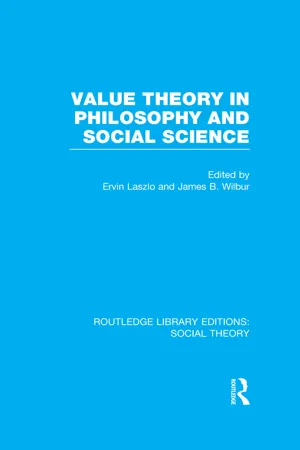
The annual Conferences on Value Inquiry bring together philosophers, scientists and humanists to discuss the many facets of the problem of value in the experience of the individual and in contemporary society. One of the criteria in choosing papers for the Conference is the ability to stimulate discussion and clarification. The papers in the present volumes show deep concern with the problems and responsibilities in making choices of value.
- 164 pages
- English
- ePUB (mobile friendly)
- Available on iOS & Android
eBook - ePub
Value Theory in Philosophy and Social Science (RLE Social Theory)
About this book
Information
PART I
Value Theory in Philosophy
THE CONCEPT OF VALUE
Leaving aside actual revolutions, no time in history has seen more extensive, more fundamental, and more rapid social changes than the present. It is probably safe to say that “Americans currently face a period in which few institutions, beliefs, or values can any longer be taken for granted. All are under strain; all are challenged. Basic transformations of man and society are now underway, and many vital choices of values must be made.” (Robin M. Williams, American Society: A Sociological Interpretation. Alfred A. Knopf. 1951). It is also generally recognized that in the determination of people’s behavior their values play an important role and that the direction in which values change importantly affects the welfare of individuals and of societies. However, empirical investigators do not have available to them a conceptual apparatus suitable even for specifying the values, value systems, or value orientations of particular individuals or societies, at any given time, or changes in these values taking place over a period of time, let alone any theories predicting and explaining such changes, and least of all any understanding of how to assess the desirability or undesirability of any anticipated changes in such values which would enable those in charge of our destiny to take appropriate steps at least to avert disaster if not to lead us to the Great Society. This is a gloomy characterization of the state of the art, but not an uncommon one.
In any case, there would seem to be room for a philosophically oriented overview of the entire conceptual area such as I shall present in this paper. My hope is that the following elucidation of the point and the empirical content of the various types of claim we make with the word ‘value’, will dispose of many of the theoretical difficulties in the way of an empirical investigation not only of the values which people in fact subscribe to but also of the question of their soundness or unsoundness. These advantages, I hope, will be thought sufficient to warrant the effort necessary to clarify fully the dimensions of the concept which I have had to leave vague.
It will be asked why I have gone to such trouble to lay bare what we ordinarily mean by the word ‘value’, instead of introducing a new and precise terminology not burdened with the old ambiguities and confusions. The answer is that it would be premature at this stage.
No doubt, eventually the increase in our knowledge of people’s values may make it advantageous or even necessary to introduce technical terms departing significantly from the concepts here discussed. However, such new terms have to be introduced and explained by means of the ordinary ones generally used. In the last resort political, social, and moral decisions are made in terms belonging to the everyday conceptual framework, for the troubles to be diagnosed and cured arise in everyday life. To give a medical analogy: hay fever sufferers may perhaps eventually describe their symptoms in terms of fluctuations in the amount of histamine in the blood-stream, but this new and more precise way of speaking will be adequate only if it is a way of describing and explaining the old concerns, i.e., irritations in the eyes and nose, excessive sneezing, headaches and discomfort, and so forth. While this is so (and why should it ever change?) it will be essential to have an unconfused everyday vocabulary capable of drawing the major distinctions required for detailed specifications of values. When we have that, it will be easier to introduce a more precise terminology for describing a person’s values and the changes they have undergone over a period of time.
Of the three fields, economics, philosophy, and sociology, in which the idea of value has been most assiduously examined and used, the analytic work of the economists has made the greatest progress and is the most useful for our purposes. This is so despite the fact that the employment of the idea of value in two different areas, for two different purposes, in two different types of theory, has led to a good deal of misunderstanding and confusion (though perhaps mainly among non-economists), and in one area has encountered seemingly insuperable difficulties. These two areas are value theory and welfare economics. In the former, the more successful area, ‘value’ or ‘exchange value’ means market price, i.e. the ratio at which commodities come to be exchanged in a market. In this area, value theory is the theory explaining and predicting the changes of these exchange values or ratios of exchange. Exchange values are public, inter-personal phenomena; the resultants of many individuals’ estimates of the intrinsic worth-whileness to them of possessing these commodities, of their usefulness, of their cheapness, of their affordability to them, and so on. Despite frequently expressed views to the contrary, exchange value is not a magnitude which does or ought to reflect some other magnitude such as the real value, just price, use value, utility, or what-have-you of that commodity.
In welfare economics, by contrast, an individual’s values are the application of his preferences to the alternative possible patterns of his society’s resource allocation; social values, the “aggregations” of these individual evaluations into an aggregated ordering of alternative resource allocations open to the society. There are many difficulties in this way of looking upon the relation between individual and social values, and there appears to be no agreement about how normative welfare economics is to proceed.
In view of the serious obstacles in the way of “aggregating” individual welfare functions into social welfare functions, or of even determining individual welfare functions on the basis either of actual preferential choices or verbally expressed preferences, I want to suggest for further development a modification of the concepts used in welfare economics. I follow the economists in distinguishing between questions concerning the good or well-being of the individual and questions concerning the good or well-being of the group of which he is a member. However, instead of the comparatively narrow question of welfare, individual or social, I raise the wider question of what I call the quality of life; and instead of conceiving of this crucial property as constructed out of the individuals’ preferences, I think of it as constructed out of hierarchically ordered answers to different types of question, including those concerning inclinations, preferences, and tastes, but also his needs and interests. Answers to the question of what is in his interest are more important, (make a stronger claim on his resources) than answers to questions of inclination or preference or taste. More about this below.
My key idea is that of something, whether an occurence or an action or state of affairs, making a favorable difference to a person’s life. To make this more precise, it is important to distinguish two aspects of a person’s life which may be so affected: the quality of his life at any given time, and the extent of his ability to raise or maintain that quality.
Consider the quality of some material or substance, such as steel, cloth, tobacco or wine. Imagine this material passing, at a steady flow, some given point of quality control where its quality is periodically inspected, in order to ensure that it continues to be of the required level or standard. If the material falls below the required quality, it is rejected; if it reaches the required level or comes above it, then it passes. By the quality of the material we mean the extent to which it meets the appropriate or legitimate requirements we make of materials of this sort. It is better or higher quality material the more fully it meets the appropriate requirements. Its quality or excellence lies in its ability or capacity to satisfy the appropriate requirements, and the measure of that quality is the extent or magnitude of that ability.
The quality of someone’s life is something analogous to the quality of some material: a measure of the excellence of that life in terms of its ability or capacity to satisfy the appropriate or legitimate demands made on it. As in the case of materials, we can try to isolate those factors which favorably affect its quality, those which make no difference to it, and those which unfavorably affect it. In this case, too, we shall naturally be concerned to promote those factors which make for an improvement of its quality and to eliminate or modify those factors which make for a lowering of its quality.
We can distinguish four different classes of demands on a life. (1) The demands a person himself makes on his life: what he wants from or out of life, what he hopes life will hold for him, what he wants life to contain, if he is to call it a worthwhile, satisfying, or good life. (2) the demands others may legitimately make on him, if they are to call it a decent, decorous, law-abiding, or morally adequate life. (3) The requirements one legitimately makes before one calls it a valuable or admirable life; e.g. those that define the heroic, the saintly, the great artist’s, the great scientist’s life, and so on. These are the contributing, valuable lives. Their high quality lies in the benefit they confer on others. The difference between the morally adequate life and the valuable life is that the former satisfies the demands others may legitimately make on a life, whereas the latter satisfies requirements outside what may be legitimately demanded. The former contains the minimal contributions anyone can be expected to make, quite irrespective of any special talents or gifts he may have. The latter acknowledge the performance of the specially gifted individual. (4) The last class of demands are those which a critic may make of the requirements spelled out in the first three sets, those actually in operation in a given society. A critic may find what a given person demands of life excessive, unreasonable in terms of what is possible and so on, or he may criticize it as too unambitious, too modest, too easily satisfied. And analogous criticisms could be offered of the other sets of criteria.
A person reaching maturity in a given society will normally have formed certain demands on his life; what he wants from or out of life. Of course, these demands may change as he grows older and learns to criticize and modify them in the light of what is possible, with the resources at his disposal, and of what is truly rewarding, and what he would regret spending his resources on. Part of his education along these lines will include the rejection of some of the things others would like him to do, and the inclusion of others he had previously ignored or rejected.
Now, we can say that anything which, at a given time, brings his life closer to the satisfaction of the demands which he, at that point reasonably makes on it, favorably affects the quality of his life. Getting a coveted job, finding a long-lost rela...
Table of contents
- Cover
- Half Title
- Title Page
- Copyright Page
- Original Title Page
- Original Copyright Page
- Preface
- Table of Contents
- Part I Value Theory in Philosophy
- Part II Value Theory in Social Science
Trusted by 375,005 students
Access to over 1.5 million titles for a fair monthly price.
Study more efficiently using our study tools.
Frequently asked questions
Yes, you can cancel anytime from the Subscription tab in your account settings on the Perlego website. Your subscription will stay active until the end of your current billing period. Learn how to cancel your subscription
No, books cannot be downloaded as external files, such as PDFs, for use outside of Perlego. However, you can download books within the Perlego app for offline reading on mobile or tablet. Learn how to download books offline
Perlego offers two plans: Essential and Complete
- Essential is ideal for learners and professionals who enjoy exploring a wide range of subjects. Access the Essential Library with 800,000+ trusted titles and best-sellers across business, personal growth, and the humanities. Includes unlimited reading time and Standard Read Aloud voice.
- Complete: Perfect for advanced learners and researchers needing full, unrestricted access. Unlock 1.5M+ books across hundreds of subjects, including academic and specialized titles. The Complete Plan also includes advanced features like Premium Read Aloud and Research Assistant.
We are an online textbook subscription service, where you can get access to an entire online library for less than the price of a single book per month. With over 1.5 million books across 990+ topics, we’ve got you covered! Learn about our mission
Look out for the read-aloud symbol on your next book to see if you can listen to it. The read-aloud tool reads text aloud for you, highlighting the text as it is being read. You can pause it, speed it up and slow it down. Learn more about Read Aloud
Yes! You can use the Perlego app on both iOS and Android devices to read anytime, anywhere — even offline. Perfect for commutes or when you’re on the go.
Please note we cannot support devices running on iOS 13 and Android 7 or earlier. Learn more about using the app
Please note we cannot support devices running on iOS 13 and Android 7 or earlier. Learn more about using the app
Yes, you can access Value Theory in Philosophy and Social Science (RLE Social Theory) by James B. Wilbur in PDF and/or ePUB format, as well as other popular books in Social Sciences & Sociology. We have over 1.5 million books available in our catalogue for you to explore.