This book establishes an analytical model for the description of existing translations in their historical context within a framework suggested by systemic concepts of literature. It argues against mainstream 20th-century translation theory and, by proposing a socio-cultural model of translation, takes into account how a translation functions in the receiving culture. The case studies of successive translations of "Hamlet" in France from the eighteenth century neoclassical version of Jean-Francois Ducis to the 20th-century Lacanian, post-structuralist stage production of Daniel Mesguich show the translator at work. Each chapter focuses on a different aspect of the changing theatrical and literary norms to which translators through the ages have been bound by the expectations both of their audiences and the literary establishment.
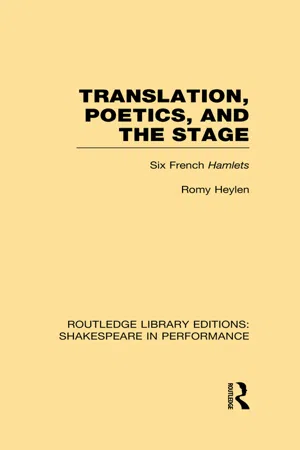
- 180 pages
- English
- ePUB (mobile friendly)
- Available on iOS & Android
eBook - ePub
About this book
Information
Chapter 1 Jean-Fran?ois Ducis' Hamlet, Tragédie imitée de l'anglois
A neoclassical tragedy?
DOI: 10.4324/9781315763972-2
Shakespeare was largely an unknown quantity in France until the early eighteenth century, when a combination of factors resulted in his becoming the most popular foreign playwright in the country. The first translations of episodes from Shakespeare, by Destouches and the Abbe Leblanc, contributed to a wave of anglomania, which was in turn further fueled by the Lettres philosophiques, in which Voltaire translated selected passages of Shakespeare into French, and even went so far as to compare the Englishman to Homer (“Essai sur la poésie épique”).
In 1745, Antoine de La Place published Le Théâtre anglois, containing translations of Hamlet and nine other Shakespearian plays.1 These were by no means complete versions of the original plays: La Place had translated only what he considered the most striking passages and linked them together by means of plot synopses. Nevertheless, La Place’s efforts still further popularized Shakespeare among the intelligentsia: his translations were not meant to be acted, but to stimulate salon conversation by providing the French literati with a glimpse of something far removed from the conventions of their own classical theatre. By presenting his work as closet drama (that is, not intended to be staged), La Place was able to depict ghosts, swordfighting, murder, and all manner of plot lines Racine would never have dared to show on stage.
Presenting his Shakespeare as closet drama did not, however, afford La Place the luxury of translating Shakespeare’s blank verse. The following passage, composed in beautifully flowing alexandrines, could have been taken from Racine, had it not been delivered by a ghost, but is in fact from La Place’s Hamlet (I, v, 9–17):
Le Spectre. Tu vois ton Père!…Un arrêt rigoureux,
Mais juste, le condamne à des tourmens affreux,
Jusqu’a l’heureux instant où l’Eternel propice
Fera cesser des maux qu’exige sa justice.
Que ne puis-je tracer cet effrayant tableau,
Que loeil mortel ne voit, qu’en entrant au tombeau?
Tu frémirois, mon fils, à laspect de mes peines,
Et je verrois ton sang se figer dans tes veines,
Je verrois sur ton front lépouvante et la mort.2
[You see your father before you.…
A harsh but just confinement to wander the earth
Has condemned him to suffer horrible torments
Until the joyous moment when the Eternal one
Will cause these ills his justice has demanded to cease.
How can I describe this horrible scene,
The mortal eye sees only on entering the tomb?
You would tremble, my son, at the sight of my pains,
And I would see your blood coagulate in your veins,
I would see in your face both terror and death.]
La Place’s translations became the talk of the salons: very soon their popularity and that of Shakespeare threatened to dethrone even Corneille and Racine. Voltaire, who had previously been so enthusiastic, now began to fear that the dissemination of such foreign material would contaminate the neoclassical ideals of French theatre. As late as 1770, he had referred to Shakespeare as “a genius” (“Du theatre anglais”). However, once it became clear that Shakespeare’s works constituted a threat to the old order, with the appearance of more comprehensive, less fragmentary translations of the plays by Jean-François Ducis (1770) and Pierre Le Tourneur (1776), Voltaire spoke out:
What is frightful is that this monster has support in France; and, at the height of calamity and horror, it was I who in the past first spoke of this Shakespeare; it was I who was the first to point out to Frenchmen the few pearls which were to be found in this enormous dunghill. It never entered my mind that by doing so I would one day assist the effort to trample on the crowns of Racine and Corneille in order to wreathe the brow of this barbaric mountebank.3
The above letter was written in 1776, more than thirty years after the appearance of La Place’s first closet translations of Shakespeare. The deciding factor in securing Voltaire’s opposition to an English tragic model seems to have been the stupendous success enjoyed by the first stage production of Ducis’ translation of Hamlet, which received its premiere in 1769. Ducis, as it happens, did not fit the traditional image of a translator, in that he spoke no English. “Je n’entends point l’Anglois,” he stated in the “Avertissement” to his version of Hamlet, “et j’ai osé faire paroître Hamlet sur la Scene Fran-çoise.” [I don’t understand a word of English and yet I have presumed to put Hamlet on the French stage.]4 His translation of the play was initially based on La Place’s synopsis, to which Voltaire had not objected; later versions included some textual changes drawn from Le Tourneur’s 1776 prose Hamlet.
What seems to have bothered Voltaire, however, is the idea of the success of a “barbaric” foreign play at the Comédie Française, the very cradle of the neoclassical ideal. Although Ducis’ translation at first sight seems to have been composed according to a neoclassical stage model, on further examination it reveals itself to be something else entirely. It seems likely that Voltaire saw in Ducis’ translation, and in the very success it enjoyed, the seeds of the imminent destruction of classical tragedy as he knew it.
Ducis, as a translator, took La Place’s bare synopsis as an intermediary translation on which to base his version (or as he calls it his “imitation”) of Hamlet. He then altered and rearranged the plot, cut down the list of players, and composed an unbroken, playable text, written in alexandrines, with all the appearance of a classic tragedy. What was not so evident was Ducis’ use of his translation of Hamlet to introduce a new theatrical model, bourgeois drama, to the repertory of the Comédie Française, by cloaking it in neoclassical garb.
Paradoxically, Ducis’ Hamlet did more for Shakespeare than it did for bourgeois drama. Not only was it the catalyst for all subsequent French translations of Shakespeare, but it was the basis for the first Italian (1772), Spanish (1772), Dutch (1777), Swedish, and Russian translations of the play.5 It stayed in the repertory of the Comédie Française until 1851, outlasting not only the “sentimental comedies” of Marivaux, but the whole tenure of Romanticism.
As a translator, Ducis never claimed to have reproduced Shakespeare as an English audience would have recognized him. Indeed he even wrote a letter to Garrick, apologizing for the changes he had imposed on the piece:
I imagine, sir, that you must have found me extremely rash to put a play such as Hamlet onto the French stage. Without even mentioning the wild irregularities which abound throughout, the ghost, which I admit plays a large part, the rustic actors and the swordplay, seemed to me to be devices which are absolutely inadmissible on our stage. However, I deeply regretted not being able to introduce the public to the fearsome spectre that exposes the crime and demands vengeance. So I was forced, in a way, to create a new play. I just tried to make an interesting character of the parricidal queen and above all to depict the pure and melancholic Hamlet as a model of filial tenderness.6
From this letter one can infer that Ducis’ “initial norm” or the basic choice he made as a translator was to subject himself completely to the conventions operative in the French theatre, those expected of a playwright by both institution and audience. When he claims to have created “a new play” from Shakespeare’s original, it is apparent that this play has been made to resemble other contemporary French tragedies. Due to the Académie Française’s veto on matters of taste, Ducis was effectively forced to change the matrix or the textual material of the original, otherwise he would have had no hope of ever presenting the play at the Comédie Française. His selection of suitable French “tragic” material to replace some of the original scenes, in other words the textual and matricial norms to which Ducis adhered, were determined by the typical French neoclassical play and, less evidently, by eighteenth-century bourgeois drama. In order to assure the play’s acceptance by the Comédie Française, Ducis made the following changes to Shakespeare’s dramatic text. Gone are the actor playing the Ghost, the traveling players (and consequently the play within the play), the combat scene at the end between Hamlet and Laertes and no fewer than fifteen of the original twenty-three characters! Ducis knew that his Hamlet would stand more of a chance of impressing the readers at the Comédie Française if he was able to uncover those “few pearls” of which Voltaire talked, and to make them fit the classical triad of bienséance, ordre, and vraisemblance, or verisimilitude. His approach (on the surface, one of complete acculturation) was at the time the only way of making Shakespeare available to the French theatre-going public. Without the modifications he made, it is open to question when if ever Shakespeare would have been performed at the Comédie Française.
Ducis’ translation brings forth the genius of Hamlet, but subject to the classical canon. He “naturalized” Shakespeare’s Hamlet for an audience used to the structures of neoclassicism. It appears to be an idealized and acculturated Hamlet, showing what Shakespeare would have written had he been a contemporary and a compatriot of Racine, a case of the French appreciating foreign genius but at the same time saying to themselves, “Ah yes, if only he had been French,” as opposed to Le Tourneur’s more source text oriented prose translation, which brought out Shakespeare “the barbarian,” and was presumably perceived at the time as “exotic” or “bizarre” due to its failure to acculturate the English material.
In order to conform to the French tragic blueprint, Ducis departed not only from Shakespeare but also from La Place’s matricial norms. There is a different plot, the relationships between the main characters have been altered, and the unities of time, place, and action are observed. All the action takes place in Elsinore, within the required twenty-four-hour period, with all the characters passing through an antechamber in the castle to deliver their speeches. Unity of action means that all the sub-plots of the original, the play within the play, the death of Ophelia, the gravediggers’ scene, and Hamlet’s “Alas poor Yorick” meditation have been discarded. As Peter Conroy points out, the character of “Ophélie” represents, to the French classical audience, an unnecessary diversion in much the same way as the character of the Infante did in Le Cid, drawing the audience’s attention away from the main plot.7 Voltaire wrote that, despite his initial enthusiasm for Hamlet, he had not been able to overcome his sense of shock at seeing comic interludes in a tragedy, and therefore could not focus on Hamlet’s meditations on death. Ducis correspondingly dropped any scenes which involved the slightest notion of comedy, such as the one with the gravediggers, to avoid incongruity of tone. Needless to say, his translation entailed a generic shift from tragi-comedy to what appeared on the surface to be pure neoclassical tragedy.8 In order to recreate the personnel habituel of classical tragedy, Ducis was forced to prune the list of players. Hamlet becomes king of Denmark, though as yet uncrowned. Claudius is next in line to the throne, but he is no longer the brother of the late king. Gertrude, who remains the late king’s widow, now has a confidante, Elvire, whose principal dramatic function is to be a foil for her mistress, and to allow the action to develop through dialogue. Ophelia is now the daughter, not of Polonius, but of Claudius. Polonius is the confidant and agent of Claudius. Horatio has been replaced by a character called Norceste, Hamlet’s childhood friend and confidant. Voltimand is a confidant with no master, having a walk-on part as the captain of the guard to fill the gaps created by the absence of Rosencrantz, Guildenstern, and, most surprising of all perhaps, Laertes. The list of characters is rounded off by some unnamed guards.
As for the background to the play, Claudius is at first presented as a nobleman who has been wronged by the late king. It later emerges he was the perpetrator of the regicide: Gertrude had plotted with him but she had repented at the la...
Table of contents
- Cover Page
- Half Title Page
- Title Page
- Copyright Page
- Original Title Page
- Original Copyright Page
- Dedication
- Table of Contents
- Acknowledgments
- Introduction: A cultural model of translation
- 1 Jean-François Ducis’ Hamlet, Tragédie imitée de l’anglois
- 2 Alexandre Dumas and Paul Meurice’s Hamlet, Prince de Danemark
- 3 Marcel Schwob and Eugène Morand’s La Tragique Histoire d’Hamlet
- 4 The blank verse shall halt for’t
- 5 Yves Bonnefoy’s La Tragédie d’Hamlet
- 6 Theatre as translation/Translation as theatre
- Concluding remarks
- Appendix: Table of selected Hamlet productions
- Notes
- Index
Trusted by 375,005 students
Access to over 1.5 million titles for a fair monthly price.
Study more efficiently using our study tools.
Frequently asked questions
Yes, you can cancel anytime from the Subscription tab in your account settings on the Perlego website. Your subscription will stay active until the end of your current billing period. Learn how to cancel your subscription
No, books cannot be downloaded as external files, such as PDFs, for use outside of Perlego. However, you can download books within the Perlego app for offline reading on mobile or tablet. Learn how to download books offline
Perlego offers two plans: Essential and Complete
- Essential is ideal for learners and professionals who enjoy exploring a wide range of subjects. Access the Essential Library with 800,000+ trusted titles and best-sellers across business, personal growth, and the humanities. Includes unlimited reading time and Standard Read Aloud voice.
- Complete: Perfect for advanced learners and researchers needing full, unrestricted access. Unlock 1.5M+ books across hundreds of subjects, including academic and specialized titles. The Complete Plan also includes advanced features like Premium Read Aloud and Research Assistant.
We are an online textbook subscription service, where you can get access to an entire online library for less than the price of a single book per month. With over 1.5 million books across 990+ topics, we’ve got you covered! Learn about our mission
Look out for the read-aloud symbol on your next book to see if you can listen to it. The read-aloud tool reads text aloud for you, highlighting the text as it is being read. You can pause it, speed it up and slow it down. Learn more about Read Aloud
Yes! You can use the Perlego app on both iOS and Android devices to read anytime, anywhere — even offline. Perfect for commutes or when you’re on the go.
Please note we cannot support devices running on iOS 13 and Android 7 or earlier. Learn more about using the app
Please note we cannot support devices running on iOS 13 and Android 7 or earlier. Learn more about using the app
Yes, you can access Translation, Poetics, and the Stage by Romy Heylen in PDF and/or ePUB format, as well as other popular books in Media & Performing Arts & Literary Criticism of Shakespeare. We have over 1.5 million books available in our catalogue for you to explore.