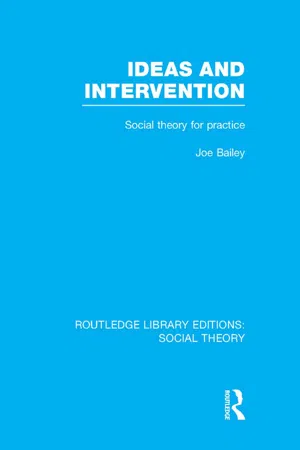
Theorizing in sociology has increasingly become a self-generating and self-fulfilling activity, as sociologists absorb theory as an isolated and formalist part of their discipline. Joe Bailey believes that sociological theory should be a contribution to practical social intervention. His book presents a practical view of social theorizing as an activity at which sociologists are skilled and which they could teach to the interventionist professions. The relation between theory and practice is defined as one in which theory guides practice and makes explicit necessary choices. A description of disciplines and professions is provided as a basis for examining social intervention in three areas – law, social work and urban planning. The author considers some exemplary contributions which sociological theorizing could and should provide, and concludes by proposing a pluralist view of theory as the best strategy for a sociology relevant to practice.
- 162 pages
- English
- ePUB (mobile friendly)
- Available on iOS & Android
eBook - ePub
About this book
Information
1 Sociology's place
DOI: 10.4324/9781315763606-1
Sociology is not enjoyed, used or approved yet sociology is taught as a formal discipline to increasing numbers of people. This is a paradox. Sociology has until recently in its, so far brief, institutional life existed in an atmosphere of internal disagreement and external uncertainty. Sociology now suffers internal schism and external hostility. This is a crisis. The paradox and the crisis make the present time for sociology something of a climacteric. Put plainly, I fear that the potential good in sociology will be destroyed as its institutional existence becomes increasingly questioned. This questioning is only partly justified, but it is responding to the dogmatism, feebleness, amorality and arrogance that flowers in so much of sociology now. The recent proliferation of sociological sects is healthy and interesting but the abandonment in the process of all common, broad goals with respect to activism, teaching, scholarship and research is the beginning of a holy war of attrition.
It was not always so. The history of British sociology suggests that while there have been problems surrounding its institutionalization, especially up to the First World War, the internecine strife which existed in the nascent discipline was always within a very broad framework of agreed intentions. The general tradition within which such apparently opposed approaches as administrative data-gathering, ameliorism and social evolutionism competed for supremacy was one of interventionism.1 The external circumstances were threatening even then. As Abrams makes clear, the role of ‘sociologist’ remained only a potential for a very long time and in great part this was due to institutional resistances over which such potential sociologists had no control. Then as now. But then internal dispute resulted in the peaceful co-existence of different sociologies. Such pluralism and tolerance could be said to be in great part one of the reasons for the existence of sociology as a discipline. This is not to praise the quality of the newly born subject, or to deny that a different mix of approaches (civics, eugenics, Boothism, etc.) would not have improved the quality of present-day sociology. It is simply to say that if the establishment of sociology had waited upon a contest to be won, certain styles and theoretical traditions to be vanquished and somehow extinguished, we would be waiting yet. If such a pluralism was important in the conception, why has it become so redundant in the subsequent nurturing? Why can progress now be talked about only in terms of the destruction of obstacles (for instance the getting rid of ‘residual’ functionalism) and the ascendency of one particular approach (for instance historical materialism)?
This all sounds like complaining for its own sake. One of the aims of this book is to evaluate a purely critical sociology and to suggest that sociology can and should be constructive. Following my own advice, I ask what do I want sociology to be?
Most importantly I want sociology to be a servant and not a master, a means and not an end. But to what end? Barrington Moore has tried to discuss the universal, institutional conditions of human misery and unhappiness in a way that social scientists, parochial as they are, have completely neglected.2 By extension one can ascribe to sociology the task of reducing misery. This is one bald and unexceptionable programme for justifying all organized intellectual activity. At this stage one need not be more explicit than this. Even by such an apparently idealistic and general prospectus a great deal of contemporary sociology, even where it claims to ‘demystify’, appears self-indulgent and inward-looking. In order to reduce misery, promote happiness and in some way deal with the problems of men and women sociology must have an institutional existence. Great intellectuals have often avoided universities like the plague (for instance Condorcet, Goethe, Marx), yet their own thought was nurtured by, created in opposition to, or founded upon, bodies of knowledge intimately connected with university-based scholarship.
Sociology is a discipline which has a benevolent potential which will die if the discipline now becomes institutionally weak, for it cannot survive outside of institutions of higher education. The ideological and institutional weight of sociology are intimately connected. In this, I think, Gouldner is right when he highlights the importance of the social organization of sociological theory.3 Organization must mediate between theory and practice, though whether the need is for a Lenin rather than a more pluralist figure I am doubtful.4 Gouldner’s call for the formation of theoretical collectives to re-establish the conditions of rational discourse is élitist and, more significantly, unnecessary if the members of the discipline could understand their own place between ideology and institution.
Who is being addressed here? Sociology cannot change under its own steam. It can never make itself accepted, and therefore the audience cannot be restricted to sociologists themselves. The audience is all those who use sociology and who ask sociology questions. Such audiences range from policy-makers at various levels and of various types, to collective interests, to practical social workers (conceived broadly), to students of sociology. No particular use is being prescribed here at this stage, merely the fact of use. It is true that sociology can simply be experienced as, for instance, liberation, intellectual growth or increased authenticity. Many students of sociology demand this sort of individual satisfaction from the discipline and from their teachers. This is very valuable and important when it happens, though I am sceptical of the possibility of a discipline such as sociology, which has little aesthetic or poetic profundity,5 delivering the goods. It does happen, but almost by chance, and the experience of personal growth or transcendence which sociology sometimes provides is parasitical upon its ability to be used by others than sociologists.
Historically sociology has addressed its users.6 The pursuit of sociological knowledge by thought and by action (and then by thought again), even the most apparently scholastic, has a practical end. It often seems that improving one’s preaching to the already converted has been the goal, but this is really something of an exaggeration based on the fact that scholars talk to one another before talking to potential users. All seekers after truth believe that the truth will set us free. However, the concern with wider audiences characteristic of the growth of sociology has recently decayed. This may be due in part simply to the growth of institutional sociology whereby the actual numbers of inward-looking purists has increased.7 The dramatic fact appears to be that more and more time is spent in arguing with ourselves.8
This book is addressed to sociologists and all those who think that there might be some use in sociology. It suggests that sociology can be rescued from the clutches of contemporary sociologists, who think they are philosophers or warriors, and given a genuine job of enlightenment. It proposes a calculation of the relations between theory and practice, between special kinds of thinking which have come to be called sociological theory and particular kinds of social practice which we might call, loosely, ‘intervention’. It proposes this in a modest sense. No overall theoretical scheme is described which will provide the panacea for sociology’s intellectual ills and the key to new liberating action. The case is made only that self-conscious calculation is better than blind and deaf assumption. The more we think about our action the better that action will be. Certainly this must be the root of rational activity itself rather than just of optimism. Yet what we might loosely call ‘interventionist’ activity is often, perhaps more often than not, performed for untheorized reasons and judged in untheorized ways.
Theory and practice in general
Theory is often asserted to be important. In a variety of ways, from the common sense and unreflected to the sophisticated and self-consciously philosophical, we are urged that what is wrong with our practice is remediable by a closer attention to theory.9 I too believe theory to be significant and I want to try to describe why theory is a necessary part of practice and to place sociological theory in explicit relation to social practice.
Social theory is important because it is inevitable, and if we ignore the inevitable we are in the uncomfortable position of willing our own ignorance. We are all social theorists both in everyday life and in what we may choose, perhaps falsely, to mark off as our ‘professional’ lives. At its crudest this may simply mean that we all have value systems or ideologies which penetrate our work. At a more discriminating level this means that we actually use theories which are usually taken from somewhere else. We do not invent our theories. Not only are we all versions of the theorist but we are all versions of specific kinds of sociological, psychological, moral and political theorists who have, in the absence of any central collective concern with this theorizing activity, developed our choices and our partisanships in what is an inadequate arena. It must be inadequate if compared with the circumstances we could create for theoretical work. The argument goes then – sociological theory is of crucial importance as the vehicle of self-consciousness about our inevitable theorizing: making the implicit explicit.
All men are theoretical beings in so far as this involves them in abstraction, generalization, prediction, choice and decisionmaking and, so far as we know, all men do these things. One of the reasons for the recent attractiveness of phenomenological sociology is surely that it gives all men the status of theorist.
All men are practical and are involved in social action. Theory and practice are often seen as different logical orders10 with different imperatives and importances. Yet we know they are connected. There are a number of common meanings given to the distinction. A series of commonsense dualisms seem to fit (e.g. intellectual/worker, manual work/brain work) and a technical and social division of labour has crystallized out around it. Theory is the rather despised half of the dichotomy (‘oh, it’s only theory’ is a common criticism) yet embedded in the pair of terms is the fact that they are a duet and that they are indissolubly connected. That is, we know that theory must have an object. But common sense leaves the nature of the connections unexplicated beyond a denigration of each separated half (‘ivory tower idealist’ versus ‘unreflective pragmatist’).
Theory and practice are events and processes in a real world composed of matter and ideas. The relation between mind and matter is the fundamental dualism of all western philosophy. For the sociologist the strains of treating this as a practical matter have often resulted in the mystification of the relations between theory and practice. In science, the humanities, and the social disciplines, the tension between theorizing and practising is colonized by the activity of theory itself: the distinction or relation between theorizing and practising is seen as a theoretical one. This tends to provide more fuel for epistemological and philosophical argument. The relation is not treated as a practical one, and there are few examinations of the actual practical connection.11
Ideas and the organization of ideas, which comprise the theory world, are not enough. Thinking about thinking is not a prior activity to thinking about thinking about something 12 if only because practice, by its very nature, does not wait upon the resolution of theory. The constraints of the real world are too great to put off activity until all the great issues are settled. What this implies is that theory has a relationship to practice which is complicated by time. We cannot wait for ever for theoretical certainty yet we can wait. Thus, given that we will act whatever, our theory must be oriented to the inevitable action. The élitism, arrogance and false expertise which theorists often evince is in part due to their ignorance of the conditional and provisional character of their activity.
Man’s activity has the outstanding characteristic that it is purposive.13 Men have intentions which are simply ideas about what they can make happen. It is true that men are very often gripped by events which seem beyond their control, but in general our efforts are devoted, often unsuccessfully, to gripping the world and to being in control. This is a rather unfashionable sentiment in much of present-day sociology. Control is felt to be unworthy and fundamentally base – a kind of hubris. Planning, foresight and the prediction of consequences, however, are themselves an important motivation for the sciences and the social disciplines alike. The painful obviousness of the unintended consequences of our intended actions is the very reason for sociology. This is not a reduction of sociology to some crude engineering version of ‘policy science’14 and it is not to deny that sociology does provide ancillary aesthetic and intellectual satisfactions. But it is a reminder that sociology is deeply concerned to discuss the relation between ends and means, as well as ends themselves, and it is in this context that theory and practice must be seen.
The institutional contexts of knowledge and activity are also an important limiting factor in their relationship.15 The growth of professions and of bureaucracies, the splitting and subsequent attempted reuniting of scholarship and activism have had profound effects on disciplines as ways of knowledge and definers of practice. The technical division of labour within all disciplines has a number of neglected implications for the impact of those disciplines on the enclosing society. In some disciplines it is true that the division between theorist and practitioner has all but disappeared for idiosyncratic reasons (e.g. astronomy). But in most, and in the social disciplines in particular, the distinction is a real one and the consequences of continuing role separation are serious. Gulfs open up in bodies of knowledge previously felt to be a unity. These often seem due more to the internal, often artificial, dynamics of the discipline than real responses to problems of knowledge and practice. Calling such sectarianism the growth of knowledge is using a very poor indicator indeed and in certain cases seems to inhibit any practice at all but further fission. Scientific revolutions and paradigm change16 are not made of such stuff. Institutions and organizations have grown in such a way as not to permit pluralism, heterogeneity and possible cooperation in a discipline, but have turned it into an exclusive and bitter conflict where the private goals become winning and nothing else.
In general theory and practice have at best a pragmatic relationship and at worst are seen to be warring activities.
Theory and practice in science
Science, the magisterial standard of all our knowledge, is generally conceived as a kind of theory. The natural sciences function stereotypically as a measure of reliability, truth, usefulness and, in general, quality of what we say we know or even experience. The philosophy of science has developed polemical yet profound descriptions of what this important standard of science is17 and a great deal of sociological theorizing has been devoted to anatomizing scientific knowledge-gaining procedures and in the process putting other disciplines within the social sciences and humanities in their ‘proper’ place. Within scientific theory science is seen as a body of ideas and a very limited single practice – namely experimentation – which feeds back on to those ideas. This theoretical view of science holds true across important debates.18
Yet science is more than ideas. It is profoundly a practice and concentrating on its idea-systems and how they have changed is as absurd as a complete view of science as is the history of technology and machines. Ironically this arrogant philosophizing is just as common among marxist sociologists who define themselves as very far away from the technical debate...
Table of contents
- Cover Page
- Half-Title Page
- Title Page
- Copyright Page
- Original Title Page
- Original Copyright Page
- Table of Contents
- Preface and acknowledgments
- 1 Sociology’s place
- 2 Disciplines and professions
- 3 Law and social theory
- 4 Social work and social theory
- 5 Planning and social theory
- 6 Social theory for intervention
- Notes
- Subject index
- Name Index
Trusted by 375,005 students
Access to over 1.5 million titles for a fair monthly price.
Study more efficiently using our study tools.
Frequently asked questions
Yes, you can cancel anytime from the Subscription tab in your account settings on the Perlego website. Your subscription will stay active until the end of your current billing period. Learn how to cancel your subscription
No, books cannot be downloaded as external files, such as PDFs, for use outside of Perlego. However, you can download books within the Perlego app for offline reading on mobile or tablet. Learn how to download books offline
Perlego offers two plans: Essential and Complete
- Essential is ideal for learners and professionals who enjoy exploring a wide range of subjects. Access the Essential Library with 800,000+ trusted titles and best-sellers across business, personal growth, and the humanities. Includes unlimited reading time and Standard Read Aloud voice.
- Complete: Perfect for advanced learners and researchers needing full, unrestricted access. Unlock 1.5M+ books across hundreds of subjects, including academic and specialized titles. The Complete Plan also includes advanced features like Premium Read Aloud and Research Assistant.
We are an online textbook subscription service, where you can get access to an entire online library for less than the price of a single book per month. With over 1.5 million books across 990+ topics, we’ve got you covered! Learn about our mission
Look out for the read-aloud symbol on your next book to see if you can listen to it. The read-aloud tool reads text aloud for you, highlighting the text as it is being read. You can pause it, speed it up and slow it down. Learn more about Read Aloud
Yes! You can use the Perlego app on both iOS and Android devices to read anytime, anywhere — even offline. Perfect for commutes or when you’re on the go.
Please note we cannot support devices running on iOS 13 and Android 7 or earlier. Learn more about using the app
Please note we cannot support devices running on iOS 13 and Android 7 or earlier. Learn more about using the app
Yes, you can access Ideas and Intervention (RLE Social Theory) by Joe Bailey in PDF and/or ePUB format, as well as other popular books in Social Sciences & Sociology. We have over 1.5 million books available in our catalogue for you to explore.