A striking feature of the human condition is its dual, contradictory, inherently split character; on the one hand, autonomy and freedom; on the other, constraint and dependence on social structure. This volume addresses this central problem of the linkage between human action and social structure in sociological and social science theory. Contributions cover several different approaches to the agency-structure problematic, and represent the work of a number of leading international sociologists. Their efforts point to a reorientation of social theory, both on philosophical and methodological levels.
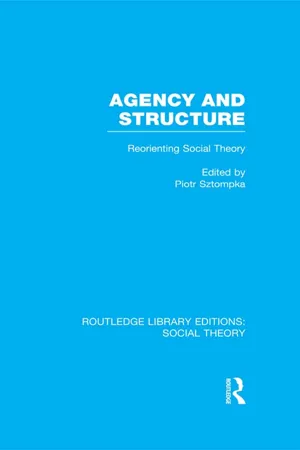
- 328 pages
- English
- ePUB (mobile friendly)
- Available on iOS & Android
eBook - ePub
About this book
Information
I.
Between Agency and Structure: An Overview of the Debate
Chapter
ONE
Agency-Structure, Micro-Macro, Individualism-Holism-Relationism: A Metatheoretical Explanation of Theoretical Convergence between the United States and Europe
PARALLEL THEORETICAL TRENDS: THE US AND EUROPE
A great deal of attention has been devoted recently in American sociological theory to the issue of micro-macro linkage, while in Europe this has been paralleled by a similar level of interest in the relationship between agency and structure. There has been considerable movement on both sides of the Atlantic away from theoretical extremism and toward more integrative orientations. Europeans have moved away from feeling the need to choose between, for example, structural and existentialist theories. Similarly, American theorists have been rejecting the necessity of choosing between macro-theories like structural functionalism and micro-theories like symbolic interactionism.
This paper seeks to offer a metatheoretical explanation for the convergence on the issue of integration in theoretical work in the United States and Europe in the 1980s and early 1990s. There are undoubtedly many explanations for this convergence. For example, it could be hypothesized that the tendency to think integratively is related to sociopolitical changes in the world as a whole. At the peak of the Cold War in the 1950s and 1960s, with the schism between communism and capitalism, sociological theory on both continents was similarly split into warring, extremist factions. However, with the decline and virtual disappearance of the global division between capitalism and communism in the 1980s, sociological theory began to pull away from extremist dichotomies and to move toward more integrative conceptualizations. While causality cannot be proven here, there is at least a parallel between the end of a worldwide dichotomy and the movement away from dichotomous thinking in the social sciences. There is certainly a relationship between the social world and social theory and it is not unreasonable to hypothesize that changes in the former will lead to transformations in the latter.
At a very different level, it seems clear that theorists on both sides of the Atlantic were growing tired of traditional theoretical differences. Thus, in addition to being related to changes on the world scene, the movement toward integration is also tied to internal developments within social theory. For example, on the continent, Pierre Bourdieu (1989) was fed up with the split between objectivism (structure) and subjectivism (agency) and sought to develop an integrative (agency-structure) alternative he labelled “constructivist structuralism.” Here is the way Bourdieu puts his integrative position:
On the one hand, the objective structures … form the basis for … representations and constitute the structural constraints that bear upon interactions: but, on the other hand, these representations must also be taken into consideration particularly if one wants to account for the daily struggles, individual and collective, which purport to transform or to preserve these structures. (Bourdieu 1989:15).
Taking Ritzer’s (1981) work as an example of a similar orientation in the United States, he argued that theorists were wearying of the need to choose between macro-oriented (“social facts”) and micro-oriented (“social definition” and “social behavior”) paradigms. Instead, he perceived a need for, and a movement toward, the development of an “integrated” sociological paradigm. Such a paradigm deals not only with the integration of micro and macro, but also subjectivity and objectivity. Thus, a series of developments within social theory in both the United States and Europe also help to account for the move toward theoretical integration.
The above are but two of many explanations that can be offered for the dramatic changes that have taken place in social theory. The objective in this paper is to offer a very different kind of explanation for the international movement toward theoretical integration. Our thesis is that theorists on both sides of the Atlantic had increasingly found, at least implicitly, the choice offered to them by philosophers of science between methodological individualism and methodological holism to be too confining and largely irrelevant to their work. The work of these social theorists involves the tacit development of methodological relationism as an alternative to individualism and holism. It was this implicit development of relationism that provided the base for social theories of the relationship between agency-structure and micro-macro.
The fact is that the offerings of philosophers have grown increasingly extraneous to work at the cutting edge of social theory. Few social theorists today can be described as either individualists or holists. Yet, these are the only two options offered to them by philosophers. Philosophers have clearly grown increasingly out of touch with contemporary work in social theory. They have continued to debate individualism-holism among themselves while ignoring recent work in social theory. In the past philosophers developed their conceptions of individualism and holism, at least in part, from a study of the work of social theorists. For example, Weber’s work on social action was seen as paradigmatic of individualism, while Durkheim’s ideas on social facts were a model for holism. However, philosophers have failed to revise their positions and develop new orientations in light of recent work in social theory. Thus, social theorists have had to create, albeit unknowingly, a philosophy of science adequate to their theoretical needs. Philosophers of social science need to immerse themselves in this body of theoretical work, just as their predecessors based their conceptualizations of holism and individualism on the work of social theorists like Durkheim and Weber. They need to create a fully formed methodological relationism to parallel their conceptualizations of individualism and holism.
The second objective of this paper is to reflect on the nature of metatheorizing and metatheory based on the analysis described above. In analyzing the relationship between micro-macro, agency-structure, and individualism-holism-relationism, we are clearly in the realm of metatheorizing (Ritzer 1988, 1990b, 1991a, 1991b, 1992). The term metatheorizing may be used in at least three different ways — the process of studying theories in order to produce better understanding of those theories, to produce new theories, and to produce metatheories (for a possible fourth alternative, see Colomy 1991). This paper involves the latter type of metatheorizing; more specifically, we are concerned with various metatheories, in the sense of overarching perspectives, produced by the process of metatheorizing. Thus, we are distinguishing between metatheorizing as a process of study and metatheory as one outcome of that study.
The three sets of ideas to be discussed in this paper (micro-macro, agency-structure, individualism-holism-relationism) are clearly metatheories in the sense of being perspectives that overarch sociological theories. However, it seems clear that they are not all metatheories of the same order. That is, micro-macro and agency-structure are of a different order of abstraction than individualism-holism-relationism. Thus, in the final section of this paper we will reflect on the implications of this difference and demonstrate the need to refine our sense of metatheory.
This paper is divided into five sections. We begin by offering brief overviews of the sociological literatures on micro-macro and agency-structure integration. These are followed by a section devoted to methodological individualism-holism as well as one dealing with the limitations of this dichotomy and the need for, and outlines of, methodological relationism. In the final section, we return to the issue of the implications of all of this in terms of the two objectives detailed above.
MICRO-MACRO RELATIONSHIP
The micro-macro linkage issue emerged as the central problematic in (largely) American sociological theory in the 1980s (Ritzer 1990a). However, efforts in the United States to analyze the micro-macro relationship predate the 1980s (Wagner 1964; Wallace 1969). Nevertheless, in the mid-1970s Kemeny (1976:731) concluded at that time that so “little attention is given to this distinction that the terms ‘micro’ and ‘macro’ are not commonly even indexed in sociological works.” Kemeny called for greater attention to the micro-macro distinction as well as to the ways in which micro and macro relate to one another.
As if heeding Kemeny’s call, in the 1980s there was substantial growth in metatheoretical work on the micro-macro linkage issue. Collins (1986:1350) argued that work on this topic “promises to be a significant area of theoretical advance for some time to come.”1 In their introduction to a two-volume set of books, one devoted to macro theory (Eisenstadt and Helle 1985a) and the other to micro theory (Helle and Eisenstadt 1985), Eisenstadt and Helle (1985b:3) conclude that “the confrontation between micro- and macro-theory belong[s] to the past.”2 Similarly, Munch and Smelser (1987:385), in their conclusion to the anthology, The Micro-Macro Link (Alexander et al. 1987) assert that “those who have argued polemically that one level is more fundamental than the other … must be regarded as in error. Virtually every contributor to this volume has correctly insisted on the mutual interrelations between micro and macro levels.”3
Some Americans focusing on micro-macro integration are concerned with synthesizing micro and macro theories,4 while others see it as a problem of developing a theory that deals with the linkage between micro and macro levels (Edel 1959; Alford and Friedland 1985; Wiley 1988; Ritzer 1989) of social analysis. For example, in the previous paragraph we quoted Eisenstadt and Helle (1985b:3) who concluded that the confrontation between micro and macro theories was behind us, while in contrast Munch and Smelser (1987:385) came to a similar conclusion about the need to choose between emphasizing either micro or macro levels. There are important differences between trying to integrate macro (e.g., structural functionalism) and micro (e.g., symbolic interactionism) theories and attempting to develop a theory that can deal with the relationship between macro (e.g., social structure) and micro (e.g., personality) levels of social analysis. In spite of these differences, the key point from our point of view is that both bodies of literature deal with micro-macro relationships.
Among those who define it, at least in part, as a problem of integrating theories are Burt (1982), Fararo and Skvoretz (1986), Hechter (1983) and Smelser (1987). On the other side are those who define the task primarily in terms of developing a theory that focuses on integrating micro and macro levels of social analysis including Alexander (1982), Coleman (1986), Collins (1981), Munch (1987), Ritzer (1981) and Wiley (1988). Gerstein (1987:86) offers a good example of the latter approach when he distinguishes between the two basic levels of analysis and then argues for the need “to create theoretical concepts that translate or map variables at the individual level into variables characterizing social systems, and vice versa.”
In addition, there are substantial differences within the groups working toward theoretical integration and integration of levels of social analysis. Among those seeking to integrate micro and macro theories, there are important differences depending on which specific theories are being integrated. For example, Hechter (1983) analyzed the relationship between rational choice theory and normative and structural theories, Burt (1982) tried to bridge the schism between atomistic and normative orientations, Fararo and Skvoretz (1986) endeavored to integrate structural theory and expectation states theory, and Smelser (1987) sought to synthesize psychoanalytic and sociological perspectives.
There are similar differences among the theorists seeking to deal with the relationship between micro and macro levels of social analysis. For example, they may seek to integrate micro and macro structures, micro and macro processes, or more specific aspects of the micro and macro levels of social reality. More specifically, differences in levels are reflected in Alexander’s (1982:65) multidimensional sociology involving an “alternation of freedom and constraint” in both action and order, Ritzer’s (1981) integrated paradigm focusing on the dialectical interrelationship of macro objectivity and subjectivity and micro objectivity and subjectivity, Collins (1981) focus on “interaction ritual chains,” Coleman’s (1986) interest in the relationship between action and system, Wiley’s (1988) concern with the integration of self, interaction, social structure and culture, and Munch’s (1987: 320) work on the “interrelation between microinteraction and macro-structures.”
It is clear that there is a large and variegated literature on micro-macro linkage. However, whatever the differences, there is an overarching concern for the relationships between micro and macro.
AGENCY-STRUCTURE
Similar to Ritzer’s contention about the micro-macro issue in the United States, in Europe, Margaret Archer (1988:ix) has asserted that: “The problem of structure and agency has rightly come to be seen as the basic issue in modern social theory.” In fact, she argues that dealing with this linkage (as well as a series of other linkages implied by it) has become the “acid test” of a general social theory and the “central problem” in theory (Archer 1988:x). Earlier, Dawe (1978:379) went even further than Archer: “Here, then, is the problematic around which the entire history of sociological analysis could be written: the problematic of human agency.” Implied in Dawe’s concern with agency is also an interest in social structure as well as the constant tension between them.5
A concern for the agency-structure linkage lies at the core of the work of a number of theorists who write in the European tradition6 such as Giddens’ (1979, 1982, 1984) structuration theory, Archer’s (1982) interest in morphogenesis, as well her (Archer 1988) later concern for the linkage between culture and agency, Burns’ (1986; Burns and Flam 1986) social rule-system theory, Lukes’ (1977; see also Layder 1985) power and structure. Abrams’ (1982) historical structuring, Bourdieu’s (1977, 1989) habitus and field, Touraine’s (1977) self-production of society, and Crozier and Friedberg’s (1980) game-theory approach.
However, as is the case with work on micro-macro integration in the United States, there are substantial differences among Europeans working on the agency-structure issue. For example, there are considerable dissimilarities in this literature on the nature of the agent. Most of those working within this realm tend to treat the agent as an individual actor (e.g., Giddens, Bourdieu), but Touraine’s “actionalist sociology” deals with collectivities such as social classes as agents. In fact, Touraine (1971:459) defines agency as “an organization directly implementing one or more elements of the system of historical action and therefore intervening directly in the relations of social domination.” A third, middle-ground position on this issue is taken by Burns and Flam (see also Crozier and Friedberg 1980) who regard either individuals or collectivities as agents. This lack of agreement on the nature of the agent is a source of substantial differences in the agency-structure literature.
There is considerable disagreement even among those who focus on the individual actor as agent. For example, Bourdieu’s agent dominated by habitus seems far more mechanical than Giddens’ agent. Bourdieu’s (1977:72) habitus involves “systems of durable, transposable dispositions, structuring structures, that is, as principles of the generation and structuring of practices and representations.” The habitus is a source of strategies “without being the product of a genuine str...
Table of contents
- Cover
- Half Title
- Title Page
- Copyright Page
- Original Copyright Page
- Table of Contents
- Introduction to the Series
- Introduction
- PART I BETWEEN AGENCY AND STRUCTURE: AN OVERVIEW OF THE DEBATE
- PART II DIVERGENT PERSPECTIVES ON HUMAN AGENCY IN CLASSICAL AND CONTEMPORARY SOCIAL THEORY
- PART III DIMENSIONS OF AGENCY AND STRUCTURE: TOWARD A THEORETICAL CONVERGENCE
- Index
Trusted by 375,005 students
Access to over 1.5 million titles for a fair monthly price.
Study more efficiently using our study tools.
Frequently asked questions
Yes, you can cancel anytime from the Subscription tab in your account settings on the Perlego website. Your subscription will stay active until the end of your current billing period. Learn how to cancel your subscription
No, books cannot be downloaded as external files, such as PDFs, for use outside of Perlego. However, you can download books within the Perlego app for offline reading on mobile or tablet. Learn how to download books offline
Perlego offers two plans: Essential and Complete
- Essential is ideal for learners and professionals who enjoy exploring a wide range of subjects. Access the Essential Library with 800,000+ trusted titles and best-sellers across business, personal growth, and the humanities. Includes unlimited reading time and Standard Read Aloud voice.
- Complete: Perfect for advanced learners and researchers needing full, unrestricted access. Unlock 1.5M+ books across hundreds of subjects, including academic and specialized titles. The Complete Plan also includes advanced features like Premium Read Aloud and Research Assistant.
We are an online textbook subscription service, where you can get access to an entire online library for less than the price of a single book per month. With over 1.5 million books across 990+ topics, we’ve got you covered! Learn about our mission
Look out for the read-aloud symbol on your next book to see if you can listen to it. The read-aloud tool reads text aloud for you, highlighting the text as it is being read. You can pause it, speed it up and slow it down. Learn more about Read Aloud
Yes! You can use the Perlego app on both iOS and Android devices to read anytime, anywhere — even offline. Perfect for commutes or when you’re on the go.
Please note we cannot support devices running on iOS 13 and Android 7 or earlier. Learn more about using the app
Please note we cannot support devices running on iOS 13 and Android 7 or earlier. Learn more about using the app
Yes, you can access Agency and Structure (RLE Social Theory) by Piotr Sztompka in PDF and/or ePUB format, as well as other popular books in Social Sciences & Sociology. We have over 1.5 million books available in our catalogue for you to explore.