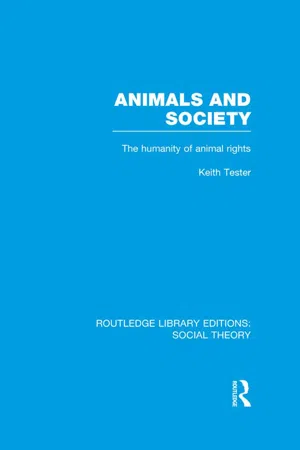
Animals and Society uses a variety of historical sources and a coherent social theory to tell the story of the invention of animal rights. It moves from incidents like the medieval execution of pigs to a discussion of the politics and strategies of modern rights organisations. The book also presents radical interpretations of nineteenth-century animal welfare laws, and the accounts of the Noble Savage. The insights generated by social science are always at the core of the discussion and the author daws on the work of Michel Foucault, Norbert Elias, Claude Levi-Strauss and Mary Douglas. This wide-ranging and accessible book provides a fascinating account of the relations between humans and animals. It raises far-reaching questions about the philosophy, history and politics of animal rights.
- 222 pages
- English
- ePUB (mobile friendly)
- Available on iOS & Android
eBook - ePub
About this book
Trusted by 375,005 students
Access to over 1.5 million titles for a fair monthly price.
Study more efficiently using our study tools.
Information
Chapter One
THE CLAIMS OF A DOG
Our environment has many unpleasant features. One is dog excrement. Piles and pats of it abound, waiting to slip up the inattentive pedestrian. But what do we do if we see a squatting dog? We either express haughty contempt, turn away, or blame the owner. Would any of us kick or punch the dog? Probably not; instead we are more likely to shout at the person holding the lead. On the one hand we seem to believe that the dog is not entirely responsible for its actions, on the other we feel that it should not be deliberately hurt simply because it is doing what it must. We are not certain what we should do about the dog that fouls our front garden, indeed we are not sure we can rightly do anything. Our treatment of the animal is difficult. Animals present society with ambiguities; with companionship, food, clothing, fun, but also with demands for compassion, abstinence and kindness. They disgust and please us; we can do with them what we will yet pull back with horror from open cruelty. The dog makes claims upon us, although we are not entirely sure what those claims are. But they still profoundly influence our treatment of the animal.
This book is about those claims and how they affect the way individuals relate to, and understand, animals. At its broadest, this book is concerned with the relationship between animals and society, but mostly it is about the special claims which are made for animals’ rights. This explanation of animal rights will discover many surprising incidents in the attitudes and beliefs of humans. I will emphasise the situation in Britain – perhaps England is better – and only refer to events in other countries if they support any case or illustrate it particularly vividly. This is not because Britain is more respectful of animal rights than anywhere else (just because we see ourselves as a nation of ‘animal lovers’, we should be wary of falling into any national chauvinism), but simply because Britain is the environment I know best. I hope that the story told in this book has some relevance elsewhere. In a sentence, I will explore the social processes and relationships which lie behind the many assertions which are made in Britain for the moral relevance of animals, and show how those relationships influence people’s lives.
Concern for animals has a long history. To give just one example, when he wrote the great radical Romantic poem Queen Mab in about 1812, Shelley bewailed the treatment of animals by which ‘the bull must be degraded into the ox, and the ram into the wether’ (Shelley 1905: 818). Yet he was only interested in the sufferings of animals because they reflected ‘manhood blighted with unripe disease’ (Shelley 1905: 770). He was not concerned with the relevance of animals so much as with the decay of humanity. The idea of animal rights is rather different precisely because it does say something tangible about animals and advocates that individuals should think about how they treat them. Animal rights does not seem to be as selfish as Shelley’s self-serving pity for a castrated ram. The wish to say something morally irreducible, something real, about animals and then establish that statement as a guide for human behaviour is a relatively recent phenomenon. In Britain the concern with animals’ rights has been an especially widespread and lively social issue since the middle of the 1970s (although, as we will see, the roots of the idea are to be found in the eighteenth century). The surge of interest can be attributed to the debates stimulated by the book Animal Liberation, written by the Australian philosopher Peter Singer and first published in Britain in 1976.
This chapter will give an introductory survey of the three clearest, most influential, and sustained statements of the claims of animals: that by Singer and later contributions by Tom Regan and Stephen Clark. It might seem curious that the whole complex issue of the relationship between animals and society is so quickly reduced to just three philosophy books: surely they cannot say everything that is important? No, they cannot, but between them Singer, Regan, and Clark do cover virtually all the ground which must be mapped in order to understand modern moral attitudes towards animals.
The argument of Animal Liberation is powerfully simple. Singer writes from within the utilitarian tradition of moral philosophy. Broadly speaking, utilitarianism holds to the central theme that pleasure is good and pain is bad. As John Stuart Mill put it, utilitarianism asserts that ‘pleasure and freedom from pain, are the only things desirable as ends’ (Mill 1910: 6). It goes beyond individualistic hedonism. Certainly, Mill tells us, the individual should follow the path of pleasure and avoid pain (such a life is morally good), but the individual lives in a social world and, consequently, should act to promote global pleasure, or at least defend the preference to avoid pain. Utilitarianism asks the individual to aggregate the consequences of his or her actions for the promotion of pleasure and avoidance of pain, and demands that she or he should morally only follow that course which causes more pleasure than it does pain. This is a morality which can be imagined as a pair of scales, and the moral act is the one which tips the individual and social balance in favour of pleasure. An act is not moral as such; rather, morality is a product of the consequences which the act has on the balance of pleasure and pain. Utilitarianism is inherently social. Singer holds to a slightly modified version of Mill’s position; for Singer the moral act is that which takes account of the preference of all sentient creatures not to experience increases in pain or suffering.
Now, utilitarianism can have important things to say about the social treatment of animals because, if animals are able to experience pleasure and pain, it is logical to assume that they prefer not to undergo any increase of suffering, and they should therefore be included in the calculations which must be made to deduce the moral consequences of any act. For utilitarians, the experience of pleasure and pain cannot be ignored simply on the grounds that the experiencing subject is an animal. Utilitarians like Singer assert that the preference for pleasure rather than increased pain demands equal consideration whether the experiencing subject is the Queen of England or a laboratory rabbit. Peter Singer calls this the principle of equality and, obviously, it is a prescription for equal ethical consideration, and not a description of equality. The principle refers to the equal consideration of interests and preferences (Singer 1976: 5). All beings that can suffer pain have an equal interest in avoiding it. Singer has no doubt that this is the essence of morality:
If a being suffers there can be no moral justification for refusing to take that suffering into consideration. No matter what the nature of the being, the principle of equality requires that its suffering be counted equally with the like suffering – in so far as rough comparisons can be made – of any other being. If a being is not capable of suffering, or of experiencing enjoyment or happiness, there is nothing to be taken into account. So the limit of sentience (using the term as a convenient if not strictly accurate shorthand for the capacity to suffer and/or experience enjoyment) is the only defensible boundary of concern for the interests of others. To mark this boundary by some other characteristic like intelligence or rationality would be to mark it in an arbitrary manner. Why not choose some other characteristic, like skin color?
(Singer 1976: 9)
The only morally relevant characteristic is the ability to suffer and the preference not to, and so according to Singer the moral terrain is a plateau of morally equal preferences in which features such as skin colour, sex or species are as morally important as the differences between green and brown eyes. Indeed, to subordinate the question of sentience to some secondary feature is utterly reprehensible, and just as overriding sentience on the basis of skin colour is morally condemned as racism, or on the basis of sex as sexism, any qualification of the principle of the equal consideration of interests on the grounds of species should, Singer asserts, be rejected as speciesism. The word was first used by Richard Ryder in a critique of the use of live animals in medical experiments (Ryder 1975) and Peter Singer defines the speciesist as a person who ‘allows the interests of his own species to override the greater interests of members of other species’ (Singer 1976: 9). Animal Liberation asserts that the truth of animals is their ability to suffer on a morally equal basis to ourselves, and they have a preference in the avoidance of suffering as we likewise do. To argue the contrary is to give voice to speciesism. Singer intended his book to be read and adopted as a persuasive repudiation of the acts of speciesism: the point is not so much that animals have a right to be treated well, rather it is that if we are to be good utilitarians, we should not act in any way that violates their preference not to suffer.
This is important. Singer does not believe that animals have rights. No, he is more concerned with the morality (or otherwise) of the acts of society and individuals. This is why the book is called Animal Liberation; Singer argues for moral, utilitarian acts, not a respect for intrinsic rights. He wants the acts which will liberate animals from speciesism. Indeed, in subsequent essays, Singer has often taken pains to distance himself from any talk of rights: ‘when I talk of rights, I do it … as a concession to popular rhetoric (Animal Liberation was not written primarily for philosophers)’ (Singer 1980a: 327). Singer is more concerned with acts, a position which has caused him to fall between two stools. Popularly he has been taken up as a prime advocate of animal rights (it must be said that Animal Liberation is not as explicit as it might have been on why it rejects talk of rights: Singer was quite prepared to play the rights card when it leant the case greater strength). Meanwhile, rights theorists have expressed grave doubts over the applicability of utilitarian calculations to the relationship between society and animals. This is especially true of Tom Regan.
Regan tears out the heart of Singer’s thesis. Singer asks that account be taken of the consequences of an act for the preference of sentient beings not to suffer, before that act is performed. It should only be carried out if, on aggregate, it does not increase the sum of pain amongst morally relevant creatures. For Regan, such an approach not only betrays a ‘significant conservative bias’ because it considerably reinforces existing social attitudes by making them the yardstick against which all else is measured (Regan 1984: 138), but, more importantly, the utilitarian emphasis on aggregates can provide no foundation for the claims of an individual over the group.
Singer does not talk about rights; he gives the individual no priority outside of the global equality of the preference or interest not to suffer. Tom Regan believes that this position is quite unsatisfactory. He is right to say that according to the utilitarian approach to morality:
we must choose that option which is most likely to bring about the best balance of totalled satisfactions over totalled frustrations. Whatever act could lead to this outcome is the one we ought morally to perform – it is where our moral duty lies. And that act quite clearly might not be the same one that would bring about the best results for me personally, or for my family or friends, or for a lab animal. The best aggregated consequences for everyone concerned are not necessarily the best for each individual.
(Regan 1985: 20)
Think of Raskolnikov in Crime and Punishment. Notwithstanding his egoistic justifications for murdering the old moneylender, Raskolnikov reasoned that by taking her money he could pay his debts and help his family; certainly the benefits of the murder would far outweigh the suffering of one unloving, decrepit old woman. In strict utilitarian terms, the murder was an exceedingly virtuous act. But, as Regan would object, this cannot mean that it is morally acceptable for us to rob and murder lonely pensioners. There is no doubt that Peter Singer would be totally horrified by mass murder of the elderly but his moral philosophy cannot totally overcome the tyrannical potential of the rule of the aggregate. For utilitarians, in certain circumstances, anything might be permissible.
Regan defends the individual by stressing that all subjects of a life, and a being is a subject of a life when it has goals, preferences, emotions and an identity over time, have an intrinsic value in and of themselves (Regan 1984: 264). In Singer’s theory sentient creatures only enter the frame of reference at the moment they are about to be acted upon, but Regan believes that the subjects of a life (a category which he argues must extend beyond humans) are always morally relevant whether they live in a cage, on a factory farm, or on a desert island. Regan accepts Peter Singer’s slogan that ‘All Animals Are Equal’, but where Singer sees a prescriptive equality of preferences, Regan identifies an equally possessed inherent value, and individual subjects have a right to expect the respect of that value. He tells us that the inherent value of subjects should be treated as a categorical concept since ‘One either has it, or one does not. There are no in-betweens. Moreover, all those who have it, have it equally’ (Regan 1984: 240–41). As Regan says in a passage which he also wants applied to animals:
Human beings have inherent value because, logically independently of the interest of others, each individual is the subject of a life that is better or worse for that individual. Because of the type of value human beings have, it is wrong (a sign of disrespect and a violation of rights) to treat humans as if they had value merely as means (e.g. to use humans merely to advance the pleasure of the group). In particular, to harm human beings for the sake of profit or pleasure or curiosity of the group is to violate their right not to be harmed.
(Regan 1983: 39)
Regan’s approach is comparable to Peter Singer’s in that they both focus on harm to animals. Yet they follow different paths to this destination. Singer looks at the speciesist immorality of the consequences of certain acts, Regan at the disrespect of intrinsic rights.
Humans disrespect the intrinsic value of animals, and the rightful claims extending from it, because of conceit and chauvinism. Conceit because we attribute to ourselves a unique and privileged place in the universe, chauvinism because we refuse to recognise that the qualities which we suppose give us universal importance ‘are also possessed by individuals other than one’s self or the members of one’s group’ (Regan 1984: 131).
The disputes amongst the protagonists of the view that animals make morally relevant claims upon humans are thrown into sharp relief by the sincere and respectful debates between Tom Regan and Peter Singer. (Their disagreements have not prevented them working together. See, for example, the collection they edited in 1976.) Where Singer rejects all a priori assumptions except the preferences of sentient subjects, and attempts to deduce a practical ethics from it, Tom Regan’s work suggests a more Kantian flavour when he recognises the authority of a reworked definition of the categorical imperative; for Regan other subjects of a life should be treated as ends in themselves and not as means to something that violates their integrity. (Kant, of course, accepted the moral relevance of only rational subjects.) Indeed, if Regan’s concern had not been to develop a philosophically consistent and weighty case for animal rights, his convincing demolition of Singer’s plea for animal liberation could have made the grip of speciesism even tighter. As it is, Regan is exceptionally careful not to throw out the baby with the bathwater, and in fact his critique of utilitarian arguments has served to consolidate the claims which are made for animals. This has been possible because, like Singer, he believes that society should begin to treat animals radically differently and, especially, stop eating them. They believe, although inevitably for different reasons, that we should all become vegetarian.
Like all else in Animal Liberation, Singer’s affirmation of vegetarianism is splendidly simple and developed with considerable intensity. Vegetarianism is a practical, personal testimony to the rejection of speciesism. Our interest in lamb cutlets is less important than the interest of the lamb in leading a life without pain, in so far as the present methods of meat production override the preferences of nonhuman creatures. Vegetarians (like Singer and Tom Regan) are people who ‘once they have broken away from flesh-eating habits … can no longer approve of slaughtering animals in order to satisfy the trivial desires of their palates’ (Singer 1976:175). To do anything else, to continue to eat meat, is profoundly speciesist and therefore immoral. Moreover, in the utilitarian scheme meat-eating is wrong since, if all sentient creatures are of equal moral relevance because their preferences count equally, clearly one human eats many animals in the course of a life, and the amount of suffering thus caused to animals far outweighs his or her culinary delights. George Bernard Shaw once said that he would be followed to his grave by the herds of cattle and shoals of fish that did not have to die because he, too, was a vegetarian (cited in Singer 1976: 177). But the rejection of speciesism goes beyond questions of cuisine; Animal Liberation asserts that speciesism also provides the rationale for using living animals in scientific experiments (vivisection) and so, too, the products of that immoral practice should be denied by any individual who accepts the requirement to act in accordance with an uncompromising utilitarian demand for equal consideration.
It is interesting to see how the argument of Animal Liberation is developed. Peter Singer does not rely on an extended consideration of a logically compelling philosophical case (we have already seen that the book was not primarily aimed at the academy). Instead he makes a highly emotive appeal that is powerful because it inspires disgust and outrage, and then offers an idea as to what the horrified reader can do to assuage guilt. The book begins by outlining the prescription of how animals should be treated before moving on to spend two chapters describing what actually happens to animals in factory farms and laboratories. Only then, when the emotional card has been played to the full, is the case for vegetarianism spelt out, along with tips on the potential implications of the renunciation of meat. Peter Singer has written a handbook for action as much as, perhaps more than, a philosophical treatise.
Tom Regan takes an opposing stance. The Case for Animal Rights is not an emotional book. On the contrary, it is carefully and deliberately philosophical and attempts to be influential solely on the grounds of its logical impact. Regan stimulates action through contemplation, and it is no surprise to learn that he finds Singer’s utilitarian vegetarianism unpersuasive. We have already seen that Singer demands vegetarianism on the grounds that, firstly, meat-eating is speciesist and, secondly, disutilitarian. Tom Regan shows that the second strand of Singer’s case is highly problematic.
Singer concentrates on the immediate immorality of one person eating hundreds, thousands, of animals. Clearly this diet flies in the face of the principle of equality; in these terms, Singer is right to say that by utilitarian criteria you and I should, strictly speaking, leave off eating meat because the way it is gained in industrialised societies forgets about the preferences of the animals. However, Regan points out that Singer’s calculation of meat and eater is far too limited; after all, the meat on our plate has to be produced. The meat industry is quite massive. In the middle 1980s, the United Kingdom’s food industry, ranging from farmworkers to meat ...
Table of contents
- Cover
- Half Title
- Title Page
- Copyright Page
- Original Copyright Page
- Table of Contents
- Acknowledgements
- 1 THE CLAIMS OF A DOG
- 2 THE OTHER ANIMAL
- 3 CIVILISED ATTITUDES
- 4 A PIG’S LIFE
- 5 A DIFFERENT KIND OF BEAST
- 6 A SIMILAR NATURE
- 7 A COMPREHENSIVE PRINCIPLE
- 8 ANIMAL MAGIC
- 9 IF A LION COULD TALK
- Bibliography
- Name index
- Subject index
Frequently asked questions
Yes, you can cancel anytime from the Subscription tab in your account settings on the Perlego website. Your subscription will stay active until the end of your current billing period. Learn how to cancel your subscription
No, books cannot be downloaded as external files, such as PDFs, for use outside of Perlego. However, you can download books within the Perlego app for offline reading on mobile or tablet. Learn how to download books offline
Perlego offers two plans: Essential and Complete
- Essential is ideal for learners and professionals who enjoy exploring a wide range of subjects. Access the Essential Library with 800,000+ trusted titles and best-sellers across business, personal growth, and the humanities. Includes unlimited reading time and Standard Read Aloud voice.
- Complete: Perfect for advanced learners and researchers needing full, unrestricted access. Unlock 1.5M+ books across hundreds of subjects, including academic and specialized titles. The Complete Plan also includes advanced features like Premium Read Aloud and Research Assistant.
We are an online textbook subscription service, where you can get access to an entire online library for less than the price of a single book per month. With over 1.5 million books across 990+ topics, we’ve got you covered! Learn about our mission
Look out for the read-aloud symbol on your next book to see if you can listen to it. The read-aloud tool reads text aloud for you, highlighting the text as it is being read. You can pause it, speed it up and slow it down. Learn more about Read Aloud
Yes! You can use the Perlego app on both iOS and Android devices to read anytime, anywhere — even offline. Perfect for commutes or when you’re on the go.
Please note we cannot support devices running on iOS 13 and Android 7 or earlier. Learn more about using the app
Please note we cannot support devices running on iOS 13 and Android 7 or earlier. Learn more about using the app
Yes, you can access Animals and Society by Keith Tester in PDF and/or ePUB format, as well as other popular books in Social Sciences & Sociology. We have over 1.5 million books available in our catalogue for you to explore.